wisen
Health Uyari
- License — License: MIT
- Description — Repository has a description
- Active repo — Last push 0 days ago
- Low visibility — Only 5 GitHub stars
Code Gecti
- Code scan — Scanned 12 files during light audit, no dangerous patterns found
Permissions Gecti
- Permissions — No dangerous permissions requested
Bu listing icin henuz AI raporu yok.
Your coding agents repeat mistakes you already corrected. wisen reads your Claude Code, Codex, Cursor, Gemini CLI, opencode and Pi sessions, writes a daily reflection, and turns recurring corrections into CLAUDE.md / AGENTS.md fixes you approve.

wisen
makes your coding agents wiser every day
You've corrected your coding agent on the same thing 40 times this week.
wisen reads your sessions and turns the corrections that keep coming back into
fixes to your CLAUDE.md and AGENTS.md, each one yours to approve.
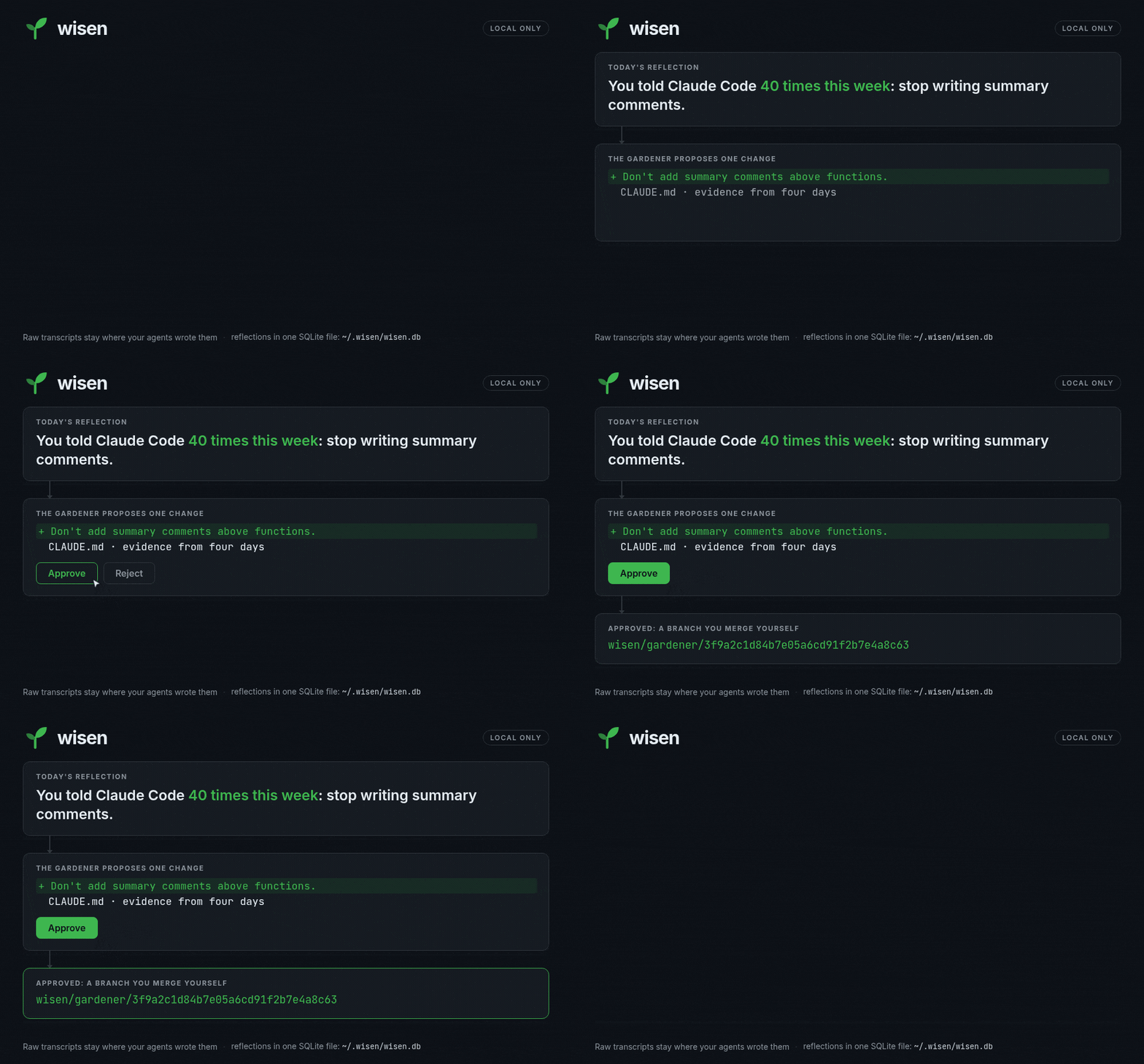
uvx wisen demo # a sample day in one second: no model call, nothing read from your machine





You spend hours a day with coding agents: corrections, rephrases, rejected
tool calls, the occasional flow state. Then it all evaporates. wisen reads
those sessions where your agents already keep them, writes one reflection
for the day, and proposes small fixes to the instruction files your agents
read. You approve each fix, and later sessions show whether it helped.
One of my own days: 213 turns, 150 of them rephrasing something I had already
said. I never counted. wisen did.
Quickstart
uv tool install wisen          # or: pipx install wisen (Python 3.11+)
wisen doctor                   # the sessions it finds per agent, and whether a model can run
wisen synthesize               # yesterday's reflection, or your latest day with sessions
The reflection, chat and the Gardener run on your Claude Pro/Max
subscription at no extra cost when the claude
CLI is installed and logged in (chat and the Gardener switch to OpenAI whenOPENAI_API_KEY is set; wisen doctor shows which). Prefer an API key? Set WISEN_SYNTH_MODEL=api
and WISEN_MODEL (any pydantic-ai model, for example openai:gpt-5.6-terra
with OPENAI_API_KEY). Configuration covers both, andwisen doctor names the fix when neither is set up.
Then wisen serve starts the API and chat on :8000 (the [server] extra:uv tool install "wisen[server]"). Every command and extra is in
docs/commands.md; to hack on wisen, see
CONTRIBUTING.md.
Features
- Eight sources. Claude Code, Codex, Cursor, opencode, Gemini CLI, Pi,
generic exports and git commits, read into one session shape. - One reflection a day. Moods, friction points, one insight and
recommendations. Days with nothing new are skipped. - Chat that investigates. Ask "how was my week?" and it searches your
reflections, transcripts and configs before answering
(docs/chat.md). - The Gardener. Proposes small changes to your
CLAUDE.md,AGENTS.md
and skill files. Each one is a git branch you approve and merge yourself
(docs/gardener.md). - Voice briefing. Hear the morning reflection out loud (the
[voice]extra). - Your own server, optional. The dashboard on your phone, push
notifications, an approval inbox and a Telegram bot. It never sees a
transcript (docs/server.md). - Any model, or your subscription. Any pydantic-ai model string, or your
Claude Pro/Max subscription for the reflection, chat and the Gardener (through
the Claude Code CLI and the Claude Agent SDK). - No database server. One SQLite file (
~/.wisen/wisen.db), created on
first use.
Claude Code plugin
wisen ships as a Claude Code plugin, so the loop lives inside the sessions it
learns from. Install the CLI first (see Quickstart), then:
claude plugin marketplace add Vela3202019/wisen
claude plugin install wisen@vela
What it adds:
- At session start, one line of context when the Gardener has proposals
waiting or approved branches you have not merged. Nothing when there is
nothing to say, and nothing whenwisenis not installed. /wisen:proposals: the approval inbox in chat. Shows each proposal's
target, rationale and diff; approves or rejects only the one you name./wisen:reflect: runs or reads a day's reflection and summarises it./wisen:setup: installs and configures the CLI on a machine that does
not have it.
The plugin is the plugin/ directory; the marketplace is .claude-plugin/marketplace.json
at the repo root. claude plugin validate . checks both.
How it works
- Read. Connectors parse each agent's on-disk history into one shape and
skip anything missing or malformed. - Observe. The Observer reads the day's turns and picks out the charged
moments: rejections, rephrase storms, hedges. - Reflect. The Synthesizer turns those notes into the day's reflection,
stored in SQLite. - Use it. The chat agent, the dashboard and the voice briefing read the
reflection; the Gardener turns recurring friction into proposals. - Measure. Two weeks after you merge a proposal, the eval loop compares
before and after, and proposes a revert if things got worse.
The full pipeline, with a diagram and a map of the code, is in
docs/how-it-works.md.
A real reflection, abridged:
// 2026-07-20.json
{
  "your_mood":  { "label": "deep-focus",
    "summary": "Determined execution — dispatched 4 bugs, wrote a design doc,
                reviewed 2 PRs, 5 commits across 5 hours with zero hesitation." },
  "agent_mood": { "label": "confident",
    "summary": "Took ownership without hedging — zero 'I think', zero
                clarifications across 3 sessions, incl. a 213-turn debug session." },
  "alignment_score": 0.85,
  "insight": "The 70% rephrase rate on your end didn't indicate friction — it
              was tight-ship compression the agent could follow.",
  "friction_points": [
    { "type": "unclear-prompt",
      "description": "150 rephrases across 213 turns. The agent handled it,
                      but this is a load pattern worth examining." } ],
  "recommendations": [
    { "target": "workflow",
      "action": "If you switch models mid-session again, note why in a
                 one-liner so the pattern becomes analyzable." } ]
}
Privacy
- Stays on your machine: raw transcripts, git history and agent configs
(wisen does not copy them), the SQLite file and your API keys. - Goes to the model provider you pick: excerpts of the day's sessions
(each turn cut to 400 characters, and a turn can include tool output), up to 20 config
files, commit messages, and chat search results. Synthesis defaults toclaude-cli:…, and chat and the Gardener toclaude-sdk:…when no API key
is set. Both send this to Anthropic under your own Claude account.synth_model = "api"and an APImodelsend it to that provider instead. Voice sends
your speech to Google's Gemini. - Goes to your own server, if you pair one: derived results, which can
quote short pieces of your sessions; in stage B also the Observer's notes
and the text of the files the Gardener may edit, never raw transcripts or
tool output. Everything passes one egress gate
that checks a typed schema, masks secrets and caps text length, andwisen egressshows what left today.
The exact limits, every packet type, stage B, Telegram and the full list of
network calls are in docs/privacy.md.
Documentation
- Configuration: models, API keys, paths
- Commands and extras
- How it works
- Chat
- The Gardener
- Your own server, with setup details in deploy/README.md
- What leaves your machine
- Development: project status, tests, upgrading from MongoDB
Project status
A personal project under active development; expect the schema and CLI to
move. Plans live in docs/plan/.
Contributing
Dev setup, offline tests and a guide to adding a connector for a new agent
are in CONTRIBUTING.md. Connectors are small, so a first
contribution is too. Please follow the
Code of Conduct, report security problems as
SECURITY.md describes, and see CHANGELOG.md for
what changed in each release.
License
Yorumlar (0)
Yorum birakmak icin giris yap.
Yorum birakSonuc bulunamadi