Semantic_Vision
Health Uyari
- License — License: MIT
- Description — Repository has a description
- Active repo — Last push 0 days ago
- Low visibility — Only 8 GitHub stars
Code Uyari
- network request — Outbound network request in frontend/demo-assets/axios/complexity.json
- network request — Outbound network request in frontend/demo-assets/axios/meta.json
Permissions Gecti
- Permissions — No dangerous permissions requested
Bu listing icin henuz AI raporu yok.
See what a code change affects before you merge it. Call graph, impact analysis, flowcharts, code health and an MCP server for AI agents. Python, JS/TS, Java, Go, C#. 100% local.
Semantic Vision
See what a code change affects before you merge it, whether you or an AI agent wrote it.




Live demo · VS Code extension · MCP server for agents · Benchmarks
The problem
AI agents can change a lot of code in seconds. A diff shows what changed, not what depends on it,
what it breaks, or whether the codebase got better or worse. Finding that out means grepping,
jumping between files and holding a mental model that is usually incomplete.
What Semantic Vision does
It parses your repository statically (your code is never executed) into a call graph, then answers
those questions in one place:
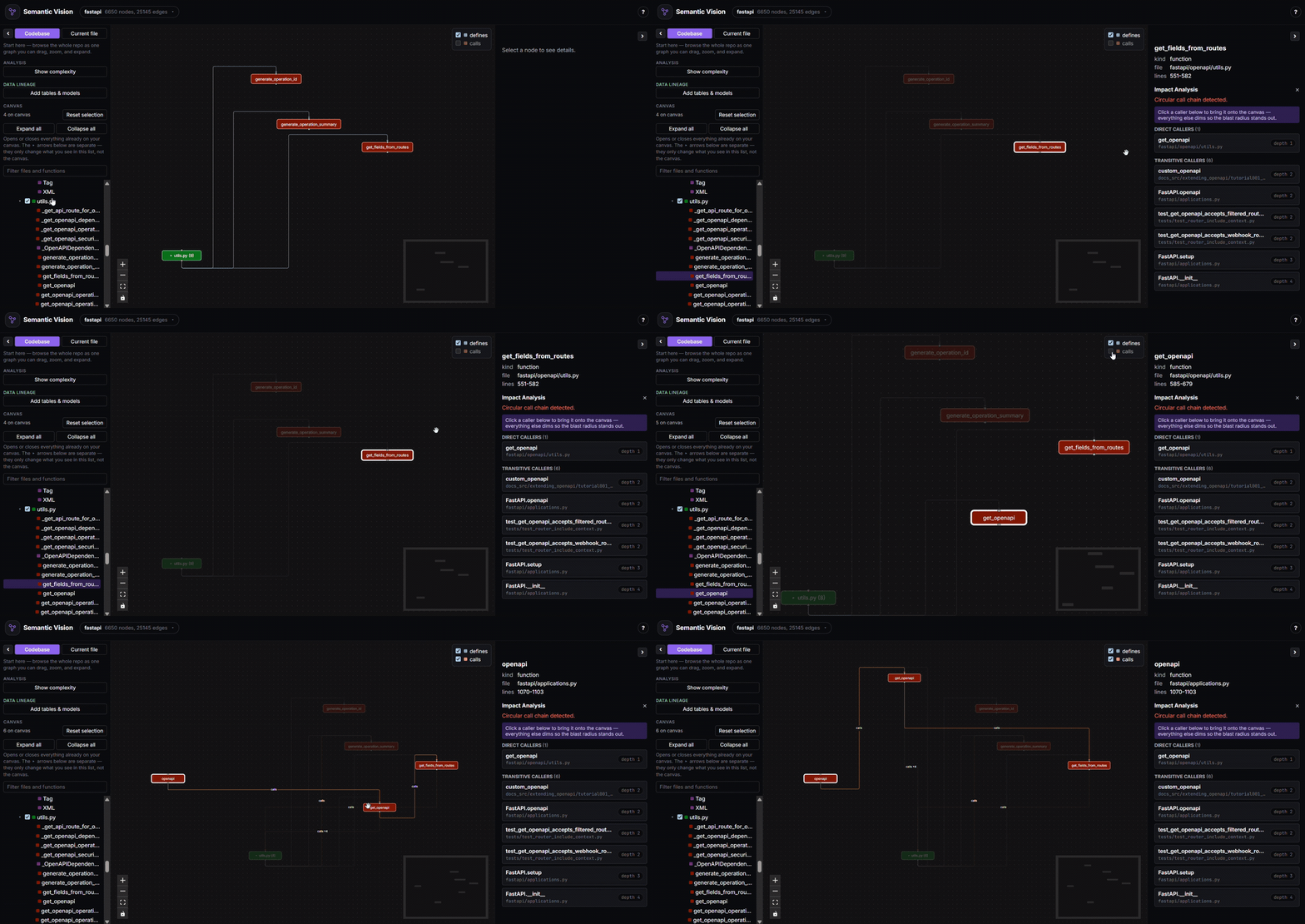
- Impact analysis: right-click a function, table or column and see every direct and transitive
caller, with circular call chains flagged. This is the blast radius, resolved from the real graph. - Interactive call graph: every directory, file, class and function, zoomable, searchable,
with call, import and defines edges. - Execution flowcharts: how one function behaves, built from its AST: branches, loops,
I/O and calls out to other functions. - Code Health: complexity, hotspots (complexity × how often the file changes), dead code,
test-coverage risk, duplicates, vulnerable dependencies, and a diff of all of it against any
commit. "Did that edit make things better?" becomes a glance. Details. - AI documentation: Markdown docs for a function, built from its real callers and callees,
using a local Ollama model, OpenAI or Anthropic. Setup. - Code-to-data lineage: SQLAlchemy models, dbt manifests and live databases join the same
graph, so impact analysis crosses from a column to the functions that depend on it.
Guide.
Give your AI agent the same map
semantic-vision-mcp exposes all of the above as MCP tools that
Claude Code, Cursor, Claude Desktop and any other MCP client can call, so an agent can ask "who
calls this?" instead of grepping and guessing.
uv sync
claude mcp add semantic-vision -- uv --directory /path/to/Semantic_Vision run semantic-vision-mcp
The VS Code extension bundles it: no Python needed, and a "Copy MCP Config" command prints the
config for your agent. Tool reference and client configs: guides/mcp-server.md.
Languages
| Python | JS / TS | Java | Go | C# | |
|---|---|---|---|---|---|
| Call graph, impact analysis, flowcharts | ✅ | ✅ | ✅ | ✅ | ✅ |
| Code Health, AI docs | ✅ | ✅ | ✅ | ✅ | ✅ |
| Code-to-data lineage | ✅ | n/a | n/a | n/a | n/a |
Mixed-language repos work: detected languages are pre-selected and each gets its own tab.
Calls are resolved without running anything, and the C# resolver is measured against the real
C# compiler: about 98% of calls attributed correctly on typical application code, 89% on EF Core's
1.8M lines (how it's measured). Dynamic patterns that can't be resolved
statically are flagged in the UI, not guessed.
Performance
Measured on large, unmodified open-source repositories, through the running app in a real browser:
| Language | Repo | Files | Backend parse (warm) | Browser: time to render |
|---|---|---|---|---|
| Python | fastapi/fastapi | 1,138 | 4.1 s | 7.2–7.8 s |
| JavaScript | three.js | 752 | 2.0 s | 4.9–5.0 s |
| TypeScript | nestjs/nest | 1,907 | 2.5 s | 6.9 s |
| Java | google/guava | 615 | 2.5 s | 4.7–7.6 s |
| Go | gohugoio/hugo | 914 | 4.4 s | 7.9–8.5 s |
| C# | jellyfin/jellyfin | 2,252 | 15.1 s | 19.7–20.5 s |
Cold-read times, node and edge counts and methodology are in benchmarks/.
Private by default
Everything runs on your machine: no account, no cloud, no telemetry. Only two opt-in features
touch the network: AI features send a function's source and its neighbours' signatures to the
provider you pick (use local Ollama to keep that on your machine too), and the Dependencies tab
queries osv.dev for vulnerabilities, after you tick a consent box.
Quick start
VS Code (easiest). Install Semantic Vision
(ext install venom21adi.semantic-vision), open a repository, and run Semantic Vision: Open Graph.
The backend is bundled for Windows, macOS and Linux. Extension guide.
Docker.
git clone https://github.com/venom21adi/Semantic_Vision.git
cd Semantic_Vision
cp .env.example .env          # Windows CMD: copy .env.example .env
docker compose up --build
Open http://localhost:5173. Images are also on GHCR
(ghcr.io/venom21adi/semantic_vision-backend and -frontend). Pointing it at your own repos:
guides/docker-setup.md.
From source (Python 3.12+, uv, Node 20+).
uv sync
uv run uvicorn semantic_vision.api.app:app --port 8000
cd frontend && npm install && npm run dev      # in a second terminal
Open http://localhost:5173, enter the absolute path of a repository, and click Load.
Layout, saved docs and analysis state persist in a .visualiser/ folder at the repo's .git root.
How it works
- Backend (
src/semantic_vision/): FastAPI. Python'sastand tree-sitter
(JS/TS, Java, Go, C#) feed per-language resolvers that turn imports and call sites into a graph,
served over a small REST API. - Frontend (
frontend/): React and TypeScript, rendered with@xyflow/react. - MCP server (
src/semantic_vision/mcp_server/): a thin wrapper over the same REST API. - Adding a language: guides/adding-a-language.md.
Development
uv sync && uv run pytest -q && uv run ruff check .     # backend
cd frontend && npm install && npm run test -- --run     # frontend
Contributing
Issues and pull requests are welcome. For anything beyond a small fix, please open an issue first.
License
MIT, see LICENSE.
Yorumlar (0)
Yorum birakmak icin giris yap.
Yorum birakSonuc bulunamadi