vibex
Health Warn
- License — License: AGPL-3.0
- Description — Repository has a description
- Active repo — Last push 0 days ago
- Low visibility — Only 5 GitHub stars
Code Pass
- Code scan — Scanned 12 files during light audit, no dangerous patterns found
Permissions Pass
- Permissions — No dangerous permissions requested
No AI report is available for this listing yet.
Your agents. Your workspace. Your control—from prompt to commit, desktop to mobile. Works with Codex, Claude Code, OpenCode, Pi, Grok, DeepSeek Harness, Antigravity, and many more through ACP.






Your agents. Your workspace. Your control—from prompt to commit, desktop to mobile.
A native, local-first AI coding workbench for Agent-powered software development.
Website • Docs • Quick start • Features • Supported agents • Architecture • Development
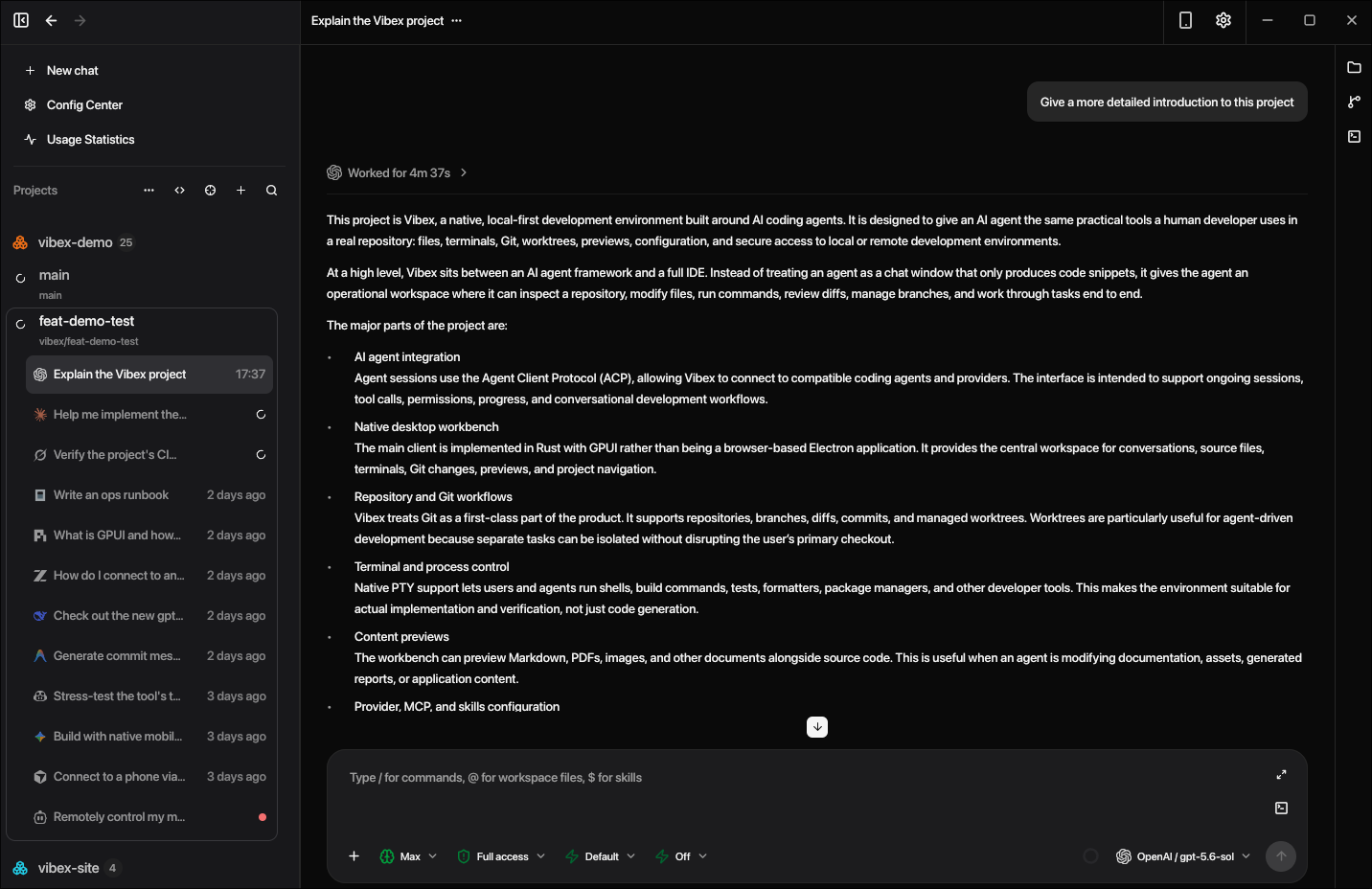
Vibex brings Agent sessions, source code, Git, terminals, previews, and provider
configuration into one focused workbench. The desktop runtime stays in control
of Agent processes, session history, workspace files, Git, PTYs, providers, and
permissions. A native mobile client lets you monitor and steer those same
sessions remotely, while an optional self-hosted Relay carries only encrypted
frames.
No Vibex-hosted workspace is required to run the local desktop. Your repository,
credentials, and durable session state remain on the machines you choose.
Why Vibex
| Principle | What it means in practice |
|---|---|
| Local-first authority | The PC owns the runtime and durable state. Mobile is a typed remote client, not a second backend. |
| Native by default | Rust and GPUI power the desktop and mobile clients without a browser shell or a separate WebUI product. |
| One Agent contract | Every online Agent session uses ACP and managed adapters, giving integrations a shared session, capability, permission, and terminal surface. |
| Remote without lock-in | Pair over Direct, Tailnet, or your own Relay. The Relay forwards encrypted frames and never becomes a second database. |
| Inspectable workflows | Plans, tool calls, process details, diffs, approvals, elicitation forms, errors, and reconnect states stay visible and explicit. |
| Provider choice | Configure Agents, model providers, credentials, MCP servers, Skills, Prompts, and Hooks inside Vibex-scoped configuration. |
Features
Vibex is designed for the complete loop: ask an Agent to change code, inspect
what it did, run the project, review the diff, and keep the session available
wherever you are.
| Workflow | Included |
|---|---|
| Agent sessions | Stream user and Agent messages as a structured timeline with Markdown, reasoning, plans, tool and process details, attachments, approvals, and typed elicitation forms. Stop, continue, fork, rename, and resume sessions, or import supported local histories. |
| Workspace and editor | Browse workspace-scoped file trees, search by name or content, read and write files with revision checks, and keep encoding, line endings, and large-file limits explicit. |
| Git-native review | Inspect status, history, diffs, and blame; create and switch branches; stage, unstage, revert, commit, fetch, and push; and manage isolated Git worktrees with guarded merge and rebase recovery. |
| Terminal and content | Use native PTYs with ANSI emulation, tabs, resize, scrollback, search, and raw-byte handling. Preview Markdown, images, PDFs, and supported Office documents in the workbench. |
| Agent and provider center | Discover and manage Agent runtimes, select models and reasoning options, authenticate providers, run health and capability probes, and keep provider profiles separate from online route identity. |
| MCP and workflow resources | Import, validate, and scope MCP servers, Skills, Prompts, and Hooks. Give Agents reusable context without scattering configuration across unrelated home directories. |
| Automation | Schedule one-shot, interval, or daily Agent runs and compose automation graphs with explicit run state, recovery, and audit history. |
| Attention and continuity | Receive desktop notifications for completed, failed, or input-blocked sessions, track unread completions, and recover authoritative timeline state after reconnects or restarts. |
| Mobile companion | Pair an iOS or Android client with the desktop runtime, read the same GUI Agent timeline, approve or decline requests, send follow-ups, inspect files and Git state, and use remote terminal surfaces when available. |
Supported Agents
Vibex uses the Agent Client Protocol (ACP)
as the only online Agent transport. The runtime is provider-neutral: an Agent's
identity and capabilities are kept separate from the protocol used to connect it.
Works with any ACP-compatible agent — if it speaks ACP, it runs in Vibex.
 Claude Code |
 Codex |
 ZCode |
 OpenCode |
 Antigravity |
 Cline |
 Codebuddy Code |
 Cursor |
 Gemini CLI |
 GitHub Copilot |
 Devin |
 Grok |
 Hermes |
 Kimi Code |
 Pi |
 DeepSeek Harness |
 Any ACP Agent |
More agents coming soon |
Built-in presets include Claude Code, Codex, ZCode, and
OpenCode. The ACP catalog also includes integrations such as Antigravity,
Cline, Codebuddy Code, Cursor, Gemini CLI, GitHub Copilot,
Devin, Grok, Hermes, Kimi Code, Pi, DeepSeek Harness, and
more. Availability is checked against the installed runtime, provider
configuration, and live capability probes.
You can also register any ACP-compatible executable with its command, arguments,
environment, and display metadata. Adding an Agent does not require a new UI or
a second vendor-specific session protocol.
Native Surfaces
| Surface | Role | Entry point |
|---|---|---|
| Desktop | Full native GPUI workbench and the authoritative DesktopRuntime for Agents, workspaces, files, Git, PTYs, providers, permissions, and durable state. |
Linux, macOS, and Windows targets; start with pnpm dev:desktop. |
| Mobile | Native GPUI iOS and Android companion. It renders the desktop session model as a GUI timeline and sends typed remote mutations. | apps/mobile; build with pnpm build:mobile:android or pnpm build:mobile:ios. |
| Self-hosted Relay | Optional Rust/Axum transport for encrypted WebSocket frames. It stores no workspace, provider, Agent, or application data. | apps/relay-server and deploy/relay; validate with pnpm smoke:relay:local. |
Mobile never starts a local Agent, owns a workspace filesystem, mutates local
Git, or becomes a second PTY authority. Its compact native UI preserves the
desktop Agent timeline semantics, including loading, streaming, approval,
error, and reconnect states.
Quick Start
Prerequisites
- Git with submodule support
- Node.js 22
- pnpm 11.3.0
- Rust 1.97.0, pinned by
rust-toolchain.toml - A graphical session and working Vulkan driver for desktop development
Native mobile builds additionally require the Android SDK/NDK and cargo-ndk,
or macOS with Xcode, XcodeGen, and the Apple Rust targets. See the platform
sections below for the exact commands.
Run the desktop workbench
git clone https://github.com/vibex-ai/vibex.git
cd vibex
git submodule update --init --recursive
pnpm install --frozen-lockfile
pnpm dev:desktop
The desktop app starts with a local runtime. Configure an Agent and provider in
the Config Center, open a project directory, then create an Agent session from
the workbench.
Repository checks
pnpm check
pnpm release:build-smoke
pnpm check:mobile-native
pnpm check runs the normal Rust, frontend, license, and deterministic behavior
gates. pnpm release:build-smoke checks the native desktop, mobile, and Relay
build graph. pnpm check:mobile-native validates the mobile crate and checked-in
native project contract without claiming that an Android or iOS SDK is installed
on the host.
Tagged releases use the free GitHub-hosted native matrix in.github/workflows/release.yml: Linux .deb/AppImage, macOS .dmg, Windows
NSIS, signed Android APK/AAB, and unsigned iOS simulator/XCFramework artifacts are
collected by one aggregation job. macOS/Windows signing and mobile store upload
are optional credentialed follow-up steps; RC and preview Android packages can
use an ephemeral CI key, while stable Android releases require a configured
release keystore.
Development
Desktop packaging
Targeted desktop checks are useful while iterating:
cargo check -p vibex-desktop --locked
cargo test -p vibex-desktop --locked
pnpm smoke:first-frame
Linux preview packages use cargo-packager and the reviewed PDFium runtime:
cargo install cargo-packager --version 0.11.8 --locked
pnpm prepare:pdfium
pnpm package:preview
Use the release runbook before building RC or
Stable packages. Generated packages and runtime binaries are build outputs and
are not tracked in the repository.
Android
Install the Android SDK/NDK, cargo-ndk, and the Rust targets for the ABIs you
will build. Debug defaults to arm64-v8a and x86_64; release defaults toarm64-v8a.
pnpm build:mobile:android
pnpm package:mobile:android
Set VIBEX_MOBILE_ANDROID_TARGETS to a space-separated ABI list to override the
debug defaults. The local release APK is unsigned and must be aligned and signed
with the intended release key before distribution; tagged release APKs are signed
by the publish workflow.
iOS
On macOS, install Xcode, XcodeGen, and the aarch64-apple-ios plusaarch64-apple-ios-sim Rust targets:
pnpm build:mobile:ios
This builds VibexFFI.xcframework and generates the Xcode project. Signing,
simulator or device selection, and distribution credentials remain local to the
developer or release pipeline.
Self-hosted Relay
The Relay is optional. Pull the published image, or build it from source:
export VIBEX_RELAY_IMAGE=ghcr.io/vibex-ai/vibex-relay-server:v0.1.0-rc.3
docker compose -f deploy/relay/docker-compose.yml pull relay-server
docker compose -f deploy/relay/docker-compose.yml up -d --no-build relay-server
curl -fsS http://127.0.0.1:9700/health
docker compose -f deploy/relay/docker-compose.yml down
The headless runtime publishes ghcr.io/vibex-ai/vibex-server the same way; both
images cover linux/amd64 and linux/arm64. Use
the Relay deployment guide for HTTPS through Caddy,
private Tailnet publication, runtime limits, and the optional operator-owned
push adapter, and
the headless runtime guide for the
image tag rules. Keep the default loopback binding for local development.
Architecture
The desktop runtime is the single authority. Shared contracts and projections
keep native desktop and mobile behavior aligned without duplicating business
state.
DesktopRuntime
|-- ACP Agent sessions and authoritative timelines
|-- Workspace files, editor, Git, and managed worktrees
|-- Native PTYs, content previews, providers, and permissions
`-- Typed RemoteGateway v2
    |-- Direct or Tailnet transport
    `-- Encrypted self-hosted Relay
            -> AutoRemoteTransport
            -> Native mobile GPUI client
The main ownership boundaries are:
crates/coredefines serialized ids, DTOs, errors, capabilities, and remote
protocol contracts.crates/desktop-modelowns framework-neutral session and timeline projections
and reducers.crates/vibex-backendexposes provider-neutral capability facades shared by
native and remote adapters.crates/vibex-uiowns semantic tokens, portable component models, workflow
controllers, and shell composition.crates/vibex-remote-clientowns pairing, reconnect, synchronization, and
Direct, Tailnet, and Relay route selection.apps/desktopowns the native workbench andDesktopRuntime;apps/mobile
only composes the shared remote projections into a compact native surface.
Read the UI architecture boundary,
platform support matrix, and
Remote Protocol v2 for the detailed contracts.
Tech Stack
| Layer | Technologies |
|---|---|
| Application | Rust 2024, Cargo workspace, Rust 1.97.0 |
| Native UI | GPUI, gpui-component, shared Rust UI contracts, generated design tokens |
| Agent runtime | Agent Client Protocol schema 1.6, managed ACP adapters, Tokio |
| Workspace runtime | SQLite via rusqlite, filesystem and Git services, xpty, alacritty_terminal |
| Content | pulldown-cmark, HTML5ever, MathJax SVG, Mermaid rendering, PDFium, ZIP/XML parsers |
| Remote transport | Axum, HTTP/WebSocket v2, Rustls, tokio-tungstenite, X25519, HKDF, HMAC, ChaCha20-Poly1305 |
| Platforms | Linux, macOS, and Windows desktop; native Android and iOS through gpui_android and gpui_ios |
| Tooling | Node.js 22, pnpm 11.3.0, deterministic smoke tests and release quality gates |
Privacy and Control
- Local-first storage: session timelines, workspace metadata, provider
profiles, and runtime state are owned by the desktop runtime and stored locally. - Explicit permissions: Agent tools, terminal actions, device access, and
remote mutations are capability-gated and auditable. - Encrypted remote access: Direct, Tailnet, and Relay routes use typed
handshakes and encrypted transport. Relay forwards frames but cannot decrypt
business payloads. - Scoped provider configuration: Vibex does not rewrite real Agent home
configuration by default. Export is an explicit user action with preview and
rollback boundaries. - Redacted diagnostics: tokens, private keys, prompts, file contents, and
terminal bytes are excluded from logs and diagnostic artifacts.
Contributing
Issues and pull requests are welcome. Before opening a change:
- Keep
DesktopRuntimeas the only authority and route mobile behavior through
typed backend and remote contracts. - Run the smallest relevant gate while iterating, then run
pnpm checkfor
cross-layer changes.
License
Vibex is free software licensed under the
GNU Affero General Public License v3.0 or later. Third-party package,
font, icon, and PDFium notices are recorded in
docs/licenses.
Reviews (0)
Sign in to leave a review.
Leave a reviewNo results found