Zyven
Health Uyari
- License — License: MIT
- Description — Repository has a description
- Active repo — Last push 0 days ago
- Low visibility — Only 5 GitHub stars
Code Gecti
- Code scan — Scanned 12 files during light audit, no dangerous patterns found
Permissions Gecti
- Permissions — No dangerous permissions requested
Bu listing icin henuz AI raporu yok.
An agent that compiles open-source libraries into verified MCP tools on demand, and keeps only the ones that pass a locked-down sandbox. Open-weight models only.
Zyven
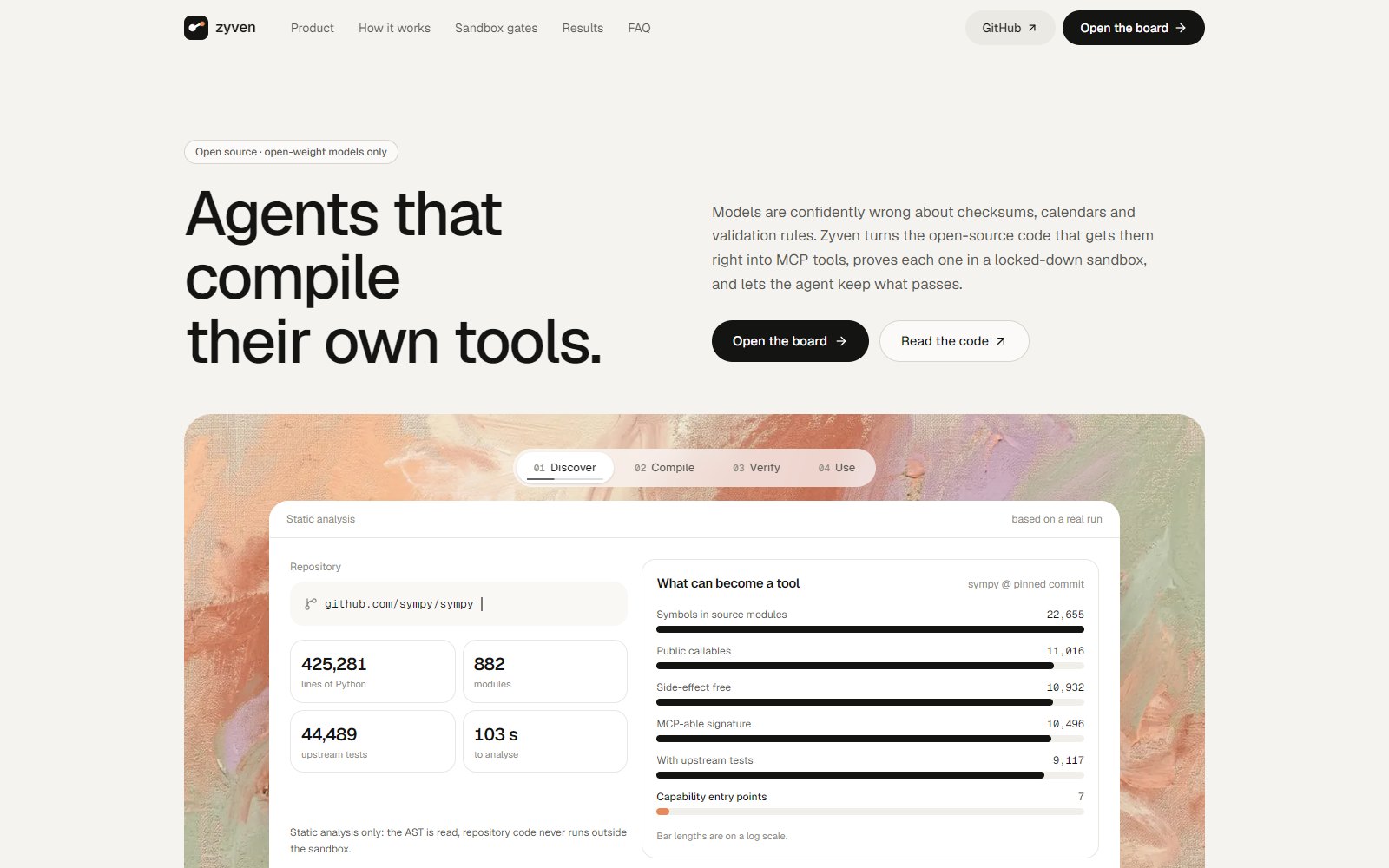
Agents that compile their own tools.
Zyven turns open-source code into verified MCP tools that an AI agent learns when it needs them, and keeps
only after they pass a locked-down sandbox.
Demo video: watch it on Google Drive




Frogtoberfest 2026 entry
Why
Language models are confidently wrong about things that need exact logic: check digits, calendar conversions,
validation rules, lookups. The correct, tested code for these already exists in open-source libraries, but an agent
can't use it until someone hand-builds a tool around it.
Zyven does that step automatically, and refuses to hand over anything it can't prove:
- Discover. Read a repository's source with static analysis, never running it: public functions, call graph,
tests, side effects, license. - Compile. Open-weight model roles propose a small MCP server around the library. Every name they write is
checked against the analysis, so invented functions are rejected. - Verify. Six gates run in a Docker sandbox with no network. One of them compares every tool's answer with the
library called directly. - Use. The agent hot-loads the verified skill mid-task and keeps it. The next task that needs it reuses it in
seconds instead of compiling for minutes.
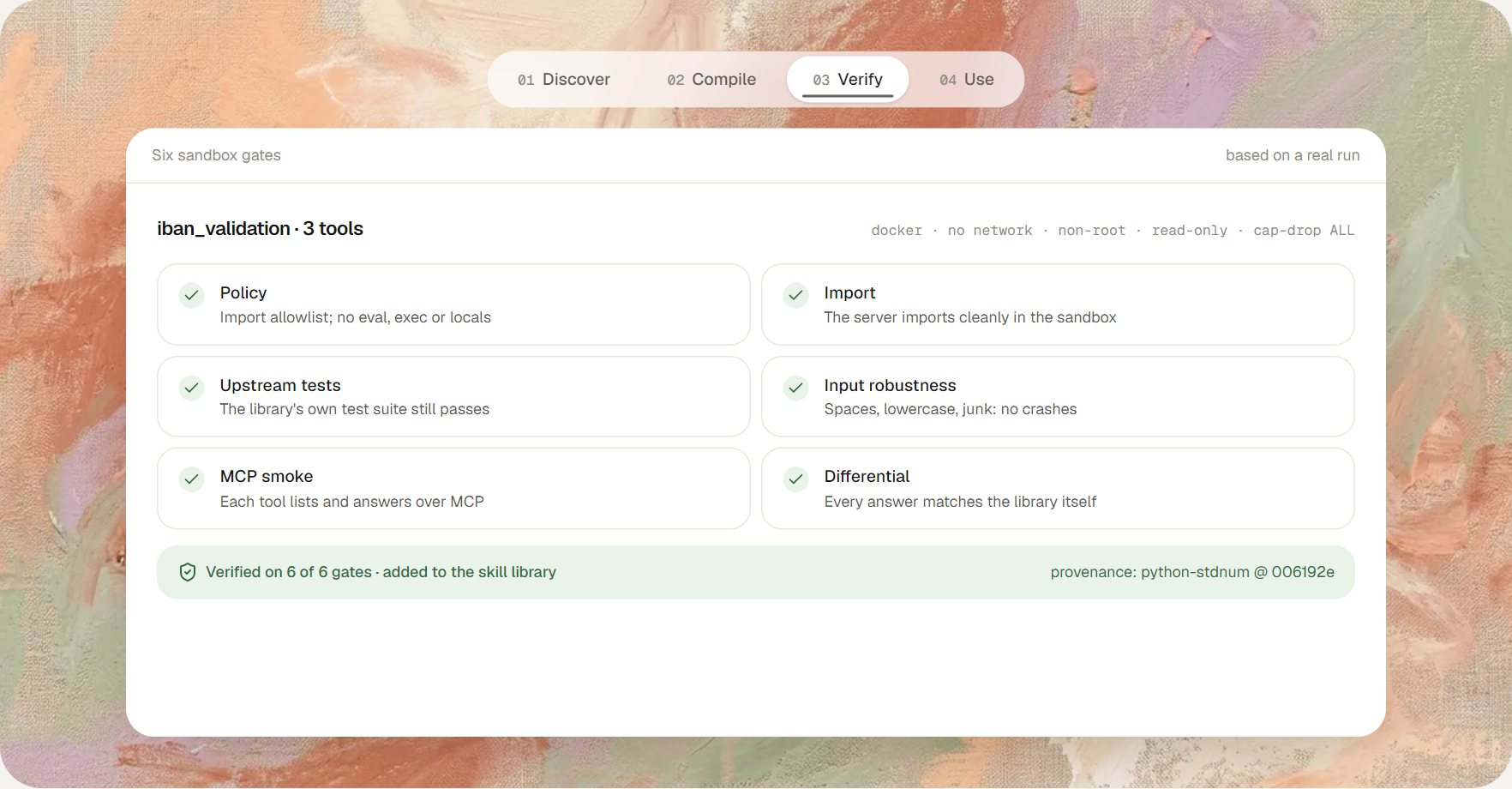
The IBAN skill's gates, from an earlier build of the app.
Results
Every run uses the open-weight model gemma-4-26b-a4b-it, with the same tasks and budget in each condition. Ground
truth is computed by the source library itself, and the raw records are in eval/results/.
| Suite | Source | Model alone | Model + Zyven-compiled skills |
|---|---|---|---|
| IBAN validity, IBAN check digits, Luhn | python-stdnum | 0 / 18 | 18 / 18 |
| Hijri ↔ Gregorian, Jewish holidays, phone validity and E.164 | hijridate, pyluach, phonenumbers | 18 / 30 | 27 / 30* |
| Bikram Sambat dates, weekdays, phone operators | py-nepali | 9 / 40 | 40 / 40 |
python-stdnum (366 modules)
| Condition | IBAN valid? | IBAN check digits | Card number passes Luhn? | Total |
|---|---|---|---|---|
| Model alone | 0/6 | 0/6 | 0/6 | 0/18 |
| Model + compiled skills | 6/6 | 6/6 | 6/6 | 18/18 |
Calendars and phone numbers
| Condition | Hijri → Greg | Greg → Hijri | Jewish holiday | Phone valid? | Phone → E.164 | Total |
|---|---|---|---|---|---|---|
| Model alone | 2/6 | 3/6 | 3/6 | 5/6 | 5/6 | 18/30 |
| Model + compiled skills | 6/6 | 6/6 | 3/6* | 6/6 | 6/6 | 27/30 |
py-nepali (Bikram Sambat calendar)
| Condition | Date conversions · weekday · phone operator | Total |
|---|---|---|
| Model alone | 2/10 · 0/10 · 1/10 · 6/10 | 9/40 |
| Model + hand-written skill | 10/10 each | 40/40 |
| Model + compiled skills | 10/10 each | 40/40 |
networkx (graph algorithms, gemma-4-26b-a4b-it, skill compiled by gemma-4-31b-it)
| Condition | Output cap | Questions | Total |
|---|---|---|---|
| Model alone | 4096 tokens | 24 | 1/24 |
| Model + compiled skill | 4096 tokens | 24 | 19/24 |
| Model alone | 8192 tokens | 12 | 3/12 |
| Model + compiled skill | 8192 tokens | 12 | 11/12 |
At the 4096-token cap, 23 of 24 runs without the skill used up the budget working the answer out by hand and gave none,
and all 5 misses with the skill were the same cap, not wrong tool results. Doubling the cap helps both conditions; the
skill still adds the most (3/12 to 11/12). The second run is a smaller sample (12 questions per condition), so read
it as a direction. A check with a second model through the Qoder CLI (5 questions per condition, dev only, not
counted here) pointed the same way. Details are in eval/results/run-20261025-150806.md andeval/results/run-20261025-170753.md.
*There was no Jewish-holiday skill in this run: the hosted endpoint timed out on that compile, so that category ran
without a skill in both conditions. Details are in eval/results/global-open-model.md.
Without tools, the model tries to compute checksums and calendars by hand and usually runs out of budget.
How to read these numbers. The baseline is the model alone, not the model with a Python interpreter, the suites are small
and were developed against these libraries, and the 4096-token cap decides much of the baseline (seeLIMITATIONS.md section 5). A model-plus-interpreter baseline and a held-out suite are open
(#24, #25).
What the gates caught during development
- Differential gate: merged imports in a generated server made the "Luhn" tool silently run a different
checksum algorithm. Every other gate passed. The comparison with the library failed 3 of 8 cases, and the build
now scopes imports per tool. - Input robustness: a card-number tool crashed on
4992 7398 71(with spaces). The Repair role fixed it. - Partial verification: an IBAN check-digit tool that could not be repaired was dropped from the package
instead of being shipped unverified.
The app
zyven board serves the landing page, the board and the APIs on one port. The screenshots below are the real app
on a clean board (zyven board --board-dir …) where every model call was made by the open-weightgemma-4-26b-a4b-it.
Task board. Give the agent a task. When it lacks a capability it proposes a pinned repository, waits for your
approval, compiles in the sandbox and finishes the task with the new tool. Anything risky waits for your click.
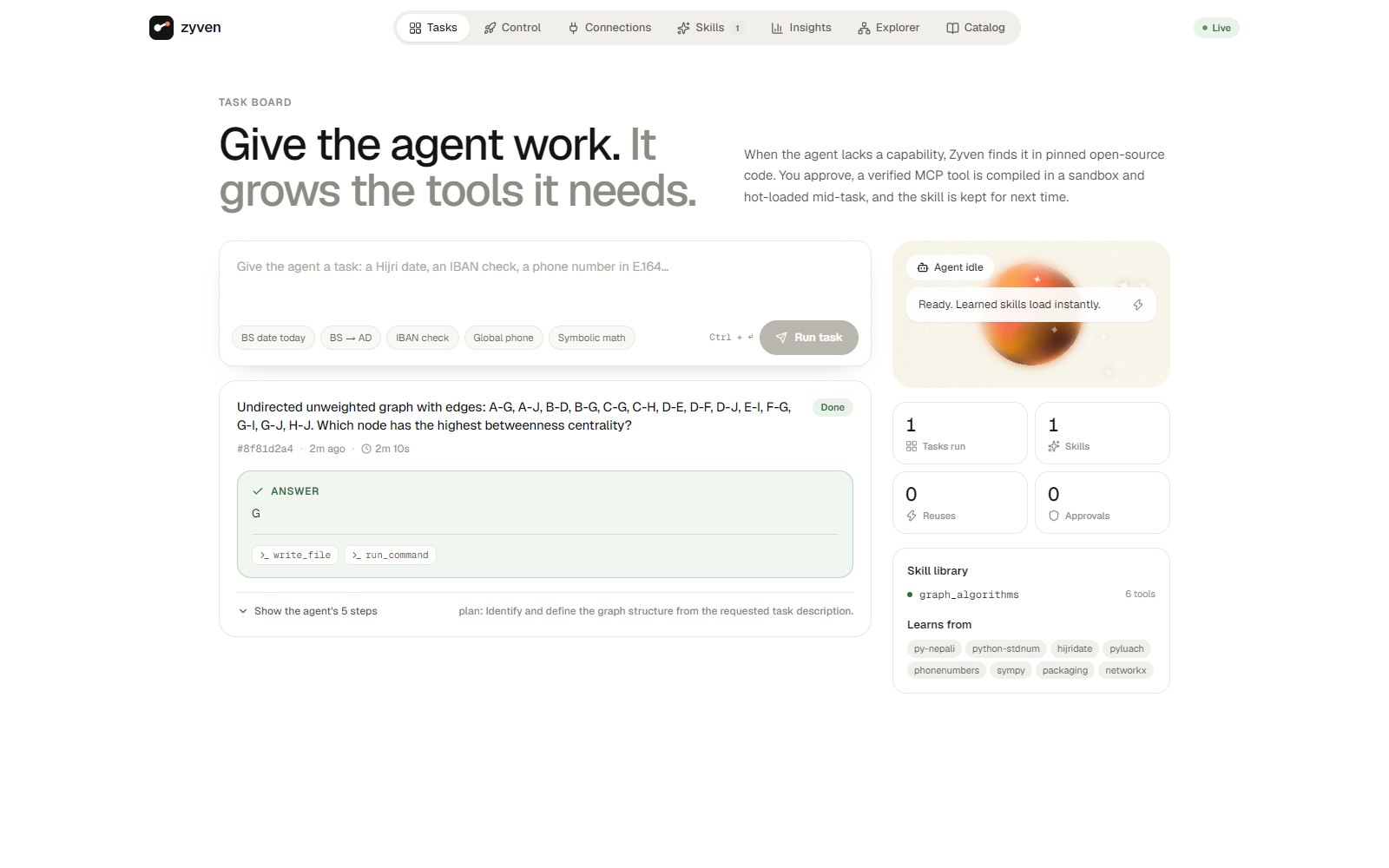
The current board, with the verified graph_algorithms skill in its library. The agent can also solve a task with its
own code in a sandbox, as it did here, so whether it goes to the catalog is the model's judgement (seeLIMITATIONS.md).
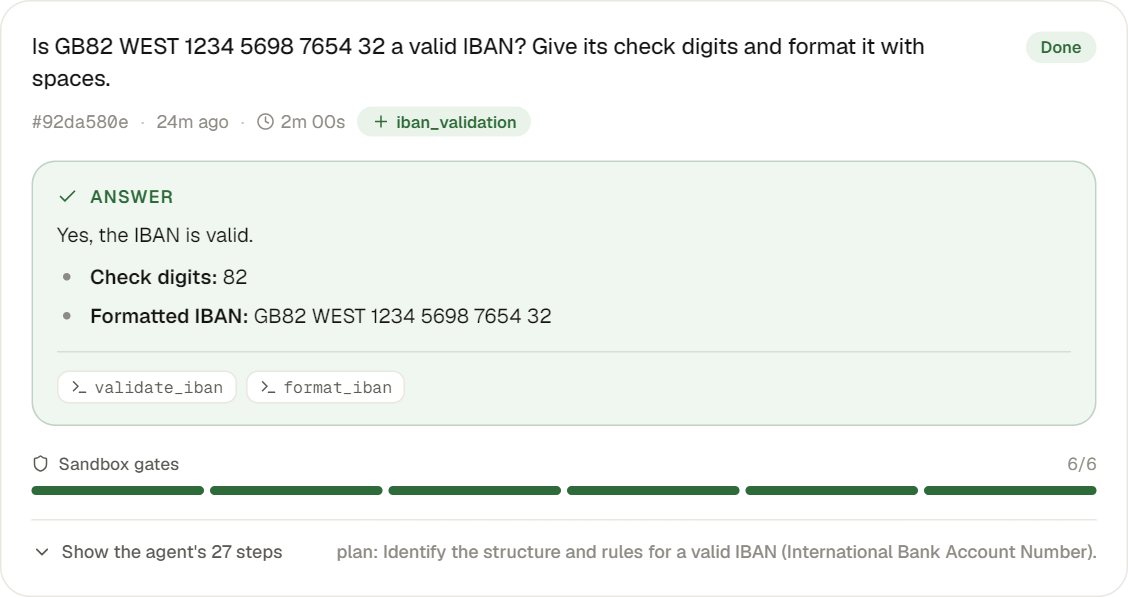
An earlier run on the same board showed the compile-then-reuse loop: the first IBAN task compiled a skill from
python-stdnum (366 modules) in 2 minutes, the second reused it and finished in 19 seconds, and a UK phone number the
model could answer on its own needed no tool at all.
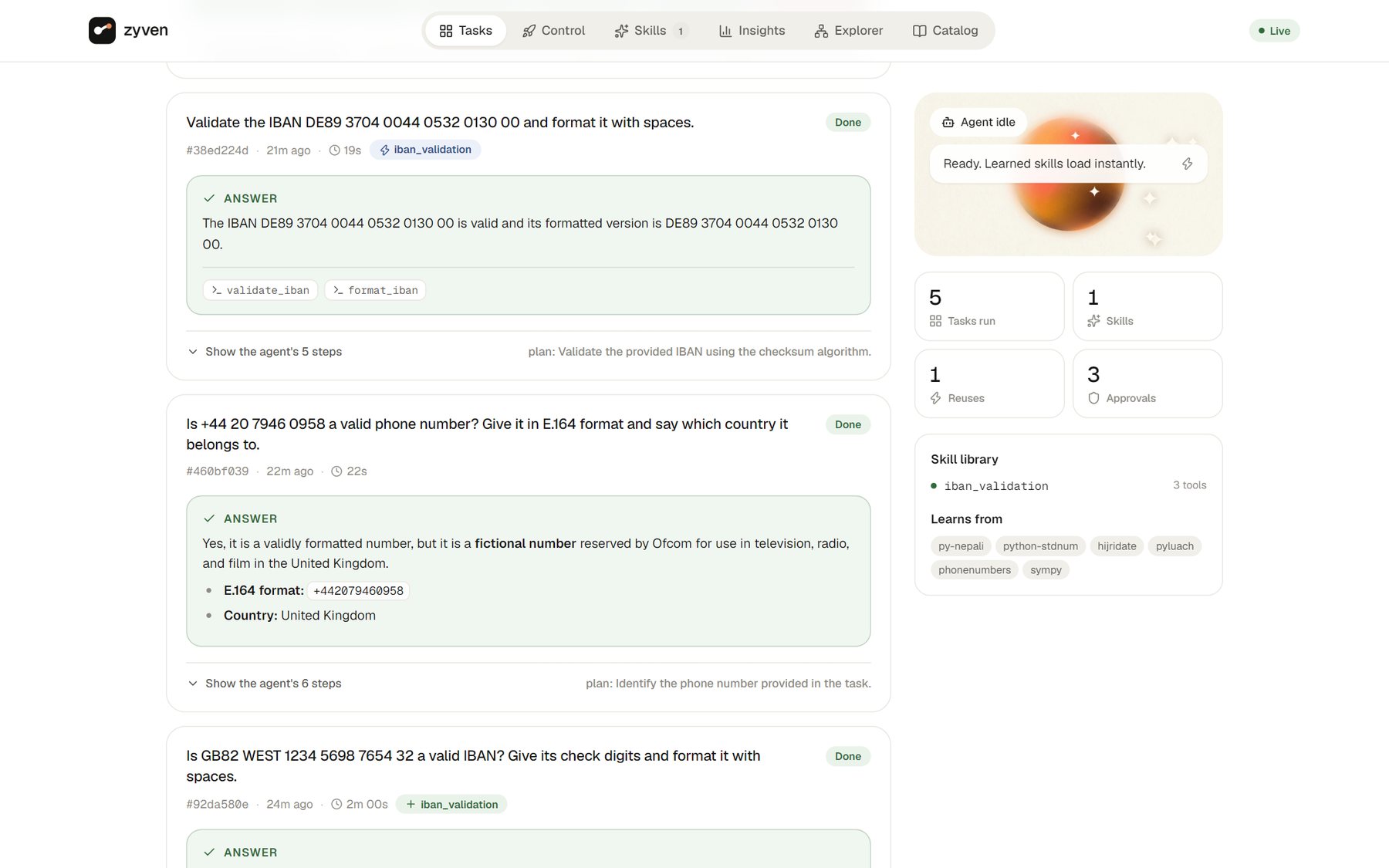
A finished task. The answer, the tool calls that produced it, the skill learned from the repository, and the six
sandbox gates it passed. Answers render as Markdown, with maths when there is any.
Insights. The learning curve, measured: how much faster a reuse is than a compile, every task on a log-scale
timeline, skill-library growth, and a grid of which gate stopped each compile attempt. In this run, a phone-number skill
compiled from python-phonenumbers passed the library's own 158 tests, but the differential gate caught one tool
disagreeing with the library on a UK mobile number. Two repairs didn't fix it, so the skill was not loaded.
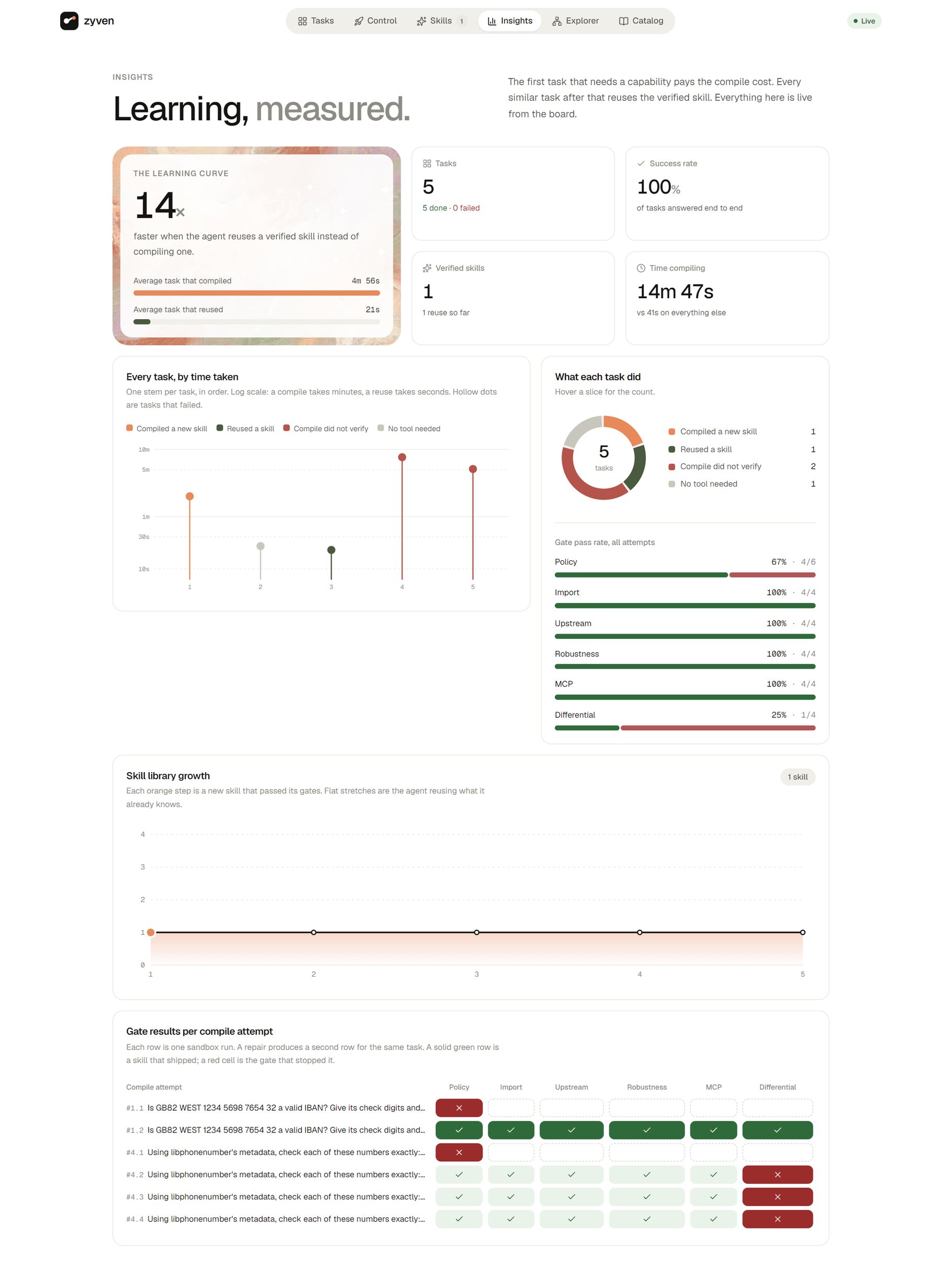
From an earlier run on an earlier build; the page still looks like this with newer data.
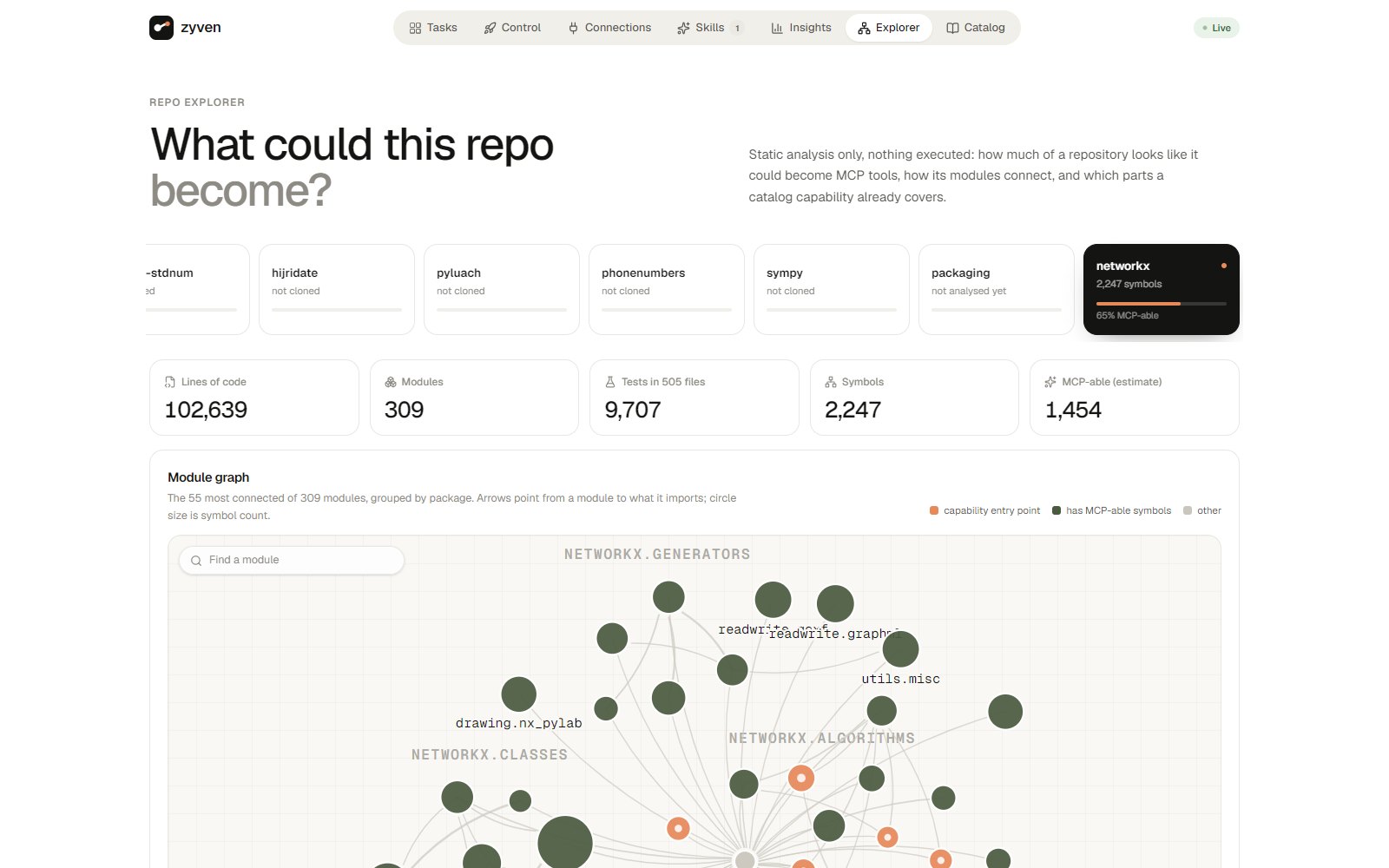
Repository explorer. What could a repository become? Here it is networkx: 102,639 lines in 309 modules, 9,707 tests
in 505 files, and 2,247 symbols, of which an estimated 1,454 could become MCP tools. It is static analysis only, so
nothing is executed. The interactive module graph lets you zoom, pan, drag, search, and click a module to see what it
imports and what imports it.
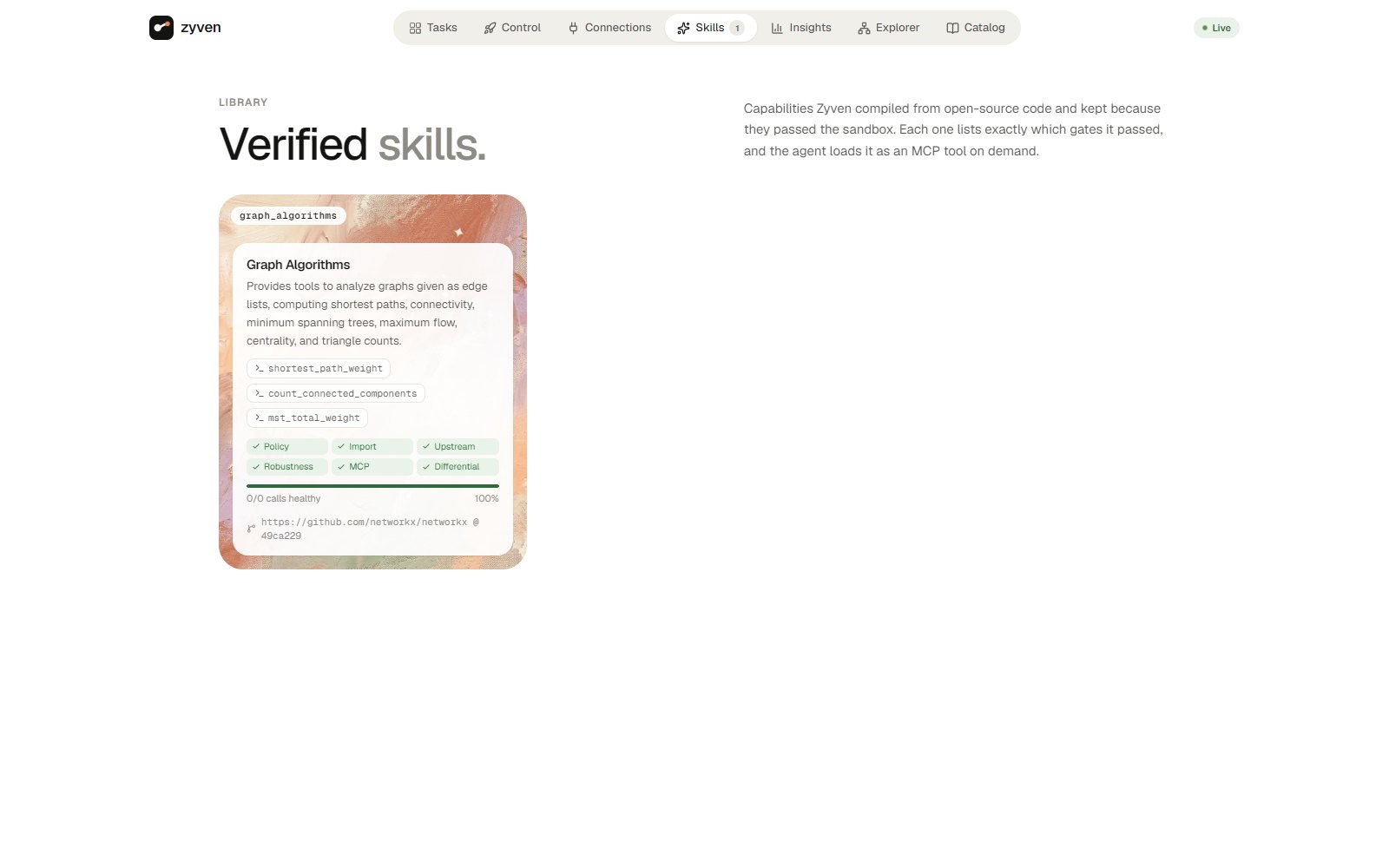
Skill library. Every verified skill is kept with its tools, call health, provenance (repository and pinned
commit) and exactly which of the six gates it passed, so the next task can reuse it.
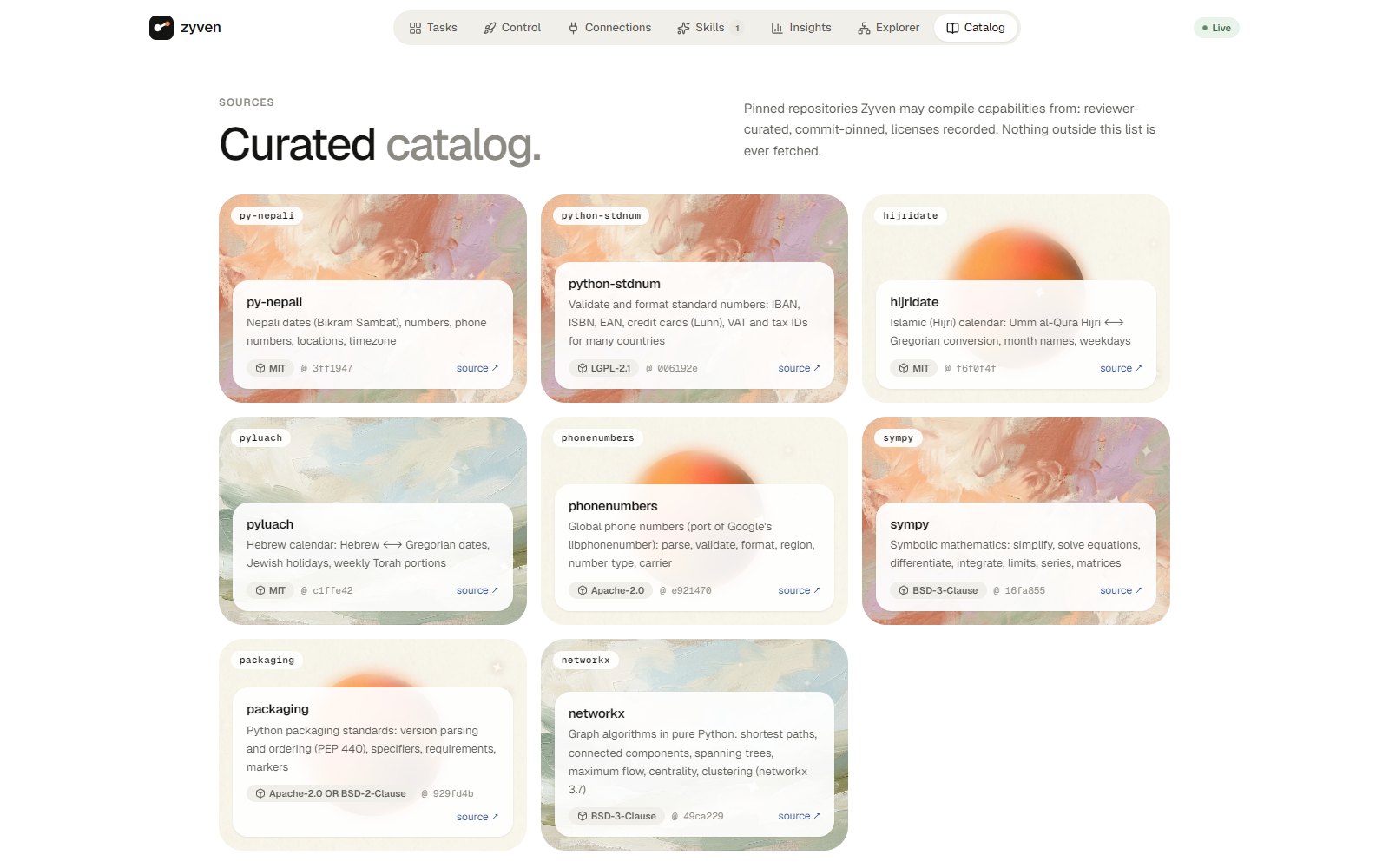
Catalog. The pinned repositories Zyven may compile from: reviewer-curated, commit-pinned, licenses recorded, and
nothing outside the list is ever fetched. Adding one is an entry in catalog/repos.json and a zyven sync.
Control center, connections and the hub (optional extras). Beyond the task board, the Control center runs work
on other runtimes and shows each run live (output, tool calls, token use, the files it changed). Everything below is
off until you switch it on, and none of it is used for any result in this README.
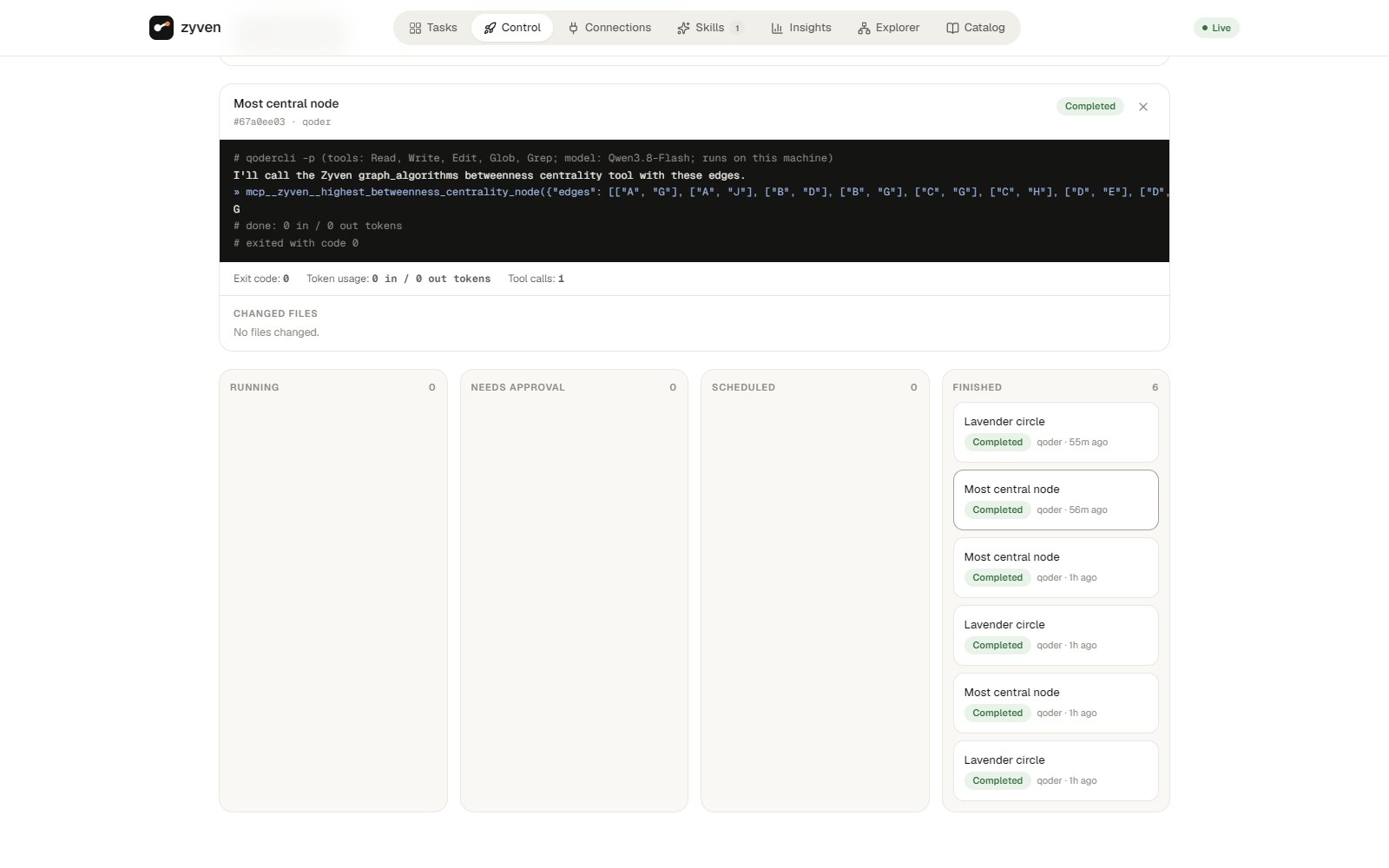
A run on the Qoder CLI runtime, given Zyven's tools through the hub. It called the verified graph tool and answered G.
| Runtime | What it is | Checked |
|---|---|---|
| Zyven agent | the built-in agent above, using the model in .env |
yes |
| Docker command | one shell command in a locked-down container (network off by default) | yes |
| GitHub | create a repository or issue with gh, after you approve the exact command |
unit tests only; no real gh call yet |
| Codex | codex exec headless, in Codex's own sandbox |
live, on Windows |
| OpenCode | opencode run headless, locked to its task folder |
live, on Windows |
| Qoder CLI | qodercli -p headless, built-in tools limited to read and edit, hub tools through a config file |
live, on Windows (Qwen3.8-Flash; model host not verified) |
| Claude Code | claude -p headless |
unit tests only; not logged in on the dev machine |
| Antigravity | agy print mode |
experimental: its headless mode printed one line and then waited, so runs stop after 2 minutes of silence |
The coding agents use whatever provider each program is signed in to (for example a ChatGPT account for Codex) or the
free hosted models OpenCode offers. They are labelled as not verified open-weight. You turn each one on, and pick a
model, from the Control center page.
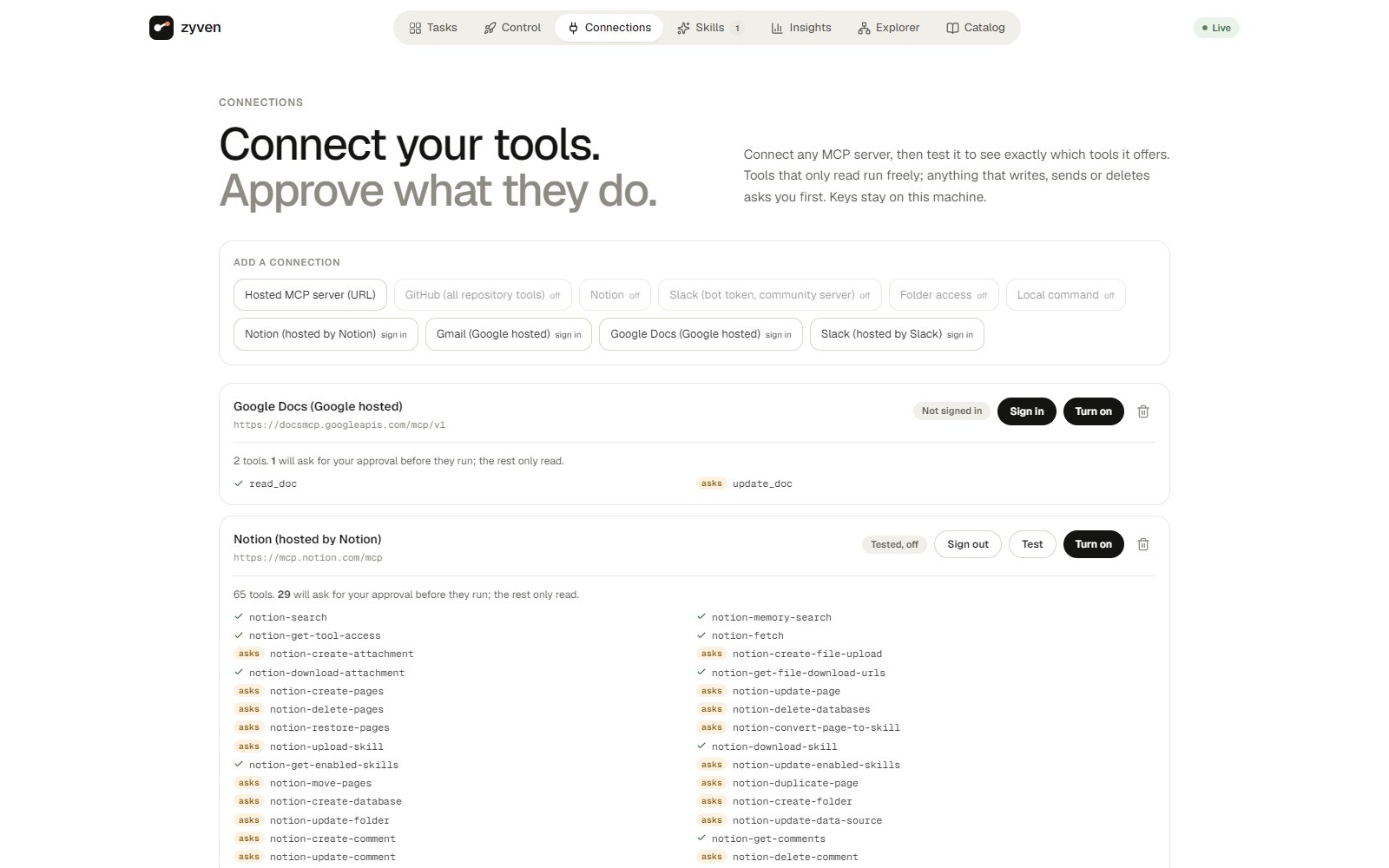
- Connections. (screenshot below) Connect any MCP server by URL or local command, or sign in through a service's own page (OAuth with
PKCE; tokens stay in a local file that the API never returns and that refreshes silently). Test a connection to see
its real tools. A tool its server does not mark read-only asks for your approval before it runs. Notion's hosted
server was tested live (sign-in, a read, and a write that was denied). Google Docs, Gmail and Slack's hosted
servers have templates; Google Docs connected and listed its tools, while Gmail and Slack were not run against the
real services (Slack refuses automatic app registration and needs its own app).
- The Zyven hub. A task started on Codex or OpenCode can be given "Zyven's tools": the board serves an MCP endpoint
(/hub/mcp) with a short-lived token per run, offering your enabled connections and your verified skills. The agent
needs no model key from Zyven. Anything that changes something raises an approval card with its exact arguments, and
the agent's call waits for your click. Tested live with Codex and OpenCode against Notion, and with Codex using a
verified Docker skill (IBAN validation, compiled earlier bygemma-4-26b-a4b-it): two calls, correct answers, 24 s
for the whole task including the container start. - Approvals. Denial, a one-hour timeout, a cancel and a restart all mean no.
- Getting results out. Download a file or a zip from a finished run, open its folder, or copy its files into one
export folder you choose (in a new subfolder, never overwriting). - Full PC access (no sandbox). Off. It needs
ZYVEN_ALLOW_FULL_ACCESS=1on the machine and then a per-task
confirmation, works only for Codex, OpenCode and Claude Code, cannot repeat on a schedule, and is badged on the run. - Local only. The board has no login. It refuses requests whose
Hostis not this machine and changing requests
from other websites. SeeLIMITATIONS.mdfor what that does not cover.
How it works
repo ──► Analyzer (AST, never executes repo code) ──► Scout (AI) ──► Architect (AI) ──► Compiler (AI) ──► Tester (AI)
          symbols, call graph, tests,                   which          tools, params,     tool bodies     library-reference
          doctests, side effects, license               capabilities   boundary, tests                    test cases (never
                                                                                                          sees the adapter)
                                         ▼
            Harness assembles the MCP server (signatures, per-tool imports, docstrings) + static policy check
                                         ▼
   Sandbox gates (Docker: no network · non-root · read-only · capabilities dropped · resource limits)
   policy · import · upstream tests · input robustness · MCP smoke · differential vs. library
                                         ▼
        fail ──► Repair (AI, bounded) ──► re-verify ──► still failing tools are dropped and recorded
        pass ──► skill package: server.py · capability.json · provenance.json · validation-report.json
The model proposes; the harness decides.
- Every symbol the model names is resolved against the static analysis.
- Generated code is policy-checked before it runs.
- Verified skills also run in the sandbox when the agent uses them, not only during verification.
- Only observed sandbox results mark a skill as verified, and only for the named checks.
The self-extending agent wraps this pipeline:
- A gap check decides whether the agent's current tools are enough.
- A capability match picks a source from the pinned catalog.
- A human approval comes before anything is compiled.
- The skill library stores verified skills with their provenance and call health.
Quick start
Requirements:
- Python 3.11+ and uv
- Docker
- Node 20+, to build the site
- an API key for a host serving an open-weight model
git clone https://github.com/VirajSawad1021/Zyven.git && cd Zyven
uv sync
cp .env.example .env                          # set MODEL_API_KEY; the model must be open-weight
docker build -t zyven-sandbox:py312 zyven/sandbox
uv run zyven sync                             # clone the pinned catalog repos
cd web && npm ci && npm run build && cd ..    # build the site (optional: there is a no-build fallback)
uv run zyven board                            # http://127.0.0.1:8765
Open http://127.0.0.1:8765/app/ and click one of the example tasks.
Command line
uv run zyven analyze path/to/repo             # deterministic analysis + rules-only baseline
uv run zyven scout   path/to/repo             # AI: capabilities worth compiling
uv run zyven compile path/to/repo --capability <name>
uv run zyven compile path/to/repo --capability iban --entry stdnum.iban.validate   # reviewer-set boundary
uv run zyven sync --scout                     # clone the catalog and cache the Scout's capabilities
uv run zyven board --port 8765                # board, site and APIs

uv run python eval/run_eval.py --suite stdnum --limit 6 --label compiled --skill skills/<name>/server.py
uv run python eval/run_eval.py --suite global --limit 6 --label compiled --skill skills/<name>/server.py
Agents and connectors (optional)
Everything here is off by default. In the Control center page (/app/control/), select a runtime, press Turn on
and optionally set a model. Environment variables also work (ZYVEN_ENABLE_CODEX=1, ZYVEN_ENABLE_OPENCODE=1,ZYVEN_ENABLE_CLAUDE=1, ZYVEN_ENABLE_AGY=1, ZYVEN_ENABLE_QODER=1, ZYVEN_ENABLE_GITHUB=1). Each program must be installed
and signed in by itself (codex login, opencode auth login, and so on); the page shows "installed / signed in" for each.
The Qoder CLI runtime runs qodercli headless with no shell or web tools, and can be given Zyven's verified tools
through the hub. Pick the model on the Control center page (the demo used a Qwen model); Zyven does not verify which
weights or host answer, so Qoder results are not part of the published numbers. If qodercli is not on PATH, setZYVEN_QODERCLI to its path.
Two switches stay environment-only on purpose, so they cannot be turned on from the web page:ZYVEN_ALLOW_STDIO_CONNECTORS=1 (connectors that start a local command) and ZYVEN_ALLOW_FULL_ACCESS=1 (tasks
without a sandbox). ZYVEN_ALLOWED_HOSTS adds host names the board answers to, if you serve it on purpose beyond
this machine. On the Connections page, add a service, press Test, then Turn on.
Working on the frontend
The site is a Next.js static export in web/. The board server mounts web/out. Without a build, / falls back
to a single-file page, which is also always available at /legacy.
cd web
npm run dev                                   # http://localhost:3000, proxies /api to the board
                                              # (set ZYVEN_API to point at another board)
Working on large repositories
- Tests: pytest runs unittest suites,
*.doctestfiles and docstring examples. The gates report how many
doctest examples were actually checked. - Digest folding: families of modules that share one API are folded for the model. For python-stdnum this cuts
182k characters to 37k, with 237 validator modules in one block. - Human-set boundaries:
--entryoverrides the Scout's choice of entry points. - Any layout: packages under
src/or another subfolder are detected and used as the import root in the
analyzer, the sandbox and the skill runtime. - Tests the sandbox can't run (they import packages that aren't installed, e.g.
bs4) are skipped with the
reason recorded, never silently counted.
Repository layout
| Path | Contents |
|---|---|
zyven/analysis/ |
analyzer, rules-only miner and digests, reference resolution, repo explorer |
zyven/ai/ |
model provider (retries, failover), typed schemas, AI roles |
zyven/compiler/ |
server assembly, static policy, verification gates, compile pipeline |
zyven/sandbox/ |
Docker runner, image, in-container MCP smoke and differential test runners |
zyven/agent/ |
MCP toolbox, tool-using agent loop, gap check, self-extending agent |
zyven/catalog/ |
the pinned catalog: clone, scout, curate |
zyven/memory/ |
skill library: verified skills, provenance, call health |
zyven/connections/ |
connected MCP servers: local secret store, OAuth sign-in, tool listing, templates |
zyven/hub/ |
the Zyven hub: connected services and verified skills offered to coding agents over MCP |
zyven/orchestrator/ |
board server: tasks, approvals, SSE, explorer API; Control center, runtime adapters (Docker, GitHub, Codex, OpenCode, Qoder CLI, Claude Code, Antigravity), local-only guard |
web/ |
Next.js site and board UI (static export served by the board) |
toolkit/ |
hand-written reference skill (baseline) |
eval/ |
task suites, before/after runner, results |
catalog/repos.json |
pinned source repositories, commits and licenses |
scripts/ |
offline checks: open-weight model policy, control-center smoke test |
docs/ |
demo script, narration text, animated explainer slides (docs/demo/), screenshots |
Models and sources
Only open-weight models, end to end. The endpoint is configurable: Google AI Studio (Gemma), OpenRouter, Groq or a
local Ollama, with automatic failover to a backup host.
| Repo | Commit | License | Used as |
|---|---|---|---|
| arthurdejong/python-stdnum | 006192e |
LGPL-2.1 | wrapped (imported, not copied) |
| dralshehri/hijridate | f6f0f4f |
MIT | wrapped (imported, not copied) |
| simlist/pyluach | c1ffe42 |
MIT | wrapped (imported, not copied) |
| daviddrysdale/python-phonenumbers | e921470 |
Apache-2.0 | wrapped (imported, not copied) |
| opensource-nepal/py-nepali | 3ff1947 |
MIT | wrapped (imported, not copied) |
| sympy/sympy | 16fa855 |
BSD-3-Clause | wrapped (imported, not copied) |
| pypa/packaging | 929fd4b |
Apache-2.0 OR BSD-2-Clause | wrapped (imported, not copied) |
| networkx/networkx | 49ca229 |
BSD-3-Clause | wrapped (imported, not copied) |
The pinned list lives in catalog/repos.json.
The default model is gemma-4-26b-a4b-it, distributed under the
Gemma Terms of Use. The repository enforces the open-weight rule with a
deterministic, offline check:
uv run python scripts/check_open_models.py
It scans committed config, skill provenance and eval reports, and runs in CI on every pull request.
Documentation
- Architecture: System design, subsystems, end-to-end execution flow, and trust boundaries.
- AI Usage Disclosure: Complete inventory of every file and function where open-weight model outputs are programmatically consumed and validated.
- Scope & Limitations: What multi-gate verification proves, what it does not prove, and system boundaries.
Status and roadmap
The capability compiler, the self-extending agent and the board work end to end. Open work is tracked in
issues:
- #7 Re-run every result with the final open-weight model
(scripts/check_open_models.pynow enforces the policy) - #8 Learning-curve evaluation (skills learned once, reused later)
- #9 Interface lint: measure the effect of the merged related-facts rule
- #24 Evaluation: add a model + Python interpreter baseline
- #25 Evaluation: held-out suite and run-to-run variance
- #26 Catalog: real-world libraries beyond pure calculators (packaging and networkx added; more to come)
- #27 Demo video: done, linked at the top of this README
Known gaps in the optional extras: Claude Code and the GitHub connector have not been run against the real services;
Antigravity's headless mode does not work on the development machine; Gmail and hosted Slack sign-in were not run
against the real services; the Qoder CLI runtime was checked with a Qwen model whose host and exact weights are not
verified; and everything was checked on Windows only. LIMITATIONS.md lists the trust assumptions.
License
MIT
Yorumlar (0)
Yorum birakmak icin giris yap.
Yorum birakSonuc bulunamadi