passdown
Health Uyari
- License — License: MIT
- Description — Repository has a description
- Active repo — Last push 0 days ago
- Low visibility — Only 5 GitHub stars
Code Basarisiz
- rm -rf — Recursive force deletion command in install.sh
Permissions Gecti
- Permissions — No dangerous permissions requested
Bu listing icin henuz AI raporu yok.
Shift-handover workflow for AI coding agents — capture ideas into an inbox, dispatch tasks to the cheapest capable executor (any CLI agent or subagent), and hand work down between sessions, agents, and tools. Composes with superpowers and OpenSpec.
passdown
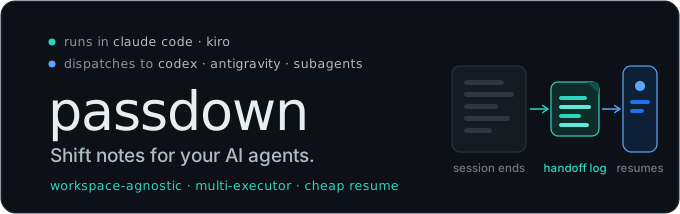




Shift notes for your AI agents.
Like a passdown log between work shifts: one session (or agent) writes down
the state, the next one picks it up — cheaply, from small files, with any tool.
Status: v0 — dogfooding. APIs, file layouts, and skill contents will change.
Why
Working with AI coding agents across long-running projects has three recurring
problems:
- Sessions grow too long. Context bloats, tokens get expensive, and there
is no natural stopping point to resume from. - One vendor is not enough. Heavy work should go to whatever executor is
cheapest and capable — another CLI agent, a subagent, a different model. - Rules live in the wrong place. Workspace-level conventions vanish when
an agent opens a sub-repo, because project-level config follows the
directory, not the user.
Strengths
- Workspace-agnostic — skills install at user level and survive any
cwdand sub-repo. - Multi-host — the same skill core runs in Claude Code, Codex, and Kiro.
- Multi-executor — dispatch routes work to the cheapest compatible
external CLI, native subagent, or main session declared inAGENTS.md. - Cheap resume — the next session reads small handoff files, not a giant transcript.
- Composes, not replaces — fits alongside superpowers, OpenSpec, and
host-specific executor adapters. - Native distribution — ships as both Claude Code and Codex plugins, plus
a direct installer for supported user-level skill directories.
How it works

passdown is three workspace-agnostic skills installed at user level, plus
conventions. Skills are the engine; each workspace's AGENTS.md is the config
(a ## passdown section declares inbox/log locations, language, and available
executors). Nothing workspace-specific ever lives inside a skill — which is
also why the skills survive any cwd and any repo.
| Skill | What it does |
|---|---|
passdown-intake |
Turns raw notes from an inbox (dropped there by weak capture tools like chat apps) into properly planned work in the right repo |
passdown-dispatch |
Routes each task to the cheapest compatible external CLI, native subagent, or main session, then verifies the result |
passdown-handoff |
Ends every session with a small handoff log: summary, next steps, and the traps that live nowhere else |
Host vs. executor. passdown can run as the orchestrator in Claude Code,
Codex, or Kiro. An executor is a separate target selected bypassdown-dispatch. Codex may be an external executor when passdown runs on a
different host; when Codex is already the host, codex is a self-target and is
skipped in favor of the current session or an explicitly authorized native
subagent.
Support matrix
| Tool | Role | Status | Install / integration |
|---|---|---|---|
| Claude Code | Primary host — runs the three skills as a plugin | Supported | Plugin marketplace (claude plugin marketplace add / install) — see Install |
| Codex | Host — runs the same three skills as a native plugin; may also be an external executor from another host | Supported | Codex marketplace (codex plugin marketplace add / add) or ./install.sh --host codex |
| Kiro | Secondary host — user-level skill dir, same skills | Supported | git clone + ./install.sh --host kiro |
| Antigravity | Dispatch executor — receives tasks from passdown-dispatch |
Executor target, not a host | Not installed directly; configured as an executor in the consumer repo's AGENTS.md, invoked via the agy CLI |
passdown composes with, and does not replace:
- superpowers — process discipline
(TDD, debugging, planning etiquette) - OpenSpec — planning artifacts
(living specs, change deltas, task lists whose state lives in files, not in
sessions) - codex-plugin-cc — an optional
Claude Code → Codex executor adapter
Install
As a Claude Code plugin (recommended):
claude plugin marketplace add vunm-io/passdown
claude plugin install passdown@passdown
Or in the desktop app: Plugins → Add marketplace → "Add from a repository".
The plugin (and its skills) then shows up under Personal plugins, like any
marketplace plugin.
Once installed, the three skills load under the passdown plugin namespace.
They trigger automatically on their descriptions, and you can invoke them
explicitly:
/passdown:passdown-intake/passdown:passdown-dispatch/passdown:passdown-handoff
As a Codex plugin (recommended):
codex plugin marketplace add vunm-io/passdown
codex plugin add passdown@passdown
Restart Codex or open a new thread after installation. The skills appear under
the passdown plugin namespace and can trigger from their descriptions or be
selected explicitly from the skill/plugin picker.
Direct user-level install:
# HTTPS (recommended for public users):
git clone https://github.com/vunm-io/passdown.git && cd passdown
# or SSH, if you have a key set up (handy for maintainers):
# git clone [email protected]:vunm-io/passdown.git && cd passdown
./install.sh --host claude
./install.sh --host codex
./install.sh --host kiro
Pick one channel per host: plugin or direct install, never both. Duplicate
channels expose namespaced and unnamespaced copies of the same skill and can
leave different versions active. Remove the direct passdown-* directories
from that host's user skill directory before switching to its plugin channel.
Running ./install.sh without --host preserves the legacy behavior: Claude
Code, Kiro when ~/.kiro already exists, and the user-level OpenSpec schema.
For new installations, prefer an explicit host.
Antigravity remains executor-only. Configure it, or an external Codex adapter
used from another host, under executors in the consumer workspace'sAGENTS.md.
Then add a ## passdown section to your workspace's AGENTS.md (seetemplates/AGENTS.thin.md for a starting point).
Layout
plugins/passdown/skills/   # the three skills (English, workspace-agnostic)
plugins/passdown/.codex-plugin/ # native Codex plugin manifest
.agents/plugins/marketplace.json # native Codex marketplace
schemas/passdown/          # OpenSpec workflow schema customizations
templates/AGENTS.thin.md   # thin AGENTS.md template for sub-repos
assets/                    # README hero + flow SVGs
install.sh                 # host-selectable user installer + repo-local schema copy
scripts/check-version.sh   # VERSION/manifest/tag agreement
scripts/validate-plugin.sh   # strict manifest validation (bash)
scripts/validate-plugin.ps1  # same, for Windows PowerShell (Git Bash/WSL path issues)
examples/basic-workspace/  # a worked example: inbox note, OpenSpec change, session log
docs/SMOKE_TEST.md         # manual verification checklist for install + skills
docs/EXECUTOR_SETUP.md     # pre-flight checklist before adding a dispatch executor
docs/GITHUB_SETTINGS.md    # required merge methods and main ruleset
See examples/basic-workspace/ for what an
inbox note, a completed passdown-schema OpenSpec change, and a session log
actually look like end to end. See docs/SMOKE_TEST.md
before shipping any change to install.sh, the plugin manifests, or the
schema.
Distribution status
- GitHub-hosted Claude Code marketplace — supported.
- GitHub-hosted Codex marketplace — supported.
- Community directories — optional after public smoke testing.
See docs/RELEASE.md for the recurring release checklist.
License
MIT
Yorumlar (0)
Yorum birakmak icin giris yap.
Yorum birakSonuc bulunamadi