atifact
Health Uyari
- License — License: MIT
- Description — Repository has a description
- Active repo — Last push 0 days ago
- Low visibility — Only 5 GitHub stars
Code Gecti
- Code scan — Scanned 12 files during light audit, no dangerous patterns found
Permissions Gecti
- Permissions — No dangerous permissions requested
Bu listing icin henuz AI raporu yok.
Turn HAR files, Claude Code, Copilot CLI, and Codex CLI logs into standardized ATIF v1.7 trajectory JSON — ready for debugging, visualization, fine-tuning, and RL pipelines.
atifact
Convert agent logs to ATIF trajectories. One command. Zero dependencies.
Turn HAR files, Claude Code logs, Copilot CLI logs, and Codex CLI logs into standardized ATIF v1.7 trajectory JSON — ready for debugging, visualization, fine-tuning, and RL pipelines.
Use with AI agents
Give your AI coding agent the atifact skill so it can extract trajectories on your behalf:
npx skills add waldekmastykarz/atifact
Once installed, ask your agent to "extract the trajectory from this HAR file", "convert Claude Code logs to ATIF", "convert Copilot CLI logs", or "convert Codex CLI logs" and it will handle the rest.
Install
npm install -g atifact
Quick start
# Convert a HAR file (auto-detected)
atifact session.har

# Convert Claude Code logs
atifact claude-log.jsonl

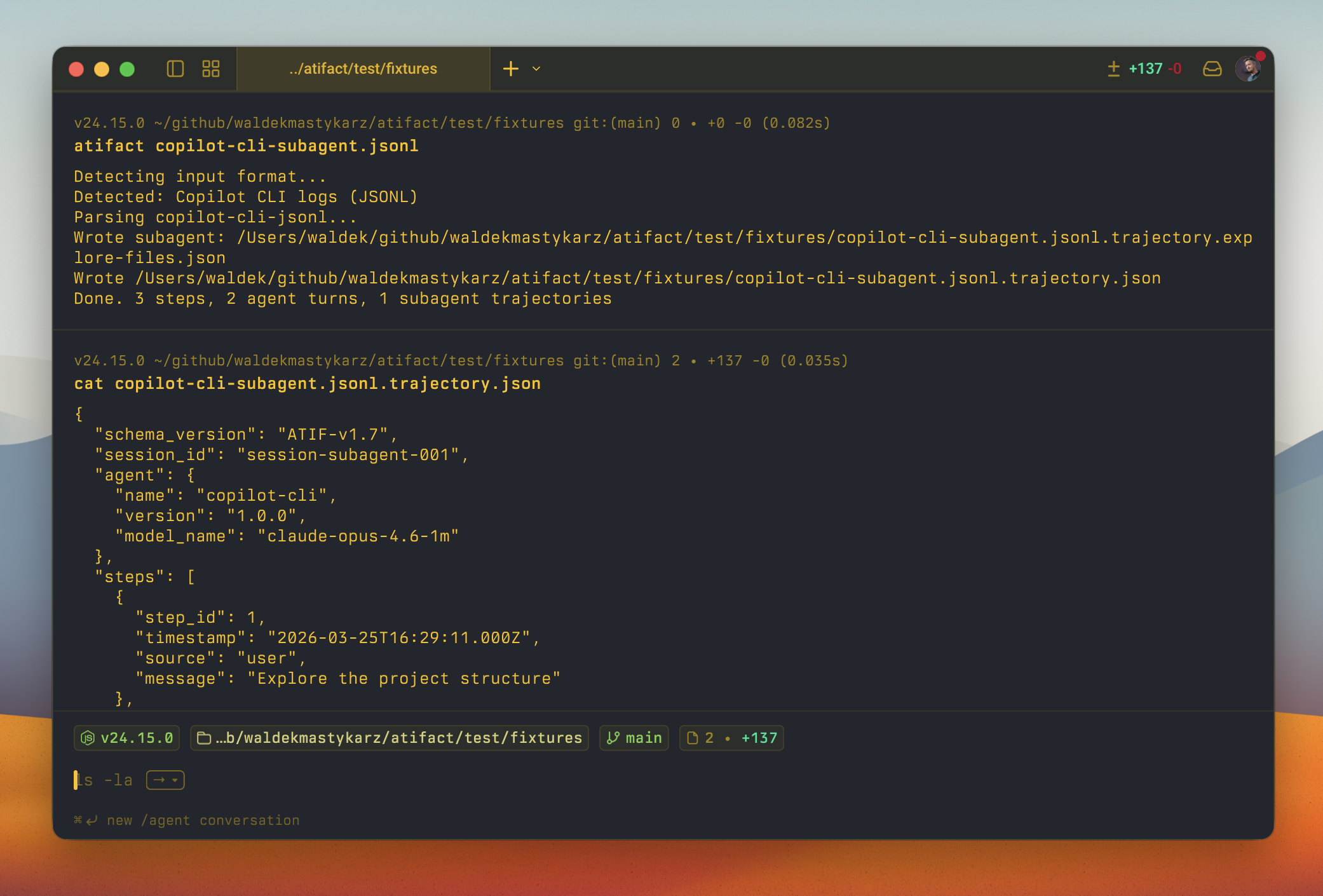
# Convert Copilot CLI logs
atifact copilot-session.jsonl

# Convert Codex CLI logs
atifact codex-session.jsonl

# Pipe to stdout (returns JSON array of trajectories)
atifact session.har --json | jq '.steps | length'
Output: <input>.trajectory.json in ATIF v1.7 format. Copilot CLI and Codex CLI logs with subagents produce additional <input>.trajectory.<name>.json files.
--json mode outputs a single trajectory with subagents embedded in the subagent_trajectories array to stdout with no files written.
Supported inputs
| Format | Source | Flag |
|---|---|---|
| HAR | OpenAI Chat Completions API, OpenAI Responses API, Anthropic Messages API | har |
| JSONL | Claude Code CLI session logs | claude-code-jsonl |
| JSONL | Copilot CLI session logs | copilot-cli-jsonl |
| JSONL | Codex CLI exec --json logs |
codex-cli-jsonl |
Format is auto-detected from file contents (not extension). Force it with -f:
atifact myfile.log -f claude-code-jsonl
atifact myfile.log -f copilot-cli-jsonl
atifact myfile.log -f codex-cli-jsonl
Usage
atifact <input-file> [options]
| Option | Description |
|---|---|
-o, --output <prefix> |
Output path prefix (default: input file path). Main: <prefix>.trajectory.json, subagents: <prefix>.trajectory.<name>.json |
-f, --format <fmt> |
Force input format: har, claude-code-jsonl, copilot-cli-jsonl, codex-cli-jsonl |
--json |
Write trajectory to stdout with subagents embedded (no files written) |
-q, --quiet |
Suppress progress messages |
-h, --help |
Show help |
--version |
Print version |
Exit codes
| Code | Meaning |
|---|---|
0 |
Success |
1 |
Runtime error (parse failure, I/O error) |
2 |
Invalid usage (bad arguments, missing file) |
Output format
atifact produces ATIF v1.7 JSON with:
- Steps — user messages, agent responses, tool calls, and observations
- Metrics — token counts, costs, cached tokens per step
- Tool calls — structured function name + arguments with observation results
- Subagent trajectories — Copilot CLI and Codex CLI subagents produce separate trajectory files linked via
subagent_trajectory_refwithtrajectory_idresolution;--jsonmode embeds them insubagent_trajectories - Final metrics — aggregated totals across the trajectory
- All timestamps preserved as ISO 8601 from source data
- Null/undefined fields excluded for compact output
Examples
HAR → trajectory
atifact recording.har -o my-trajectory
# Writes: my-trajectory.trajectory.json
Claude Code → trajectory, piped
atifact ~/.claude/projects/*/sessions/*.jsonl --json --quiet > trajectory.json
Copilot CLI → trajectory with subagents
atifact copilot-session.jsonl
# Writes: copilot-session.jsonl.trajectory.json
# Writes: copilot-session.jsonl.trajectory.<subagent-name>.json (per subagent)
Codex CLI → trajectory
atifact codex-session.jsonl
# Writes: codex-session.jsonl.trajectory.json
Count agent steps
atifact session.har --json | jq '[.steps[] | select(.source == "agent")] | length'
Requirements
- Node.js 22+
License
Yorumlar (0)
Yorum birakmak icin giris yap.
Yorum birakSonuc bulunamadi