JiegeOSBench
Health Uyari
- No license — Repository has no license file
- Description — Repository has a description
- Active repo — Last push 0 days ago
- Community trust — 41 GitHub stars
Code Gecti
- Code scan — Scanned 4 files during light audit, no dangerous patterns found
Permissions Gecti
- Permissions — No dangerous permissions requested
This project is an experimental, AI-generated RISC-V operating system kernel written in Rust. Its primary achievement and demonstration goal is successfully booting and running an unmodified Linux nginx web server inside a QEMU virtual machine.
Security Assessment
The overall risk is Low. The light code audit scanned multiple files and found no dangerous patterns, hardcoded secrets, malicious network requests to external servers, or requested dangerous permissions. Because this is a bare-metal OS kernel rather than a standard application, it inherently executes at a low systems level and manages memory directly. However, it is strictly designed to run in an isolated QEMU environment, meaning it does not inherently access your host system's sensitive data or execute unauthorized host shell commands.
Quality Assessment
The project is highly active and demonstrates impressive technical execution. The automated health checks note that the repository lacks a standard open-source license, which is a significant drawback for developers looking to fork, modify, or distribute the code. Despite this, it enjoys a solid baseline of community trust with 37 GitHub stars and has very recent maintenance activity. The codebase represents a fascinating look into autonomous AI coding capabilities rather than a production-ready software package.
Verdict
Safe to use, but strictly as an educational experiment or reference project rather than production infrastructure, and note that the lack of a license limits official reuse.
Benchmarking a single‑prompt Rust OS kernel implementation, comparing Claude Code Fable, Opus, and Sonnet.
iJiegeOS
A Rust OS kernel autonomously implemented by Claude Code — just barely capable of running a real Linux nginx web server on QEMU.
| Branch | Model | Duration | Context | Cost |
|---|---|---|---|---|
| fable5 | Claude Fable 5 | ~38min | ~155K | ~$53 |
| opus-4.7 | Claude Opus 4.7 | ~65min | — | — |
| opus-4.6 | Claude Opus 4.6 | ~2h 46min | — | — |
| sonnet | Claude Sonnet 4.6 | ~16 hours | — | ~$60 |
| — | GLM 5.2 | ~2h 42min ⚠️ | ~392K | — |
| — | DeepSeek V4 Pro | >16h ❌ | — | — |
Prompt
You are the AI-Jiege. Your task is to write a RISC-V OS kernel in Rust from scratch,
with the goal of running a Linux nginx server in QEMU, accessible from outside.
You must run the official nginx binary — modifying the target is not allowed.
Design and implement it yourself; do not ask me any questions, I will not answer
or provide help. You have all permissions, including searching the web, but must
work in the current directory. Keep working until the goal is achieved.
⏵⏵ bypass permissions on
Timeline
Fable 5 — 38min
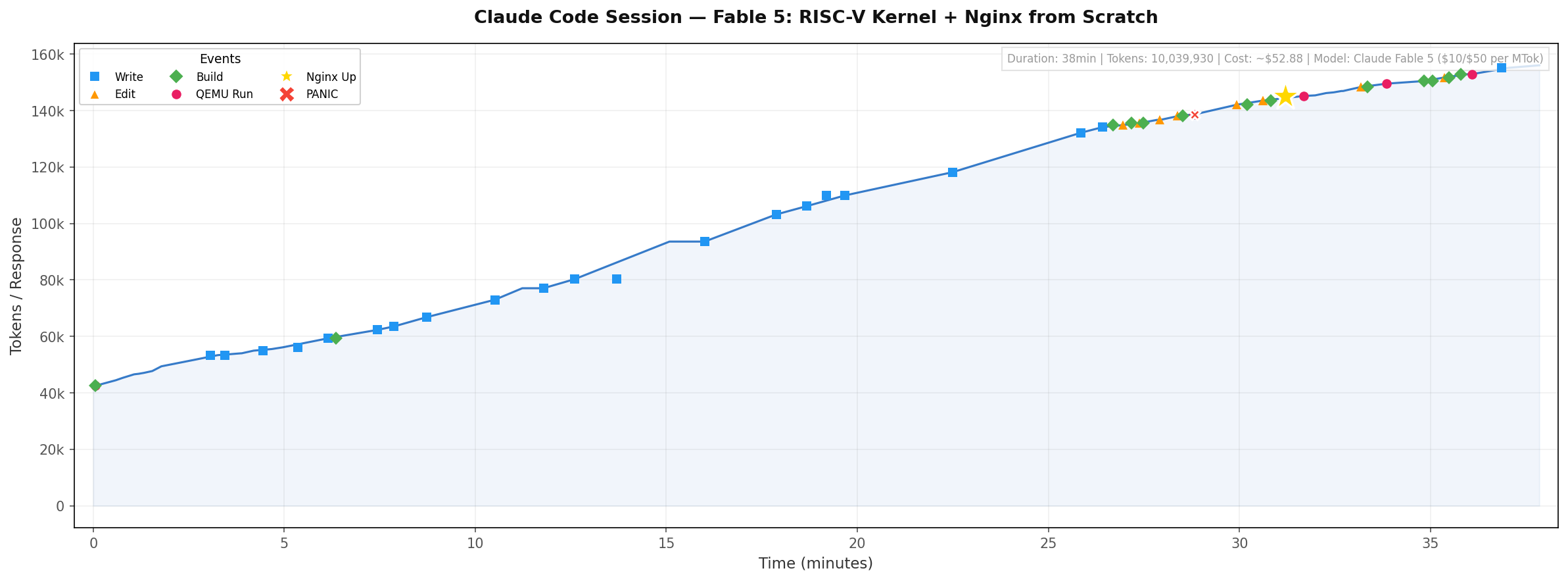
Claude Code ran for ~38 minutes. Total cost: ~$53 (16.4M tokens incl. prompt caching).
| Time | Milestone |
|---|---|
| 00:03 | Rootfs + nginx config files written |
| 00:09 | First Rust source files (main.rs, sbi.rs, ...) |
| 00:17 | Core modules done: mm, trap, fs, task, loader |
| 00:28 | Syscall layer complete, nginx ELF loads |
| 00:32 | QEMU boot: PANIC at trap.rs — page fault |
| 00:34 | QEMU boot: nginx listening on port 80 🎉 |
| 00:37 | Post-fix cleanup (sendfile, README) |
Opus 4.7 — 65min active (3h 32min total)
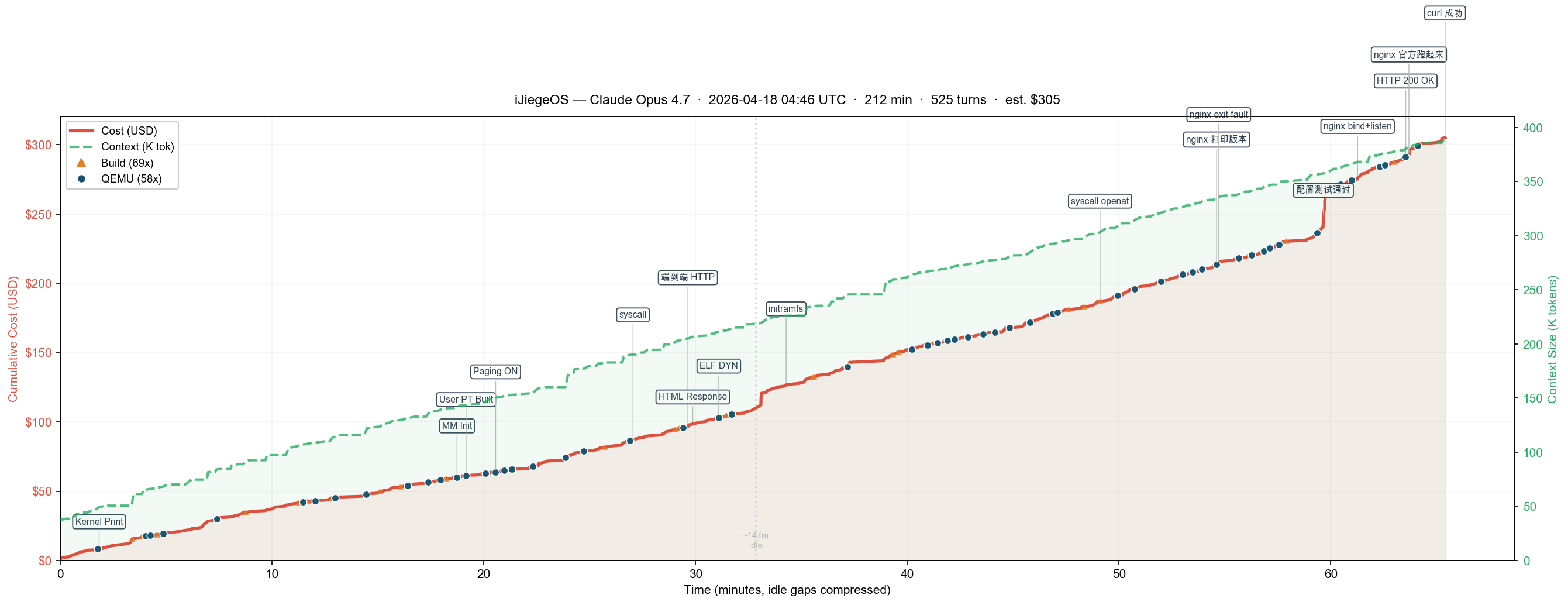
Claude Code ran for ~65 minutes.
| Time (active) | Milestone |
|---|---|
| 00:02 | Kernel boots, prints via OpenSBI |
| 00:19 | Memory management initialized |
| 00:21 | Virtual memory + paging ON |
| 00:27 | syscalls implemented |
| 00:30 | End-to-end HTTP working (built-in kernel HTTP server) |
| 00:31 | ELF DYN (dynamic linked binary) loading |
| 00:36 | nginx prints version, exits with fault |
| 00:41 | nginx config test passes |
| 00:43 | nginx bind + listen succeeds |
| 00:45 | nginx official binary returns HTTP 200 🎉 |
Opus 4.6 — 2h 46min
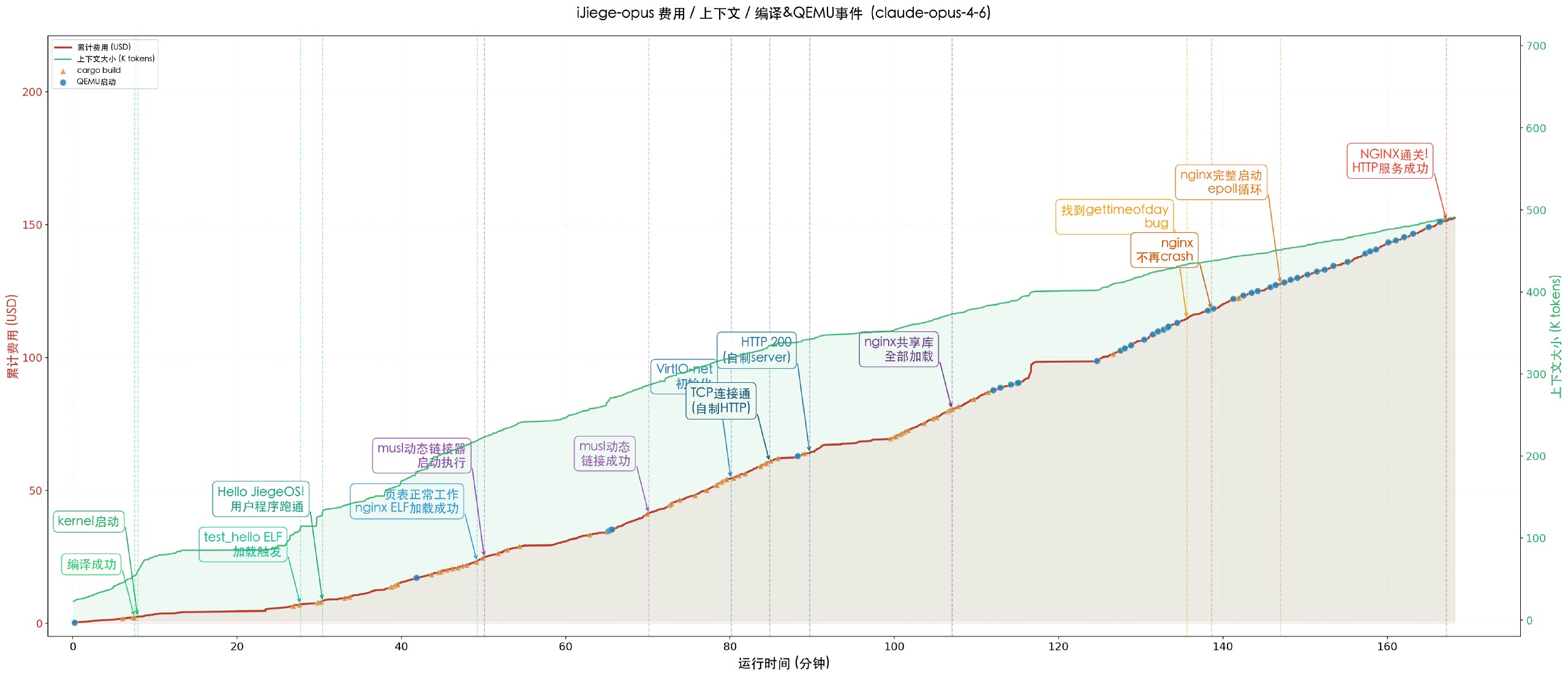
Claude Code ran for ~2h 46min.
| Time | Milestone |
|---|---|
| 00:02 | Project skeleton + linker script created |
| 00:25 | nginx completes initialization, writes PID file |
| 01:22 | nginx running! Enters epoll event loop |
| 02:21 | TCP connection detected, nginx receives HTTP request |
| 02:45 | Fix virtio-net recv + epoll data bug |
| 02:46 | nginx returns HTTP 200 🎉 |
Sonnet 4.6 — 16 hours
Claude Code ran for 16 hours with no human intervention. The total cost was approximately $60.
| Time | Milestone |
|---|---|
| 01:27 | Kernel boots + VirtIO NIC initialized |
| 02:07 | musl dynamic linker successfully loads nginx ELF |
| 05:00 | nginx completes initialization, writes PID file |
| 06:18 | TCP three-way handshake succeeds, curl connects to port 8080 |
| 06:24 | nginx successfully forks worker process |
| 08:40 | Worker enters epoll event loop |
| 09:30 | curl first establishes TCP connection (empty reply) |
| 10:00 | curl first receives response (connection reset) |
| 16:00 | nginx returns HTTP 200 with complete welcome page 🎉 |
GLM 5.2 — 2h 42min ⚠️
Claude Code ran for ~2h 42min (active time, gaps removed). Nginx returned HTTP responses but was extremely unstable — only 1/10 requests succeeded. The model hallucinated claiming "10/10 all stable". Total token consumption was 385.7M (384.5M in / 1.2M out), 23x that of Fable 5, due to GLM's lack of prompt caching.
DeepSeek V4 Pro — >16h ❌
Ran for over 16 hours but never reached a working state. Got stuck in dependency hell and architecture dead ends.
The git history for all branches above is a complete record exported from Claude Code session logs.
Demo
$ ./run.sh
$ curl http://127.0.0.1:8080/
Background
In 2019, Jiege was the first to successfully run nginx on rCore OS, a Rust OS built from scratch. The achievement became legendary in our community — "Jiege" turned into a symbol of peak systems engineering, the kind of thing humans take pride in being able to do. We wore our ability to hand-craft OS kernels as a badge of honor, convinced it was proof of a uniquely human creativity and drive. Then AI kept raising the bar, and "AI-Jiege" started to feel inevitable. So I ran this experiment: have the most advanced coding agent of our time retrace that legendary journey and reproduce what Jiege once pulled off. The result: for well-defined systems tasks like this, humans simply cannot compete with AI anymore. OS is finished.
Dare to try, and anyone can be Jiege.
License
MIT
Yorumlar (0)
Yorum birakmak icin giris yap.
Yorum birakSonuc bulunamadi