sessfork
Health Warn
- License — License: MIT
- Description — Repository has a description
- Active repo — Last push 0 days ago
- Low visibility — Only 5 GitHub stars
Code Fail
- rm -rf — Recursive force deletion command in install.sh
Permissions Pass
- Permissions — No dangerous permissions requested
No AI report is available for this listing yet.
Fork live Chrome auth sessions (Cookies + LocalStorage) into headless AI agent browsers — zero window focus theft, zero runtime dependencies.
sessfork



English · 简体中文 · Interactive Visual Guide
Fork live Chrome auth sessions (Cookies + LocalStorage) into headless AI agent browsers — zero window focus theft, zero runtime dependencies.
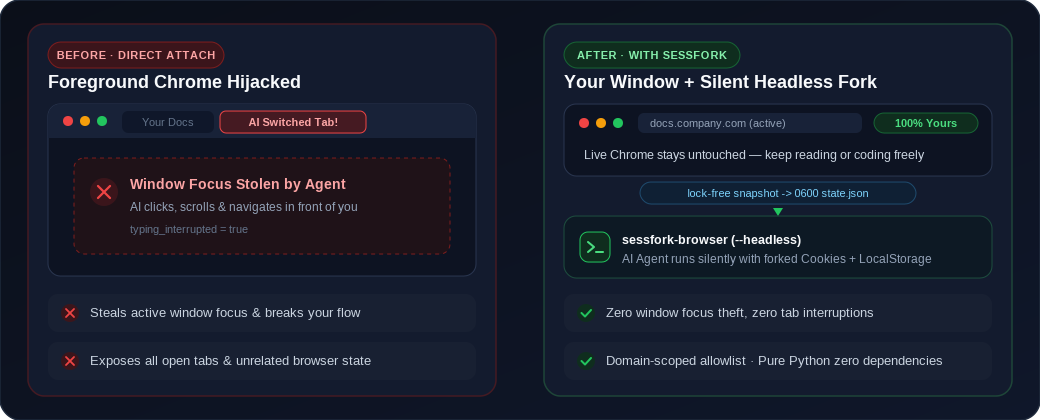
When AI coding agents (Google Antigravity, Claude Code, or Cursor) connect directly to your main Chrome instance to reuse logged-in sessions, they hijack your active window, switch tabs, and break your flow.
sessfork decouples your UI viewport from browser auth state in a single command: it takes lock-free snapshots of your live Chromium SQLite Cookies database and LevelDB Local Storage/leveldb store, decrypts cookies in memory via native OS APIs, reconciles MVCC sequence numbers for SPA/JWT localStorage tokens, writes a strict 0600 Playwright storageState file, and wires a silent background Playwright MCP server (sessfork-browser) across your installed AI agents.
10-Second Lazy Quickstart
Install once, then just talk to your AI agent in plain language.
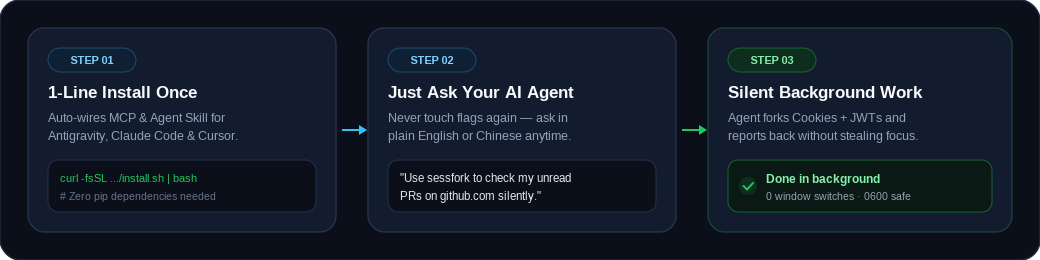
Option A · One-Click Auto-Setup (Recommended — zero prerequisites)
Auto-detects installed AI tools (Antigravity, Claude Code, Cursor), registers the background sessfork-browser MCP server, and installs the global Agent SKILL.md:
curl -fsSL https://raw.githubusercontent.com/wasabihu/sessfork/main/install.sh | bash
Want to fork your first domains in the very same command? Pass them right after --:
curl -fsSL https://raw.githubusercontent.com/wasabihu/sessfork/main/install.sh | bash -s -- github.com linear.app
(Note: On each cookie fork, macOS asks to read "Chrome Safe Storage" from Keychain — click Allow. For pure LocalStorage JWT sites, pass --no-cookies for zero Keychain prompts. See the FAQ for the opt-in --cache-key.)
Option B · Zero-Install One-Shot (uvx)
Try sessfork immediately without touching global binaries:
uvx --from git+https://github.com/wasabihu/sessfork sessfork github.com
Option C · Global uv tool or Editable Local Checkout
# Install globally via uv
uv tool install git+https://github.com/wasabihu/sessfork.git

# Or clone locally
git clone https://github.com/wasabihu/sessfork.git
cd sessfork
uv tool install -e .
(Tip: Once installed, reload MCP servers once in your AI editor or run /mcp in CLI so sessfork-browser becomes active.)
5 Real-World Copy-Paste Examples
Once installed, you don't even have to remember CLI flags. Copy any prompt below straight to your AI agent — or run the 1-line command directly.
1. Triage GitHub PRs & CI Failures Silently
Copy & paste to your AI Agent:
"Usesessforkto fork mygithub.comlogin session intosessfork-browser, then silently check my unread notifications and review the failing PR checks without switching or touching my active Chrome window."
sessfork github.com
2. Check Linear / Notion / Jira Sprint Tasks
Copy & paste to your AI Agent:
"Fork mylinear.appandnotion.sosessions withsessforkand summarize today's assigned sprint blockers in the background."
sessfork linear.app notion.so
3. Pure SPA / JWT Apps & Localhost (Zero Keychain Prompt)
Modern SPAs (Supabase, Vercel dashboards, local dev apps) store bearer tokens in localStorage instead of HttpOnly cookies. Skip Keychain completely with --no-cookies:
Copy & paste to your AI Agent:
"Runsessfork app.supabase.com localhost:3000 --no-cookiesand verify the authenticated dashboard API responses insessfork-browser."
sessfork app.supabase.com localhost:3000 --no-cookies
4. Paste Full URLs Straight from Your Address Bar
Don't bother stripping https:// or paths — sessfork automatically normalizes full URLs to their domain allowlist:
sessfork https://github.com/notifications
5. Fork from Arc, Brave, Edge, or a Specific Work Profile
sessfork supports chrome, canary, brave, edge, and arc, and automatically discovers your most recently active profile (or lets you target one explicitly):
sessfork x.com --browser arc
sessfork console.cloud.google.com --profile "Profile 1"
Architecture & Highlights
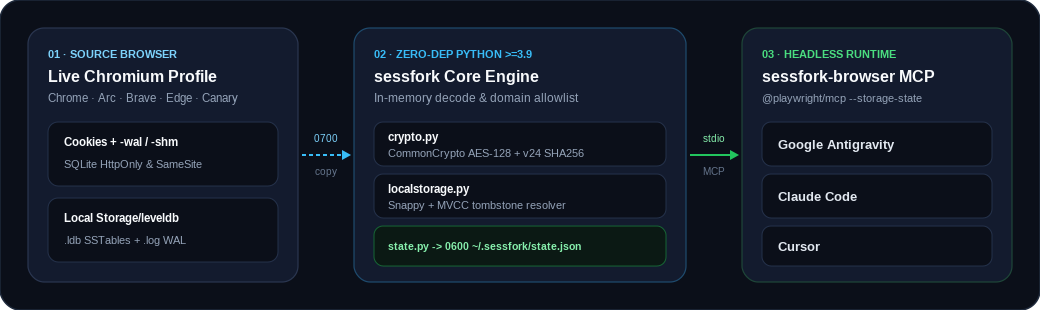
- Zero Runtime Dependencies: Pure Python standard library (
>=3.9). Uses macOSCommonCrypto(/usr/lib/libSystem.B.dylibviactypes) for AES-128-CBC cookie decryption (andopensslCLI on Linux) plus a built-in pure-Python LevelDB SSTable/WAL + Snappy reader. - Full Dual-Layer Auth (
Cookies+LocalStorage):- SQLite Cookies: Handles Chromium Cookie DB
meta.version >= 24(SHA-256(host_key)32-byte plaintext prefix stripping), live-wal/-shmsidecars, andSameSite/HttpOnlyfidelity. - LevelDB LocalStorage (
origins): Parses Chromium's_<origin>\x00encoding-prefixed (0x00UTF-16LE /0x01Latin-1) records across.ldbSSTables and.logWALs, honoringkTypeDeletiontombstones (localStorage.removeItem) so logged-out JWTs are never resurrected.
- SQLite Cookies: Handles Chromium Cookie DB
- One-Command Auto-Wiring:
sessfork <domain>andsessfork --setupauto-detect Antigravity, Claude Code, and Cursor (--target auto), resolve absolutenpxpaths (avoiding macOS GUI$PATHlaunch failures), and installSKILL.md.
Cheat Sheet
| Goal | Command |
|---|---|
| One-time setup (MCP + Skill for all detected agents) | sessfork --setup |
| Fork Cookies + LocalStorage for domains | sessfork github.com linear.app |
| Fork LocalStorage JWT only (zero Keychain prompt) | sessfork app.spa.io --no-cookies |
| Fork SQLite Cookies only | sessfork github.com --no-local-storage |
Choose source browser (chrome, arc, brave, edge, canary) |
sessfork x.com --browser arc |
| Target specific profile folder | sessfork github.com --profile "Profile 1" |
| Wire Antigravity + Claude Code + Cursor explicitly | sessfork --setup --target all |
| Inspect cached domains & origins (redacted, safe) | sessfork --status |
Re-fork all domains currently saved in state.json |
sessfork --refresh |
| Opt-in: cache the derived key to skip future Keychain prompts (see FAQ) | sessfork github.com --cache-key |
| Force re-read the key from Keychain (e.g. after Chrome rotated it) | sessfork github.com --refresh-key |
| Delete any cached derived keys | sessfork --purge-keys |
| Remove cached state for specific domain (or all) | sessfork --clear linear.app / sessfork --clear |
FAQ
How is sessfork different from dedicated AI browsers (such as ego-lite)?Dedicated AI browsers (like ego-lite) ship a separate Chromium desktop app with built-in workspaces and import your Chrome profile so agents can act visually alongside you. sessfork takes a deliberately lighter, least-privilege approach:
- Keep your existing browser: No second desktop browser to install, maintain, or migrate to — keep using your native Chrome, Arc, Brave, or Edge as usual.
- Domain-scoped isolation (least privilege): Instead of handing an AI browser your entire profile (banking, primary email, corporate SSO, extensions, and all open tabs),
sessforkforks only the exact domains you allowlist (e.g.sessfork github.com linear.app) into a one-way0600snapshot. - Standard Playwright ecosystem: Outputs standard Playwright
storageStateJSON, so it plugs straight into official@playwright/mcpas well as your own Playwright scripts and headless automation pipelines.
Choose a dedicated AI browser if you want a visual cursor watching the agent click or routinely deal with heavy headed anti-bot flows; choose sessfork if you want a zero-dependency CLI that keeps your main browser untouched and exposes only selected domains to a silent headless agent.
Chromium encrypts cookie values using a master passphrase stored under "Chrome Safe Storage" in your macOS Keychain. Click Allow so macOS authorizes security to read that entry. If a site uses localStorage tokens (many modern SPAs), pass --no-cookies to bypass Keychain completely.
By default sessfork does not store the derived decryption key anywhere, so macOS stays in charge of every authorization. If you prefer convenience, --cache-key saves the derived key to ~/.sessfork/keys.json (0600). Trade-off: any process running under your user account could then read that file and decrypt your Chrome cookies without a Keychain prompt. Run sessfork --purge-keys to remove it at any time.
- macOS: fully supported and tested on real Chrome profiles.
- Linux: experimental — covered by unit tests, but not yet verified against many real-world Chrome/Secret Service setups. Bug reports welcome.
- Windows: not supported (Chromium on Windows uses DPAPI / app-bound encryption).
Chromium batches localStorage flushes from memory to LevelDB on disk roughly every 5 seconds. Wait ~5 seconds after signing in and re-run sessfork <domain>.
Run sessfork --clear <domain> to purge a single site, or sessfork --clear (or rm -rf ~/.sessfork) to wipe all cached session state.
No — only reload MCP once right after initial installation. Whenever you run sessfork <domain> or sessfork --refresh, sessfork updates an atomic 0600 mirror at ~/.sessfork/playwright-output/.sessfork-state.json inside Playwright MCP's --output-dir sandbox, and your AI agent hot-reloads it straight into the running sessfork-browser via browser_set_storage_state with zero restarts.
sessfork-browser fail on macOS with Target page, context or browser has been closed / Mach rendezvous failed?
@playwright/mcp defaults to system /Applications/Google Chrome.app in --headless mode. On macOS, system Chrome can crash mid-hydration with Mach rendezvous failed when --isolated --storage-state=<state.json> contains many LocalStorage origins, causing every MCP call to fail with Target page, context or browser has been closed.
sessfork automatically detects Playwright's chrome-headless-shell binary (highest chromium_headless_shell-<rev> for your CPU architecture) and pins --executable-path=<chrome-headless-shell> in your MCP config on macOS. If it is not installed yet (or your config was created by an older version), install it and re-wire MCP once, then reload sessfork-browser:
npx -y playwright-core install chromium-headless-shell
sessfork --setup
Check sessfork --status to confirm the detected binary and pinned config status. To opt out and use system Chrome (or pin a custom executable on any OS), set SESSFORK_BROWSER_EXECUTABLE_PATH=system (or none, or an executable path) before running sessfork --setup.
Security & Responsible Use
- Domain Allowlist by Default: Only the domains/origins you explicitly name are extracted.
- Strict File Permissions:
~/.sessfork/is0700and~/.sessfork/state.jsonis atomically created with0600permissions before a single byte is written. - Redacted Diagnostics:
sessfork --status,--json, andSKILL.mdnever print raw cookie or LocalStorage values to stdout or agent prompt context. - No Key Persistence by Default: The derived cookie key lives only in memory for the duration of one command. Persisting it (
--cache-key) is an explicit opt-in. - Isolated Headless Browser:
sessfork-browserruns@playwright/mcp --headless --isolated, so each MCP session starts from the forkedstate.jsoninstead of a persistent profile. Page snapshots and screenshots go to~/.sessfork/playwright-output/(--output-dir), never into a.playwright-mcp/folder inside your projects. - Responsible Use:
sessforkoperates strictly within your signed-in OS user account and relies on native OS keyring authorization (macOS Keychain / Linux Secret Service) — it never bypasses OS access controls or sandboxes. Use it only on devices and accounts you own or are explicitly authorized to test, and always comply with target websites' Terms of Service. - Reporting Vulnerabilities: See SECURITY.md.
Development & Tests
PYTHONPATH=src python3 -m unittest discover -s tests -v
License
Reviews (0)
Sign in to leave a review.
Leave a reviewNo results found