spring-ai-loom-agent
Health Pass
- License — License: Apache-2.0
- Description — Repository has a description
- Active repo — Last push 0 days ago
- Community trust — 274 GitHub stars
Code Fail
- rm -rf — Recursive force deletion command in spring-ai-loom-agent-test/src/main/resources/application.yml
Permissions Pass
- Permissions — No dangerous permissions requested
No AI report is available for this listing yet.
A Spring Boot auto-configuration library that injects RAG knowledge base, MCP tool calling, and Skill library into Spring AI applications with an out-of-the-box chat UI.
Spring AI LoomAgent
Spring Boot AI Agent — an out-of-the-box solution that makes your app converse, remember, think, and act.









Features
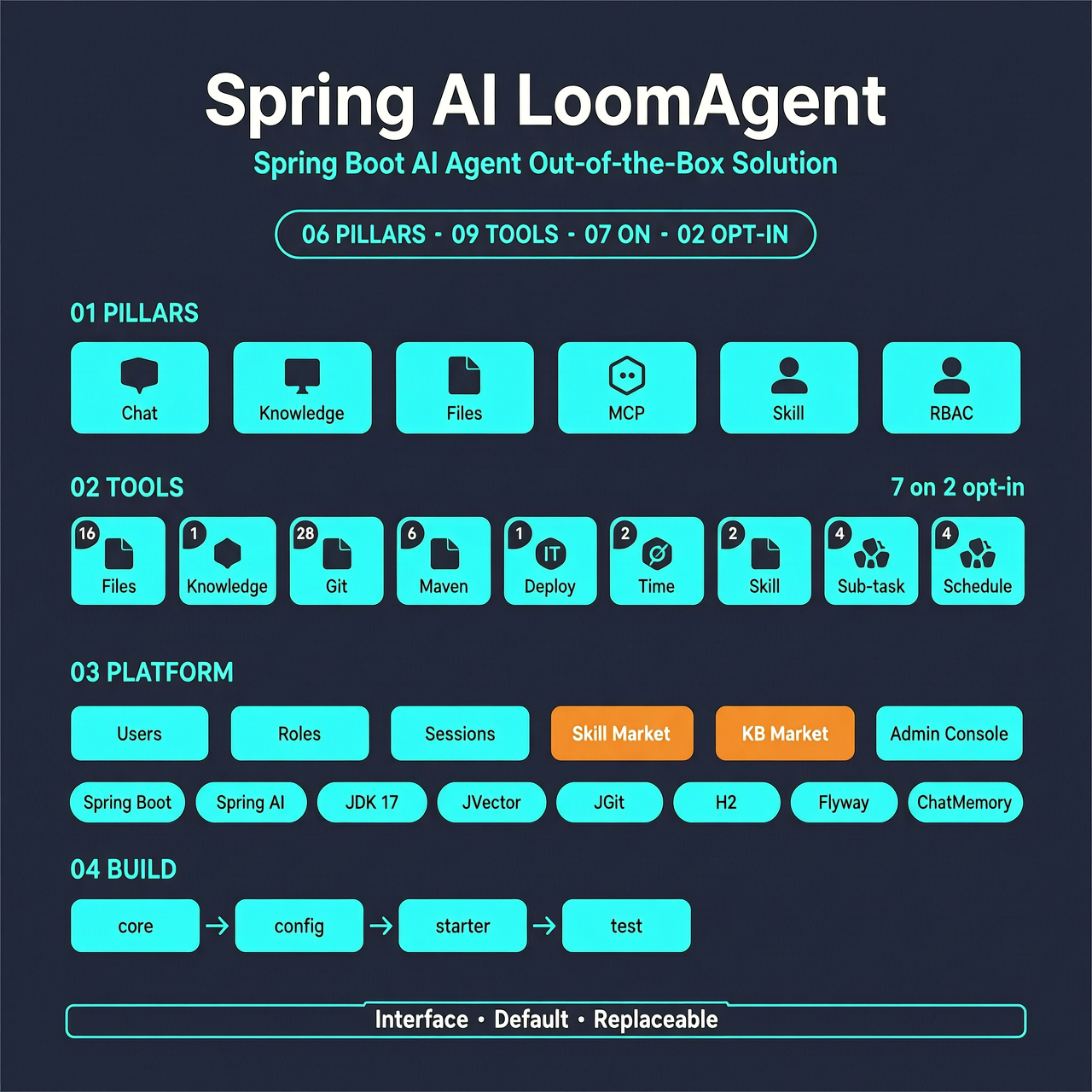
6 Pillars: 💬 Chat · Knowledge · 📁 Files · 🔧 MCP · 🧠 Skill · 🛡 RBAC
Platform: 🧠 Skill Market · Knowledge Market · 🎛 Admin Console
Advanced: 🧩 Sub-tasks · ⏰ Scheduled tasks · 🖼 Multimodal — one dependency, batteries included.
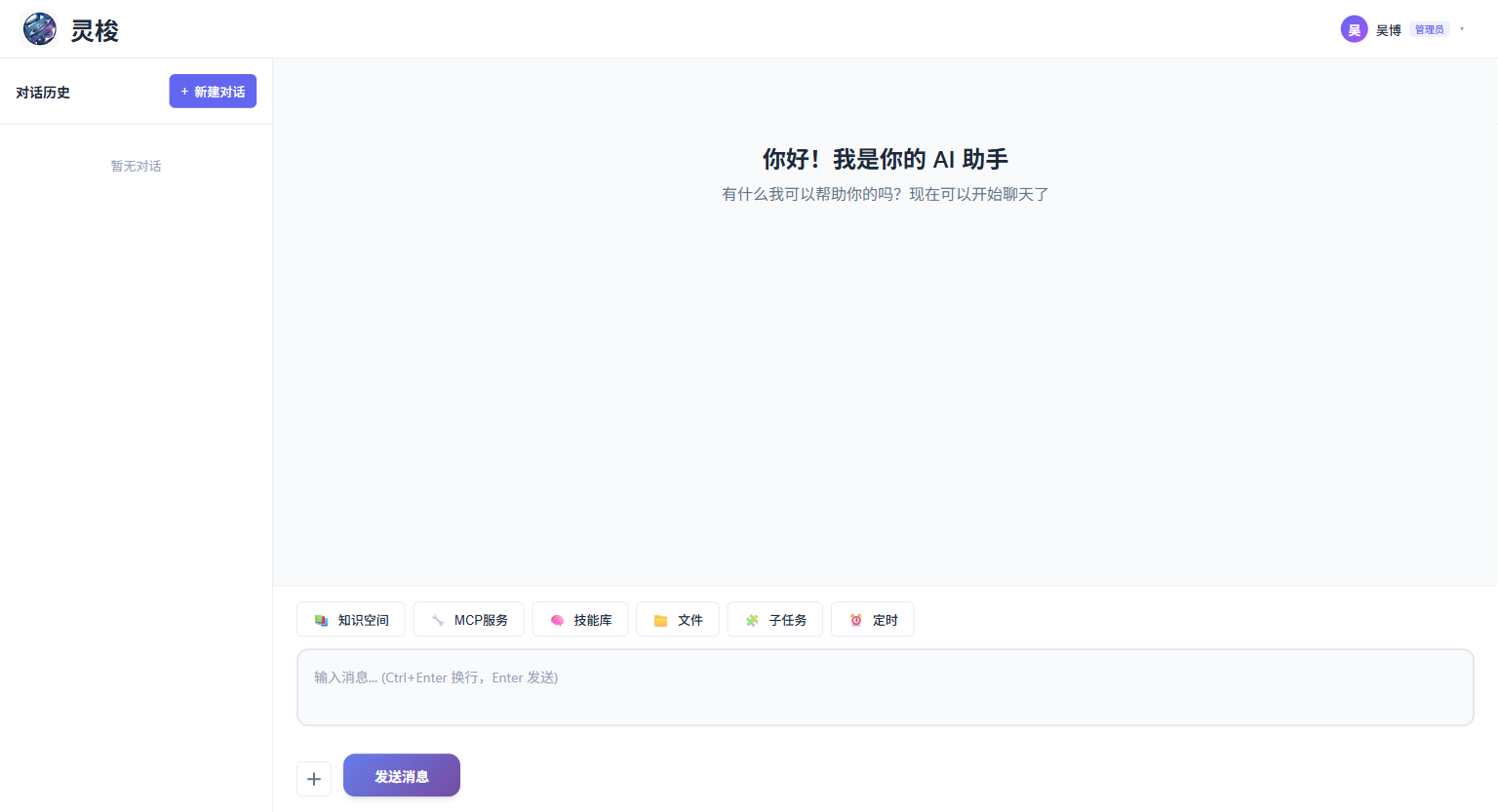
- 💬 Streaming Chat — SSE multi-turn, collapsible reasoning, message copy/download; multimodal image + document mixed input
- 📚 RAG Knowledge Base — Multi-KB management, Tika parsing + vectorization, built-in JVector local store (swap in any Spring AI vector store)
- 🔧 MCP Tool Integration — Sync/async dual mode; available tools gated by role authorization, enabled per chat
- 🧠 Skill Market — DB-stored prompt templates, 3 sources (self-built / market-pulled / role-granted); no approval flow (submit goes direct APPROVED); pull rejects overwriting same-name USER_CREATED; remove blocked when
market_skill_idis set; admin only edits / pulls (no creation); no version field. Skills call MCP via@tool_name. Frontend chat input supports/picker for precise skill selection. - 🧩 Sub-tasks & ⏰ Scheduled Tasks — Delegate a slice of work to a synchronous "sub-model"; LLM-created schedules run as sub-tasks and survive restarts
- 🛡 RBAC — Two levels: user type (admin / user) + business roles; admin sees all, normal users get the union of their roles' grants
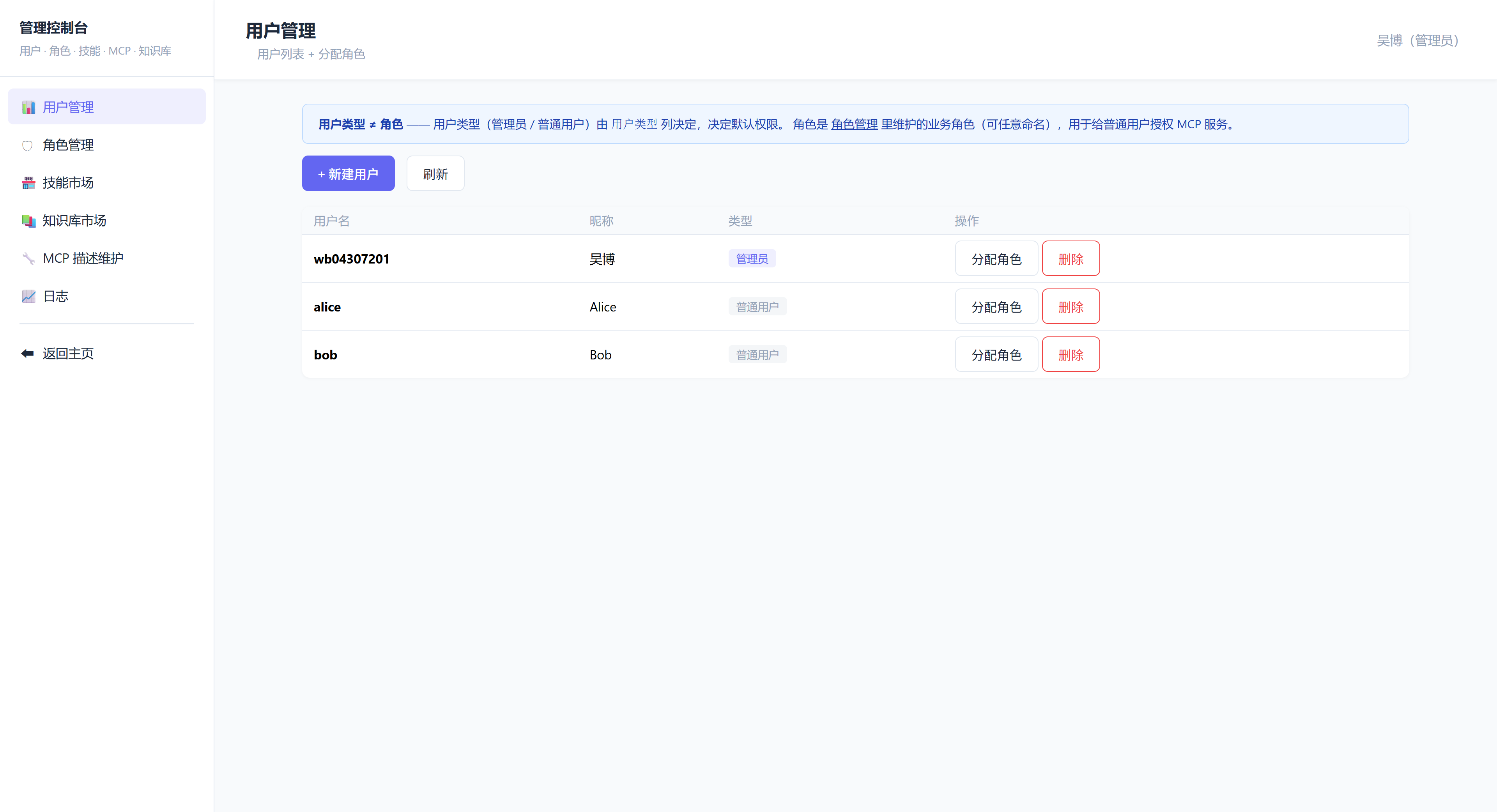
- 🎛 Admin Console — Sidebar SPA: users / roles / skill market / knowledge market / MCP descriptions / logs (formerly usage stats); admin-gated
- 📁 File Management — Disk storage + H2 metadata, upload / preview / download, chat-attachment bridging
- 🧰 Built-in Tools — Time / file / skill / sub-task / schedule / end-to-end deploy (on by default), git / maven (opt-in); see TOOLS.md
- ⚙️ Batteries-included Engineering — Spring Boot auto-config, every bean replaceable via
@ConditionalOnMissingBean, Flyway migrations, broad chat / embedding / vector-store support
Built-in Tools
All tools follow the interface + default implementation pattern. Every component is registered with @ConditionalOnMissingBean, allowing consumers to replace any piece with a custom implementation.
| Tool | Interface | Methods | Default | Config Property |
|---|---|---|---|---|
| Time | ITimeTool |
2 | ✅ enabled | time.enabled |
| File | IFileTool |
16 | ✅ enabled | file.enabled |
| Skill | ISkillTool |
3 | ✅ enabled | skill.enabled |
| Knowledge | IKnowledgeTool |
1 | ✅ enabled | knowledge.enabled |
| Sub-task | ISubTaskTool |
4 | ✅ enabled | subtask.enabled |
| Schedule | IScheduleTool |
4 | ✅ enabled | schedule.enabled |
| Git | IGitTool |
28 | ❌ disabled | git.enabled |
| Maven | IMavenTool |
6 | ❌ disabled | maven.enabled |
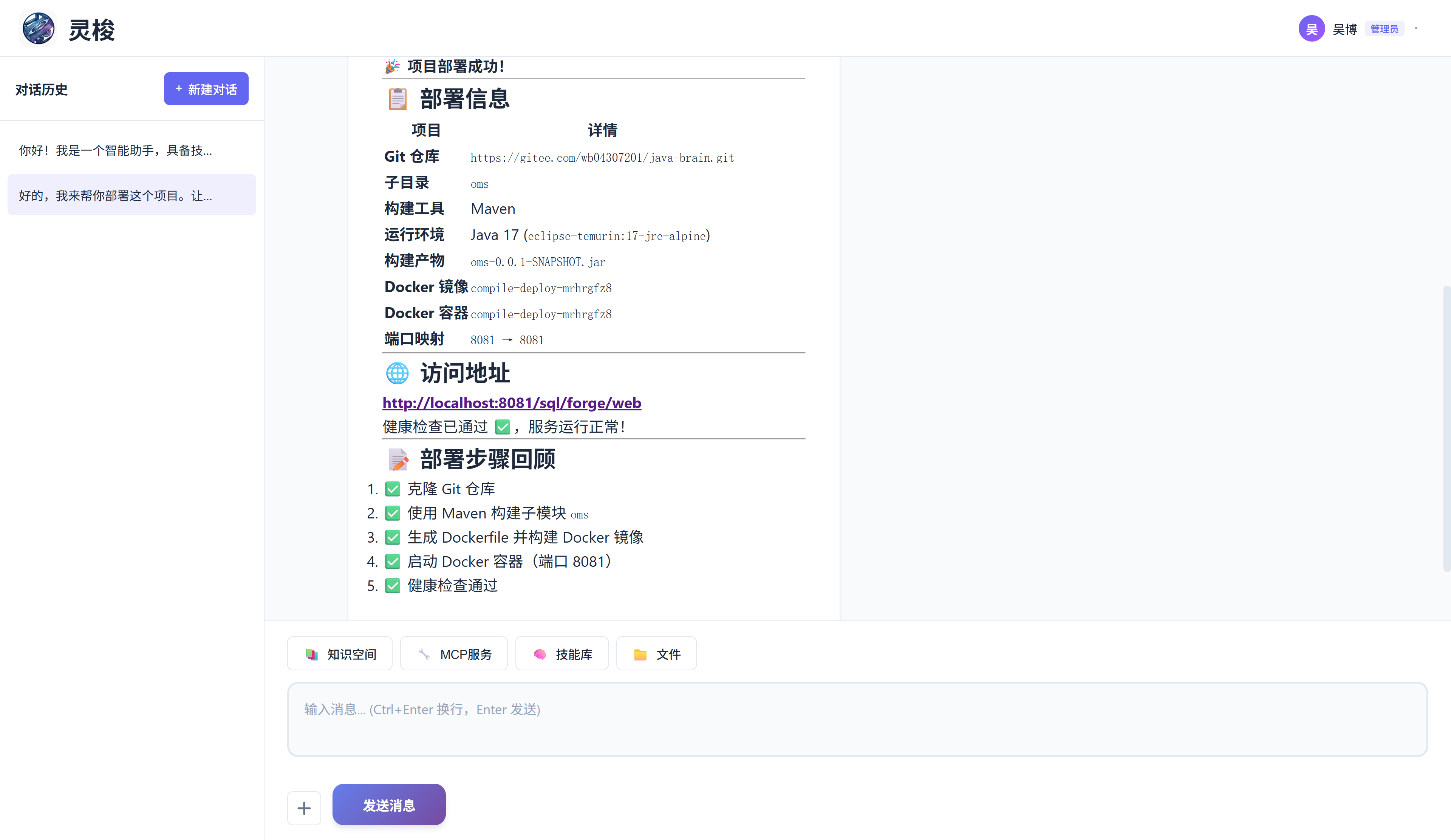
| Compile & Deploy | ICompileAndDeployTool |
1 | ✅ enabled | compile.enabled |
For full @Tool method signatures, parameter details, and configuration reference, see TOOLS.md.
Compile & Deploy Tool
Admin Console
Standalone MCP Servers
File, Git, Maven, and Compile each have a standalone MCP server module — the core layer has no Spring dependency and can be deployed via jbang to any MCP-compatible agent (Claude Desktop, Cursor, etc.):
| MCP Server | Description | README |
|---|---|---|
loom-file-mcp |
File system operations — read, write, edit, search, directory browsing, delete (14 tools) | EN · 中文 |
loom-git-mcp |
Git operations via JGit — clone, commit, push, merge, rebase, and more (14 tools) | EN · 中文 |
loom-maven-mcp |
Maven build operations — execute, build, package, test, dependency tree, validate (6 tools) | EN · 中文 |
loom-compile-mcp |
End-to-end deploy pipeline — git clone → build → docker build → docker run → health check (1 tool) | EN · 中文 |
Quick Start: Add a Chat Interface
1. Add LoomAgent Dependency
<dependency>
 <groupId>io.github.wb04307201</groupId>
 <artifactId>spring-ai-loom-agent-spring-boot-starter</artifactId>
 <version>1.1.39</version>
</dependency>
2. Add a Spring AI Model Dependency
The test application uses Alibaba's Qwen (DashScope) via Spring AI Alibaba. Swap the dependency and config for any other provider:
<dependency>
 <groupId>com.alibaba.cloud.ai</groupId>
 <artifactId>spring-ai-alibaba-starter-dashscope</artifactId>
 <version>1.1.2.3</version>
</dependency>
spring:
 ai:
 dashscope:
 api-key: ${DASHSCOPE_API_KEY}
 chat:
 options:
 model: qwen3.7-plus
 multi_model: true
 enable_thinking: true
Note: For document-based Q&A, ensure the model supports multimodal input (e.g.,
multi_model: true). Document content is injected via System Prompt.
3. Start the Project
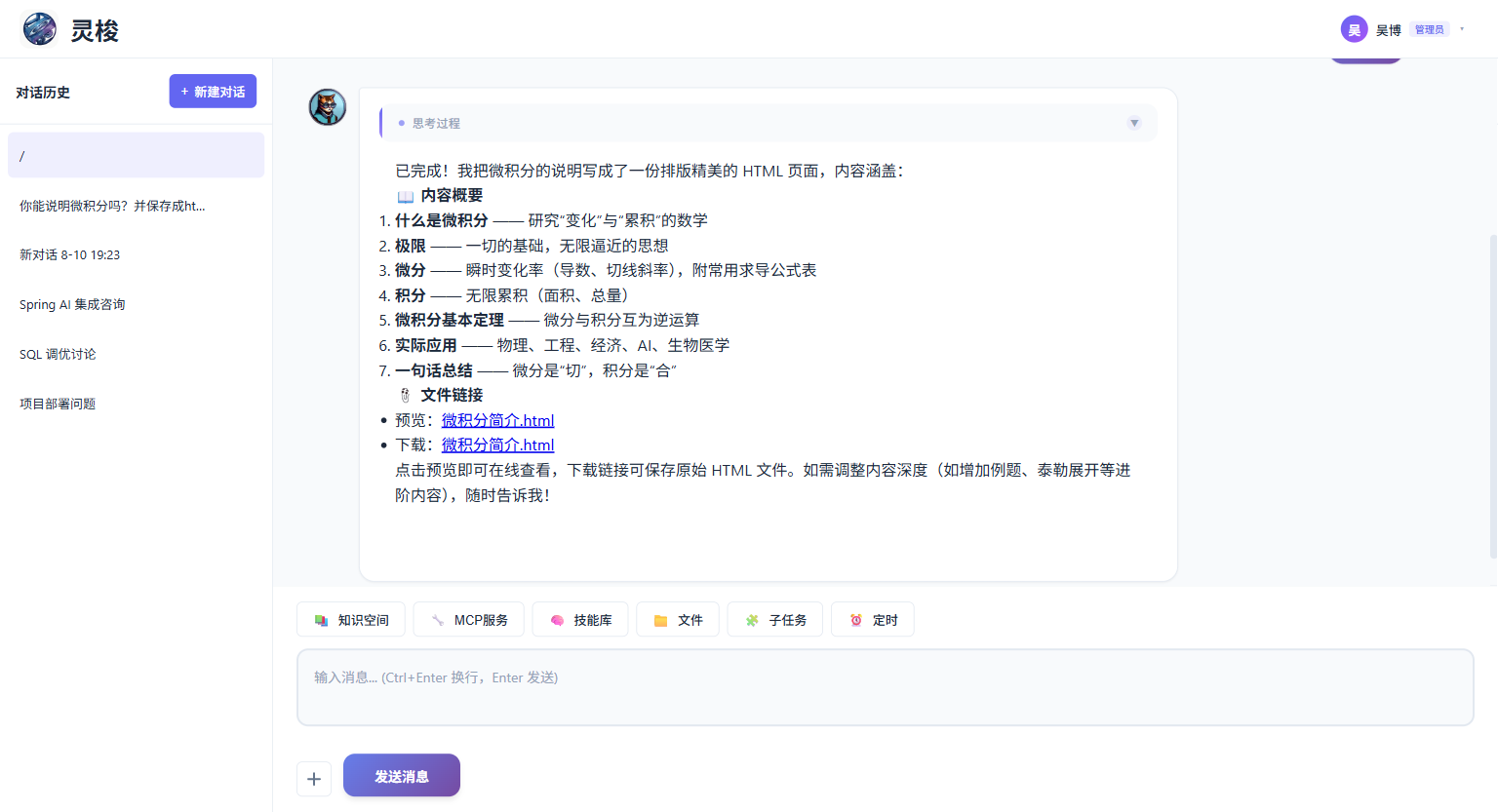
Visit http://localhost:8080/spring/ai/loom
Document Upload & Conversation
Click the + button next to the input field to upload images or documents. After uploading, type your question and send it.
Supported Document Formats
PDF, DOCX, XLSX, PPTX, MD, TXT, HTML, CSV, RTF, and more.
How It Works
- Images: Passed as Media type directly to the multimodal model (requires model support, e.g., DashScope Qwen series)
- Documents: Text content extracted via Apache Tika, injected as System Prompt into the conversation context
- Mixed scenarios: Images and documents can be uploaded together; the model synthesizes visual information and document text
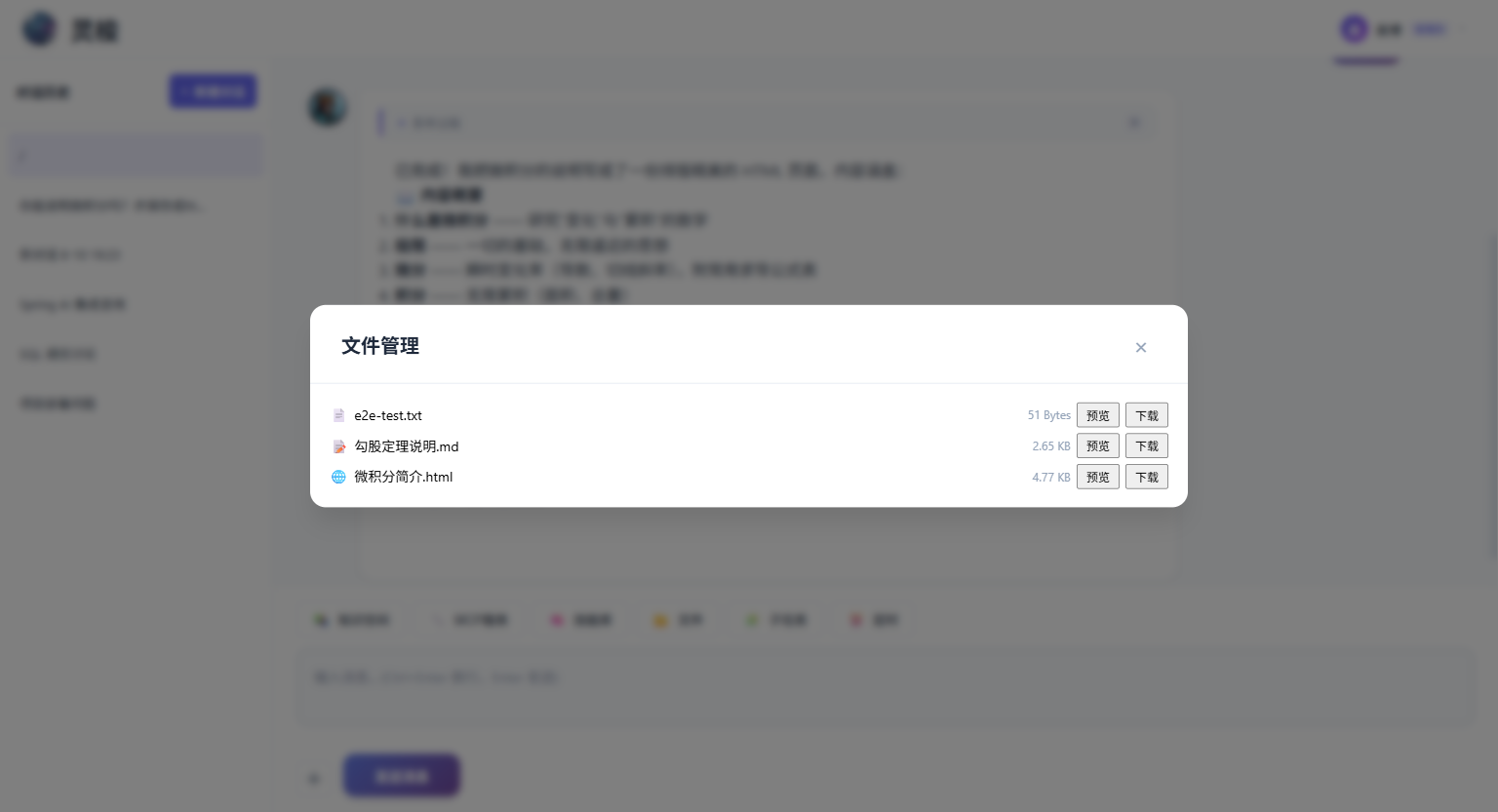
File Download, Preview, and Deletion
Uploaded and generated files can get download links via MCP tool downloadFileUrl, or preview links via MCP tool viewFileUrl. Files and directories can be removed via MCP tool deleteFileOrDirectory (requires explicit I_CONFIRM_DELETE confirmation — token configurable via spring.ai.loom.agent.file.deleteConfirmToken, supports recursive directory removal, and cleans up temporary file_info records).
The "File" entry provides unified browsing, previewing, downloading, and deleting for all non-knowledge-base files (including tool uploads and git repositories).
Replace the Default RAG Implementation
The following example uses Qdrant as the vector store. Add the dependency:
<dependency>
 <groupId>org.springframework.ai</groupId>
 <artifactId>spring-ai-starter-vector-store-qdrant</artifactId>
</dependency>
Add configuration:
spring:
 ai:
 vectorstore:
 qdrant:
 host: localhost
 port: 6334
 collection-name: qwen-collection-name
Optional RAG configuration:
spring:
 ai:
 loom:
 agent:
 rag:
 similarityThreshold: 0.50 # Similarity threshold, default 0.0
 top-k: 4 # Top-k results, default 4
MCP Services
Taking the time MCP service as an example, add the dependency:
<dependency>
 <groupId>org.springframework.ai</groupId>
 <artifactId>spring-ai-starter-mcp-client</artifactId>
</dependency>
Add configuration:
spring:
 ai:
 mcp:
 client:
 stdio:
 servers-configuration: classpath:mcp-servers.json
mcp-servers.json:
{
 "mcpServers": {
 "time": {
 "command": "uvx",
 "args": [
 "mcp-server-time",
 "--local-timezone=Asia/Shanghai"
 ]
 }
 }
}
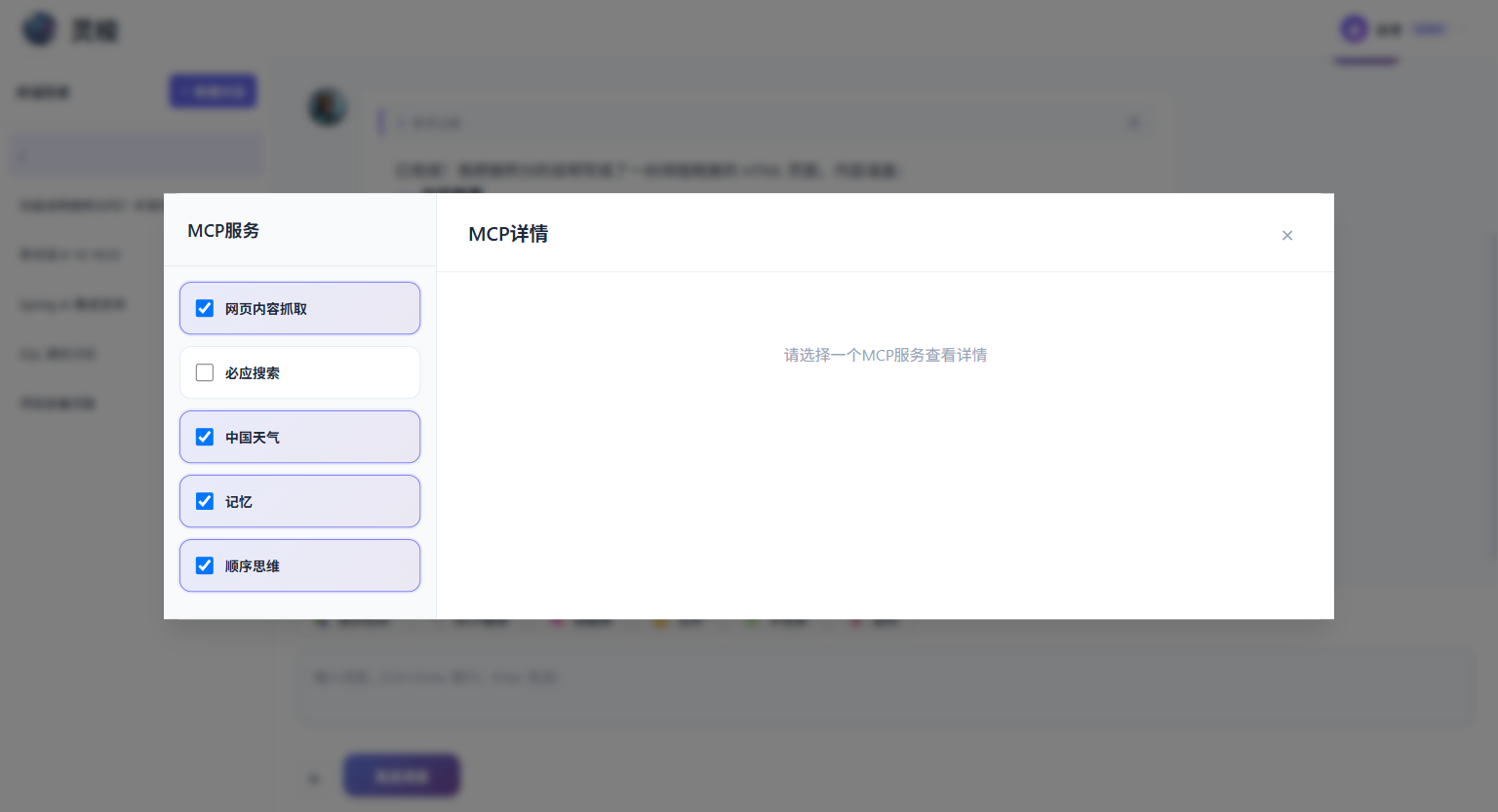
The MCP button opens a panel showing available services:
Add Chinese labels and descriptions for tools via configuration:
spring:
 ai:
 loom:
 agent:
 mcps:
 - name: spring-ai-mcp-client - time
 title: Time
 description:
 A Model Context Protocol service that provides time and timezone conversion functionality. This service enables
 large language models to obtain current time information and perform timezone conversions using IANA timezone names,
 with automatic system timezone detection.
 tools:
 - name: get_current_time
 description: Get the current time in a specified timezone
 - name: convert_time
 description: Convert time between different time zones
Skill Market
Skills are prompt templates that the LLM uses for recurring workflows. The data is fully managed in the database (no more yml skills[] block) and lives in three tables:
| Table | Purpose |
|---|---|
market_skill |
Public Skill Market — every entry has only (author, name) unique constraint ( removed version); admin edits / pulls (cannot create) — |
user_skill |
A user's local copy of a skill (source = USER_CREATED / MARKET_PULLED / ROLE_GRANTED); remove blocked when market_skill_id is set; pull rejects overwriting same-name USER_CREATED |
role_skill |
Role → market_skill authorization (which skills a role unlocks for its users); setRoleKnowledges auto-syncs user_knowledge for all assigned users |
6 seeded system skills
On first launch, the init migration seeds 6 system skills (stored directly in each user's user_skill with source=USER_CREATED, default_loaded=true) so every fresh install already has useful ones — including Monthly Event Report, HTTP Test, Deploy Project, Auto E2E, etc. Admins can edit / delete any of them at any time from the Skill Market admin page (no creation from admin).
Skill lifecycle for a normal user
- Create — In the chat UI's Skill Library → 我的 tab → + 新增, or
PUT /spring/ai/loom/skill. The skill is stored inuser_skillwithsource=USER_CREATED. Fully editable (name / desc / content / default-loaded). - Submit to market — Library → 共享 tab. Click your skill, the form shows market metadata (无版本号)。 Submitted with
status=APPROVEDdirectly (no approval flow). Same(author, name)re-submits UPSERT (overwrites content + status). - Pull from market — Library → 市场 tab. Click item → right panel shows full details + 「添加到我的知识库」 button. Creates / refreshes a
user_skillrow withsource=MARKET_PULLED. Re-pull of same name UPSERTs (no error).
- ****: If you already have a same-name
USER_CREATEDskill, pull is rejected (403) — use 「复制为我的技能」 first to copy as a newUSER_CREATED.
- Receive via role authorization — If admin granted a role → market_skill, the skill is auto-injected into your
user_skillon every login withsource=ROLE_GRANTED, locked=true.setRoleKnowledgesauto-syncs new role grants. You cannot edit or delete it (it's pinned by the role).
What admins can do that normal users cannot
- Edit / 下架 (delete) any
market_skill(admin no longer creates new skills — author is the one who publishes from chat UI) - Authorize any APPROVED market skill to any role via
role_skill(auto-syncs to all assigned users) - 下架 cascades to all
user_skill(pullers) androle_skill(role grants) — no orphans
Permission matrix
| Operation | USER_CREATED | MARKET_PULLED | ROLE_GRANTED |
|---|---|---|---|
Edit name |
✗ (PK) | ✗ | ✗ |
Edit description |
✅ | ✅ | ✗ |
Edit content |
✅ | ✗ (re-pull) | ✗ |
Edit default_loaded |
✅ | ✅ | ✗ |
| Delete | ✅ | ✅ | ✗ |
| Submit to market | ✅ (new ver.) | ✗ | ✗ |
Using skills in the chat UI
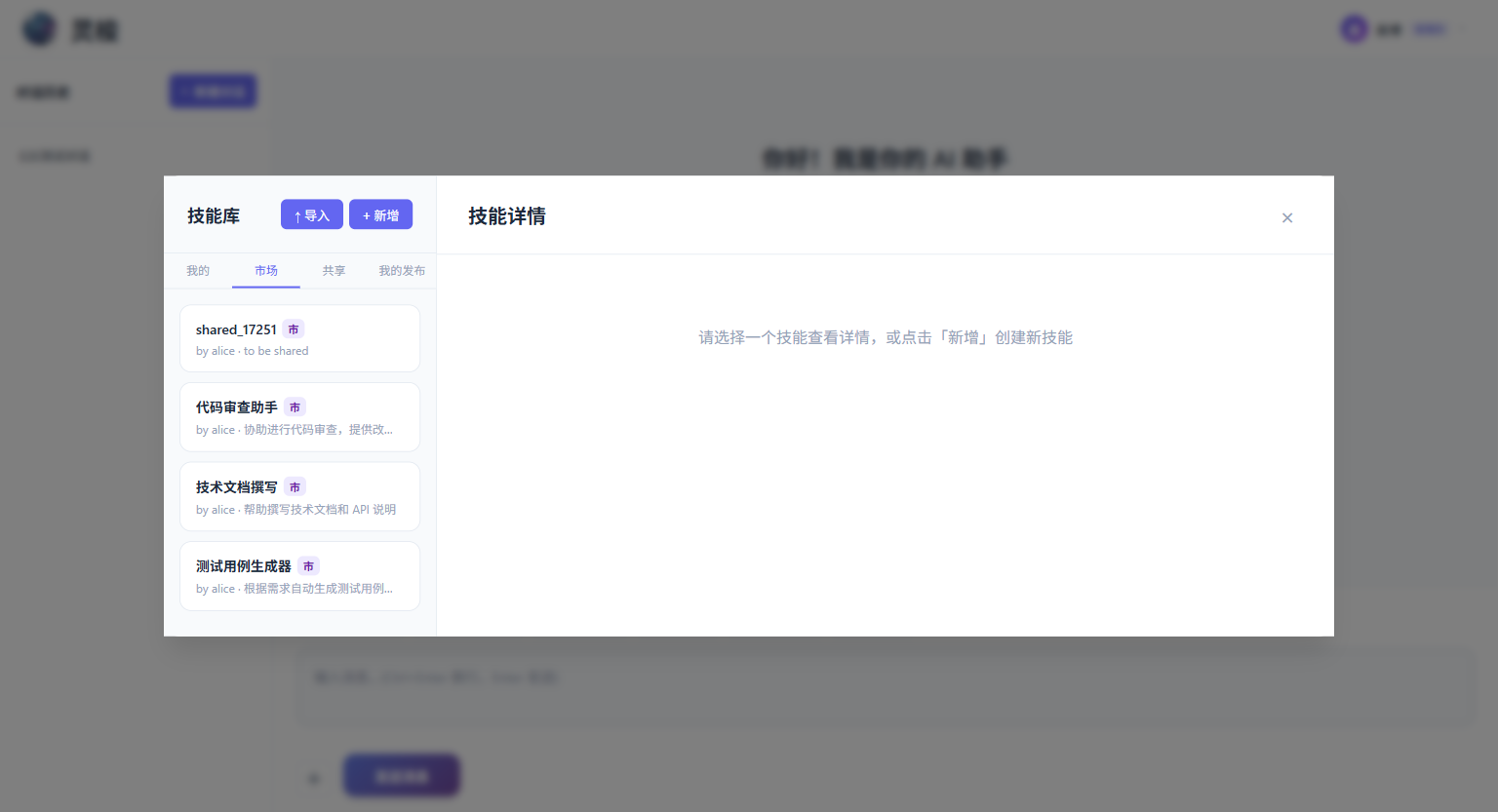
Open the Skill Library button (🧠) — four tabs:
- 我的 — your local
user_skill(plus admin's union view). Click a skill to see details, then 应用 (overwrite the textarea and auto-send to the model) or 复制 (overwrite the textarea, no send). - 市场 — browse all
APPROVEDmarket skills and 拉取 them into youruser_skill(rejects if you already have a same-nameUSER_CREATED). - 共享 — submit a
USER_CREATEDskill to the market. status is directAPPROVED, no approval. no version number. two-stage click list item → right panel form. - 我的发布 — track your market submissions (all
APPROVEDafter de-approval). Click list item → right panel with 「撤回共享(下架)」 button. Withdraw cascades to alluser_skillandrole_skill.
Inside content you can reference MCP tools by @tool_name — the available tools come from the role-based mcps authorization, not from yml.
For the full REST API, see docs/API.md → §6 Skill Management.
Knowledge Base & Knowledge Market
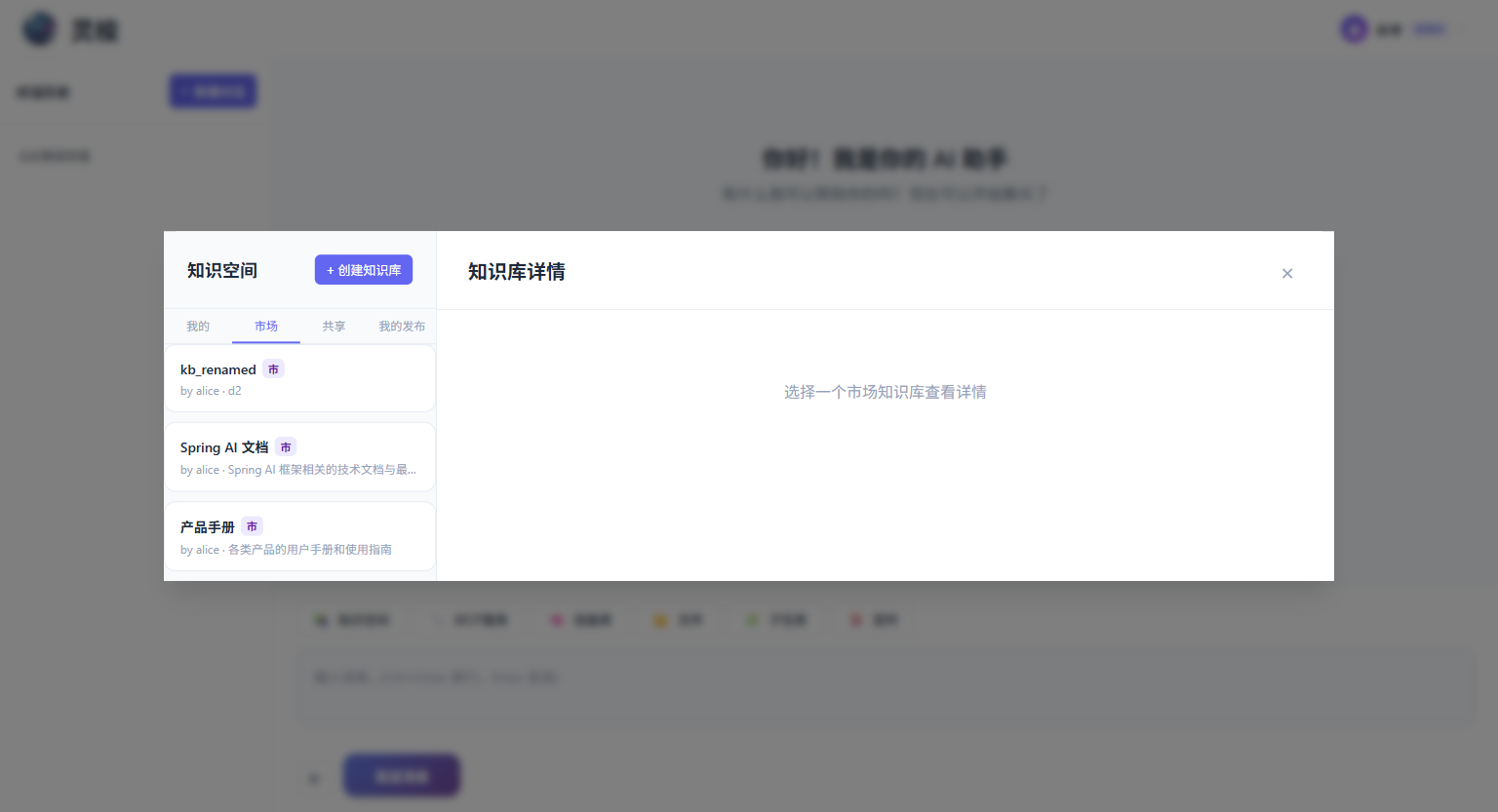
Knowledge bases store documents for RAG retrieval. The knowledge space modal has four tabs:
- 我的 — your own knowledge bases. Create, upload documents, delete.
- 市场 — browse approved market knowledge bases and 添加到我的知识库 (subscribe).
- 共享 — your own knowledge bases not yet shared. Click 共享到市场 to submit for admin approval.
- 我的发布 — track your market submissions (PENDING / APPROVED / REJECTED). Withdraw PENDING items.
Market workflow: submit → PENDING → admin approve → APPROVED → other users can subscribe. Role-based authorization can also auto-grant knowledge bases to users (similar to skills).
For the knowledge market REST API, see docs/API.md → §5.8 Knowledge Market.
Admin Console
The admin console is a sidebar-navigated single-page-app shell. After admin login, all admin pages share a fixed left sidebar:
| Section | Path | Purpose |
|---|---|---|
| 用户管理 | admin/console.html |
User list + role assignment + batch content cleanup |
| 角色管理 | admin/roles.html |
RBAC roles + grant MCP / Skill |
| Skill 市场 | admin/skills-market.html |
Approve / reject / directly CRUD Skill |
| MCP 描述维护 | admin/mcps.html |
Maintain Chinese descriptions for SDK MCP tools |
| 用量统计 | admin/stats.html |
Monthly Token usage (year + month filter) |
| 返回主页 | / |
Back to chat home page |
- 未登录跳 login: All admin HTML paths are auth-protected. Unauthenticated access 302-redirects to
/spring/ai/loom/login.html; API calls 401. - "清理聊天内容" 唯一入口: Only
控制台 → 批量清理button. The duplicate "清理内容" / "一键清理" buttons in user row / conversation row were consolidated. - Role gating: All admin paths require
user_info.type = 'ADMIN'. Non-admin attempting admin URL is redirected back to chat home.
- For built-in tool reference (time / skill / file / git / maven / compile), see: TOOLS.md
- For standalone MCP server usage (file / git / maven / compile), see the Built-in Tools → Standalone MCP Servers section above
- For more configuration and extension points, see: Spring AI LoomAgent Customization Guide
- For custom UI integration and API reference, see: Spring AI LoomAgent API Documentation
Reviews (0)
Sign in to leave a review.
Leave a reviewNo results found