OpenGeno
Health Uyari
- License — License: MIT
- Description — Repository has a description
- Active repo — Last push 0 days ago
- Low visibility — Only 5 GitHub stars
Code Gecti
- Code scan — Scanned 7 files during light audit, no dangerous patterns found
Permissions Gecti
- Permissions — No dangerous permissions requested
Bu listing icin henuz AI raporu yok.
GNME (pronounced Gen-Me) is a lightweight framework that replaces static, task-based specifications with living Module Genomes. It is designed specifically for developers using AI assistants (Cursor, Claude) to build complex, evolving systems.
OpenGeno
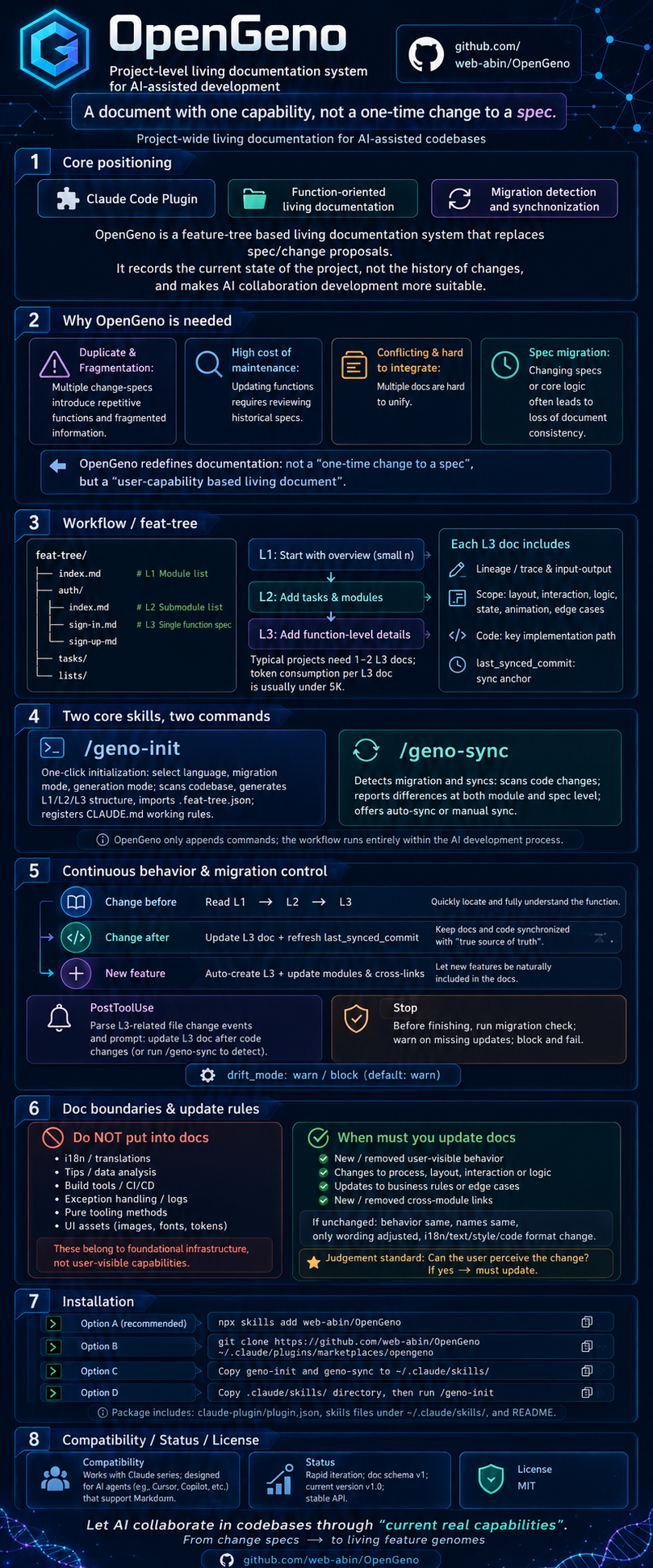
Project-wide living documentation for AI-assisted codebases.
One source of truth per feature — not per change.
Why
Spec-driven workflows like openspec
and GitHub spec-kit organize work
around changes: each requirement gets its own spec / change proposal
that gets reviewed, implemented, and archived. That works well at the
moment of change, but accumulates four problems over time:
- Duplication and conflict. Multiple change-specs that touch the
same feature each describe it from a different angle. Reading them
later is a triangulation problem. - Discovery. Before changing feature X, you have to know whether
any prior spec mentioned X, and where. - Merging and archiving. When several change-specs cover the same
feature, who consolidates them, and into what? - Drift. When code is edited outside the spec workflow (manual
edits, "vibe coding"), the change-specs go stale silently.
OpenGeno picks a different axis. Instead of one doc per change, it
maintains one doc per user-visible feature, organized as a hierarchical
tree at the project root. The tree is the current state of the project,
not its change history. Changes mutate the tree; they don't accumulate
beside it.
How it works
The project grows a feat-tree/ directory:
feat-tree/
├── index.md                # L1 — list of modules (~500 tokens)
├── auth/
│   ├── index.md            # L2 — sub-features of auth
│   ├── sign-in.md          # L3 — full spec for one feature
│   └── sign-up.md
├── tasks/
│   └── ...
└── lists/
    └── ...
Three tiers, lazy-loaded:
- L1 — always read (small).
- L2 — read when a task touches that module.
- L3 — read when a task touches that feature.
A typical task reads 1–2 L3 docs, costing well under 5k tokens.
Each L3 doc carries:
- A wireframe (for UI features) or trigger / I/O block (for logic)
- Layout, interactions, logic, state, animation, edge cases
- A
code:frontmatter list of associated source paths - A
last_synced_commitSHA — the contract that the doc and code agreed
at that commit
When code referenced by a doc changes after that SHA, the
drift checker flags the doc
for re-verification.
Two skills, two commands
OpenGeno only adds two slash commands. Everything else — read-before-change,
update-after-change, add-new-feature — happens automatically because/geno-init injects the workflow rules into your CLAUDE.md (andAGENTS.md if present), and the hooks installed by the skill enforce
them.
| Command | When |
|---|---|
/geno-init |
One-time project setup. Asks for documentation language (English / 中文), drift mode, and generation mode (stub-only by default, or one-shot full docs); scans the codebase, proposes modules, generates L1 + L2 + L3, writes .feat-tree.json, injects workflow rules into CLAUDE.md. |
/geno-sync |
On-demand drift check & reconciliation. Walks the tree, reports drift since last sync, walks you through fixing it. |
Continuous behavior (no command needed)
After /geno-init runs, your CLAUDE.md carries the workflow contract.
On every subsequent session, the AI:
- Before changing feature behavior — reads the relevant L3 doc by
walking L1 → L2 → L3. - After changing feature behavior — updates the L3 doc and bumps
last_synced_commitin the same session. - When adding a new feature — creates its L3 doc from the bundled
templates (in the chosen language), updates the L2 module index,
cross-links from any feature that reaches it.
Two Claude Code hooks back this up:
PostToolUseon Edit/Write — soft reminder when you edit a file
that's referenced by an L3 doc.Stop— runs the drift checker at session-end. Inwarnmode it
prints a summary; inblockmode it refuses to end the session while
drift exists.
Mode is per-project, set in .feat-tree.json (drift_mode: "warn" or"block"). Default warn.
Documentation language
/geno-init asks once: English or 中文. Whatever you pick, the entire
tree is generated in that language — headings, prose, placeholders,
the workflow rules injected into CLAUDE.md, and any future docs created
or edited under the workflow.
The injection in CLAUDE.md instructs the AI to keep writing in the
chosen language on subsequent sessions. So the language choice
perpetuates without you having to repeat yourself.
What does NOT belong in the tree
- i18n / translations
- Analytics / telemetry
- Build tooling, CI/CD
- Error reporting (Sentry, Crashlytics, etc.)
- Logging
- Pure utility helpers
- Theme primitives (color tokens, typography scales)
These are infrastructure, not features. They belong in CLAUDE.md / ADRs /
code comments, not in the tree.
What changes trigger a doc update?
| Type of change | Update doc? |
|---|---|
| Add / remove user-visible behavior | Required |
| Change interaction flow, layout, animation | Required |
| Change business logic branches | Required |
| Add / remove cross-module dependency | Required (both sides) |
| Bug fix where new code matches existing doc | No |
| Bug fix where behavior changed (even toward "right" answer) | Required |
| Refactor / rename — same behavior | No |
| Performance optimization — same behavior | No |
| i18n / copy / theme tweaks | No |
Rule of thumb: would a user notice? If yes → update.
Install
OpenGeno is a Claude Code plugin (.claude-plugin/plugin.json at repo root,
skills under skills/).
Option A — skills CLI (recommended)
npx skills add web-abin/OpenGeno
Option B — Plugin install
git clone https://github.com/web-abin/OpenGeno ~/.claude/plugins/marketplaces/opengeno
Claude Code auto-loads any plugin under ~/.claude/plugins/marketplaces/.
Option C — Global skills install
Copy the two skill folders into your global skills dir:
mkdir -p ~/.claude/skills
cp -r /path/to/OpenGeno/skills/geno-init ~/.claude/skills/
cp -r /path/to/OpenGeno/skills/geno-sync ~/.claude/skills/
Option D — Project-local skills install
Copy into a single project only:
cd /path/to/your-project
mkdir -p .claude/skills
cp -r /path/to/OpenGeno/skills/geno-init .claude/skills/
cp -r /path/to/OpenGeno/skills/geno-sync .claude/skills/
After any of the above, run /geno-init in Claude Code on your project.
Compatibility
OpenGeno is built for Claude Code and uses its hooks system for
drift gating. The methodology and document format work in any AI agent
(Cursor, Copilot, etc.) that can read markdown — but only Claude Code
gets the automatic drift detection. Other agents can run/geno-sync manually as a check-up.
Design documentation
If you want to understand why OpenGeno is shaped this way (rather
than just how to use it), see docs/ — design rationale,
architecture, and ADRs for each non-obvious choice.
Status
Active development. Format version schema: 1. v1.0 stable API targeted —
breaking schema changes will ship with a migration via /geno-sync.
License
MIT — see LICENSE.
Yorumlar (0)
Yorum birakmak icin giris yap.
Yorum birakSonuc bulunamadi