open-brain-template
Health Uyari
- No license — Repository has no license file
- Description — Repository has a description
- Active repo — Last push 0 days ago
- Community trust — 14 GitHub stars
Code Uyari
- process.env — Environment variable access in api/memories.js
- network request — Outbound network request in api/memories.js
Permissions Gecti
- Permissions — No dangerous permissions requested
This tool provides a visual dashboard for managing and prioritizing AI agent memory. It acts as an MCP server to help persistent memory systems load structured context across various AI applications.
Security Assessment
The overall risk is rated as Medium. The tool does not request dangerous permissions, execute shell commands, or contain hardcoded secrets. However, it does make outbound network requests and accesses environment variables. These behaviors are expected since the software relies on external services like Supabase and Vercel, but it means the tool will handle your database credentials and AI memory payloads. You should be absolutely certain to securely configure your environment variables before deploying.
Quality Assessment
The project is in active development, with its most recent push occurring today, and has garnered 14 GitHub stars, indicating a small but present user base. A major concern for enterprise or open-source adoption is the complete lack of a license file. Without a defined license, the software is technically proprietary, meaning you have no legal permission to modify, distribute, or use the code.
Verdict
Use with caution: the code itself is safe, but you must supply your own credentials and should wait for an official license to be added before adopting it fully.
Visual brain map dashboard for AI memory systems. Built on Supabase + Vercel. Works with any MCP-compatible AI tool.
Open Brain
Stop your AI from forgetting your rules.
Open Brain is a visual dashboard for managing what your AI knows, when it loads it, and how it prioritizes context. Built for people who work with AI agents every day and need persistent, structured memory that works across tools.
Works with Claude Code, Claude Desktop, ChatGPT, Cursor, or any MCP-compatible AI tool. Pairs with Mem0 for intelligent memory compression and deduplication. As of April 2026, includes an optional Memory Steward smart-query layer powered by Anthropic Managed Agents.





The Problem
AI agents start every session with amnesia. You re-explain your preferences, re-state your rules, re-describe your project. Notes apps and docs don't solve this because they're flat. The AI doesn't know what to read first, what's critical vs. reference, or when to load what.
And even when you have a memory bank wired up, raw semantic recall returns noise. Ask "what's our deploy procedure" and you get back five tangentially related memories, only one of which is actually the answer. The AI then has to read all of them and guess.
How Open Brain Solves It
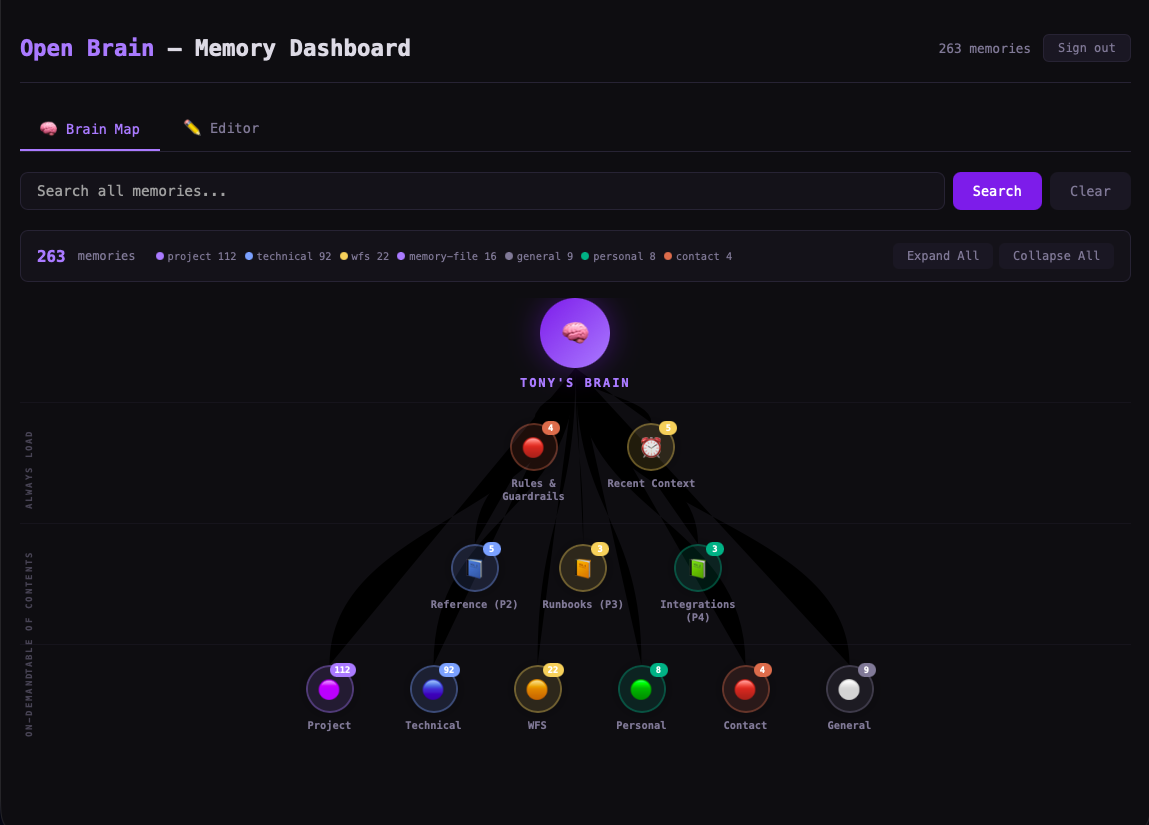
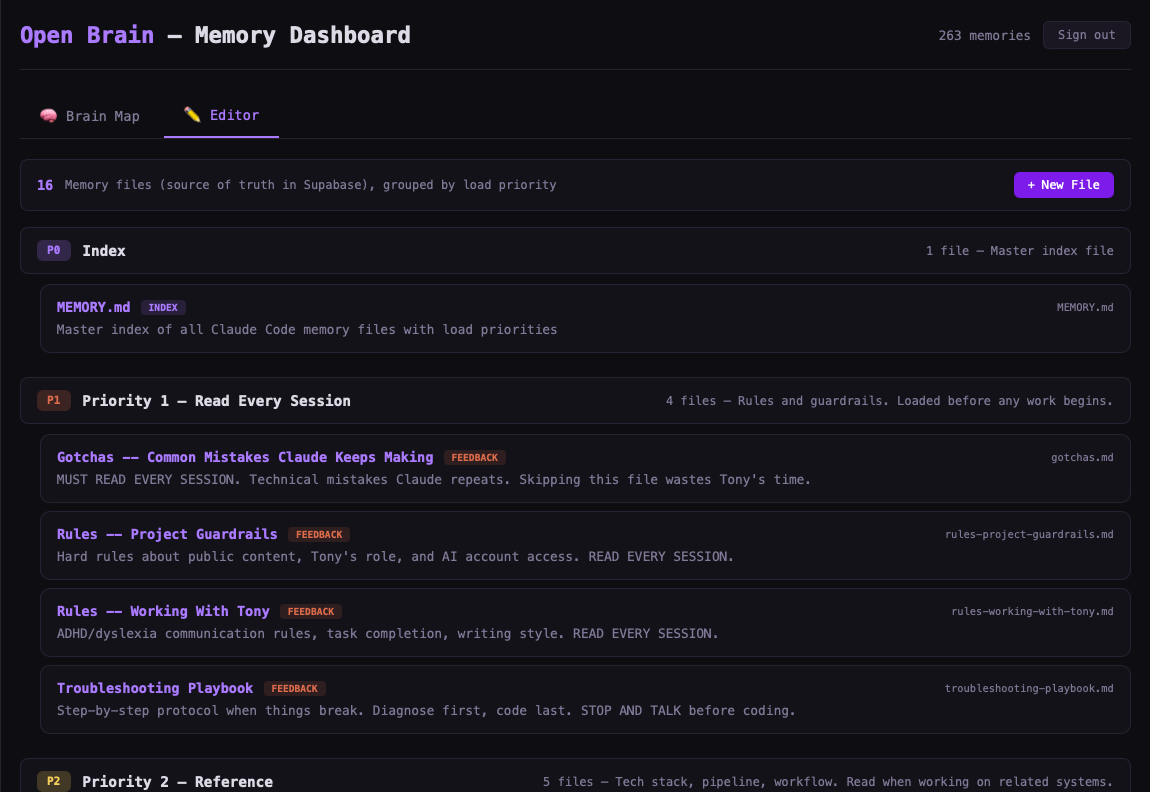
Priority-based loading. Not all memories are equal. P1 rules load every session. P2 reference loads when relevant. P3 runbooks load before touching specific systems. P4 integrations load only when needed. Your AI boots up like an operating system, not a blank slate.
Visual brain map. See your entire memory hierarchy at a glance. Click any node to expand, edit, or delete. Know exactly what your AI knows.
Semantic search. Find any memory by meaning, not keywords. Powered by pgvector embeddings.
Works across tools. One memory bank, any AI tool. Claude Code at work, ChatGPT on your phone, Cursor in your IDE — they all read from the same brain.
(New, April 2026) Smart query layer via Memory Steward. A dedicated Anthropic Managed Agent sits in front of your raw memory and does the work raw recall doesn't: reformulates queries for better embedding matches, runs multiple parallel searches, re-ranks results by actual usefulness (not raw similarity), filters out duplicates and stale entries, and synthesizes one good answer with cited memory IDs. Slower than raw recall (10-40s) but dramatically more relevant.
(New) Auto-load at session start. A single SessionStart hook script reads your N most recent memories at the beginning of every Claude Code session and injects them as context, so the AI literally starts the conversation already knowing what happened yesterday.
Screenshots
Brain Map — Visual Memory Hierarchy
Editor — Priority-Based Memory Files
Who This Is For
- AI power users who work with Claude/GPT daily and are tired of re-explaining context
- Developers building with AI agents who need persistent project memory
- Teams that want shared AI context (rules, preferences, guardrails) across members
- Anyone who's said "I already told you this last session"
Why Not Just Use Notes?
| Notes/Docs | Open Brain | |
|---|---|---|
| Priority loading | No | P1-P4 system |
| Semantic search | No | pgvector embeddings |
| Smart query (re-rank, dedup) | No | Memory Steward Managed Agent |
| Agent-readable | Copy-paste | MCP protocol (native) |
| Session boot sequence | Manual | Automatic checklist |
| Auto-load on session start | No | SessionStart hook |
| Mid-session refresh | Start over | /refresh command |
| Multi-tool | Per-app | One brain, any tool |
Key Concepts
Priority-Based Load Order
P1 (Always Load)    -- Rules, guardrails, gotchas. Every session, no exceptions.
P2 (Reference)      -- Tech stack, pipeline, workflow. When working on related systems.
P3 (Runbooks)        -- How-to guides, specs, roadmap. Before touching these systems.
P4 (Integrations)   -- Third-party setup docs. Only when relevant.
Session Start Checklist
Your AI agent follows this boot sequence every session:
- Load P1 rules (non-negotiable)
- Load recent context (last session checkpoint)
- Read table of contents (know what exists, don't load everything)
- Ask what you're working on
- Load specific memories on-demand as topics come up
The /refresh Pattern
Long AI sessions cause context drift — the agent "forgets" rules loaded at the start. The /refresh command forces re-reading of P1 rules mid-session without starting over.
Mem0 Integration (Recommended)
Mem0 adds an intelligent layer on top of Open Brain:
- Automatic deduplication — won't store the same fact twice
- Memory compression — extracts clean facts from messy conversations
- Better relevance ranking — 0.9 similarity scores vs. 0.5 with raw pgvector
- Supabase stays your source of truth. Mem0 makes search smarter.
Memory Steward Smart Query (New, April 2026)
Raw semantic recall is fast but returns noise. Memory Steward is a dedicated Anthropic Managed Agent that wraps the raw recall in intelligence:
- Query reformulation — your "deploy command" becomes "deploy procedure for production frontend including the dangerous CLI to never use"
- Parallel multi-search — runs 3-5 different phrasings in parallel, gathers all candidates
- Re-ranking — re-scores by usefulness to your actual task, not raw cosine similarity
- Dedup-check before save — when called to remember something, runs a recall first to check for near-duplicates
- Synthesized output — returns one tight answer with cited memory IDs instead of a list of raw matches
It exposes as a single MCP tool (memory_query) alongside the existing 5. Use raw recall when you need bulk results or a category dump. Use memory_query when you want one good answer.
Setup recipe in docs/memory-steward.md.
SessionStart Auto-Load Hook (New, April 2026)
Add this single hook to your ~/.claude/settings.json and Claude Code will automatically inject your last N memories as context at the start of every session — no manual recall needed at the top of each conversation:
{
  "hooks": {
    "SessionStart": [
      {
        "hooks": [
          {
            "type": "command",
            "command": "$HOME/.claude/hooks/session-start-memory.sh",
            "timeout": 15
          }
        ]
      }
    ]
  }
}
The hook script template lives at docs/session-start-hook.md.
Quick Start
- Create a Supabase project
- Clone this repo
- Replace
YOUR_SUPABASE_URLandYOUR_SUPABASE_ANON_KEYinindex.html - Add your email to
ALLOWED_EMAILS - Deploy to Vercel
- (Optional) Add the SessionStart hook for auto-loading
- (Optional, requires Anthropic API key with Managed Agents access) Stand up Memory Steward via docs/memory-steward.md
Full setup instructions in CLAUDE.md (readable by both humans and AI agents).
Stack
- Frontend: Vanilla HTML/CSS/JS (no build step, single file)
- Auth: Supabase Auth with Google OAuth
- Database: Supabase (Postgres + pgvector)
- Hosting: Vercel
- Memory Protocol: MCP (Model Context Protocol)
- Smart Layer (recommended): Mem0 for compression, dedup, and ranking
- Smart Query (optional, new): Anthropic Managed Agent (Memory Steward)
How Your AI Agent Uses This
Session starts
  |
  v
SessionStart hook auto-injects last 20 memories as context (new)
  |
  v
Load P1 rules (ADHD rules, project guardrails, gotchas)
  |
  v
Read table of contents (know what exists)
  |
  v
Ask: "What are we doing today?"
  |
  v
Load specific memories on-demand:
  - For one good answer: memory_query (Steward, 10-40s)  (new)
  - For bulk / category dump: recall (raw, sub-second)
  |
  v
After meaningful work, save a checkpoint
Architecture
You <-> AI Agent (Claude/GPT/Cursor)
            |
            v
        MCP Server (personal-memory)
        |        |
        |        v
        |    Memory Steward Managed Agent (new, optional)
        |        |
        |        v
        v    Orchestrator (executes Steward's tool calls)
       Mem0 (smart layer - recommended)
            |
            v
        Supabase (source of truth)
            |
            v
        Open Brain Dashboard (visual UI)
The Memory Steward path is optional — the older direct recall / remember path still works. Adding the Steward gives you smarter recall without breaking anything that already works.
What's New (Changelog)
April 2026 — Memory Steward release
- New
memory_queryMCP tool: smart query layer via Anthropic Managed Agent - New SessionStart hook: auto-load N most recent memories at every session start
- New optional orchestrator service: drives Memory Steward sessions, executes custom tool calls against the existing Supabase memory-api, returns synthesized answers
- Full backward compatibility: legacy
remember/recall/recent_memories/forget/memory_statsMCP tools unchanged
See docs/ for setup recipes:
- docs/memory-steward.md — create the Managed Agent + stand up the orchestrator
- docs/session-start-hook.md — auto-load hook script + Claude Code settings.json snippet
Contributing
PRs welcome. If you build something cool on top of this, open a PR or issue.
License
MIT
Yorumlar (0)
Yorum birakmak icin giris yap.
Yorum birakSonuc bulunamadi