agent-collab-skills
Health Warn
- License — License: MIT
- Description — Repository has a description
- Active repo — Last push 0 days ago
- Low visibility — Only 9 GitHub stars
Code Pass
- Code scan — Scanned 9 files during light audit, no dangerous patterns found
Permissions Pass
- Permissions — No dangerous permissions requested
No AI report is available for this listing yet.
Claude Code marketplace for multi-agent collaboration — task splitter, output reconciler, adversarial debate, shared memory, acceptance gate. Composes with codex-delegate / gemini-delegate.
Agent Collab Skills

English ・ 繁體中文
6 Claude Code skills for context-safe multi-agent collaboration —
task splitter, context budget, output reconciler, adversarial debate,
shared memory, acceptance gate. Designed to compose withcodex-delegate
andgemini-delegate-skill.
📚 Part of the agentic AI learning roadmap — a 7-stage curated path for building agentic AI, multilingual (zh-TW · zh-CN · English). Multi-agent orchestration is covered in Stage 7.
A focused marketplace for the orchestration layer above delegation.
Existing delegate skills solve "Claude → Codex / Gemini handoff." This
catalog solves what comes next: how to split a goal across agents, how
to reconcile their outputs, how to remember decisions across sessions,
and how to gate merges.
Sister marketplace: ai-research-skills
(13 skills for the research workflow).
⏱ Where the skills help most
Three high-leverage scenarios where these skills clearly pay off:
- Multi-locale mirror sync — delegate reads/writes the bulk, main session only consumes a short result summary. Largest saving in our usage.
- Mechanical sweeps in parallel — Codex handles batch edits / renames / refactors; the reviewer pattern catches drift before merge.
- Acceptance gate before commit — structured verdict from a subagent replaces hand-rolled
grep × Nchecks, and the YAML presets have caught real drift the human audit missed.
Token measurements and incident logs are in docs/measured-benefits.md for the curious — but the practical takeaway is just the three scenarios above.
📋 When should I actually invoke which skill / preset? See
docs/when-to-invoke.md— has the trigger rules, YES / NO / judgment-call scenarios, decision flowchart, and a copy-paste CLAUDE.md template you can drop into your own project to codify the rules.
Install
Prerequisite: Claude Code (https://claude.ai/code). Recommended (but
not required): codex-delegate and gemini-delegate already
installed via ai-research-skills, plus their CLI binaries on PATH.
claude plugin marketplace add WenyuChiou/agent-collab-skills
claude plugin install agent-collab-workspace@agent-collab-skills
This installs all 7 skills as one bundle. Verify:
claude plugin list
ls ~/.claude/skills/   # should include agent-task-splitter, etc.
Or use the helper script:
bash scripts/install-all.sh        # macOS / Linux / git-bash
pwsh scripts/install-all.ps1       # Windows PowerShell
Do I need to modify CLAUDE.md?
No. Claude Code's built-in skill matching reads each SKILL.md's description field and auto-routes user prompts. Plugin install is the only setup step — saying "split this across Claude, Codex, and Gemini" triggers agent-task-splitter without any extra configuration.
You may optionally add explicit routing rules to your ~/.claude/CLAUDE.md if you:
- already have a delegation protocol there that competes with these skills (e.g., a long-standing "always hand-write codex task files" rule that would otherwise win the routing race)
- want to enforce hard behaviors (e.g., "always run
agent-acceptance-gatebefore merging any multi-agent round")
Otherwise leave CLAUDE.md alone — the skills are designed to work via description-based discovery.
The 7 skills
| Skill | Triggered when you say... | Writes to .coord/ |
|---|---|---|
agent-task-splitter |
"Split this task across Claude / Codex / Gemini" / "Plan a multi-agent run for X" | plan.yml + .ai/codex_task_*.md / .ai/gemini_task_*.md |
agent-context-budget |
"Context is getting too large" / "Prepare a fresh session primer" / "Bound this Codex + Gemini run" | context_<NNN>.md + session_primer.md |
agent-output-reconciler |
"Reconcile these N agent outputs" / "Did Codex and Gemini agree?" | reconciliation_<NNN>.md |
agent-debate |
"Have Claude and Codex debate this design" / "Adversarial review on X" | debate_<topic>.md |
agent-shared-memory |
"Update shared memory with X" / "What have agents decided so far?" | memory.yml |
agent-acceptance-gate |
"Run the acceptance gate" / "Pre-commit check before merging" | acceptance_<NNN>.md |
agent-plan-act-reflect (v0.2.2) |
"Iterate on X until it passes Y" / "Self-correct this draft" | par_<topic>.yml + par_<topic>_final.md |
Numbering <NNN> matches the round field in plan.yml so artifacts
trace back to the run that produced them.
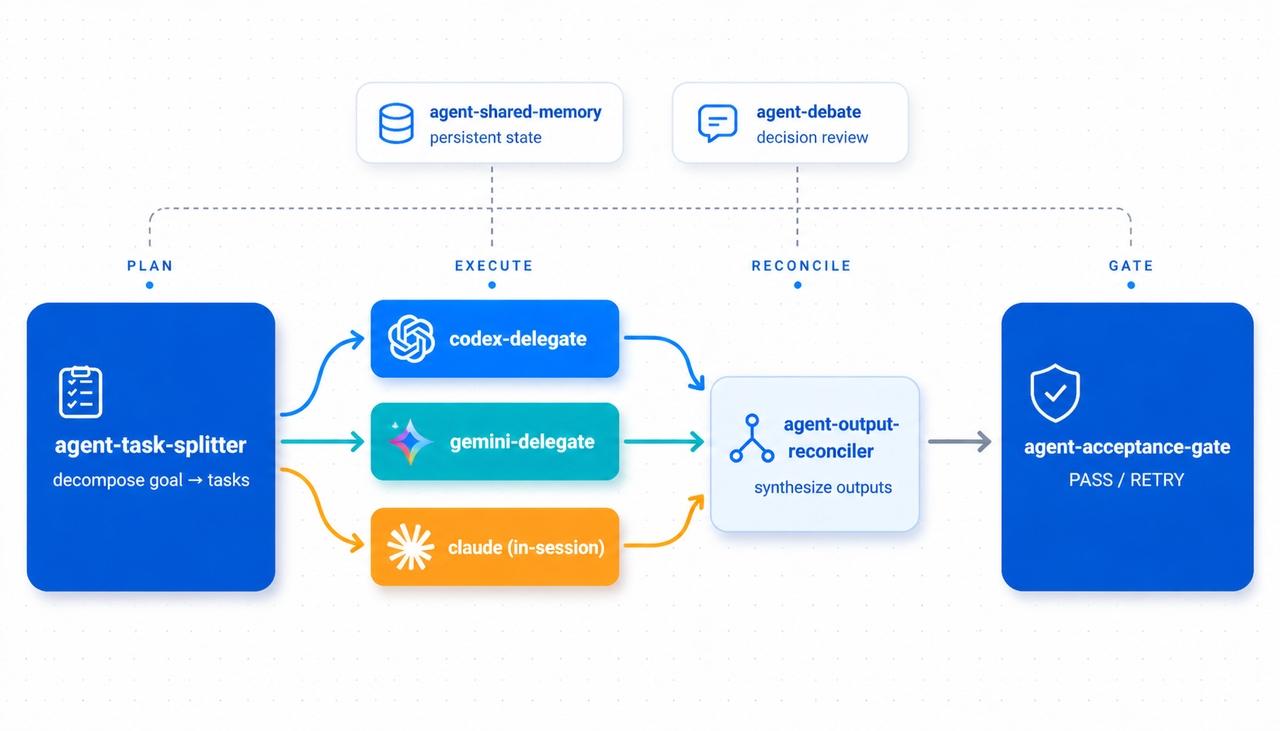
How they compose
goal
  ↓ agent-task-splitter
.coord/plan.yml + .ai/codex_task_*.md / .ai/gemini_task_*.md
  ↓ agent-context-budget
.coord/context_<NNN>.md + .coord/session_primer.md
  ↓ codex-delegate / gemini-delegate (existing)
.ai/codex_log_*.txt + .result.json + codex_result_*.md
  ↓ agent-output-reconciler
.coord/reconciliation_<NNN>.md
  ↓ agent-acceptance-gate
.coord/acceptance_<NNN>.md → merge or retry
agent-shared-memory runs alongside the whole pipeline and stores
accepted decisions, open questions, artifacts, and session outcomes.agent-context-budget keeps handoffs bounded so the main session does
not absorb raw logs or full memory. agent-debate is invoked on
consequential decisions (architecture, design choice), not in the main
loop.
See docs/example-walkthrough.md for
a worked example with real .coord/ sample artifacts produced by
running the pipeline end-to-end against actual Codex + Gemini CLI
invocations.
Why these 6 specifically
The pain points each one solves, in order:
- Task splitting is mental load. You currently classify "is
this Codex-shaped or Gemini-shaped?" in your head every time. The
splitter encodes the heuristics. - Context explodes during large runs. The context-budget skill
turns memory, logs, and agent outputs into bounded packets and a
session primer. - Multi-agent output is hard to compare. When 3 Codex jobs come
back in parallel, you read 3 result.json files and merge them
manually. The reconciler does the diff. - Consensus-driven LLM output hides trade-offs. When you ask one
agent for a design, you get one answer. The debate skill forces
two agents to argue opposing positions. - Agent sessions don't share memory. Codex resume works
per-session; nothing persists across Claude session A → Codex
session B → Gemini session C. Shared-memory makes.coord/memory.yml
the cross-session blackboard. - No standardized merge gate. You currently eyeball the diff +
runpytestmanually. The gate runs allsuccess_criteriafromplan.yml+ cost budget + cross-agent consistency check.
Composes with
codex-delegate—
consumes splitter output, produces input for reconciler.gemini-delegate-skill
— same.academic-writing-skills
— acceptance gate optionally calls its banned-word audit on prose
changes.agentmemory—
optional recall cache only..coord/memory.ymlremains canonical;
see docs/agentmemory-integration.md.
Known issues
- Gemini-cli refuses to read gitignored files. The
.ai/
directory is conventionally gitignored to keep transient task
files out of commits, butgemini -p "Read .ai/gemini_task_*.md"
fails withfile ignored by configured ignore patterns.
Workaround: invoke gemini with the task content inlined into
the prompt:
Side effect: gemini doesn't have file-system context for pathsTASK=$(cat .ai/gemini_task_<NNN>_<slug>.md) gemini -p "$TASK" --yolo \ < /dev/null > .ai/gemini_log_<NNN>_<slug>.txt 2>&1
the task file references — make sure the prompt body itself
contains all critical context, not just paths to read. The
splitter skill's step 6b documents this. - Both
codexandgeminihang at startup if stdin is open.
When launching from a script or non-interactive shell, codex-cli
≥ 0.121.0 prints "Reading additional input from stdin..." and
waits forever. Same for gemini-cli. Workaround: redirect
stdin to/dev/nullon every direct invocation:
Thecodex exec --full-auto -m <model> "<prompt>" \ < /dev/null > .ai/codex_log_<NNN>_<slug>.txt 2>&1codex-delegatewrapper script handles this internally; only
directcodex exec/gemini -pcalls need the explicit
redirect. - Codex reads gitignored files normally — only gemini has the
gitignore conflict. - Worked example with sample
.coord/artifacts and honest
documentation of what real multi-agent runs look like:
docs/example-walkthrough.md.
Status & License
MIT. Early-stage — the SKILL.md prompt scaffolding is complete and
tested in real workflows; please file issues if a skill misfires or
the .coord/ schema breaks under your use case.
Contributions welcome — see CONTRIBUTING.md for
the catalog ↔ delegate-skill interop rules.
Reviews (0)
Sign in to leave a review.
Leave a reviewNo results found