crag
Health Uyari
- License — License: MIT
- Description — Repository has a description
- Active repo — Last push 0 days ago
- Low visibility — Only 6 GitHub stars
Code Basarisiz
- rm -rf — Recursive force deletion command in .github/workflows/release.yml
- rm -rf — Recursive force deletion command in .github/workflows/test.yml
- process.env — Environment variable access in .github/workflows/test.yml
- fs module — File system access in .github/workflows/test.yml
- fs module — File system access in scripts/bump-version.js
- process.env — Environment variable access in scripts/sync-skill-hashes.js
- fs module — File system access in scripts/sync-skill-hashes.js
- fs module — File system access in src/analyze/ci-extractors.js
- fs module — File system access in src/analyze/doc-mining.js
- fs module — File system access in src/analyze/gates.js
Permissions Gecti
- Permissions — No dangerous permissions requested
This tool acts as a configuration compiler for AI coding agents. It generates a centralized `governance.md` file and uses it to automatically synchronize project quality rules and CI workflows across multiple AI tools (like Cursor, Copilot, and Gemini) without requiring an LLM or network access.
Security Assessment
The overall risk is Low. The tool operates entirely offline, explicitly requiring no network access or LLM integration. It is built with zero external dependencies, significantly reducing the risk of supply-chain attacks. There is no evidence of hardcoded secrets. The tool does access the file system (`fs` module) and reads environment variables (`process.env`), which is expected and necessary for its core function of reading your repository to generate configuration files.
Two detected failures involve `rm -rf` (recursive force deletion) commands. However, these are safely isolated within GitHub Actions workflows (`release.yml` and `test.yml`) used for CI cleanup, not in the tool's runtime code. No dangerous permissions are requested by the package.
Quality Assessment
Code quality and maintenance appear excellent. The repository is very new but actively maintained, with its last push occurring today. It uses the permissive and standard MIT license. The CI is fully integrated. The only notable weakness is low community visibility; with only 6 GitHub stars, the project is in its early stages and has not yet undergone widespread community auditing or testing.
Verdict
Safe to use—the code is transparent, offline-first, free of external dependencies, and its file access aligns perfectly with its stated purpose.
The bedrock layer for AI coding agents. One governance.md. Any project. Never stale. Universal skills + cross-agent compilation (Claude, Cursor, Codex, Gemini, Aider).
crag
Your AI coding rules and your CI will never disagree again.
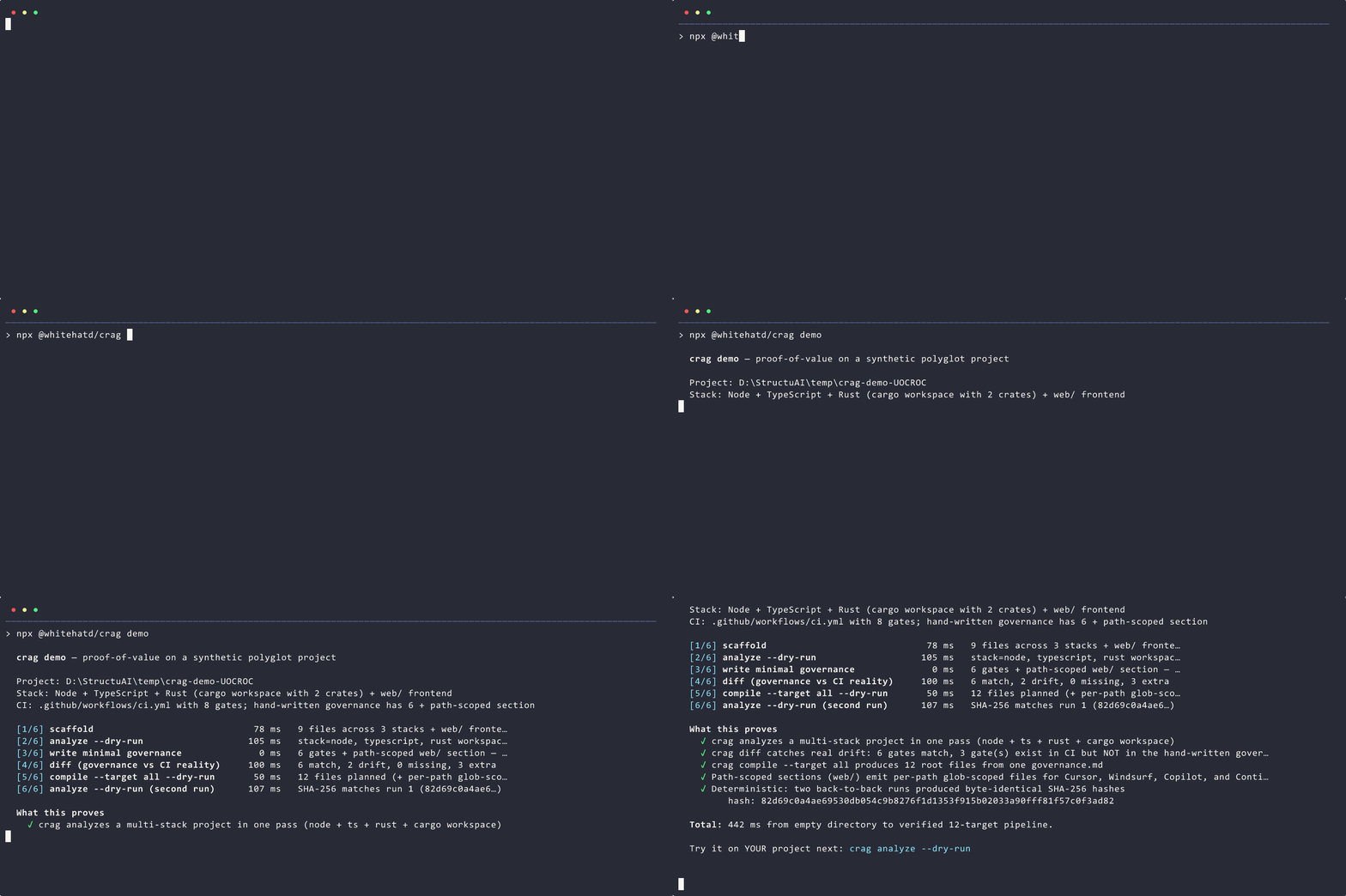
404 ms, no install, no config, no network, no LLM — SHA-verified on every CI push.
npx @whitehatd/crag demo          # see it work (no install needed)
npx @whitehatd/crag analyze       # generate governance.md from your project
npx @whitehatd/crag compile       # regenerate every derived file





Write your quality rules once in a ~20-line governance.md. crag keeps
them in sync with your CI workflow, pre-commit hooks, and whichever AI
coding tool you use — Cursor, Copilot, Gemini, Cline, Continue, Zed,
Windsurf, Cody, and more. Change one line, regenerate everything.
Deterministic — no LLM, no network.
What 12 files from one governance.md looks like
crag compile --target all --dry-run --verbose on crag itself:
$ crag compile --target all --dry-run --verbose

  Compiling governance.md → github, husky, pre-commit, agents-md, cursor,
  gemini, copilot, cline, continue, windsurf, zed, cody
  9 gates, 1 runtimes detected (dry-run)

  plan .github/workflows/gates.yml                  1.57 KB
  plan .husky/pre-commit                              507 B
  plan .pre-commit-config.yaml                      2.23 KB
  plan AGENTS.md                                    1.08 KB
  plan .cursor/rules/governance.mdc                   993 B
  plan GEMINI.md                                    1.24 KB
  plan .github/copilot-instructions.md              1.86 KB
  plan .clinerules                                  1.58 KB
  plan .continuerules                               1.70 KB
  plan .windsurfrules                               1.72 KB
  plan .zed/rules.md                                1.69 KB
  plan .sourcegraph/cody-instructions.md            1.75 KB

  Total: 17.9 KB across 12 target(s)
  Dry-run complete — no files written.
Same rules, 12 files, zero copy-paste. Change one gate, recompile, all
12 update together.
Why this exists
Every project duplicates quality rules across CI workflows, pre-commit
hooks, and a growing list of AI agent config files — up to 12 places to
keep in sync. They drift: someone tightens lint rules in .cursor/rules/,
misses the Copilot file; someone updates CI, forgets the hook.
crag removes the duplication. One governance.md, one crag compile,
12 files regenerated atomically.
How it works
your repo  ───►  crag analyze  ───►  governance.md  ───►  crag compile  ───►  12 files
                                      (~20 lines)                              CI workflow
                                           │                                   pre-commit hook
                                      edit one line                            AGENTS.md
                                      recompile all                            .cursor/rules
                                                                               + 8 more

crag diff    ───►  MATCH / DRIFT / MISSING / EXTRA
crag doctor  ───►  integrity + drift + security check
Deterministic: same input → byte-identical output. No LLM. No network.
Validated on 141 open-source repositories




Stress test — 101 repos, 4,400 invocations, 0 crashes. Every
supported language, CI system, and workspace type, plus edge cases
(mirror repos, dotfile repos, multi-GB monorepos, non-English READMEs).
28 findings surfaced, 28 resolved, 141 regression tests added.
Full report: benchmarks/stress-test.md.
Reference benchmark — 40 repos, 100 % Grade A. 7 language families,
polyglot density repos. Full methodology:benchmarks/results.md.
Self-audit: crag applies its own governance and passes its own gates
on every commit.
crag doctor   29/29 pass, 0 warn, 0 fail
crag diff     12 match, 0 drift, 0 missing, 0 extra
crag check    9/9 core files present
Why not X?
| Alternative | When it's better than crag | When crag is better |
|---|---|---|
Hand-written .cursorrules |
You use exactly one AI tool, rules rarely change | You use more than one AI tool, or rules drift from CI |
| Makefile as source of truth | Small repos, single-language, Jenkins-shaped CI | Cross-stack projects, multiple targets, AI agents need their own formats |
| Conftest / OPA | Runtime policy enforcement on cluster state | Dev-time gate definition before code reaches the cluster |
| Pre-commit framework alone | Pre-commit is the only surface you care about | You also want the same rules in CI, AI agents, and contributor docs |
Copy-pasted CONTRIBUTING.md |
You trust contributors to read and follow docs | You want rules enforced mechanically, not documented |
First 5 minutes
# 1. See it work (no install needed)
npx @whitehatd/crag demo

# 2. Generate governance.md from your project
cd your-repo
npx @whitehatd/crag analyze

# 3. Verify it matches reality
npx @whitehatd/crag diff

# 4. Compile to every target
npx @whitehatd/crag compile --target all --dry-run   # preview
npx @whitehatd/crag compile --target all             # write

# 5. Health check
npx @whitehatd/crag doctor
These five commands cover 95 % of real-world usage. Everything else is
in docs/.
Requirements: Node.js 18+ and git. Zero runtime dependencies.
Further reading
All reference material lives under docs/:
docs/commands.md— every subcommand, every flag, every exit codedocs/compile-targets.md— the 12 compile targets, their outputs, their consumersdocs/governance-format.md— thegovernance.mdv2 format (annotations, sections, inheritance)docs/languages.md— the 25+ stack detectors and the gates each emitsdocs/ci-systems.md— the 11 CI extractors and the files they parsedocs/workspaces.md— the 12 workspace types, fixture filtering, symlink protectiondocs/claude-code.md— Claude Code session loop (pre-start / post-start skills)docs/release-pipeline.md— how the auto-release workflow publishes to npm
Contributing
Issues and PRs at github.com/WhitehatD/crag.
See CONTRIBUTING.md for the workflow.
If crag analyze misses a language, CI system, or gate pattern on a
public repo, file an issue with the repo URL and crag analyze --dry-run output. That's the most valuable bug report.
License
MIT — see LICENSE. Built by
Alexandru Cioc (WhitehatD).
Yorumlar (0)
Yorum birakmak icin giris yap.
Yorum birakSonuc bulunamadi