awsl
Health Gecti
- License — License: Apache-2.0
- Description — Repository has a description
- Active repo — Last push 0 days ago
- Community trust — 33 GitHub stars
Code Gecti
- Code scan — Scanned 12 files during light audit, no dangerous patterns found
Permissions Gecti
- Permissions — No dangerous permissions requested
Bu listing icin henuz AI raporu yok.
Codex-verified, Claude-compatible durable local runtime for Claude Code Workflow JS, with resume, checkpoints, budgets, and Git worktrees
awsl — durable local runtime with resume for Codex and Claude Code Workflows
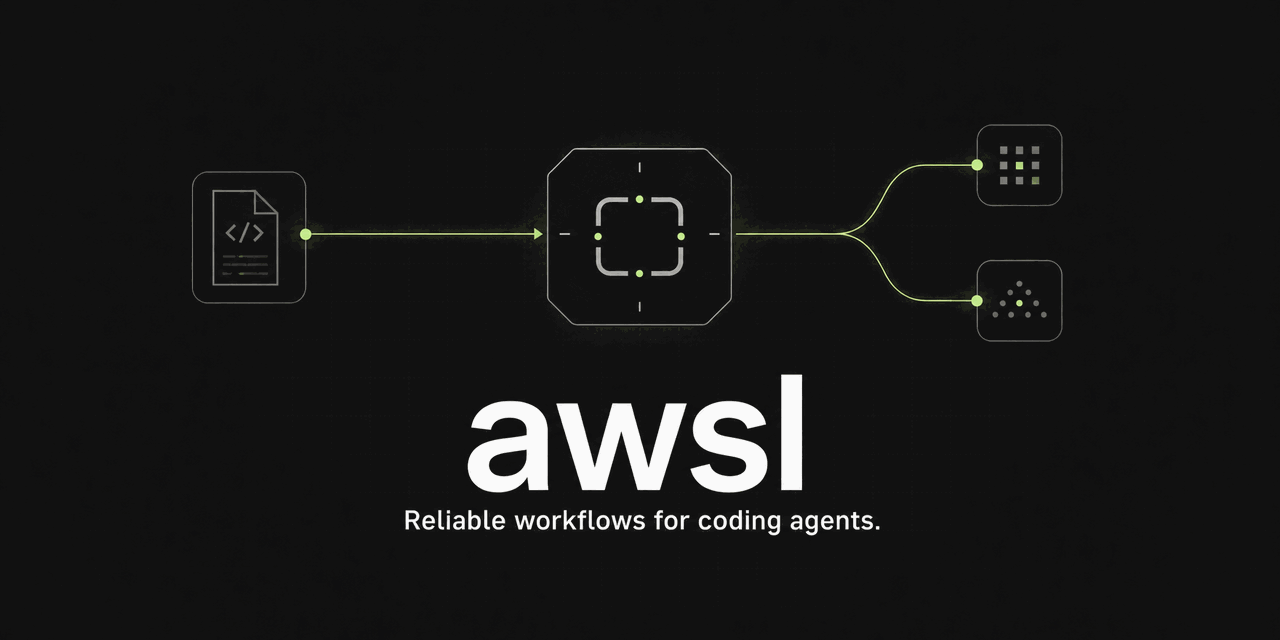



The local control plane for coding-agent workflows.
Run compatible Claude Code Workflows on Codex without rewriting them. Kill
the process. Resume the run.Codex-verified. Claude-compatible.
The model is the worker. awsl is the runtime.
awsl is the Agent Workflow State Layer: a durable local runtime for trusted
coding-agent Workflow JavaScript. Write a workflow once, run it through Codex
or the Claude-compatible adapter, and resume it after interruption. awsl owns
the runtime pieces that multi-agent scripts usually rebuild: bounded
parallelism, shared budgets, durable journals, isolated Git worktrees,
versioned events, and redaction.
awsl runs the provider CLIs you already use. It is local, inspectable, and
deliberately smaller than a general-purpose agent framework.
Quick start
Install awsl and check the local provider setup:
npm install --global @xhinliang/awsl
awsl --install-skills
awsl doctor
--install-skills installs the awsl Codex Skill in~/.agents/skills/awsl. It is safe to run again after upgrading awsl.
doctor reports every provider independently and bases overall readiness on
the selected provider. An unavailable unused provider does not degrade the
selected path. Versions with committed protocol evidence are verified; other
strictly branded semantic versions are unverified and may still run.
Run the built-in three-logical-call demo with an 8k output-token gate:
awsl demo --provider codex
demo invokes the selected model provider and creates a normal durable run.
The gate stops new calls after recorded output reaches 8k; already active calls
may finish above it.
Create a ready-to-run review workflow without writing JavaScript:
awsl init review.js --template code-review
awsl workflow inspect review.js
Select the provider when the run starts:
awsl run review.js \
  --provider codex \
  --args '{"scope":"the authentication module"}' \
  --budget 20000

awsl run review.js \
  --provider claude \
  --args '{"scope":"the authentication module"}' \
  --budget 20000
One provider is pinned for the complete workflow tree. awsl never silently
falls back to another provider during a run. The Codex path has real-provider
acceptance evidence. The Claude-compatible path has protocol and conformance
coverage; authenticated Claude acceptance remains an explicit evidence gap.
Why awsl
Provider CLIs are excellent workers. A workflow that coordinates many calls
still needs runtime semantics of its own.
| Without a workflow runtime | With awsl |
|---|---|
| Hand-written process and concurrency glue | agent(), parallel(), and pipeline() |
| Start over after interruption | Durable run state and longest-prefix resume |
| Shared checkout collisions | Per-call isolated Git worktrees |
| Ad hoc logs and parsing | Stable JSON, JSONL events, and terminal envelopes |
| Provider-specific orchestration | One JavaScript workflow for Codex or Claude |
| Unbounded or invisible spend | Shared output-token budgets and call limits |
workflow.js ──> awsl runtime ──┬──> Codex CLI
                │              └──> Claude Code
                └── journal · budget · events · worktrees
Read why awsl exists, including when a direct provider CLI
or a general-purpose distributed workflow engine is the better choice.
Example workflows
- Browse the five-workflow gallery
research-panel.js— independent research and synthesisparallel-code-review.js— parallel specialist reviewknowledge-compile.js— source-grounded repository knowledgeincident-investigation.js— evidence-ranked incident assessmentmigration.js— planned migration in an isolated worktreeworktree-refactor.js— isolated coding-agent worktreesresume-after-failure.js— stable labels and durable reuse
The
reporting migration case study
shows how a real reporting application moved provider-neutral scheduling into
awsl while keeping collection, validation, persistence, and delivery in the
domain layer.
Requirements and compatibility
- Node.js 22 or newer
- Git for
isolation: "worktree" - At least one Codex CLI or Claude Code executable with a standard semantic
version banner
awsl owns and versions the JavaScript Workflow ABI independently from provider
executables. This release normalizes structurally compatible workflow files toawsl-workflow@1. Codex CLI 0.145.0 and 0.146.0, and Claude Code 2.1.218,
have committed protocol evidence; newer versions are accepted as unverified
rather than rejected by a patch-version allowlist.
Read the fullawsl-workflow@1 portable workflow ABI proposal.
See the
compatibility report for the
evidence behind each verified, partial, or unsupported behavior.
From a source checkout:
corepack enable
pnpm install --frozen-lockfile
pnpm run build
pnpm awsl --help
CLI
awsl <workflow>
awsl demo [topic]
awsl init [file] [--template <template>]
awsl run <workflow>
awsl resume <run-id>
awsl runs list
awsl runs show <run-id>
awsl runs pause <run-id>
awsl doctor
awsl config show
awsl workflow inspect <workflow>
awsl --install-skills
awsl help <command>
run accepts:
--provider codex|claude
--args <json>
--args-file <path|->
--cwd <path>
--budget <output-tokens>
--format auto|pretty|jsonl|json
--args, --args-file, and non-empty piped stdin are mutually exclusive.
Input JSON is strict, rejects duplicate keys, and is limited to 512 KiB.
resume accepts replacement --args, --args-file, --budget, and--format. The provider, executable profile, working directory, Workflow ABI,
and model policy remain pinned. The workflow is reloaded from its stored path;
source bytes are not content-pinned, so do not edit a workflow while its run is
still resumable. Matching calls reuse the immediately preceding attempt's
longest valid result prefix.
Output contracts:
autoselectsprettyfor a TTY andjsonlotherwise.prettywrites progress to stderr and the final business result to stdout.jsonlwrites only versioned events to stdout.jsonwrites one terminal envelope. In addition to the business result,
budget, and aggregate token metrics, completed invocations include a
versionedtimingsummary.
timing is derived from the durable lifecycle events, so awsl runs show <run-id> can report it for runs created by earlier awsl versions too. It
contains:
- lifecycle
elapsedMs, attempt-activeactiveMs, time between attempts asidleMs, and the union of live agent intervals ascallActiveMs; - each attempt and call, including queue, execution, retry, and elapsed time;
- per-attempt phase rollups with elapsed and active time, cumulative call time,
maximum parallelism, the longest call, and the last finishing call.
Phase elapsed times can overlap when workflows run phases concurrently and
cumulative callMs can exceed wall-clock time. Reused calls have elapsed time
but no live durationMs.
SIGINTexits 130 andSIGTERMexits 143 after a durable terminal record.
doctor probes Node, Git, Codex, and Claude versions without invoking a model.
Its overall status follows the configured provider, while every provider keeps
an independent availability and evidence status.
Workflow contract
The first statement must be a pure literal export const meta = ....meta.name and meta.description are required non-empty strings. Workflow
source is limited to 512 KiB and may use top-level await and return.awsl workflow inspect <file> reports the normalized Workflow ABI. The ABI is
versioned by awsl rather than by the installed Claude or Codex executable.
The normative observable contract is documented in theawsl-workflow@1 proposal.
The workflow global API is:
args: the strict JSON input.agent(prompt, options?): run one provider call.parallel(thunks): run branches concurrently and preserve input order.pipeline(items, ...stages): process items concurrently while stages for
each item remain serial.phase(title): change the current display and event phase.log(message)andconsole.*: emit workflow log events.workflow(reference, args?): invoke one child workflow.budget.total,budget.spent(), andbudget.remaining().- bounded
setTimeoutandclearTimeout.
Supported agent options are:
{
  label: "stable call label",
  phase: "phase name",
  schema: { type: "object" },
  model: "provider model or configured tier",
  effort: "low" | "medium" | "high" | "xhigh" | "max",
  isolation: "worktree",
  agentType: "registered-agent-name",
}
Non-cancellation failures inside parallel and pipeline become null and
emit a log, matching the stable Workflow ABI. A null pipeline
value skips the remaining stages for that item. Child workflows inherit the
root provider and shared limits; a child cannot recursively start another child.
The VM deliberately exposes no process, require, filesystem API, CommonJS
globals, static or dynamic imports. String and WebAssembly code generation,Date.now(), bare or zero-argument Date, and Math.random() are disabled.
These are limited deterministic-API restrictions, not a complete
reproducibility guarantee or a hostile-code sandbox. Explicit dates and Intl
can still observe host locale and timezone behavior.
Configuration
Precedence, from highest to lowest:
CLI > AWSL_* > <project>/.awsl/config.toml > user config > defaults
Recognized environment variables are:
AWSL_PROVIDERAWSL_STATE_DIRAWSL_RAW_PROVIDER_EVENTSAWSL_CODEX_COMMANDAWSL_CLAUDE_COMMAND
The project config is .awsl/config.toml. On macOS, user configuration and
state live below ~/Library/Application Support/awsl. On Linux and WSL they
use ${XDG_CONFIG_HOME:-~/.config}/awsl and${XDG_STATE_HOME:-~/.local/state}/awsl.
Example:
provider = "codex"
raw_provider_events = false

[providers.codex]
executable = "codex"
args = []
profile = "default"

[providers.codex.tiers.fast]
model = "gpt-5.6-terra"
effort = "low"

[registry]
plugin_dirs = []
Provider tables accept executable, args, default_model,native_models, tiers, and models; profile is Codex-only.awsl config show reports merged values, field provenance, and hashed config
sources, with defensive redaction.
Provider CLIs may apply their own ambient project rules, instructions, hooks,
MCP configuration, and permission settings. awsl does not independently
reproduce or certify every ambient provider setting. When a requestedagentType policy cannot be expressed by an adapter without broadening its
permissions, awsl fails closed.
Durable state and resume
Runs have running, paused, completed, failed, or killed status. State
is private by default: directories use mode 0700 and state, journal, lock, and
optional raw-event files use mode 0600.
Resume considers only the immediately preceding attempt and replays its longest
valid contiguous journal-key-v2 prefix. Only completed, non-null result
observations with complete output-token usage are reusable;compatibility-null, failed, and indeterminate observations are not. Budget and
call-cap gates run before replay lookup. Calls after the first missing or
mismatched entry execute again. This gives at-least-once behavior: if an
external side effect completed but its successful journal record was not
durably stored, a resume can repeat that call. Workflow authors must use
idempotency keys or their own reconciliation for side effects.
Each logical provider call also has a bounded transient-failure retry: at most
three attempts with backoff. awsl retries only a provider error explicitly
classified as recoverable with complete zero-token usage. The Codex adapter
uses that classification only for transient transport or upstream failures
before any substantive item, command, or file change is observed. Authentication,
protocol, schema, and post-output failures are not retried automatically. Acall.retrying event is emitted before each fresh attempt; after exhaustion the
logical call fails normally and remains eligible for explicit durable resume.
awsl runs pause verifies both PID and process-start identity before signalling
the owner. Opening, listing, or resuming a run repairs only a verified stale
terminal lock.
Worktrees
agent(prompt, { isolation: "worktree" }) creates a per-call Git worktree from
the root run's pinned base. awsl never merges it into the original worktree.
Clean successful worktrees are removed; dirty, failed, or cancelled worktrees
are retained and reported for inspection.
Events
The stable envelope is:
{
  "version": 1,
  "type": "run.started",
  "timestamp": "2026-07-28T00:00:00.000Z",
  "runId": "opaque-run-id",
  "data": {}
}
Runtime event types include run.started, run.completed, run.failed,run.killed, run.paused, call.scheduled, call.started,call.retrying, call.completed, call.failed, call.reused, phase.changed,workflow.log, worktree.created, and worktree.retained. Non-run CLI
commands can emit command.completed.
The data object is event-specific and may gain fields. Consumers should
dispatch on version and type, ignore unknown fields, and tolerate unknown
event types.
Security boundary
Workflow files are trusted code. Provider processes are spawned directly with
an executable and argument vector, never through a shell. awsl does not save the
complete environment or provider credentials. Stored events and JSONL output
redact common authorization headers, cookies, tokens, passwords, credentials,
signatures, API keys, and AWS credential fields.
Raw provider event capture is disabled by default. Enablingraw_provider_events or AWSL_RAW_PROVIDER_EVENTS=true creates additional
redacted diagnostic data, but users should still treat it as sensitive.
Report vulnerabilities through
GitHub private vulnerability reporting.
The main branch and latest release are supported; older releases are not.
Read SECURITY.md before running third-party workflows.
Development
corepack enable
pnpm install --frozen-lockfile
pnpm run check
pnpm run test
pnpm run build
pnpm run test:package
pnpm run test:conformance
pnpm run sbom
git diff --check
CI runs the release gate on Node 22 for Ubuntu and macOS. Oracle capture is
explicitly opt-in and is never run by CI.
See CONTRIBUTING.md for the contribution workflow and the
evidence expected for compatibility changes.
The generated sbom.cdx.json is a deterministic CycloneDX 1.6 inventory of the
production dependency closure in pnpm-lock.yaml. It describes the release
build; dependency ranges can resolve differently in a later consumer install.
Release prerequisites
.github/workflows/release.yml publishes only from a published GitHub Release
whose tag exactly matches v<package version>. The official repository pins
the package identity to @xhinliang/awsl, uses the release.yml npm trusted
publisher, and has immutable releases enabled.
Before each release, an authorized maintainer must confirm the required
licensing and organizational open-source approval. The release job uses GitHub
OIDC and npm provenance. It contains no long-lived npm publication token.
License
awsl is licensed under the Apache License 2.0. Public CI uses an independently
authored 19-call orchestration profile. External and vendor fixtures are
excluded from the repository and release package.
Yorumlar (0)
Yorum birakmak icin giris yap.
Yorum birakSonuc bulunamadi