WhyBuddy
Health Gecti
- License — License: MIT
- Description — Repository has a description
- Active repo — Last push 0 days ago
- Community trust — 263 GitHub stars
Code Basarisiz
- execSync — Synchronous shell command execution in .kiro/specs/repo-system-reconnaissance-2026-05-28/evidence/build-inventory.mjs
- execSync — Synchronous shell command execution in .kiro/specs/repo-system-reconnaissance-2026-05-28/evidence/cap-audit.mjs
- exec() — Shell command execution in .kiro/specs/repo-system-reconnaissance-2026-05-28/evidence/classify-specs.mjs
Permissions Gecti
- Permissions — No dangerous permissions requested
Bu listing icin henuz AI raporu yok.
WhyBuddy — an AI agent crew that questions your product idea and rehearses it before you build. One sentence in → goal clarification, multi-route plan, full spec (requirements/design/tasks), feasibility & architecture out. Decide what's worth building, in minutes.

🌐 WhyBuddy
WhyBuddy — an AI agent crew that questions your product idea and rehearses it before you build.
Edge execution · Cloud orchestration · One sentence in, full spec out



🚀 Quick Start (1 minute · 2 commands)
cp .env.example .env       # then fill in LLM_API_KEY (see "MUST FILL" section)
docker compose up
Open http://localhost:3000 and you're in. The WhyBuddy server (3001 internally) is published on host port 3000 so you can navigate directly without remembering port numbers.
Three ways to run — pick whichever matches your environment:
- Online demo — https://opencroc.github.io/whybuddy/ (browser-only mode, no install).
- Docker compose — the snippet above; one MySQL + one WhyBuddy container.
- Local dev —
pnpm install && pnpm run dev:all(full stack, hot reload, see Local Dev below).
🔑 MUST FILL — without these you'll get template-only output
The server starts even when these are blank, but every autopilot bridge silently
falls back to deterministic templates and you'll see the same canned answers
regardless of input. Fill these two and you'll get real LLM-driven generation:
| Variable | What to put | Where to get one |
|---|---|---|
LLM_API_KEY |
An OpenAI-compatible API key | OpenAI · DashScope · OpenRouter · Moonshot · SiliconFlow · Zhipu · DeepSeek · any provider that speaks the OpenAI Chat / Responses API |
SESSION_SECRET |
Any 64-char hex string | openssl rand -hex 32 |
LLM_BASE_URL and LLM_MODEL should match the provider you picked
(default values target api.openai.com + gpt-5.4). Everything else in.env.example ships with safe defaults — leave them alone unless you have
a reason.
💡 What it does (in 30 seconds)
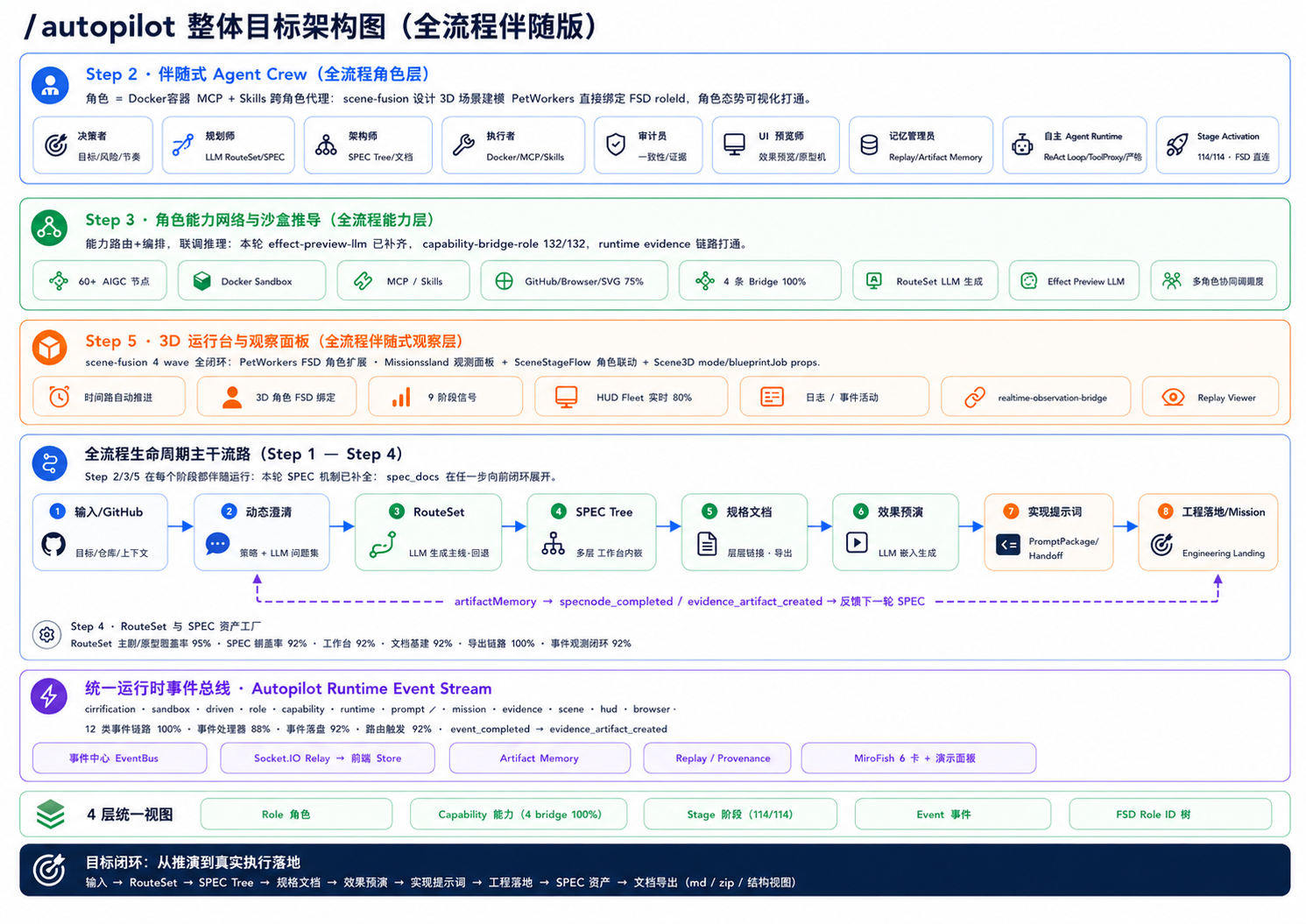
You type one sentence. The system rehearses the entire product for you:
    💬 "AI comic platform"
        │
        ▼
    ① 🔍 Smart Clarification    Goals · Constraints · Personas · Success criteria
        │
        ▼
    ② 🗺️ Route Planning         Main route + Alternatives + Risk + Cost
        │
        ▼
    ③ 🌳 SPEC Tree              Modular spec node decomposition
        │
        ▼
    ④ 📄 Spec Documents         Requirements / Design / Tasks (streaming)
        │
        ▼
    ⑤ 🎨 Effect Preview         Architecture + Prompts + Next steps
        │
        ▼
    📦 Export → Markdown / ZIP / Online
💡 The entire process is observable in real time: a 3D office scene shows
the agent fleet collaborating, while the right-rail workbench streams
generation progress with stage indicators.
🤖 The FSD Fleet
Seven specialized AI roles collaborate on every rehearsal:
| Role | Responsibility |
|---|---|
| 🧠 Planner | Breaks the goal into executable routes |
| ❓ Clarifier | Fills gaps, resolves ambiguity |
| 🔬 Researcher | Gathers context, validates assumptions |
| ✍️ Generator | Produces spec documents & artifacts |
| ⚙️ Operator | Executes in Docker sandbox when needed |
| 👁️ Reviewer | Checks quality, flags issues |
| 📋 Auditor | Maintains evidence trail & compliance |
Each role has access to 50+ AIGC capability nodes, Docker sandbox, MCP
tools, Skills, and domain knowledge injection.
✨ Key Features
👁️ Full ObservabilitySee every step: active roles, invoked capabilities, ReAct cycle stage, produced artifacts. No black boxes. |
🗺️ Multi-Route PlanningQuick / Standard / Deep / Conservative routes with risk, cost, and takeover points. Choose before anything runs. |
🛑 Human TakeoverClarification, approval, risk, budget, delivery — all explicit pause points. Never silently fails. |
🔁 Evidence & ReplayExportable artifacts, audit logs, replay timeline. Inspect any decision at any moment. |
🐳 Docker SandboxReal code execution in isolated containers with HMAC callbacks and live terminal streaming. |
📦 Export EverythingMarkdown, ZIP, or online preview. Every rehearsal is a shareable document package. |
🛠️ Local Dev
git clone https://github.com/opencroc/whybuddy.git && cd whybuddy
pnpm install
pnpm run dev:all          # Full stack: frontend + server + executor
pnpm run dev:frontend # Opens at localhost:5173
Or visit the Live Demo directly on GitHub Pages.
📋 Requirements- Node.js 22+
- pnpm
- Docker (optional, only required for full sandbox executor mode; WhyBuddy
falls back to a native runner when Docker is unavailable)
- The compose file boots two containers:
whybuddy-app(the server +
bundled frontend) andwhybuddy-mysql(MySQL 8 with thewhybuddyschema kept for backward compat — the data shape is
unchanged, only the project brand changed). - The Lobster Executor sandbox is not in the compose file by default.
Docker-in-Docker introduces extra surface area and isn't required for
the spec generation loop. Opt in by settingLOBSTER_EXECUTION_MODE=realand pointing the host's Docker daemon at
the executor service yourself. - All
BLUEPRINT_*_ENABLEDflags default to safe values matched to a
fresh dev environment; the AUTOPILOT_REAL_RUNTIME master switch is
on by default — bridges that find their dependencies will run real,
bridges that don't will fall back gracefully.
🖼️ Screenshots
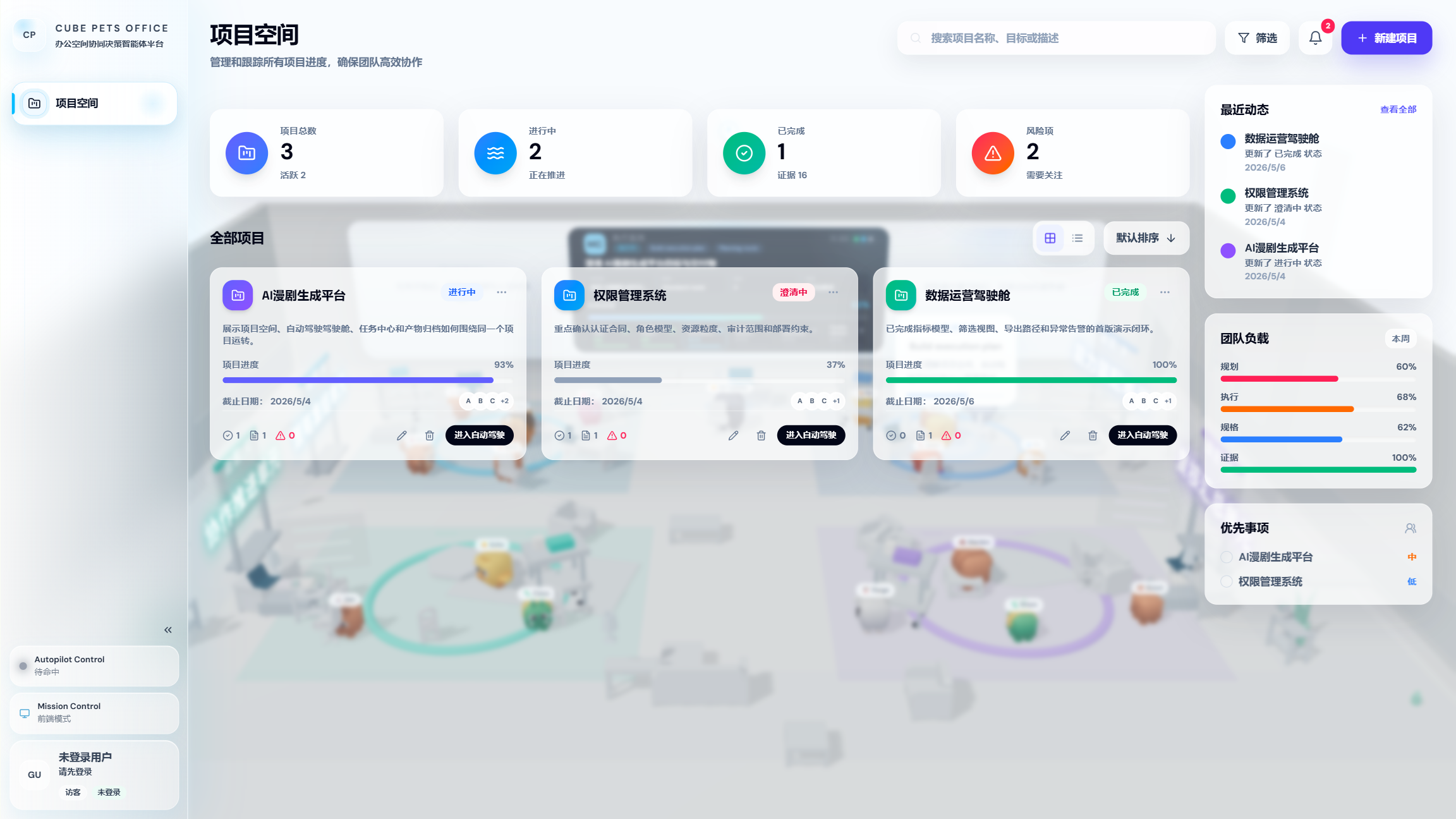 |
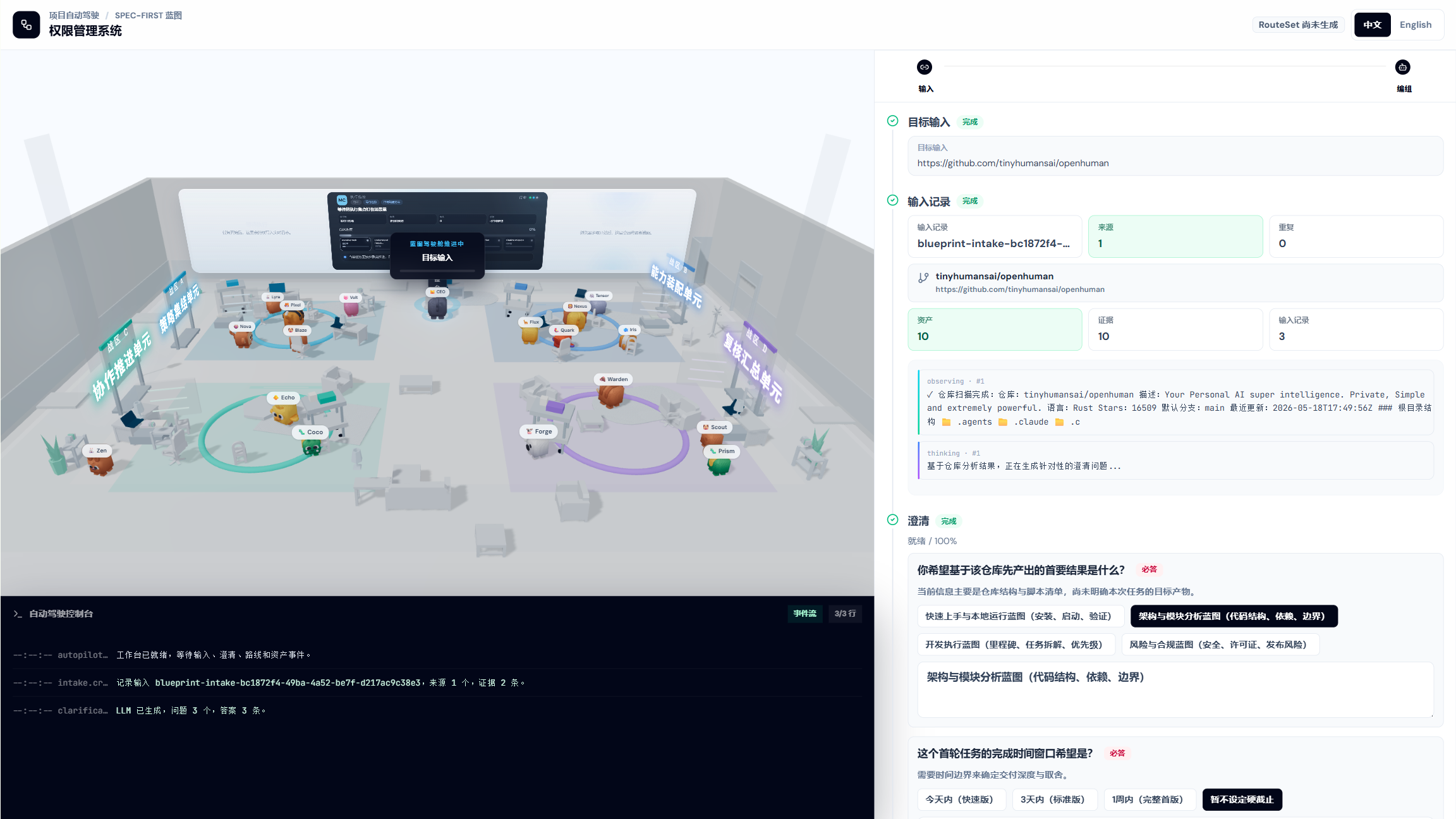 |
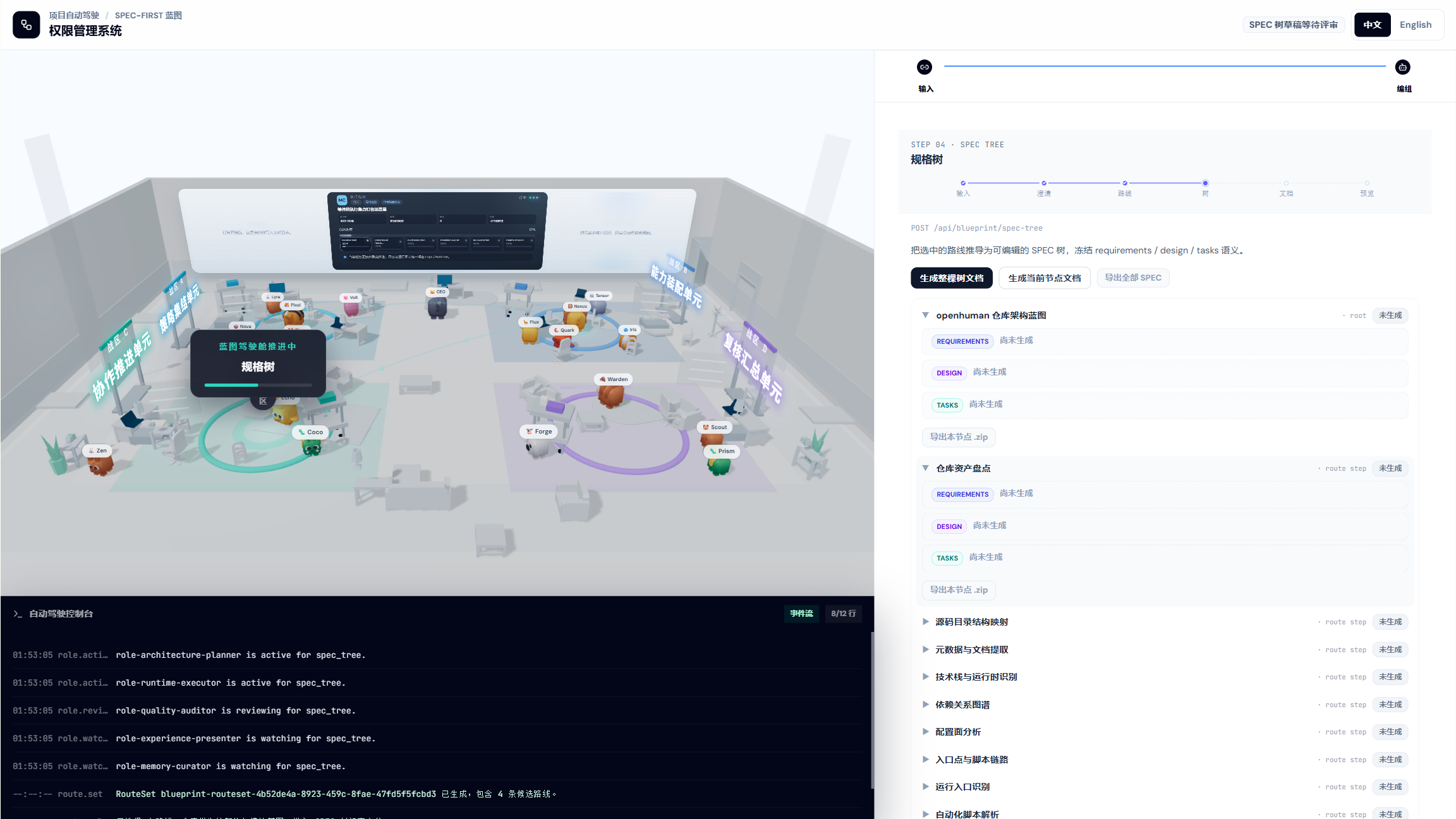 |
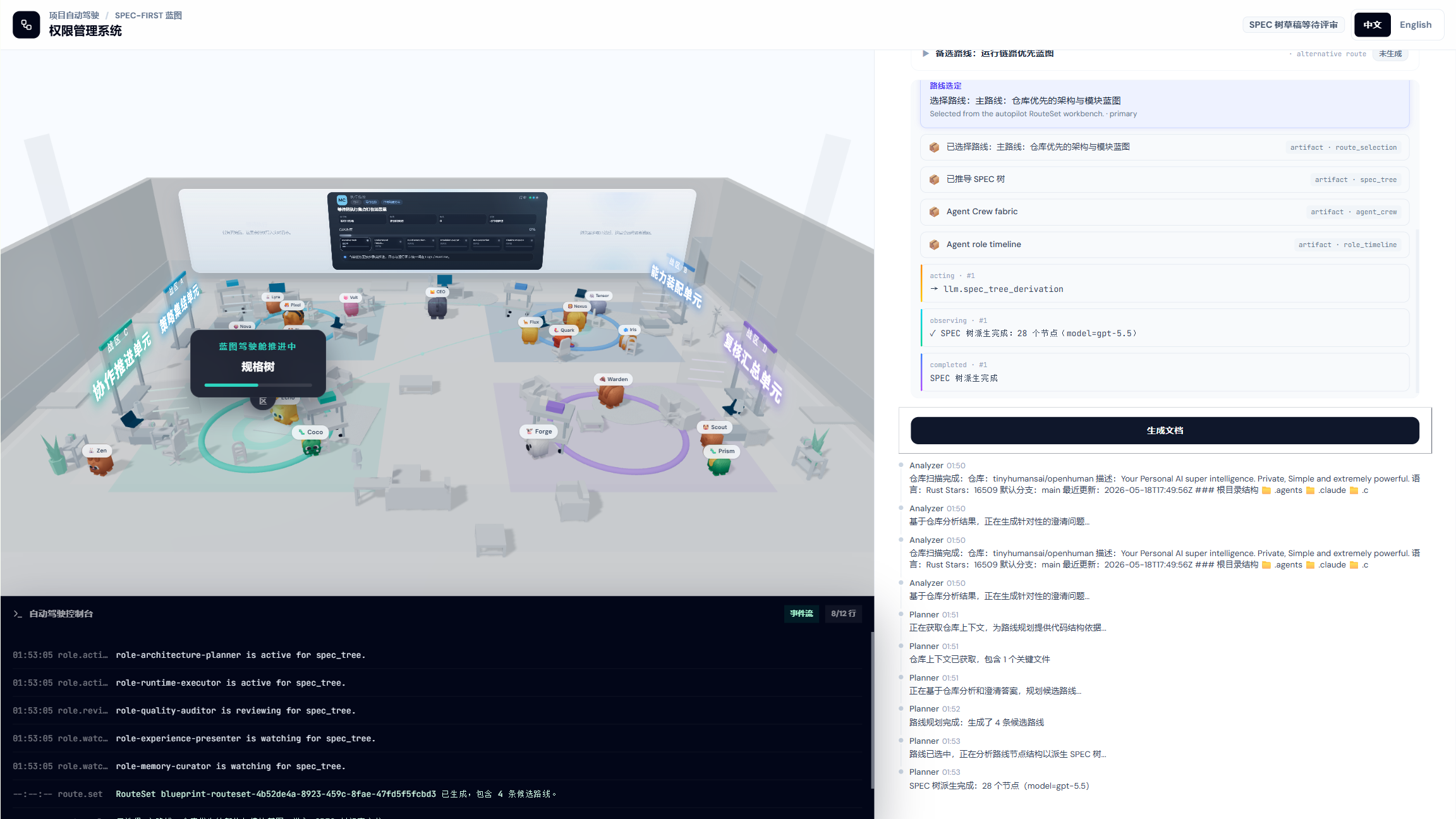 |
 |
 |
📝 Rehearsal Examples
Every rehearsal is a shareable piece of content. 50 rehearsals = 50
distribution opportunities.
| 💬 Input | 📦 Output |
|---|---|
| "AI comic platform" | 6 SPEC modules · content pipeline · monetization · architecture |
| "Permission management SaaS" | 8 SPEC modules · RBAC · multi-tenant · API contracts |
| "Sentiment analysis tool" | 5 SPEC modules · data pipeline · model selection · alerts |
| "Indie dev bookkeeping app" | 4 SPEC modules · local-first · sync · privacy compliance |
| "Enterprise knowledge base" | 7 SPEC modules · RAG pipeline · permissions · indexing |
| "Cross-border product picker" | 6 SPEC modules · data sources · scoring · competitor analysis |
🏗️ Architecture
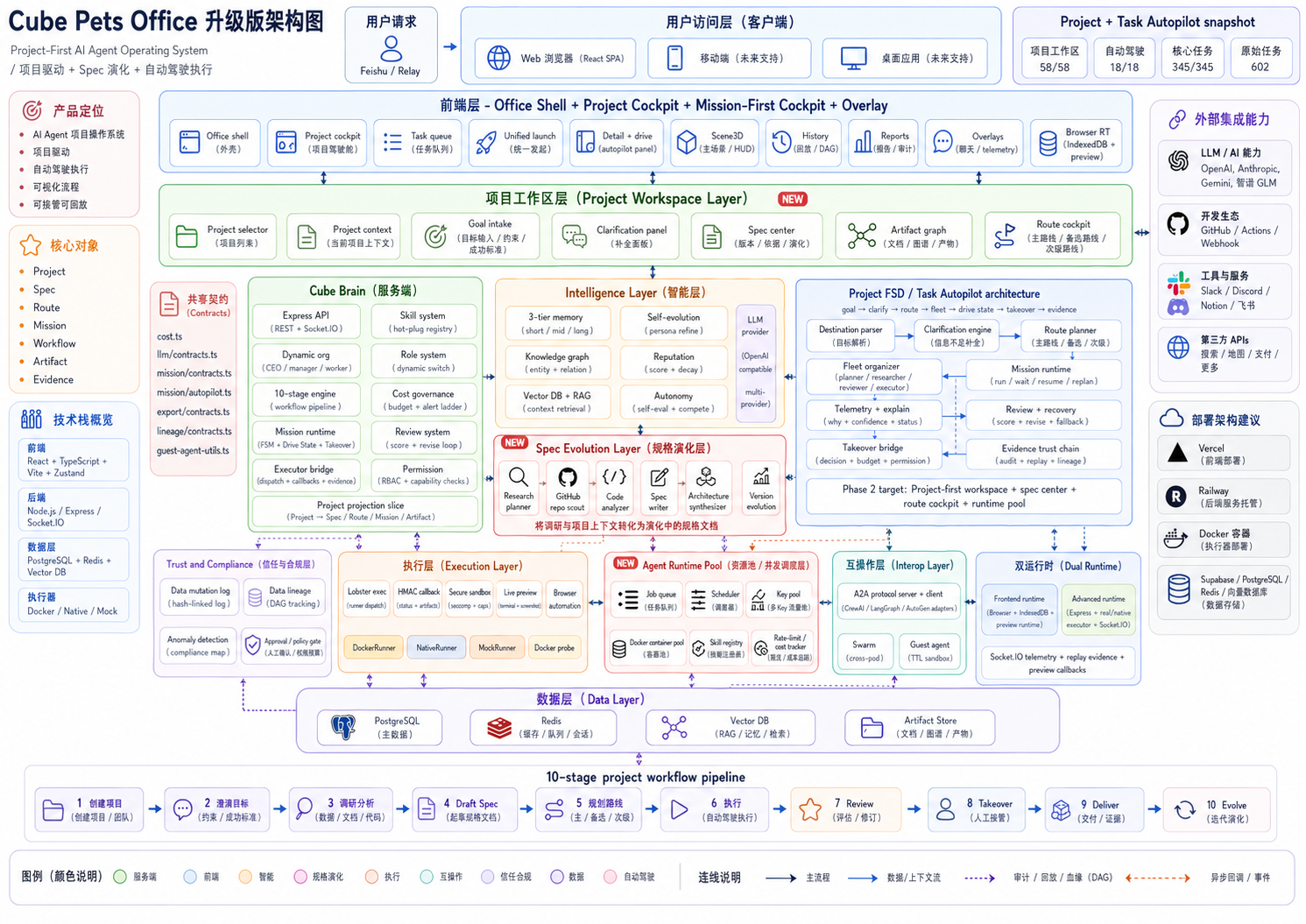
┌─────────────────────────────────────────────────────────────────┐
│  🌐 ENTRY          Browser · Feishu Relay · Destination Input   │
├─────────────────────────────────────────────────────────────────┤
│  🖥️ FRONTEND       3D Scene · Task Cockpit · Route View        │
│                    Drive State · Takeover Panel · Replay         │
├─────────────────────────────────────────────────────────────────┤
│  🧠 CUBE BRAIN     10-Stage Workflow · Mission Runtime          │
│                    Dynamic Roles · Cost Governance · Review      │
├─────────────────────────────────────────────────────────────────┤
│  🔮 PROJECTION     Mission→Destination · Workflow→Route         │
│                    State→DriveState · Decision→Takeover          │
├─────────────────────────────────────────────────────────────────┤
│  💡 INTELLIGENCE   3-Level Memory · Knowledge Graph · RAG       │
│                    Self-Evolution · LLM Multi-Provider           │
├─────────────────────────────────────────────────────────────────┤
│  🛡️ TRUST          Hash-Chain Audit · Lineage DAG · Evidence    │
├─────────────────────────────────────────────────────────────────┤
│  ⚙️ EXECUTION      Docker Containers · HMAC · Sandbox · Terminal│
├─────────────────────────────────────────────────────────────────┤
│  🔗 INTEROP        A2A Protocol · Swarm · Guest Agent Market    │
└─────────────────────────────────────────────────────────────────┘
🛠️ Tech Stack
| Layer | Technology |
|---|---|
| Frontend | React 19 · Vite · TypeScript · Zustand · Three.js (R3F) · Framer Motion |
| Server | Express · Socket.IO · TypeScript |
| AI | OpenAI-compatible API (any provider) |
| Execution | Docker (dockerode) · Browser Runtime · Native Runtime |
| Testing | Vitest · fast-check (PBT) |
| Storage | IndexedDB (browser) · JSON (server) |
📊 Project Scale
| Metric | Count |
|---|---|
| Project files | 4,707 |
| TypeScript/TSX files | 2,130 |
| Lines of TypeScript | 545,000 |
| Test files | 866 |
| Spec directories | 287 |
| Spec markdown files | 1,074 |
| Task checkboxes | 7,887 ✅ / 919 ⬜ |
⚔️ Comparison
| Feature | Dify | n8n | CrewAI | LangGraph | WhyBuddy |
|---|---|---|---|---|---|
| Open Source | ✅ | ✅ | ✅ | ✅ | ✅ |
| One sentence → full product | ❌ | ❌ | ❌ | ❌ | ✅ |
| Spec generation (Req+Design+Tasks) | ❌ | ❌ | ❌ | ❌ | ✅ |
| Multi-route planning | ❌ | ❌ | ❌ | ⚠️ | ✅ |
| Multi-role agent fleet | ❌ | ❌ | ✅ | ✅ | ✅ |
| Real-time 3D observability | ❌ | ❌ | ❌ | ❌ | ✅ |
| Human takeover governance | ⚠️ | ⚠️ | ❌ | ❌ | ✅ |
| Replay & audit trail | ❌ | ❌ | ❌ | ❌ | ✅ |
| Docker sandbox | ❌ | ⚠️ | ❌ | ❌ | ✅ |
| Export Markdown/ZIP | ❌ | ❌ | ❌ | ❌ | ✅ |
| Browser-only demo | ❌ | ❌ | ❌ | ❌ | ✅ |
🤝 Contributing
1. Fork & clone → pnpm install
2. pnpm run dev:frontend (UI) or pnpm run dev:all (full stack)
3. Before PR: node --run check && pnpm run test
See CONTRIBUTING.md for details.
🪪 About the name
WhyBuddy is two characters: 端 (edge / endpoint) and 云 (cloud).
Together they describe the model the project converges on — workloads execute
at the edge when they can (browser runtime, native sandbox, your laptop's
Docker), and fall back to the cloud when they need shared coordination
(LLM, MCP servers, the Lobster Executor service). The codebase still carries
the legacy package name whybuddy in some internal modules; that is
intentional and tracked underwhybuddy-internal-rename for a future sweep, not the entry
point you read first.
The domain whybuddy.com is reserved for the hosted edition.
⭐ Star History
Every rehearsal is content that helps others discover possibilities. Star
this repo to help more people find it.
Yorumlar (0)
Yorum birakmak icin giris yap.
Yorum birakSonuc bulunamadi