hecate
Health Uyari
- License — License: MIT
- Description — Repository has a description
- Active repo — Last push 0 days ago
- Low visibility — Only 5 GitHub stars
Code Gecti
- Code scan — Scanned 12 files during light audit, no dangerous patterns found
Permissions Gecti
- Permissions — No dangerous permissions requested
Bu listing icin henuz AI raporu yok.
Enterprise-grade, multi-tenant, model-agnostic, MCP-first Agent platform.
Hecate


Enterprise-grade, multi-tenant, model-agnostic, MCP-first Agent platform.
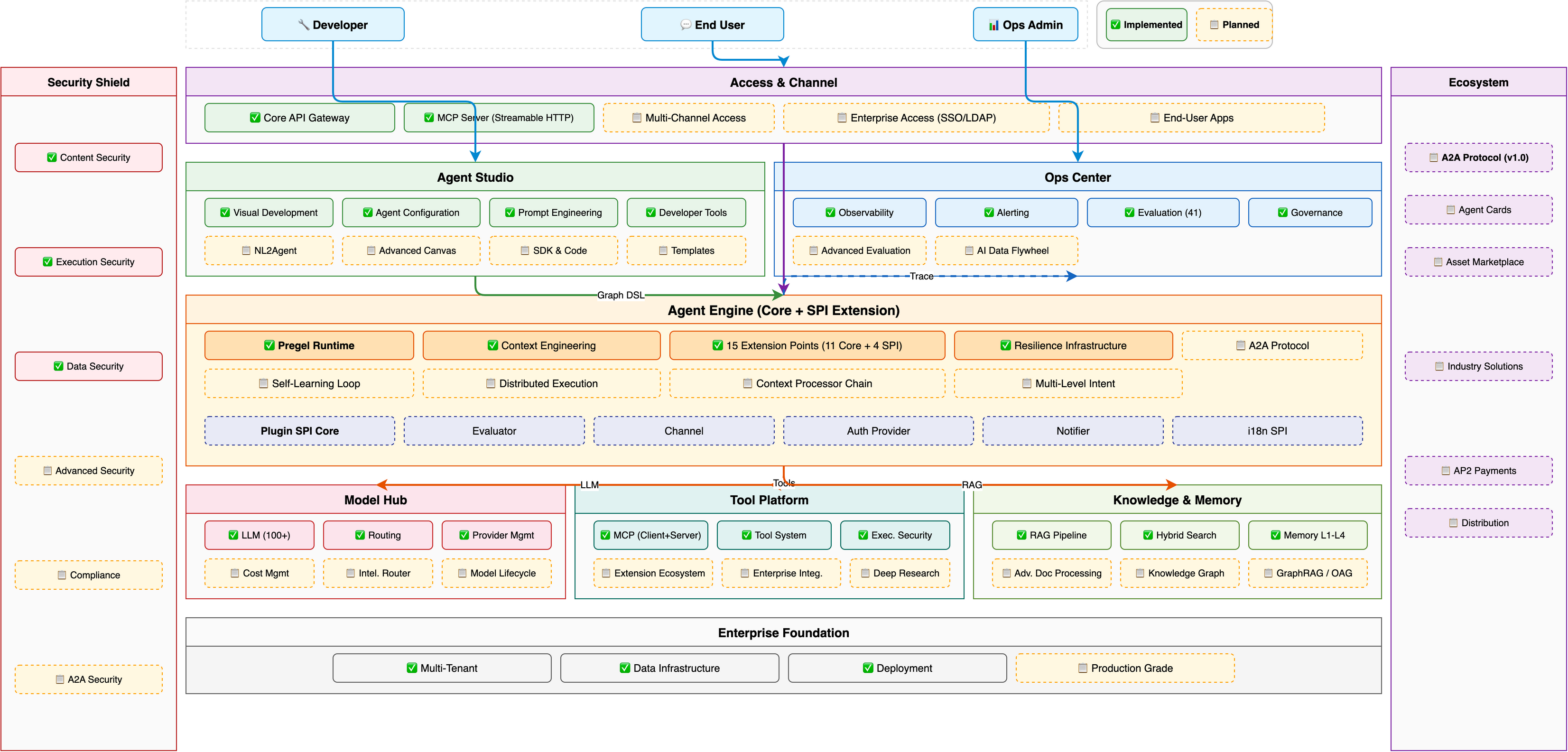
Hecate is an enterprise-grade Agent platform with a self-developed Pregel execution runtime. It speaks MCP and A2A natively, integrates 100+ LLMs, and exposes an OpenAI-compatible API so existing tools integrate without change. Multi-agent orchestration, engine-level guardrails, and Docker-isolated sandbox execution are first-class concerns.
Who is this for?
Hecate is a good fit if you need any of the following:
- A flexible agent runtime — code-first Python API for engineers and a visual canvas for non-developers
- Engine-level extensibility — 11 core + 4 SPI extension points let you swap schedulers, checkpointers, guardrails
- Self-hosted on your own infrastructure — your prompts never leave your network; LLM traffic uses your API keys
- Multi-agent orchestration with persistence — graph-based state, durable checkpoints, human-in-the-loop
- A multi-tenant foundation — Organization → Workspace → RBAC for an internal agent platform product
- To study or extend an agent runtime — layered architecture with a self-developed Pregel engine and no framework lock-in
Hecate is not a good fit if you want a managed cloud service — Hecate is OSS, self-hosted, and you run it on your own infrastructure. (Dify or n8n may be better fits if your team is non-developer-first and you want a pure GUI-driven, no-code experience.)
Quick Start
git clone https://github.com/xueyufish/hecate.git
cd hecate
docker compose -f docker/docker-compose.yml up -d
source .venv/bin/activate && uv pip install -e ".[dev]"
cp .env.example .env       # edit API keys and DB URLs
alembic upgrade head
uvicorn hecate.main:app --reload
Then send your first chat request:
curl -X POST http://localhost:8000/v1/chat/completions \
  -H "Authorization: Bearer your-api-key" \
  -H "Content-Type: application/json" \
  -d '{
    "model": "gpt-4o",
    "messages": [{"role": "user", "content": "Hello!"}]
  }'
Interactive API docs are available at http://localhost:8000/docs (Swagger UI) and /redoc.
Features
- Graph-First Engine — Self-built Pregel/BSP runtime with 11 core + 4 SPI extension points. Zero external framework dependencies for the engine.
- Context Engineering — An extensible pipeline (assembler, evidence tracker, phase detector, token budget, provider shaping, message prioritization, tool filtering, offloader) that keeps long-running agents on-budget and on-task.
- MCP + A2A Native — Bidirectional MCP client and server, plus Linux Foundation A2A protocol support for cross-framework agent communication.
- Multi-Agent Orchestration — Six collaboration patterns (Hierarchical, Handoff, Pipeline, Broadcast, Negotiation, Debate) unified as Graph templates.
- Multi-Tenant — Organization → Workspace → RBAC with workspace_id on 35 data models for tenant isolation.
- Engine-Level Guardrails — Four hook types (Pre/Post LLM/Tool) at every LLM and Tool boundary; the same hooks power PII masking, audit logging, and human-in-the-loop flows.
Engineering Approach
Hecate's design follows three disciplines common to serious agent platforms:
- Harness engineering — the runtime is the harness. Every LLM call passes through the Pregel superstep loop, with durable checkpoints, retry policies, and 11 core + 4 SPI extension points providing observability and control at every boundary.
- Loop engineering — agent control loops are first-class. The superstep iteration is complemented by
interrupt()/Command()for human-in-the-loop,RetryStrategyfor failure recovery, and multi-agent delegation patterns where each subgraph runs its own execution loop. - Graph engineering — workflows are graphs. A JSON DSL describes nodes and edges; the compiler validates, optimizes, and emits an executable
CompiledGraph. Six multi-agent collaboration patterns ship as static graph templates.
Trust & Security
Built for on-premises and regulated deployments:
- PII masking and data isolation — guardrail hooks redact sensitive content before it leaves your network
- Audit trail — every LLM call, tool invocation, and checkpoint is logged to your own PostgreSQL
- Sandboxed tool execution — Docker-isolated runtime with explicit permission scopes per agent
- No external data retention — prompts and completions go directly to your LLM provider; Hecate does not store them
CLI Tools
Hecate ships two console-script entry points:
hecate— the main CLI for managing agents, sessions, knowledge bases, workflows, and other resources. Seedocs/reference/cli.mdfor the full command list.hecate-migrate— standalone migration runner. Designed for one-shot use as a Docker Compose init service, a Kubernetes init container, or a Helm pre-install hook — runs Alembic migrations without booting the full web application.
After uv pip install -e ".[dev]", both commands are available on your PATH.
Documentation
- Getting Started — install and run Hecate
- Tutorials — end-to-end examples (first agent, knowledge base, MCP, multi-agent)
- How-to Guides — task-oriented recipes (LLM providers, deployment, backup)
- API Reference — REST and CLI references
- Architecture — engine design, concepts, ADRs
Inspired by
Hecate builds on the shoulders of giants: LangGraph, Model Context Protocol, A2A Protocol, FastAPI, Pydantic, SQLAlchemy, LiteLLM. Full credits and specific inspirations are in docs/about/inspired-by.md.
Contributing
Contributions are welcome. See CONTRIBUTING.md for the workflow, coding conventions, and how to file issues. Every feature ships through the OpenSpec workflow with requirements, scenarios, and design docs.
License
Yorumlar (0)
Yorum birakmak icin giris yap.
Yorum birakSonuc bulunamadi