y
Health Gecti
- License — License: MIT
- Description — Repository has a description
- Active repo — Last push 0 days ago
- Community trust — 88 GitHub stars
Code Uyari
- process.env — Environment variable access in app/e2e/desktop.spec.ts
- network request — Outbound network request in app/e2e/desktop.spec.ts
- process.env — Environment variable access in app/electron.vite.config.ts
- process.env — Environment variable access in app/playwright.config.ts
Permissions Gecti
- Permissions — No dangerous permissions requested
Bu listing icin henuz AI raporu yok.
Malleable coding agent app. Use Claude Code and Codex to code and reshape the app itself live.
y
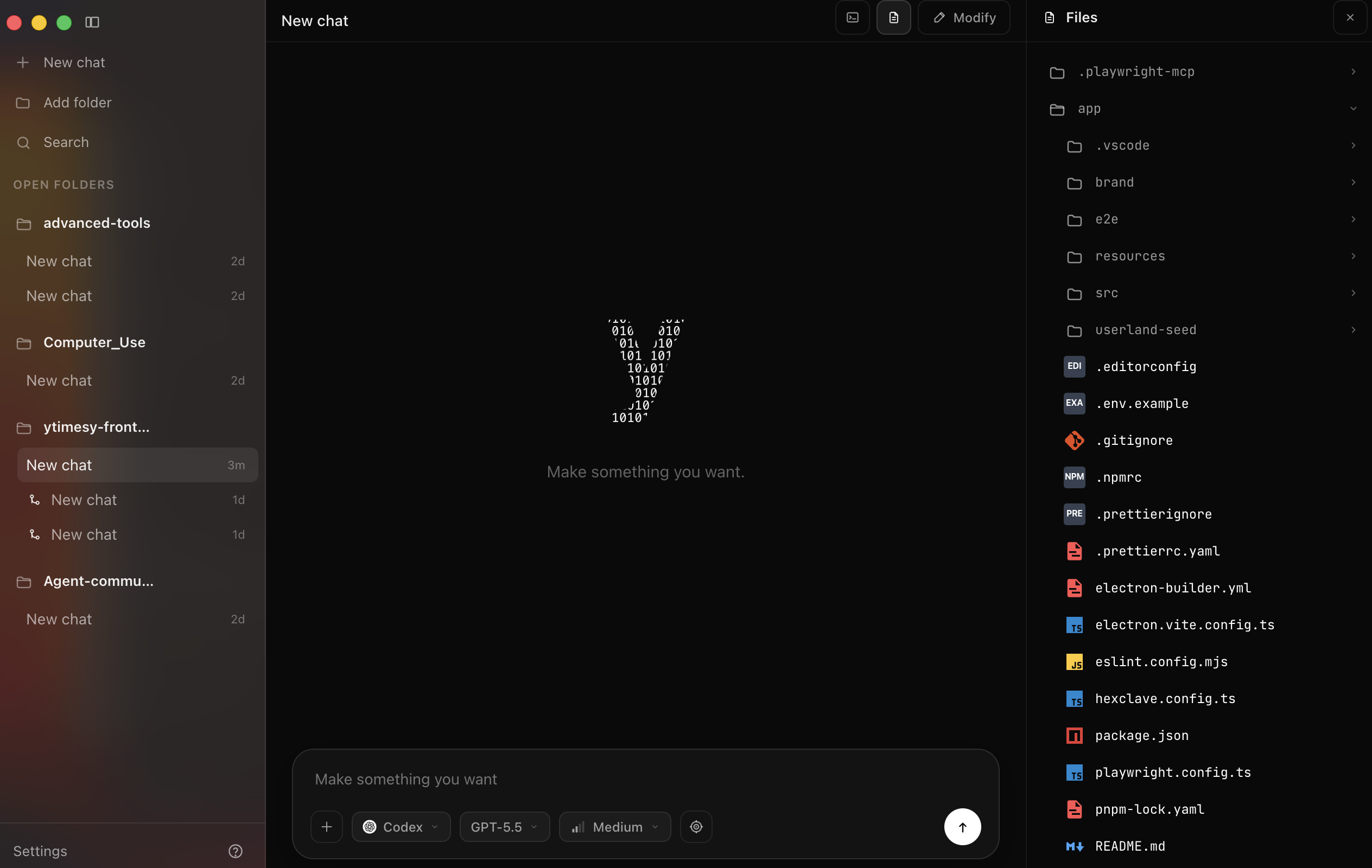
https://github.com/user-attachments/assets/24f10277-bb0e-4c3f-8a05-6833363d07a2
Star History

y is a malleable desktop coding-agent app.
It is built around a simple idea: software should become malleable while you use it. The main interface is a chat, but the app can reshape its own UI through a protected Modify surface. You can ask y to change how y itself works, keep the change if it renders safely, or roll it back if it does not.
y is not a new agent model. It is a local, chat-first workspace for the coding agents you already use: Claude Code, OpenAI Codex, and other CLI-native agents over time.
Privacy at a glance
y does not collect your chat data. Project files, terminal commands, chat contents, and agent prompts are not collected or stored by y.
y only uses product analytics for basic app health and usage signals, like sign-in state, feature usage, feedback, and missing-brick requests. "Local" means Claude Code and Codex run on the user's machine through their official CLIs. Login supports account-based product features and basic usage analytics.
Things to try
- Run Claude Code and Codex side by side from one desktop app.
- Let your coding agent run
git init, then start separate chats in isolated workspaces so agents can work in parallel without touching the same checkout. - Ask Modify to change y's interface live, then review the generated diff before keeping it.
- Add or adjust app UI controls, layout, copy, and local workflow affordances through Modify.
- Open the file tree, terminal, and diff views while an agent is working.
- Revert a Modify change if the new UI is not what you wanted.
What Modify is
Modify is the part of y that edits y itself. It is a separate chat focused on changing the app interface, not your project code. The change still goes through code and diff review: Modify edits the local Userland UI, y renders it, and you choose whether to keep or revert it.
Modify is not meant to control the protected app core. It should not get access to auth/session internals, analytics controls, privileged host APIs, or the Modify system itself. Those boundaries live in the protected Kernel.
Why y exists
Most coding-agent apps are fixed products. You can use them, configure them, maybe install plugins, but the product itself still belongs to someone else.
y is different. It treats the app as malleable software:
- Chat first. The default surface is a focused conversation, not an editor clone.
- Self-modifying. The Modify rail can edit the live Userland UI while the protected Kernel stays locked.
- Local agents. Claude Code and Codex run as official local CLIs with the user's own login.
- Parallel work. Chats can use isolated workspaces so agents can work in parallel without stepping on the same files.
- Diff-gated changes. UI changes compile, render, show a diff, and can be kept or discarded.
- Rollback built in. The app keeps known-good snapshots so broken UI changes can recover.
How it works
y is split into two parts:
| Layer | What it does |
|---|---|
| Protected Kernel | Auth, local engine adapters, app state, safety rails, filesystem boundaries, terminal bridge, Modify rail, and rollback runway. |
| Mutable Userland | The chat UI and app surface that can be edited live by the user or by Modify. |
This split lets y feel self-modifying without giving the modification agent control over the protected core. The app can change its own interface, but the Kernel still owns the trust boundaries.
Claude Code and Codex
y runs coding agents locally instead of proxying them through a hosted account.
- Claude Code uses the official Claude Code CLI.
- Codex uses the official Codex CLI.
- Model and effort settings stay visible in the composer.
- Multiple chats can run against different engines.
- Isolated workspaces let parallel agents work without interfering with each other.
The user's local CLI auth remains the source of truth. y orchestrates the experience; it does not replace the agent providers.
Download
The latest macOS build is published on GitHub Releases:

Current release target: macOS Apple Silicon.
Development
cd app
pnpm install
pnpm dev
Useful checks:
pnpm typecheck
pnpm test:ui
Build a local macOS bundle:
pnpm build:mac
The generated app artifacts are written to app/dist/ and are intentionally not committed.
Status
y is under active development. The current focus is launch-readiness for macOS: packaging, auth, analytics, local app-state durability, and the self-modifying Modify workflow.
License
MIT. See LICENSE.
Yorumlar (0)
Yorum birakmak icin giris yap.
Yorum birakSonuc bulunamadi