screencap
Health Pass
- License — License: MIT
- Description — Repository has a description
- Active repo — Last push 0 days ago
- Community trust — 86 GitHub stars
Code Fail
- process.env — Environment variable access in dist-mcp/index.js
- execSync — Synchronous shell command execution in electron.vite.config.ts
- process.env — Environment variable access in electron.vite.config.ts
- execSync — Synchronous shell command execution in electron/builderHooks/afterPack.cjs
- process.env — Environment variable access in electron/builderHooks/afterPack.cjs
- fs module — File system access in electron/builderHooks/afterPack.cjs
- fs module — File system access in electron/builderHooks/beforePack.cjs
- network request — Outbound network request in electron/main/app/__tests__/protocol.test.ts
Permissions Pass
- Permissions — No dangerous permissions requested
This tool is a macOS desktop application that routinely captures your screen activity, windows, and applications to generate a timeline and summary of your day. It also includes a local Large Language Model (LLM) for activity classification and an optional end-to-end encrypted (E2EE) social feed for sharing progress.
Security Assessment
Overall risk rating: High. This application continuously handles highly sensitive user data by capturing screen content and actively tracking background applications. While it does not request explicit dangerous permissions and no hardcoded secrets were found, there are several severe code-level concerns. The codebase contains instances of synchronous shell command execution (`execSync`) within its build scripts, which introduces significant risks of command injection if exploited. Furthermore, the tool makes outbound network requests and accesses environment variables. Given that its core functionality involves reading local file systems and capturing active screens, it requires extreme trust from the user.
Quality Assessment
The project appears to be actively maintained, with its most recent push occurring today. It enjoys a solid foundation of community trust with 86 GitHub stars and is properly licensed under the permissive MIT license. The repository includes a clear description and provides comprehensive documentation regarding its security, sharing, and local LLM features.
Verdict
Use with caution due to the highly invasive nature of constant screen capturing and the presence of synchronous shell command execution in the codebase.
To remember what happened yesterday, share progress and break addictions. With E2EE social publishing, local LLM classification, and MCP support
Screencap
To understand where your day went
A macOS desktop app that captures screenshots, windows and apps (both background and foreground) on a schedule and transforms them into a timeline, daily summaries, project milestones, addiction tracking, with optional E2E-encrypted social feed.
Screencap answers the questions like:
- What did I actually do today?
- How long did I really work?
- Am I spending too much time on Chess?
- What progress did I make on my project?
- What my colleagues are doing?
- What actual progress on project X has been made since September?
The idea behind this opensource is to inspire as many forks as possible. The project (both app and social backend) are fully free to use, enrouranging everyone to customise and build their own Screencaps.
Project started as a background project tracker, as we all tend to have zero-to-little screenshots from projects we worked on for months. Then addiction tracker came it, the Spotify background played, End Of Day flow, activity popup, and social E2E network in tray (I couldn't help myself)
Download · Homebrew Tap · Changelog · Security · E2EE & Sharing · Local LLM
Install
Homebrew
brew install --cask yahorbarkouski/tap/screencap
Or, if you prefer to add the tap first:
brew tap yahorbarkouski/tap
brew install --cask screencap
Features Summary
Timeline
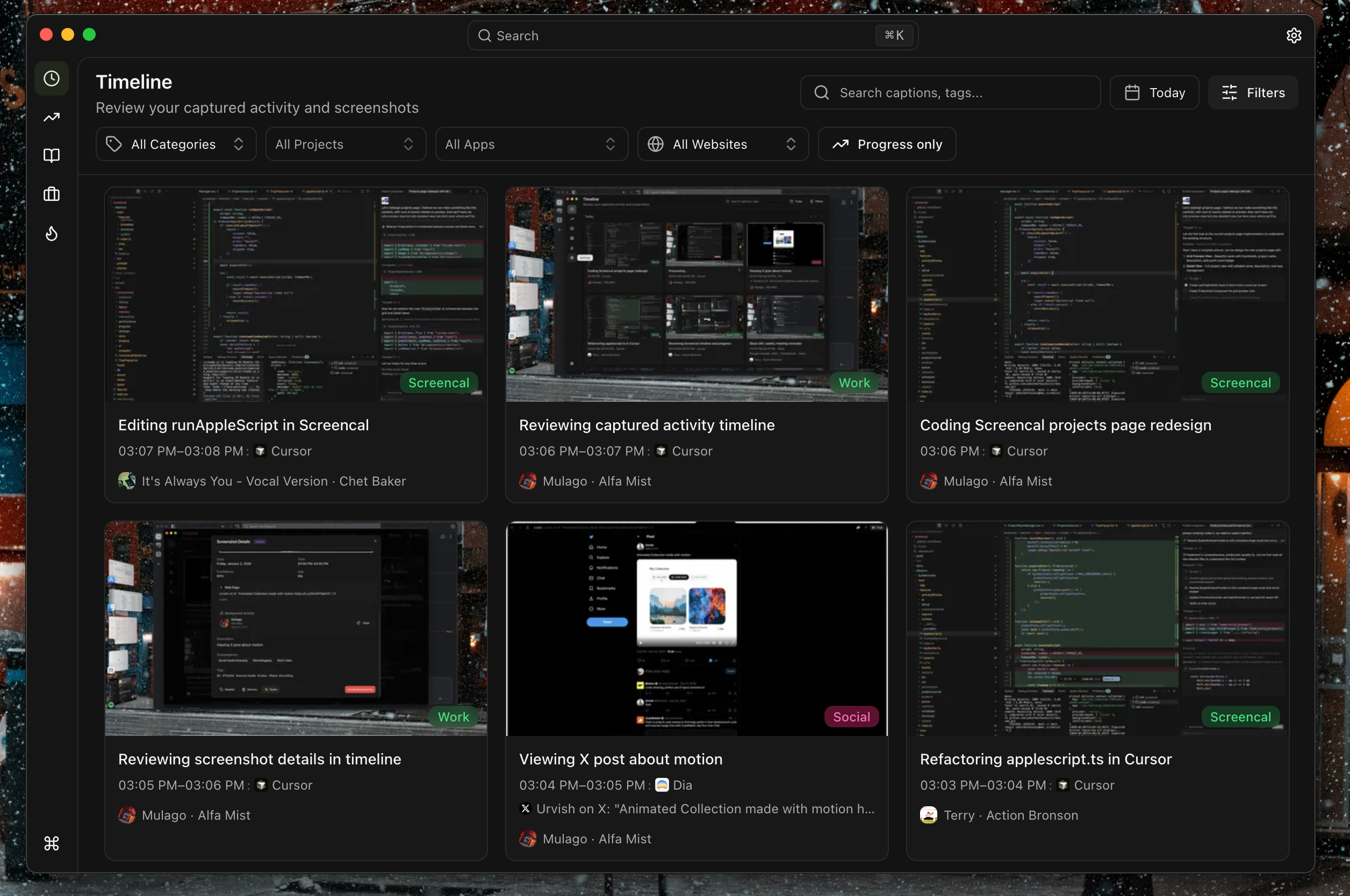
Time period (day), visualized as a stream of events
- Each card is an event — multiple captures with the same context and similar pixels merge into one time window
- Rich context extraction — app name, window title, browser URL, media playing, and per-app lower contexts like VS Code workspace
- Fully editable — relabel events, dismiss captures, copy screenshots, create per-app or per-website automation rules, mark as progress or addiction (by default done automatically via llms)
Day Wrapped
The tray widget "what happened today?" with quick actions and different views available.
|
Apps View - see which apps and websites dominated each time slot |
|
|
Categories - what categories dominated |
Addictions - confirmed signals highlighted |
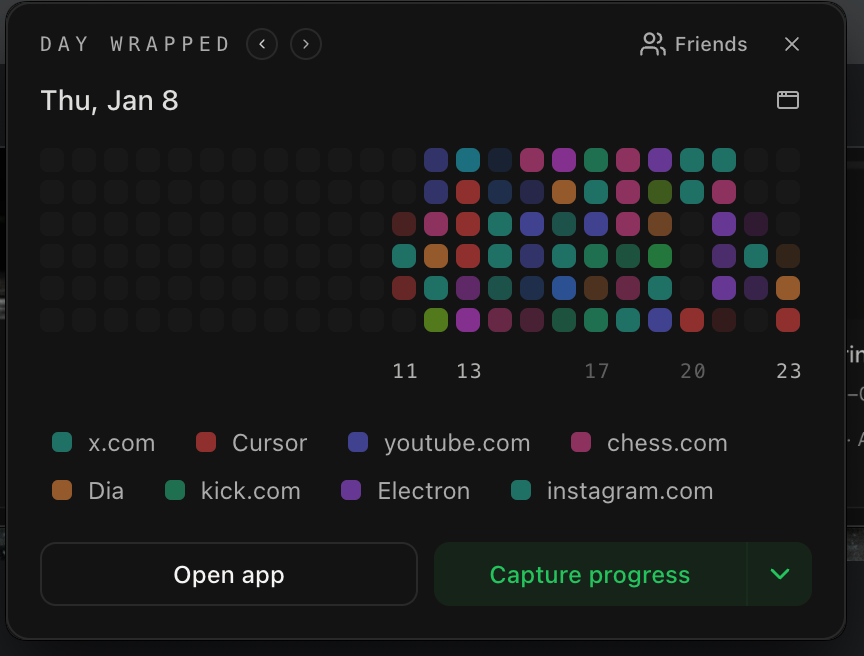
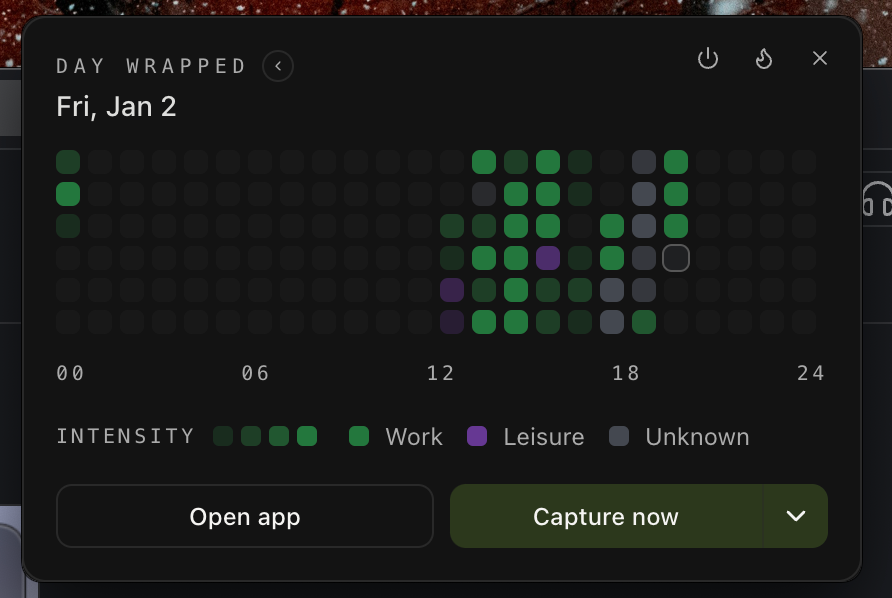
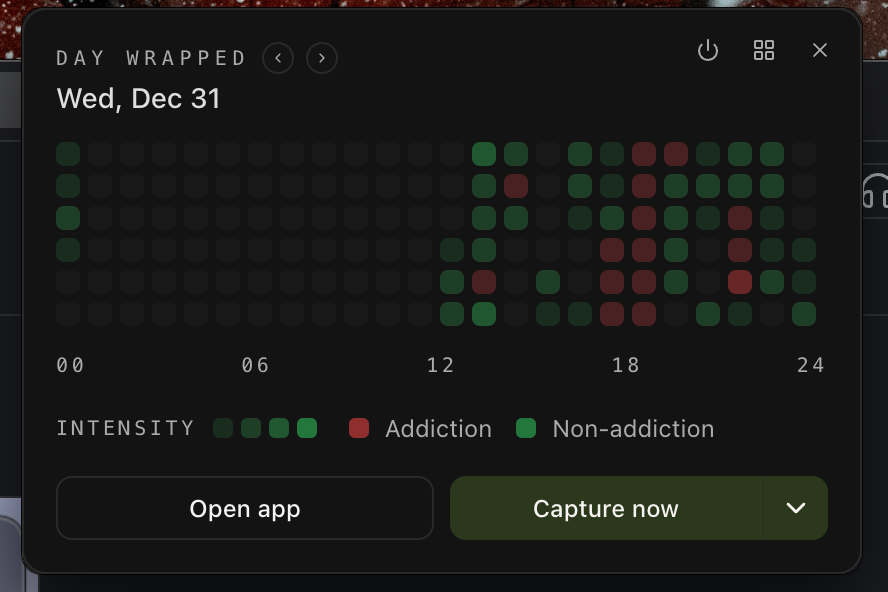
Quick actions:
- Capture now — trigger an immediate capture
- Capture project progress — save a milestone with a caption (screenshots active window and waits for a comment. would want to double-down and add loom-like view support one day)
Journal
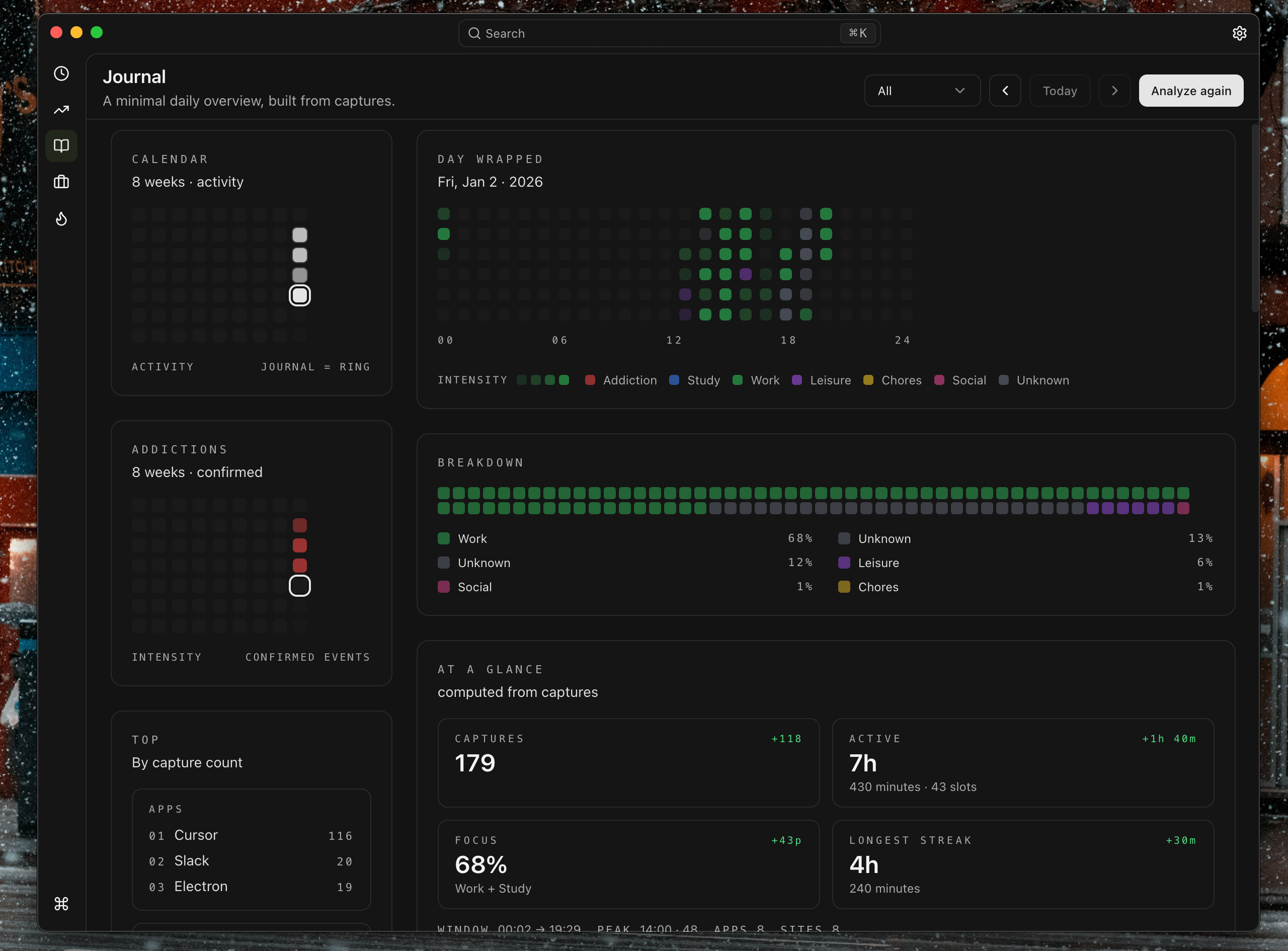
To turn your day into a narrative
- Dayline visualization — see your entire day at a glance with category colors
- Breakdown metrics — active time, focus percentage, longest streak, top apps/sites/projects
- End of Day — optional LLM-powered daily recap (or the one from End of Day flow below)
- Manual journaling — write reflections, embed event screenshots, create custom sections
End of Day Flow
A guided ritual to close your day intentionally, guides you through:
- Summary — metrics and dayline visualization
- Progress Review — confirm or promote potential milestones
- Addictions Review — acknowledge or dismiss flagged events
- Write — compose custom sections with embedded event screenshots
| Summary |
|---|
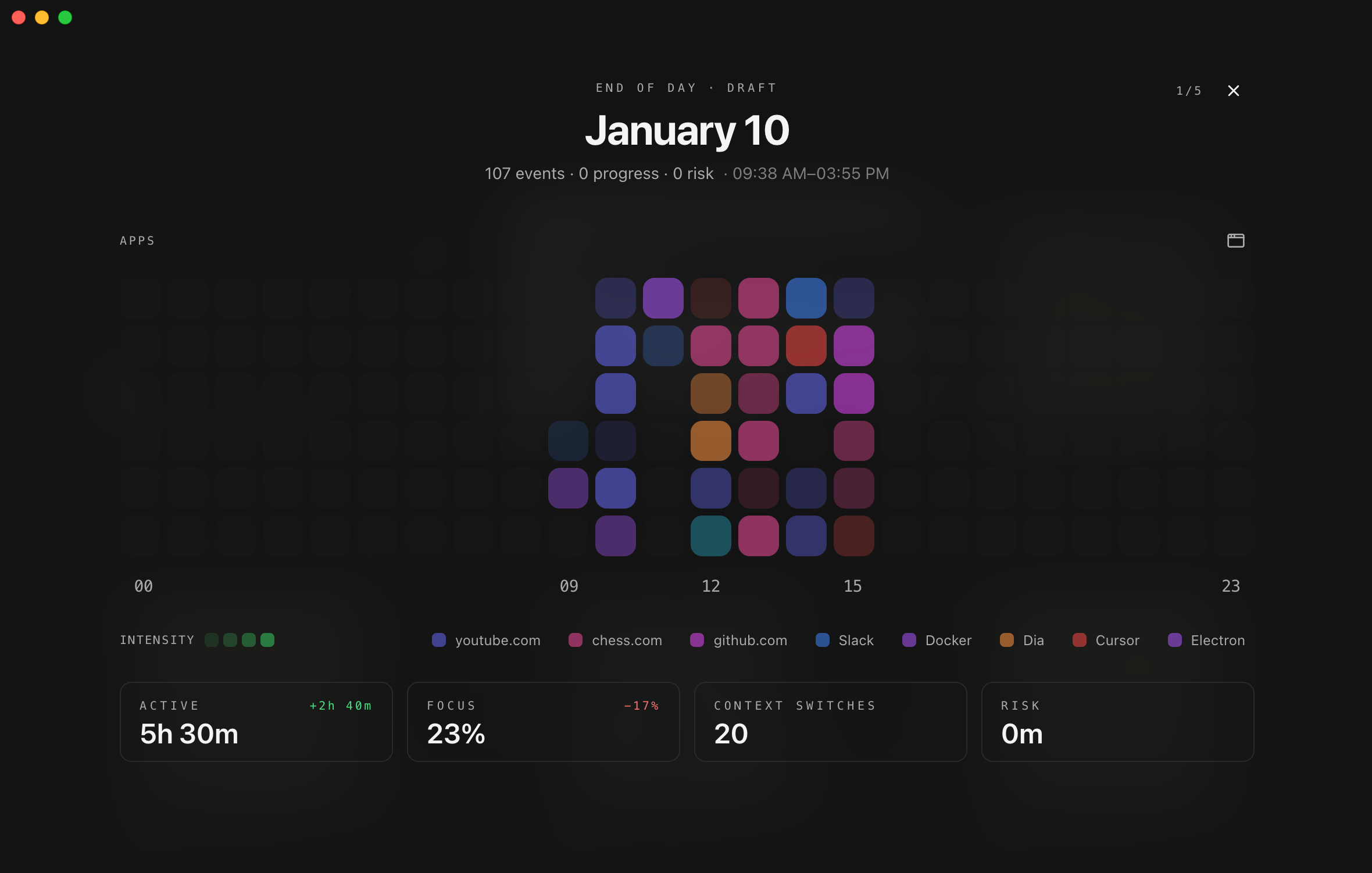 |
| active time, focus, progress milestones, addiction episodes. |
| Write |
|---|
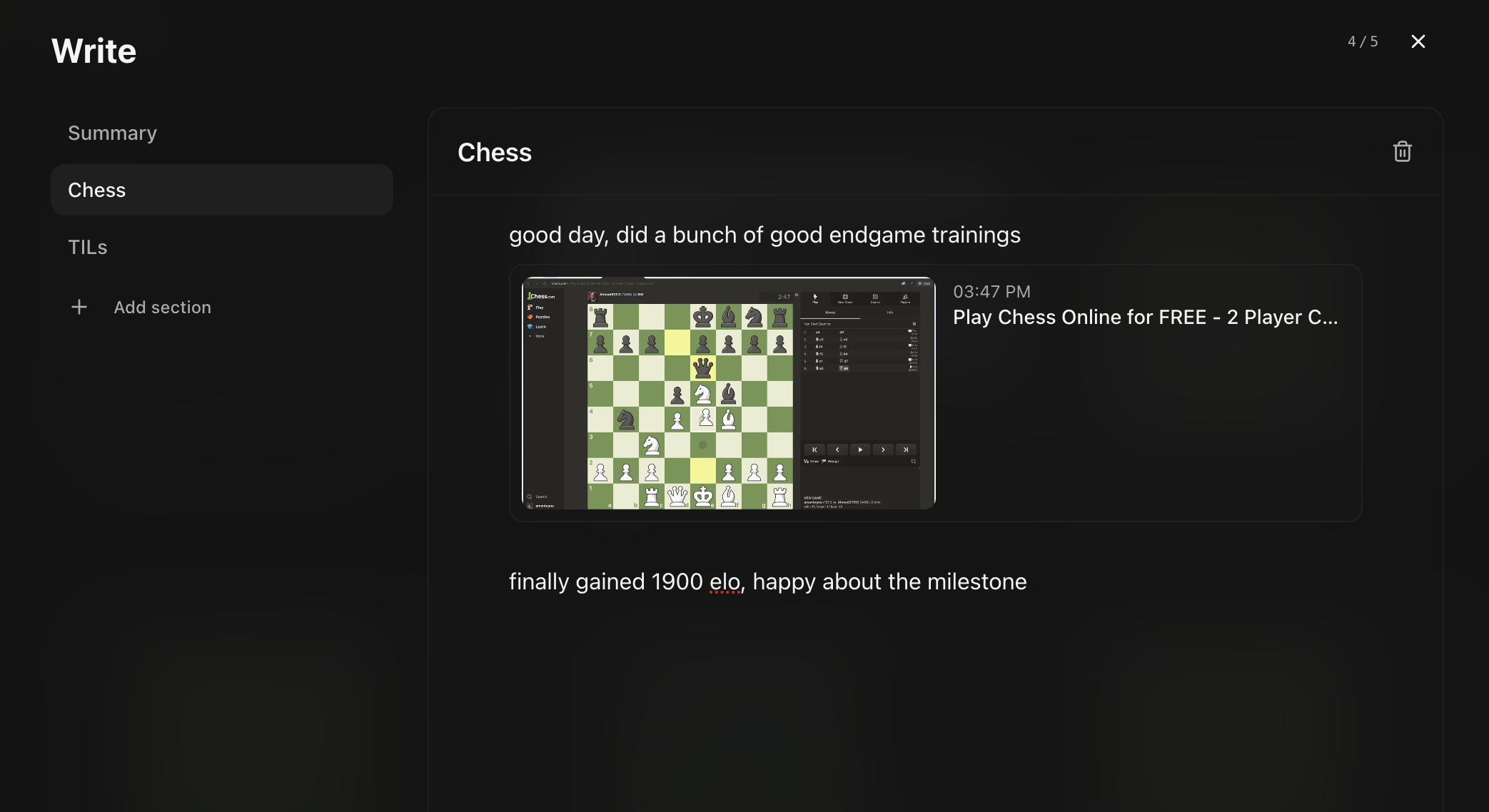 |
| to compose with embedded screenshots and custom sections. |
Addictions
Define behaviors you want to track, then measure. Bullet chess in my case:) But is thought for games and porn too, so tricky events are well-covered.
| Overview | Example: Speed Chess |
|---|---|
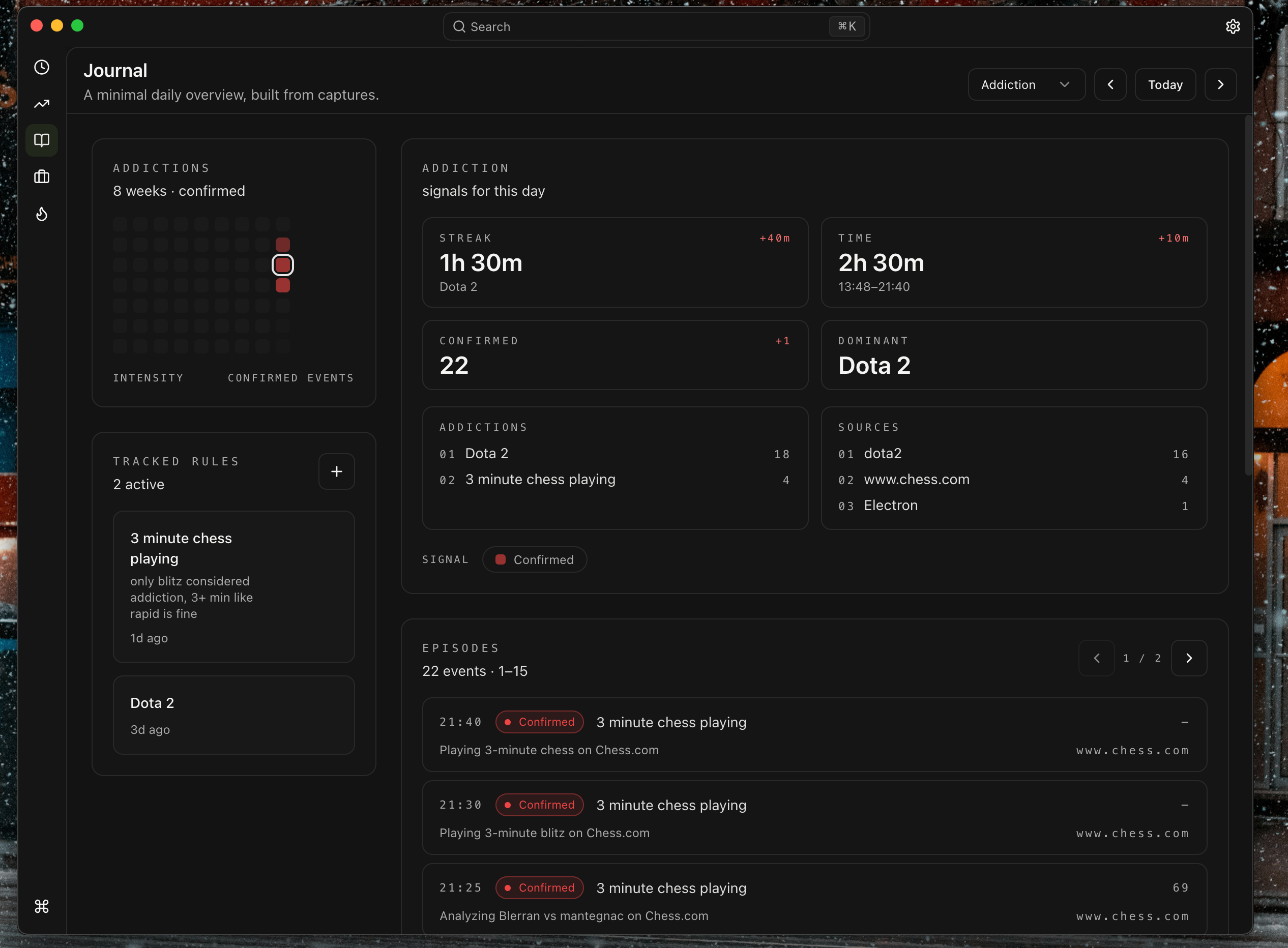 |
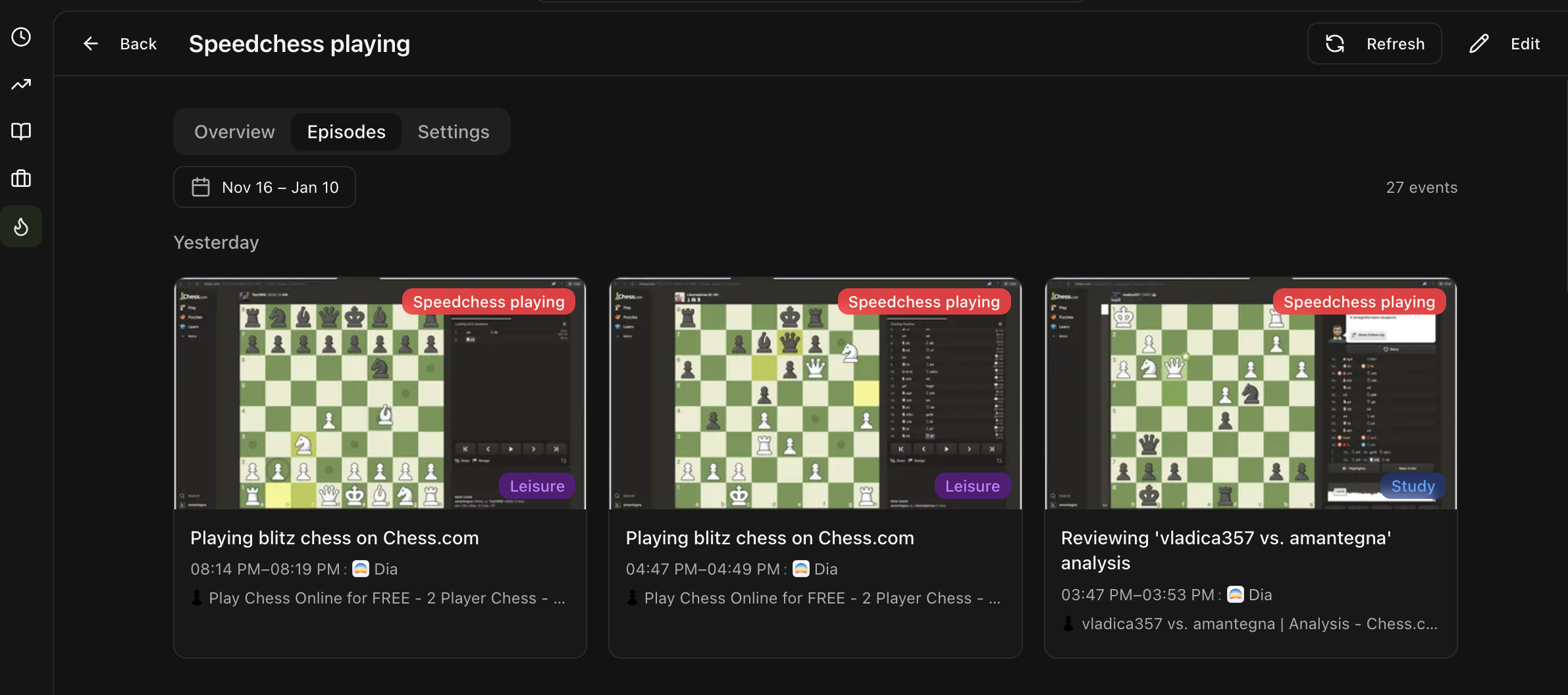 |
| Calendar heatmap, streak counter, and episode timeline. See patterns across weeks. | Track specific behaviors like bullet chess. The AI detects candidates, you confirm episodes. |
- Create rules — define what counts as an addiction
- AI detection — the LLM surfaces candidates based on content (either image OCR or image itself + Accessibility context)
- Calendar view — see patterns across weeks
- Streak tracking — visualize consecutive clean days
- Episode timeline — drill into specific incidents with screenshots
Project Progress
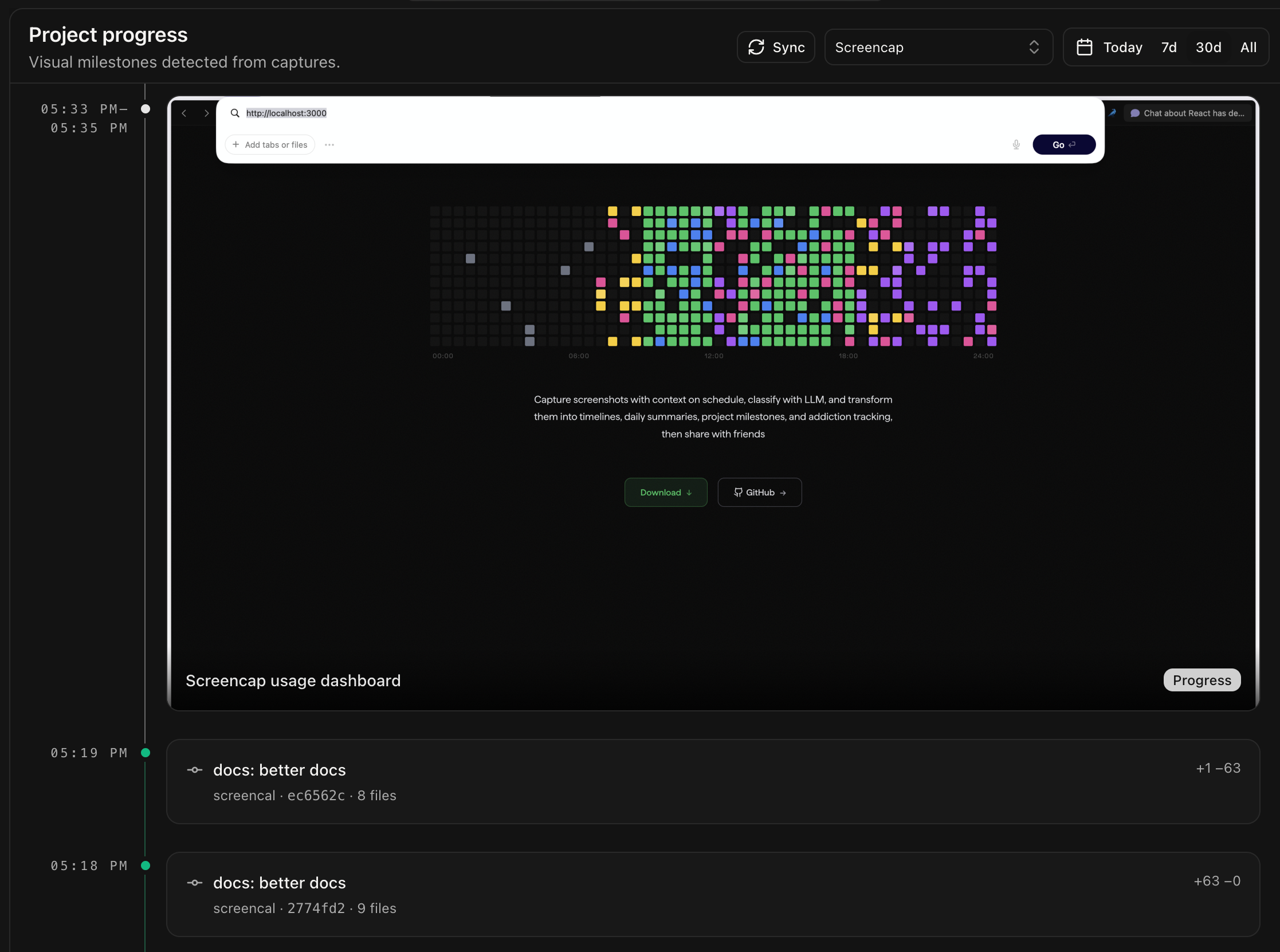
A dedicated timeline for milestones and momentum, the foundation for multiplayer collaboration
- Automatic detection — AI identifies progress-worthy captures
- Manual milestones —
⌘⇧Pto capture and caption a moment - Git integration — link local repositories to see commits alongside work sessions
- Multi-project filtering — track progress across all projects or focus on one
Sharing: Projects can be shared with friends via encrypted rooms. Invite collaborators by username, and everyone sees each other's milestones in a unified timeline. All shared content is end-to-end encrypted; the server never sees your screenshots or captions, but just in case you can selfhost and set your own backend, for a better guide see screencap-website project
Social & Friends
So you can feel-not-ask each other:)
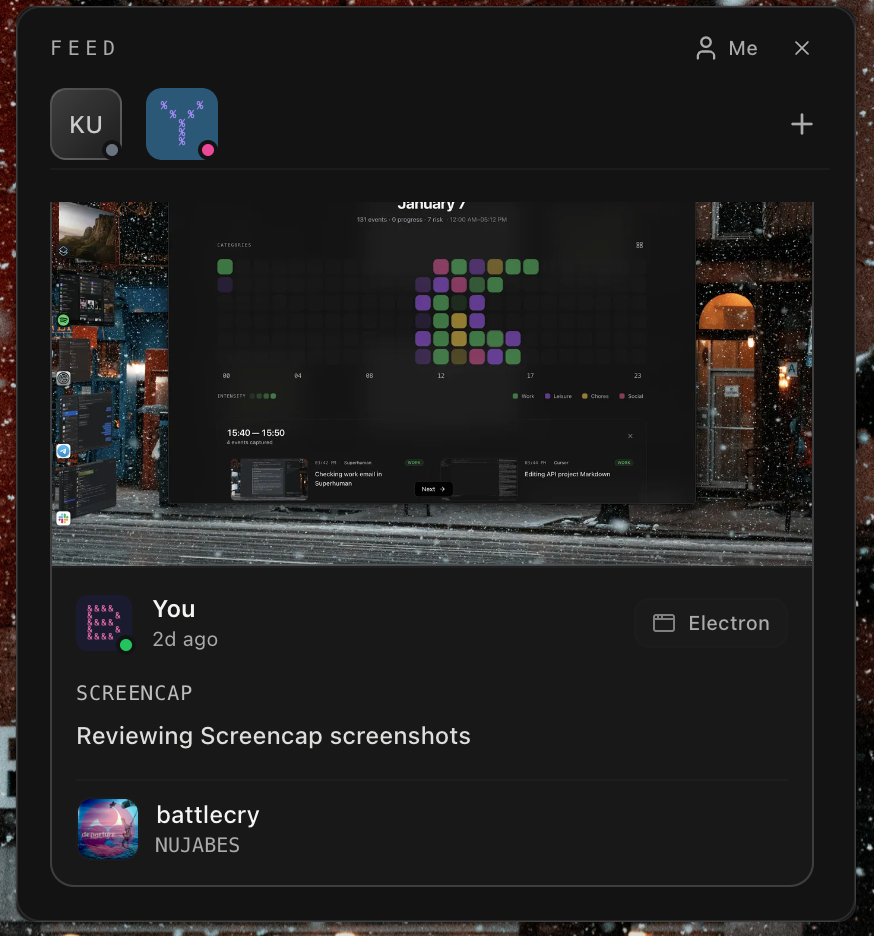
| Activity Feed | Friend's Day |
|---|---|
 |
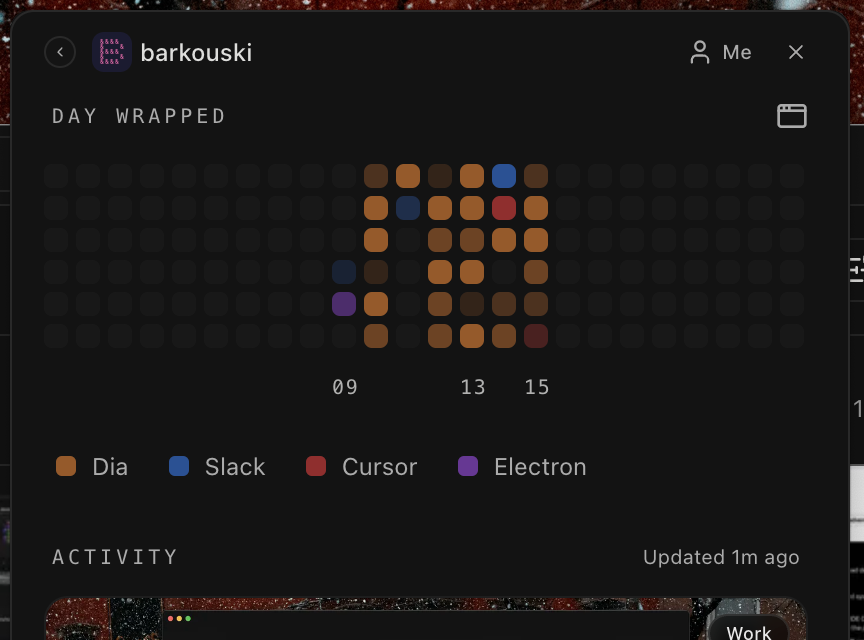 |
| See what friends are working on. Screenshots, captions, and context | View a friend's dayline, categories, and recent activity in real-time. |
The flow is simple:
- Choose a username
- Add friends
- Share Day Wrapped — let friends see your dayline in real-time
- Shared projects — invite friends to project rooms, see their milestones
- Comments — react to shared events with threaded messages
- Activity feed — see what friends are working on
Context Providers
Screencap extracts rich context from your active window:
| Provider | What it captures |
|---|---|
| Native macOS APIs | Frontmost app, window title, fullscreen state |
| Safari | Current URL, page title |
| Chromium browsers | Current URL, page title (Chrome, Arc, Brave, Edge, etc.) |
| Spotify | Track name, artist, album art |
| Cursor/VS Code | Workspace path, project name |
With accessibility + automation permissions, we can get pretty much precise context
LLM Classification
When enabled, events go through a multi-step classification pipeline:
- Cache reuse — instant match by fingerprint + context
- Local retrieval — match against your own history
- Local LLM — Ollama, LM Studio, or any OpenAI-compatible server
- Cloud text — OpenRouter with context + OCR (no images)
- Cloud vision — OpenRouter with screenshots (if enabled)
- Fallback — baseline classification from context alone
Classification output:
- Category — Work, Study, Leisure, Social, Chores, Unknown
- Project — detected project name
- Caption — human-readable description
- Addiction candidate — potential matches against your rules
- Progress detection — milestone-worthy content
Automation Rules
Fine-grained control over capture and classification:
| Rule | Effect |
|---|---|
| Skip capture | Don't screenshot this app/website at all |
| Skip AI | Capture locally but never send to LLM |
| Force category | Always assign Work/Study/etc. |
| Force project | Always tag captures with a project |
Create rules from any event card or in Settings->Automation.
Privacy & Security
Local-first overall, but for LLM classification both local and remote (openrouter/openai) options are available.
What stays local
- SQLite database under
~/Library/Application Support/Screencap/ - All screenshots (thumbnails + originals)
- Settings and encryption keys (Keychain-encrypted)
What can go to the network (opt-in)
| Feature | Data sent | Where |
|---|---|---|
| Cloud AI | Context + OCR text | OpenRouter/OpenAI |
| Cloud Vision | Screenshot images | OpenRouter/OpenAI (if enabled) |
| Friends/Sharing | Encrypted events | Backend (default: screencaping.com; can be self-hosted) |
| Auto-updates | Version check | GitHub Releases |
End-to-End Encryption
All shared content (screenshots, captions, chat) is encrypted on your device before upload.
- Device identity — Ed25519 signing key + X25519 key agreement key
- Room keys — 32-byte secrets, per-recipient-device encrypted envelopes
- Event encryption — AES-256-GCM with keys derived via HKDF
- Chat encryption — DMs use X25519 shared secret; rooms use room key
The server sees ciphertext, metadata (timestamps, usernames, project names), and encrypted blobs. It cannot read content.
See Security & Privacy: Sharing and E2EE Crypto Spec.
Install
Requirements
- macOS 13+ (Ventura or later)
- Screen Recording permission (required)
- Accessibility permission (recommended)
- Automation permissions (recommended)
Download
- Grab the latest DMG from Releases
- Open the DMG and drag
Screencap.appto Applications - Launch — the onboarding wizard guides you through permissions and setup
Permissions
| Permission | Purpose | Required? |
|---|---|---|
| Screen Recording | Capture screenshots | Yes |
| Accessibility | Read window titles | Recommended |
| Built-in macOS APIs | Identify focused window | Enabled automatically |
| Automation -> Browsers | Read URLs from Safari/Chrome/etc. | Recommended |
| Automation -> Media apps | Capture Spotify track info | Optional |
First Run
The onboarding wizard walks you through:
- Screen Recording — grant the core permission
- Accessibility — enable rich window context
- Automation — allow per-app context extraction
- AI Setup — choose Cloud, Local, or Disabled
- First Capture — see what Screencap captures
After onboarding:
- Capture interval is set in Settings -> Capture
- Retention period is set in Settings -> Data
- Global shortcuts are customizable in Settings -> Capture -> Shortcuts
Shortcuts
| Action | Default | Notes |
|---|---|---|
| Command palette | ⌘K |
Quick access to any view or action |
| Capture now | ⌘⇧O |
Immediate screenshot |
| Capture project progress | ⌘⇧P |
Opens caption popup for milestone |
| End of Day | ⌘⇧E |
Open the journal flow |
All shortcuts are configurable in Settings -> Capture -> Shortcuts.
How Capture Works
Screencap uses dominant activity scheduling:
- Sample context every second — which app, window, URL is in focus
- Wait for stability — context must be stable for ~10 seconds
- Capture candidate — take a multi-display screenshot
- Keep the dominant — at the end of the interval, save the most representative capture
- Merge similar events — captures with same context + similar pixels become one event
This means:
- Quick app switches don't produce captures
- You get one clean event per sustained activity
- Storage usage stays reasonable
The overall capturing algo is still in very rough and can be very much improved
LLM Configuration
Cloud LLM (OpenRouter / OpenAI)
Screencap uses OpenRouter by default, but any OpenAI-compatible API works
- Get an API key from openrouter.ai/keys or platform.openai.com
- Settings -> AI -> Cloud LLM -> paste your key
- Choose a model (default:
openai/gpt-5-mini) - Toggle Allow vision uploads if you want image-based classification
OpenRouter gives you access to many models (Claude, GPT-5, Gemini, open-source) through one API key, so very much recommended
Local LLM (Ollama / LM Studio)
- Run a local OpenAI-compatible server
- Settings -> AI -> Local LLM -> enable and configure:
- Base URL:
http://localhost:11434/v1(Ollama) orhttp://localhost:1234/v1(LM Studio) - Model: the model name from
/v1/models
- Click Test to verify
See Local LLM Guide for detailed setup.
Disable AI
Settings -> AI -> Classification -> Off
Captures still happen, but no LLM calls. Events get basic category from context only.
Social Setup
Create Your Identity
- Open the tray popup -> Social tab
- Choose a username (alphanumeric, unique)
- Your device generates E2EE keys automatically
Add Friends
- Click + in the Social tab
- Enter their username
- They accept your request
Share Day Wrapped
Settings -> Social -> Day Wrapped Sharing -> Enable
Friends see your dayline in their feed. You control what's shared:
- Categories (always)
- App names (optional)
- Addiction flags (optional)
Share Projects
- Open Projects -> select a project -> Share
- Invite friends by username
- They accept the room invite and see your milestones
Self-Hosting
Screencap's backend is open source. Run your own:
- Settings -> System -> Custom Backend -> Enable
- Enter your backend URL
- See Self-Hosted Backend Guide
Your data, your server, full control.
Development
Requirements
- macOS
- Node.js 20+
- npm
Setup
git clone https://github.com/yahorbarkouski/screencap.git
cd screencap
npm install
Run
npm run dev
Test
npm test
Build
npm run build
npm run preview
Package
npx electron-builder --config electron-builder.yml
Architecture
screencap/
├── electron/
│   ├── main/           # Main process
│   │   ├── app/        # Window, tray, popup, lifecycle
│   │   ├── features/   # Capture, AI, context, social, sync
│   │   ├── infra/      # Settings, logging, storage
│   │   └── ipc/        # Secure IPC handlers
│   ├── preload/        # Context bridge (window.api)
│   └── shared/         # IPC channels, shared types
├── src/                # React renderer
│   ├── components/     # UI components
│   ├── hooks/          # React hooks
│   ├── lib/            # Utilities
│   └── stores/         # Zustand stores
└── docs/               # Documentation
Key Services
| Service | Purpose |
|---|---|
CaptureService |
Screenshot capture, fingerprinting |
ContextService |
App/window/URL/media extraction |
ClassificationService |
AI pipeline orchestration |
EventService |
Event creation, merging, storage |
IdentityService |
E2EE key management |
RoomsService |
Shared project rooms |
SocialFeedService |
Friend activity publishing |
MCP Integration (Claude Desktop / Cursor)
Screencap includes a built-in MCP server that exposes your activity data to Claude Desktop, Cursor, and other MCP-compatible tools. The MCP server is bundled with the app and does not require a separate build step.
Configure Claude Desktop
Add to ~/Library/Application Support/Claude/claude_desktop_config.json:
{
  "mcpServers": {
    "screencap": {
      "command": "/usr/bin/env",
      "args": [
        "-u",
        "ELECTRON_RUN_AS_NODE",
        "/Applications/Screencap.app/Contents/MacOS/Screencap",
        "--mcp"
      ]
    }
  }
}
For detailed documentation, see MCP Server Guide.
Available Tools
| Tool | Description |
|---|---|
query_events |
Query events with filters (date, category, project, app) |
search_events |
Full-text search across captions and window titles |
get_recent_activity |
Quick access to recent events |
get_time_summary |
Category/project time breakdown |
get_app_usage |
App usage statistics |
get_website_usage |
Website usage statistics |
compare_periods |
Compare productivity across two periods |
get_project_progress |
Progress events for a project |
list_projects |
All projects with stats |
get_addiction_stats |
Addiction tracking data |
get_focus_score |
Focus/distraction score for a day |
get_event_image |
Get thumbnail for a specific event |
Available Resources
| Resource | Description |
|---|---|
screencap://activity/today |
Today's activity events |
screencap://activity/recent |
Recent 2 hours of activity |
screencap://stats/today |
Today's category breakdown |
screencap://stats/week |
This week's statistics |
screencap://projects |
All projects with stats |
screencap://stories/latest |
Recent daily/weekly stories |
screencap://memories |
User-defined memories |
screencap://eod/today |
Today's end-of-day entry |
Available Prompts
| Prompt | Description |
|---|---|
daily_summary |
Summarize activity for a day |
project_status |
Get status of a specific project |
focus_analysis |
Analyze focus and distraction patterns |
Example Usage
In Claude Desktop or Cursor, you can now ask:
- "What was I working on today?"
- "How did I spend my time this week?"
- "Show me progress on the Screencap project"
- "Am I spending too much time on YouTube?"
- "Compare my productivity this week vs last week"
The LLM will use the appropriate tools to query your Screencap data and provide insights.
Contributing
Read Security Practices before adding new IPC handlers or file access surfaces.
Key principles:
- Treat IPC as a security boundary
- Validate all renderer inputs with Zod
- Use the
secureHandlewrapper for new handlers - Prefer allowlists over blocklists
Known Limitations and Pitfalls
This project is in beta. Expect rough edges, breaking changes, and behaviors that may surprise you.
AI Usage Can Spike Unexpectedly
The classification pipeline can make up to 2 LLM calls per screenshot (one for general classification, another for addiction verification). There's no rate limiting or cost tracking - if you capture frequently, your API bill can grow fast. Small models work best tho, but be thoughtful about this for a while
What's needed: smarter classification logic, caching improvements, and optional cost caps.
Event Trimming is Time-Based Only
Retention cleanup deletes old data based on time thresholds, not activity relevance. Important events get purged alongside noise if they're past the retention window.
What's needed: activity-aware or user-marked retention. Really curious one.
Hardcoded Thresholds
Many parameters are fixed /theoretically/:
- Fingerprint similarity thresholds
- Capture stability window (10s)
- Merge gap for events (~2× capture interval)
- HQ image retention (12 hours)
These may not fit all workflows and require some good practice to make sense / become dynamic
macOS Only
The entire context system uses AppleScript, macOS Vision, and Apple-specific APIs
If any of these bother you, PRs are very welcome
License
MIT
Reviews (0)
Sign in to leave a review.
Leave a reviewNo results found