opus-manager
Health Gecti
- License — License: MIT
- Description — Repository has a description
- Active repo — Last push 0 days ago
- Community trust — 40 GitHub stars
Code Gecti
- Code scan — Scanned 1 files during light audit, no dangerous patterns found
Permissions Gecti
- Permissions — No dangerous permissions requested
Bu listing icin henuz AI raporu yok.
Make Claude the manager, not the coder: one skill that hands work to cheaper AI CLIs, verifies the results, and gets a second vendor to review.
Opus Manager
English · 中文
国内下载 (China mirror): yan-auto.me/downloads/opus-manager
A Claude Code skill that makes Claude the manager of your project instead of its typist. Claude plans the work as tickets, dispatches them to cheaper coding agents already on your machine, verifies the results itself, and has a model from a different vendor review the code.
Why
Claude (Opus in particular) is strongest at judgment: breaking work down, deciding what "done" means, and telling a real bug from a false alarm. Writing the implementation is where most tokens go, and cheaper models can do that part.
With this skill, Claude's quota is spent on planning, acceptance and verification. The implementation runs on pay-per-use models. In the author's words: a $20 Claude Pro plan starts to feel like the $200 Max plan.
Field numbers
Each row is one day of real use. Small sample; your numbers will differ.
| Setup | Result |
|---|---|
| A colleague (anonymous) hands a full working day to the skill | 20% of the weekly Claude Pro quota; about $5–6 on worker models |
Work project: DeepSeek builds, GLM reviews (both via pi) |
DeepSeek: 3,617 model calls, ~808M tokens, ~$10.24. GLM review: 206 calls, ~$0.51 |
Author's app: Grok builds (cursor-agent), Gemini reviews (agy) |
13 tickets, 3 review rounds, 36 findings; Claude accepted and fixed 35, rejected 1 |
Worker models are billed per use, so they are not free. The saving is that Claude's quota stops going to implementation.
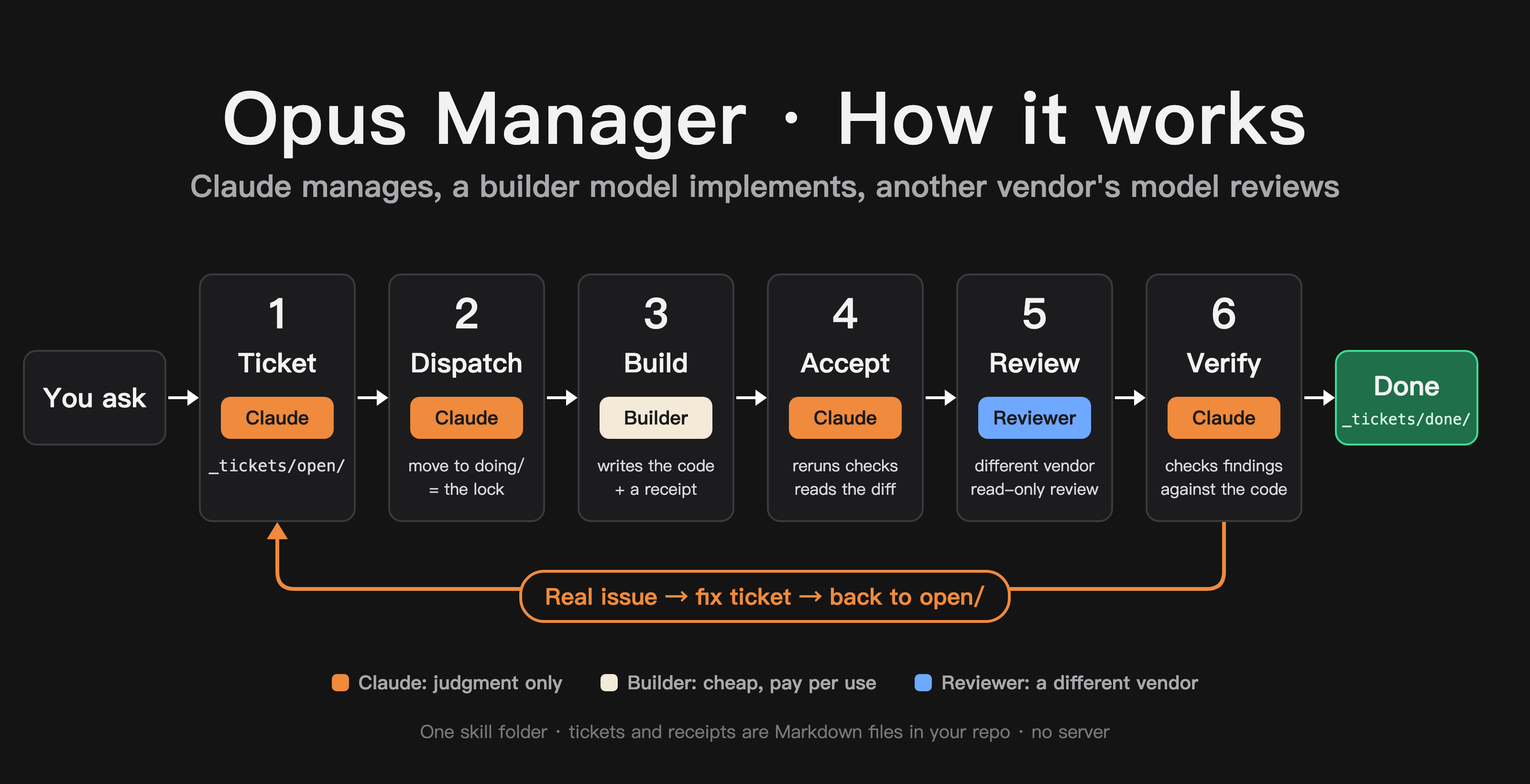
How it works
- Ticket. Claude writes a ticket in
_tickets/open/: the goal, the files that may change, acceptance commands, and why those commands matter. - Dispatch. Claude moves the ticket to
_tickets/doing/(the move is the lock), signs it with the worker and model, and runs the worker's CLI headless in the background. - Receipt. The worker writes
_receipts/<ticket>.receipt.mdwith the exact commands it ran and their raw output. - Acceptance. Claude reruns every acceptance command itself and checks the diff. A receipt is a claim, not evidence.
- Cross-vendor code review. A model from a different vendor reviews the change read-only and reports findings with file, line and evidence.
- Verification. Claude checks each finding against the code. Real ones go back as a fix ticket; wrong ones get a one-line reason. Accepted tickets move to
_tickets/done/.
Everything is plain Markdown in your repository: tickets, receipts, review reports, and Claude's verdicts.
First run
The first time you use it in a project, Claude sets it up with you:
- finds which AI CLIs are installed (
cursor-agent,agy/gemini,codex,pi,opencode,aider, …) and reads their--helpfor headless, auto-approve, model and read-only options; - asks you, one question at a time, who builds, who reviews, which models to use, which tools may see your code, and whether workers may edit without asking;
- runs a small trial ticket and saves the result to
_tickets/workers.md.
If you have no worker CLI yet, Claude explains the options (subscription-based or pay-per-use, where the privacy terms are) and installs the one you choose from its official source after you say yes. Sign-in and API keys stay with you.
Claude does not make privacy, cost or permission decisions for you.
Requirements
- Claude Code (Pro is enough)
- At least one other AI command-line tool, or let Claude install one on first run
Install
Easiest: open Claude Code and say
Install
skill/en/opus-managerfrom https://github.com/yanauto/opus-manager as my personal skill.
Or by hand:
macOS / Linux
git clone https://github.com/yanauto/opus-manager.git
mkdir -p ~/.claude/skills
cp -R opus-manager/skill/en/opus-manager ~/.claude/skills/
Windows (PowerShell)
git clone https://github.com/yanauto/opus-manager.git
New-Item -ItemType Directory -Force "$env:USERPROFILE\.claude\skills" | Out-Null
Copy-Item -Recurse opus-manager\skill\en\opus-manager "$env:USERPROFILE\.claude\skills\"
No git? On GitHub click Code → Download ZIP and copy skill/en/opus-manager to the same place.
Restart Claude Code afterwards.
Use
In your project, tell Claude Code:
Use tickets: add remember-me to the login page.
"Manage this" or "hand it off to other models" also work.
Tip
Let it run. Cutting in mid-task makes Claude stop and verify what you said, which costs quota. Speak up for real decisions; keep passing thoughts for later.
Status
- macOS: full workflow used daily.
- Windows: installation and tool discovery confirmed by one user; a full ticket run is not yet confirmed.
- Linux: expected to work, not yet tested.
Contributing
Issues and PRs are welcome. See CONTRIBUTING.md.
License
MIT
Yorumlar (0)
Yorum birakmak icin giris yap.
Yorum birakSonuc bulunamadi