proof-engine
Health Warn
- License — License: MIT
- Description — Repository has a description
- Active repo — Last push 0 days ago
- Low visibility — Only 6 GitHub stars
Code Fail
- eval() — Dynamic code execution via eval() in docs/examples/purchasing-power-decline/proof.py
Permissions Pass
- Permissions — No dangerous permissions requested
This AI agent skill creates formal, verifiable proofs of claims by offloading empirical claims to specific citations and all mathematical reasoning to executable Python scripts. It generates reproducible artifacts, including a re-runnable proof.py script and detailed markdown summaries.
Security Assessment
The overall risk is Medium. The tool does not request dangerous system permissions and contains no hardcoded secrets. However, the automated code scanning flagged a critical issue: the use of dynamic code execution via `eval()` inside its example scripts. While this is located within a documentation example rather than the core application logic, utilizing this agent to automatically generate and execute Python code inherently introduces a risk. Additionally, because the tool is designed to fetch live URLs and web snapshots to verify citations, it routinely makes external network requests.
Quality Assessment
The project is highly transparent about its goals and recently maintained, with its last push occurring today. It is properly licensed under the permissive MIT license. However, community trust and visibility are currently very low. The repository only has 6 GitHub stars, which indicates a very small user base and limited peer review.
Verdict
Use with caution: the project is active and open-source, but dynamic code execution in examples and low community adoption warrant a careful security review before integrating it into sensitive workflows.
AI agent skill that creates formal, verifiable proofs of claims — every fact computed or cited, never asserted
Proof Engine
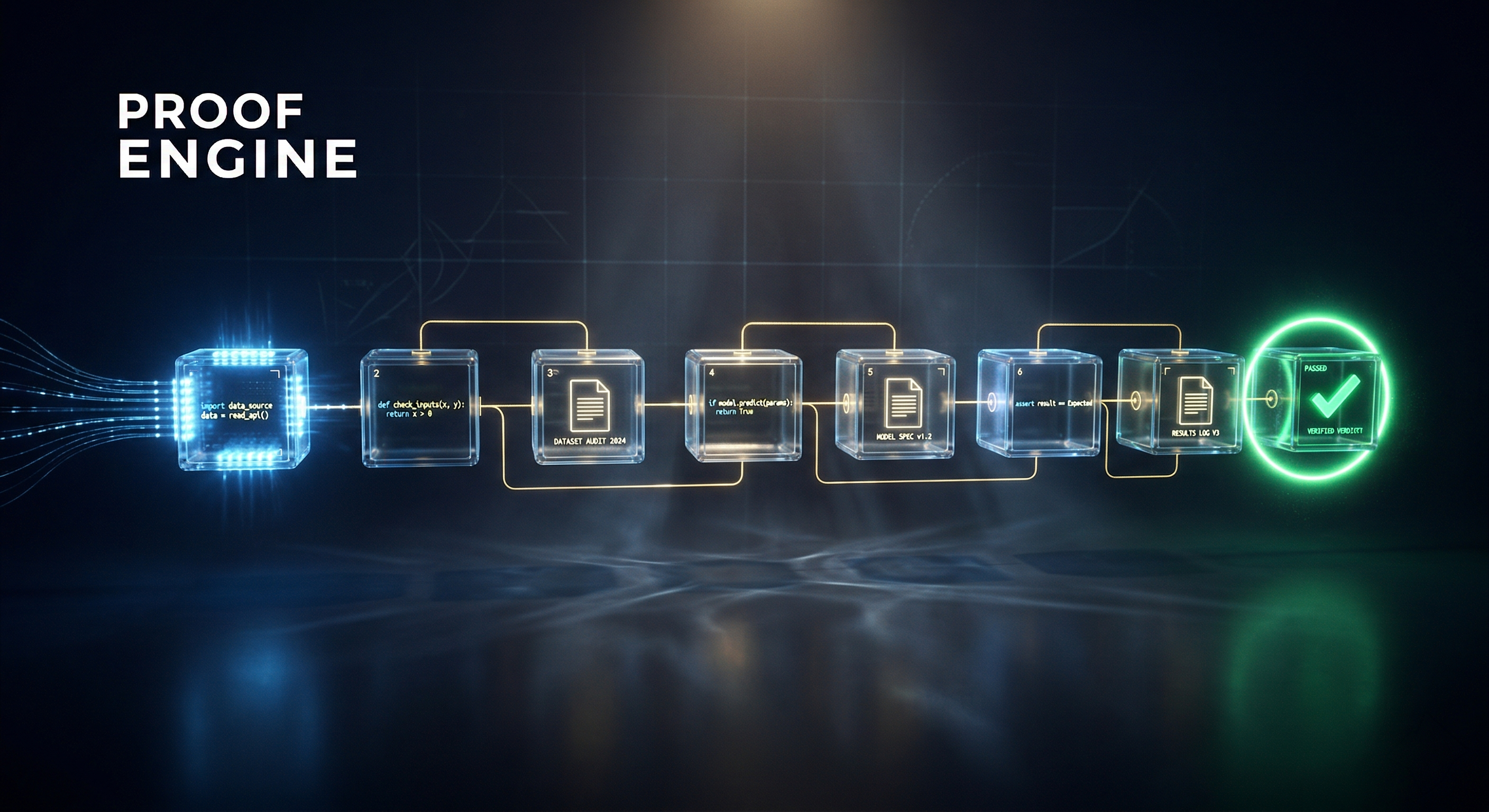





An AI agent skill that creates formal, verifiable proofs of claims. Every fact is either computed by Python code anyone can re-run or backed by a specific source, URL, and exact quote. The LLM never asserts a fact on its own authority.
Uses the open Agent Skills standard. Works with Claude Desktop, Claude Cowork, Claude Code, Codex CLI, Cursor, Windsurf, Manus, ChatGPT, and any other compatible tool.
What It Does
LLMs have two weaknesses that make them unreliable for factual claims: they hallucinate facts and they make reasoning errors. This skill overcomes both by:
- Offloading facts to citations — every empirical claim must have a source, URL, and exact quote
- Offloading reasoning to code — every computation is executable Python, not prose
- Enforcing 7 hardening rules — closing specific failure modes where proof code looks correct but is silently wrong
- Optionally offline-reproducible — embedded page snapshots let proofs run without network access
- Multi-mode verification — live fetch, embedded snapshots, Wayback Machine archive, and PDF support
The skill produces three outputs: a re-runnable proof.py script, a reader-facing proof.md summary with verdict, and a proof_audit.md with full verification details. Verdicts: PROVED, SUPPORTED, DISPROVED, PARTIALLY VERIFIED, UNDETERMINED, or qualified variants with unverified citations.
Installation
Claude.ai (Web)
- Download
proof-engine.zip - Click Customize in the sidebar
- Go to Skills and click +
- Choose Upload a skill and upload the zip file
Claude Desktop
— or install manually —
- Click Customize in the sidebar
- Click Browse Plugins
- Go to the Personal tab and click +
- Choose Add marketplace
- Type
yaniv-golan/proof-engineand click Sync
Claude Code (CLI)
From your terminal:
claude plugin marketplace add https://github.com/yaniv-golan/proof-engine
claude plugin install proof-engine@proof-engine-marketplace
Or from within a Claude Code session:
/plugin marketplace add yaniv-golan/proof-engine
/plugin install proof-engine@proof-engine-marketplace
Cursor
- Open Cursor Settings
- Paste
https://github.com/yaniv-golan/proof-engineinto the Search or Paste Link box
Manus
- Download
proof-engine.zip - Go to Settings -> Skills
- Click + Add -> Upload
- Upload the zip
ChatGPT
Note: ChatGPT Skills are currently in beta, available on Business, Enterprise, Edu, Teachers, and Healthcare plans only. See OpenAI's documentation for the latest on plan availability.
- Download
proof-engine.zip - Upload at chatgpt.com/skills
Codex CLI
Use the built-in skill installer:
$skill-installer https://github.com/yaniv-golan/proof-engine
Or install manually:
- Download
proof-engine.zip - Extract the
proof-engine/folder to~/.codex/skills/
Other Tools (Windsurf, etc.)
Download proof-engine.zip and extract the proof-engine/ folder to:
- Project-level:
.agents/skills/in your project root - User-level:
~/.agents/skills/
Published Proofs
Browse verified proofs at yaniv-golan.github.io/proof-engine — a searchable catalog of claims that have been formally proved or disproved, with full audit trails. AI agents can fetch structured proof data via the JSON API or paste the llms.txt URL into any LLM for a quick overview.
Want to contribute? See how to submit a proof.
Usage
The skill auto-activates when you ask to prove, verify, or fact-check a claim. Examples:
Can you prove that the sum of the first 1000 prime numbers is itself prime?
Is it really true that the State of Israel is over 70 years old? Prove it rigorously.
Fact-check this: Earth's average temperature has risen by more than 1 degree Celsius since 1880.
The skill will:
- Analyze the claim — classify as mathematical, empirical, or mixed; identify ambiguities
- Gather evidence — search for supporting AND contradicting sources (adversarial)
- Write proof code — a Python script importing bundled verification modules, with hardening rules enforced
- Validate and execute — run static analysis, then execute the proof
- Report — deliver three files:
proof.py(re-runnable script),proof.md(reader summary with verdict), andproof_audit.md(full verification details)
Examples
See docs/examples/ for complete proof triplets generated by the skill:
| Example | Claim | Verdict |
|---|---|---|
| Purchasing Power Decline | US dollar lost >90% purchasing power since 1913 | PROVED |
| Cortical Plasticity | Adult brain incapable of experience-dependent reorganization | DISPROVED |
Each example includes a runnable proof.py, reader-facing proof.md, and detailed proof_audit.md.
What Claims Work Well?
The key limit is not hard vs easy, but formalizable vs fuzzy. The engine handles very nontrivial claims as long as they decompose into a finite set of extractable facts and a clear rule for what counts as proof or disproof.
Note: disproof is often easier than proof — for crisp factual claims, a single counterexample suffices. For consensus-style claims, the system requires multiple independent sources (default threshold: 3).
Good fit
| Claim | Why |
|---|---|
| "The sum of the first 1000 primes is itself prime" | Pure computation — sympy answers definitively |
| "Israel is over 70 years old" | Empirical with clear textual sources + date arithmetic |
| "Earth's temperature has risen more than 1°C since 1880" | Multiple authoritative sources with extractable numbers |
| "The Fibonacci sequence's 100th term is divisible by 11" | Computation, no citations needed |
Borderline — may result in PARTIALLY VERIFIED
| Claim | Why |
|---|---|
| "Coffee reduces the risk of type 2 diabetes" | Requires synthesizing multiple studies with conflicting findings |
| "The Roman Empire fell because of lead poisoning" | Causal inference from messy historical evidence; competing interpretations |
| "Transformer models are more efficient than RNNs" | Depends on metric, dataset, and task — needs precise scoping first |
Bad fit — engine will decline or return UNDETERMINED
| Claim | Why |
|---|---|
| "Python is the best programming language" | Opinion / value judgment — no objective criteria |
| "AI will surpass human intelligence by 2030" | Future prediction — no verifiable evidence |
| "This painting is beautiful" | Subjective — no factual decomposition possible |
| "The defendant is guilty" | Requires legal interpretation, not fact-checking |
How This Differs From...
Theorem provers (Lean, Coq, Isabelle) — These prove mathematical theorems from axioms. Proof Engine verifies real-world claims against web sources and computation. Lean can prove the irrationality of sqrt(2); it cannot verify that a country's GDP grew by 5% last year. Different problem, different tool.
Probabilistic/Bayesian scorers — The engine produces auditable pass/fail verdicts with full evidence trails, not confidence percentages. This is deliberate: a "73% confidence" score hides why it's 73%. The six-tier verdict system (PROVED, DISPROVED, PARTIALLY VERIFIED, UNDETERMINED, PROVED with unverified citations, DISPROVED with unverified citations) plus the complete audit trail lets reviewers see exactly which facts held and which didn't.
RAG pipelines — RAG retrieves context to help an LLM generate an answer. This engine forces the LLM to prove its answer with re-runnable code and exact quotes. The output is a Python script (importing bundled verification modules) anyone can re-execute, not a chat response.
Security Model
Proof scripts run in your existing agent environment (Claude Code, ChatGPT, etc.). The engine never uses eval() — computations use AST walking instead. validate_proof.py performs static analysis before execution, flagging rule violations. Code execution inherits whatever sandboxing your agent platform provides.
The 7 Hardening Rules
| Rule | Closes Failure Mode |
|---|---|
| 1. Never hand-type values | LLM misreads dates/numbers from quotes |
| 2. Verify citations by fetching | Fabricated quotes/URLs |
| 3. Anchor to system time | LLM wrong about today's date |
| 4. Explicit claim interpretation | Silent ambiguity in operators/terms |
| 5. Independent adversarial check | Confirmation bias |
| 6. Independent cross-checks | Shared-variable bugs |
| 7. Never hard-code constants | LLM misremembers formulas |
Design
For a deeper look at the design principles, trust boundaries, hardening rules, and limitations, see docs/DESIGN.md.
License
MIT
Reviews (0)
Sign in to leave a review.
Leave a reviewNo results found