9routerx
Health Gecti
- License — License: NOASSERTION
- Description — Repository has a description
- Active repo — Last push 0 days ago
- Community trust — 35 GitHub stars
Code Basarisiz
- child_process — Shell command execution capability in .github/workflows/npm-publish.yml
- spawnSync — Synchronous process spawning in .github/workflows/npm-publish.yml
- process.env — Environment variable access in .github/workflows/npm-publish.yml
- fs module — File system access in .github/workflows/npm-publish.yml
- rm -rf — Recursive force deletion command in benchmark/run_benchmark.sh
- Hardcoded secret — Potential hardcoded credential in benchmark/run_benchmark.sh
Permissions Gecti
- Permissions — No dangerous permissions requested
Bu listing icin henuz AI raporu yok.
9RouterX (9R Next Go Generation): Single-binary Go AI router, LLM gateway & 20-40% token saver. Route Claude Code, Cursor & Codex across 155 providers, 28 OAuth & 248 free models (24 keyless) — OpenAI, Claude, Gemini, DeepSeek, Groq, Ollama & MCP.

9RouterX — FREE AI Router & Token Saver (Single Binary)
High-performance local AI gateway and OpenAI/Anthropic-compatible LLM router compiled into a single Go binary.
Cut tool-output token consumption by 20–40%, automate multi-tier failover (Subscription → Cheap → Free), and route across 155 AI providers and 248 free models with zero Node.js runtime overhead.







Quick Start • Why 9RouterX? • Key Features • Supported Clients • Free Providers • Database Sharing • Screenshots • Setup Guide • Comparison • FAQ • Docs • Wiki
155 Providers · 28 OAuth One-Click · 29 Free-Tier · 248 Free Models (24 Keyless) · 20–40% Token Saved · 5 Platforms · 1 Binary
What is 9RouterX?
9RouterX is an open-source, self-hosted AI routing gateway, local LLM proxy, and request/response token optimizer written in Go with an embedded Svelte 5 + Vite + Tailwind 4 web dashboard (listening on default port
20128). It exposes a unified OpenAI-compatible (/v1/chat/completions,/v1/messages,/v1/responses,/v1/embeddings,/v1/models) and Anthropic-compatible local proxy endpoint that connects AI coding assistants (Claude Code, Cursor, OpenAI Codex CLI, Cline, Roo Code, OpenCode, Antigravity, Gemini CLI, OpenClaw) to 155 AI providers—comprising 91 API key services, 28 one-click OAuth integrations, 29 free-tier providers (248 cataloged free models across 36 providers, including 24 keyless models requiring zero external provider setup), and 4 web cookie providers.
Why 9RouterX?
AI-assisted software engineering workflows suffer from fragmented monthly subscriptions, sudden upstream rate limits, runaway token billing, and bloated CLI tool context windows. 9RouterX resolves these operational bottlenecks locally at the gateway layer before your requests leave your machine:
- Unused Monthly Quotas & Rate-Limit Interruptions → Smart 3-Tier Cascade (
Subscription → Cheap → Free): Stop losing unused monthly subscription credits or hitting429 Too Many Requestsin the middle of a complex multi-file refactor. 9RouterX prioritizes your active Subscription tier first (via 28 one-click OAuth or 4 web cookie providers), overflows seamlessly to Cheap API providers (such as DeepSeek, Groq, Fireworks, or Nebius), and automatically falls back to Free-Tier / Keyless models (248 free models across 36 providers, including24 keyless models) when primary limits are exhausted. - Verbose CLI & Tool-Call Outputs → 20–40% Token Saver Suite: Autonomous coding agents regularly burn tens of thousands of input tokens reading raw terminal logs, directory trees, build outputs, and repetitive JSON responses. Built-in RTK compression (
internal/tokensaver,internal/compression), 50+ ready-made per-tool output filters (git diff,git log,grep,ripgrep,docker logs,npm install,pnpm,cargo build,go test,terraform plan,kubectl,pytest, and friends), GCF/tabular headroom compression (internal/compression/gcf,internal/headroom), context squeezing, and output style directives (Caveman, Ponytail, ADHD, and Anti-Slop modes) strip redundant noise before forwarding requests upstream. - Uncontrolled API Spend → Per-Key Financial Governance & Guardrails: Enforce strict daily USD spending ceilings with instant hard cutoffs (
internal/budget), per-key request rate limits, CIDR/IP whitelists, per-key system prompt injection, and scoped endpoint permissions (internal/policy,internal/guardrails,internal/keikey) before distributing local gateway keys (sk-...) to autonomous agents, CI pipelines, or team members. - Silent Endpoint Failures & Broken Tool Calls → Active Health Probing & Auto-Repair: Upstream LLM providers frequently return malformed JSON tool-call arguments, truncated schemas, or suffer silent latency degradation. 9RouterX repairs broken tool-call structures in transit (
tool-call repair fallback), guards against SSRF dispatch and leaks via PII masking, and continuously tracks live endpoint health (internal/modelhealth,internal/resilience) with a 3-tier circuit breaker to bypass degraded nodes automatically. - Redundant Repeated Prompts → Semantic & Prompt Caching: Reduce round-trip latency and API token billing through local vector-similarity semantic caching (
internal/semanticcache) combined with automatic upstream prompt cache header passthrough (internal/promptcache) and zero-allocation FastJSON parsing (internal/fastjson). - Heavy Runtime Dependencies → Single Self-Contained Go Binary: No Node.js runtime memory bloat, no Python virtual environments, and no external PostgreSQL or Redis containers required. Everything—including the reactive Svelte 5 dashboard, SQLite storage engine, MCP server, and MITM inspector—runs from a single native binary across Linux (
x64/arm64), macOS (x64/arm64), and Windows (x64).
System Architecture
  AI Coding Clients (Claude Code, Cursor, Codex, Cline, OpenCode, Gemini CLI, OpenClaw)
                                           │
                   http://localhost:20128/v1 (OpenAI / Anthropic / MCP / A2A)
                                           ▼
┌─────────────────────────────────────────────────────────────────────────────────────┐
│                             9RouterX Single Go Binary                               │
│  ┌────────────────────────┐  ┌────────────────────────┐  ┌───────────────────────┐  │
│  │  Governance & Policy   │→ │   Token Saver Suite    │→ │  Semantic & Prompt    │  │
│  │  • Daily Cost Cutoff   │  │   • RTK Compression    │  │       Caching         │  │
│  │  • Rate Limit / IP WL  │  │   • 50+ Tool Filters   │  │  • Vector Similarity  │  │
│  │  • Guardrails & Vault  │  │   • GCF / Headroom     │  │  • Prompt Passthrough │  │
│  │  • PII Mask / SSRF Grd │  │   • Tool-Call Repair   │  │  • FastJSON Engine    │  │
│  └────────────────────────┘  └────────────────────────┘  └───────────────────────┘  │
│                                           │                                         │
│                                           ▼                                         │
│  ┌───────────────────────────────────────────────────────────────────────────────┐  │
│  │          Smart Combo Router & Resilience Engine (Model Health Probes)         │  │
│  │     Strategies: Fallback │ Round-Robin │ Sticky │ Least-Used │ Capacity       │  │
│  └───────────────┬────────────────────────┬────────────────────────┬─────────────┘  │
└──────────────────┼────────────────────────┼────────────────────────┼────────────────┘
                   ▼                        ▼                        ▼
       [Tier 1: Subscription]      [Tier 2: Cheap API]     [Tier 3: Free / Keyless]
        28 One-Click OAuth +        91 API Key Providers    248 Free Models across
        4 Web Cookie Providers      (DeepSeek, Groq...)     36 Providers (24 Keyless)
Key Features
| Feature Group | Capabilities & Internal Modules |
|---|---|
<svg width="16" height="16" viewBox="0 0 24 24" fill="none" stroke="currentColor" stroke-width="2"><path d="M16 3h5v5M4 20L21 3M21 16v5h-5M15 15l6 6M4 4l5 5"/></svg> Routing & Fallback |
Auto 3-Tier Fallback (Subscription → Cheap → Free), Combo Routing (fallback, round-robin, sticky, capacity, fusion via internal/routing, internal/combos & internal/combopresets), multi-account round-robin load balancing, active Model Health probing (internal/modelhealth), and 3-stage circuit-breaker resilience (internal/resilience). |
<svg width="16" height="16" viewBox="0 0 24 24" fill="none" stroke="currentColor" stroke-width="2"><path d="M13 2L3 14h9l-1 8 10-12h-9l1-8z"/></svg> Token Saver Suite |
20–40% tool-output token savings (internal/tokensaver, internal/compression), RTK Compression, 50+ ready-made per-tool output filters (for git diff, grep, docker logs, npm install, terraform plan, and friends), GCF/Tabular Headroom (internal/compression/gcf, internal/headroom), Context Squeezer for long histories, Output Style Directives (Caveman, Ponytail, ADHD), Anti-Slop Injector (internal/tokensaver/antislop), and automated Tool-Call Repair Fallback. |
<svg width="16" height="16" viewBox="0 0 24 24" fill="none" stroke="currentColor" stroke-width="2"><path d="M12 22s8-4 8-10V5l-8-3-8 3v7c0 6 8 10 8 10z"/></svg> Governance per Key |
Daily Cost Ceiling + Hard Cutoff (internal/budget), per-key request rate limits, IP Whitelist, per-key custom system prompts, granular endpoint permissions, reusable Plan Templates (internal/policy, internal/guardrails, internal/keikey), SSRF dispatch protection, PII masking, encrypted credential storage (internal/vault, internal/sessionvault), and audit logs (internal/securitylog). |
<svg width="16" height="16" viewBox="0 0 24 24" fill="none" stroke="currentColor" stroke-width="2"><circle cx="12" cy="12" r="10"/><path d="M2 12h20M12 2a15.3 15.3 0 0 1 4 10 15.3 15.3 0 0 1-4 10 15.3 15.3 0 0 1-4-10 15.3 15.3 0 0 1 4-10z"/></svg> Providers & Auth |
155 total providers: 91 API Key providers, 28 One-Click OAuth integrations, 29 Free-Tier providers, and 4 Web Cookie providers (internal/browsercookies, internal/browserlogin). Supports custom OpenAI-/Anthropic-compatible base URLs, custom HTTP headers, Kiro external_idp JSON auth import, per-key proxy pools, and Codex quota tracking (internal/codexquota). |
<svg width="16" height="16" viewBox="0 0 24 24" fill="none" stroke="currentColor" stroke-width="2"><path d="M20.59 13.41l-7.17 7.17a2 2 0 0 1-2.83 0L2 12V2h10l8.59 8.59a2 2 0 0 1 0 2.82z"/><line x1="7" y1="7" x2="7.01" y2="7"/></svg> Free Tier & Keyless |
29 free-tier providers (23 CategoryFreeTier + 6 CategoryFree) and 248 free models cataloged across 36 providers, including 24 keyless models that require zero upstream API keys (antigravity, opencode, blackbox). Tracks daily, monthly, credit, one-time, and uncapped quota regimes automatically. |
<svg width="16" height="16" viewBox="0 0 24 24" fill="none" stroke="currentColor" stroke-width="2"><ellipse cx="12" cy="5" rx="9" ry="3"/><path d="M21 12c0 1.66-4 3-9 3s-9-1.34-9-3"/><path d="M3 5v14c0 1.66 4 3 9 3s9-1.34 9-3V5"/></svg> Cache & Performance |
Semantic Cache (internal/semanticcache) for vector-matched query deduplication, upstream Prompt Cache optimization (internal/promptcache), and high-throughput FastJSON serialization (internal/fastjson). |
<svg width="16" height="16" viewBox="0 0 24 24" fill="none" stroke="currentColor" stroke-width="2"><polyline points="22 12 18 12 15 21 9 3 6 12 2 12"/></svg> Observability |
Extended Logging + Payload Inspector, custom usage analytics windows (12h, 14d, custom date ranges), Tremor-inspired data visualizations (bits-ui + layerchart), distributed Tracing (internal/tracing, internal/observ), Uptime monitoring (internal/uptime), Security Log, multi-target Webhooks + Notifications (internal/notifications), and Telegram Bot alerts (internal/telegram). |
<svg width="16" height="16" viewBox="0 0 24 24" fill="none" stroke="currentColor" stroke-width="2"><rect x="2" y="2" width="20" height="8" rx="2" ry="2"/><rect x="2" y="14" width="20" height="8" rx="2" ry="2"/><line x1="6" y1="6" x2="6.01" y2="6"/><line x1="6" y1="18" x2="6.01" y2="18"/></svg> Infra & Extras |
Single Go Binary across 5 OS/arch targets, background daemon CLI (start/stop/restart/status/logs), Docker container (ghcr.io), desktop Tray App, built-in Tunnel (internal/tunnel), self-Updater (internal/updater), encrypted Sync Bundle backup/restore (internal/syncbundle), TLS Stealth (internal/tlsstealth), MITM Traffic Inspection (internal/mitm), MCP Server (internal/mcpserver), A2A Protocol (internal/a2a), and Media TTS/STT. |
Quick Start
Install 9RouterX, create your local gateway API key in the dashboard on port 20128, and execute your first routed completion in 3 steps.
1. Install 9RouterX
Option A — Via npm (Recommended for Linux, macOS, and Windows): requires Node.js >= 18.
npm install -g 9routerx
Option B — Via Official Installer Script (Linux / macOS / Windows):
# Linux & macOS
curl -fsSL https://raw.githubusercontent.com/yanstd888/9routerx/main/install.sh | sh

# Windows (PowerShell)
irm https://raw.githubusercontent.com/yanstd888/9routerx/main/install.ps1 | iex
Option C — Prebuilt Standalone Binaries:
Download the standalone archive for linux-x64, linux-arm64, darwin-x64, darwin-arm64, or win32-x64 directly from GitHub Releases.
2. Start & Create API Key
9routerx
# Dashboard: http://localhost:20128 (Default password: 123456 — change in Settings → Profile)
# Next: Settings → API Keys → Create Key → copy your key (sk-...)
- Default Login: First login uses the default compatibility password
123456. Change it immediately in Settings → Profile. - Gateway Auth Note:
RequireApiKey(internal/middleware/auth.go) validates client keys against your local SQLite database (0 keys configured = 401 Authentication required). Always create at least one gateway API key (sk-...) in Settings → API Keys before sending requests.
3. Send Your First Request (Zero-Config Keyless Model)
Once you have created your local gateway key (sk-YOUR-KEY), test the router immediately using one of the 24 built-in keyless models (such as antigravity/gemini-3.7-flash-medium—no upstream provider API key required):
curl http://localhost:20128/v1/chat/completions \
  -H "Content-Type: application/json" \
  -H "Authorization: Bearer sk-YOUR-KEY" \
  -d '{
    "model": "antigravity/gemini-3.7-flash-medium",
    "messages": [
      {"role": "user", "content": "Verify 9RouterX local gateway on port 20128 in one sentence."}
    ]
  }'
Keep the Terminal Free (Background Mode)
Run 9RouterX as a background daemon without tying up an active terminal session:
9routerx start          # launch in background (writes DATA_DIR/run/gateway.pid)
9routerx status         # check running PID and active port
9routerx restart        # restart background instance
9routerx logs -n 100    # tail the last 100 lines of DATA_DIR/run/gateway.log
9routerx stop           # stop the background daemon
- PID & Logs: Background state is stored in
DATA_DIR/run/gateway.pidand daemon output is written toDATA_DIR/run/gateway.log. - Windows Note: On Windows,
9routerx stopusesTerminateProcess(which skips graceful in-flight drain). For a graceful drain on Windows, trigger Shutdown from the web dashboard or use9routerx restart.
Running with Docker (GHCR)
Run 9RouterX in a container with persistent SQLite storage mounted on port 20128:
docker run -d \
  --name 9routerx \
  --restart unless-stopped \
  -p 20128:20128 \
  -v ~/.9router:/data \
  -e DATA_DIR=/data \
  ghcr.io/yanstd888/9routerx:latest
- Experimental Builds: To test bleeding-edge commits from the experimental branch, pull
ghcr.io/yanstd888/9routerx:exp(docker pull ghcr.io/yanstd888/9routerx:exp). Experimental workflow builds only publish to theexptag and never overwritelatest.
Install Alternatives & Build from Source
Release binary: download from GitHub Releases and verify against SHA256SUMS.txt.
Experimental builds: unpublished work ships as experimental builds — GitHub Releases marks them Pre-release (so 9routerx update keeps pointing at stable), and GHCR tags them exp (ghcr.io/yanstd888/9routerx:exp), never latest. Opt in only to help shake out bugs.
Build from source: prerequisites Go 1.27 and Bun 1.x (dashboard is embedded into the binary, so build web first) — then make build. Full flags and steps: wiki — installation.
Start on boot: autostart/service installation is documented in the wiki — installation.
Sharing a Database with 9Router
9RouterX is engineered as a drop-in compatible upgrade for existing 9Router and 9router-go installations. It listens on the exact same default port (20128) and opens the same DATA_DIR/db/data.sqlite database—meaning your configured providers, OAuth connections, combos, client API keys, and usage history carry over automatically without migration.
| Deployment Mode | Default DATA_DIR / SQLite Database Path |
|---|---|
| Linux / macOS (Native) | ~/.9router (opens ~/.9router/db/data.sqlite) |
| Windows (Native) | %APPDATA%\9router (opens %APPDATA%\9router\db\data.sqlite) |
| Docker Container | Mount host ~/.9router:/data with -e DATA_DIR=/data |
- Caveat: Do not run both 9Router and 9RouterX against the same SQLite file simultaneously. Stop the old process first (or back up
data.sqlitebefore switching) so only one binary holds the SQLite write lock.
Screenshots
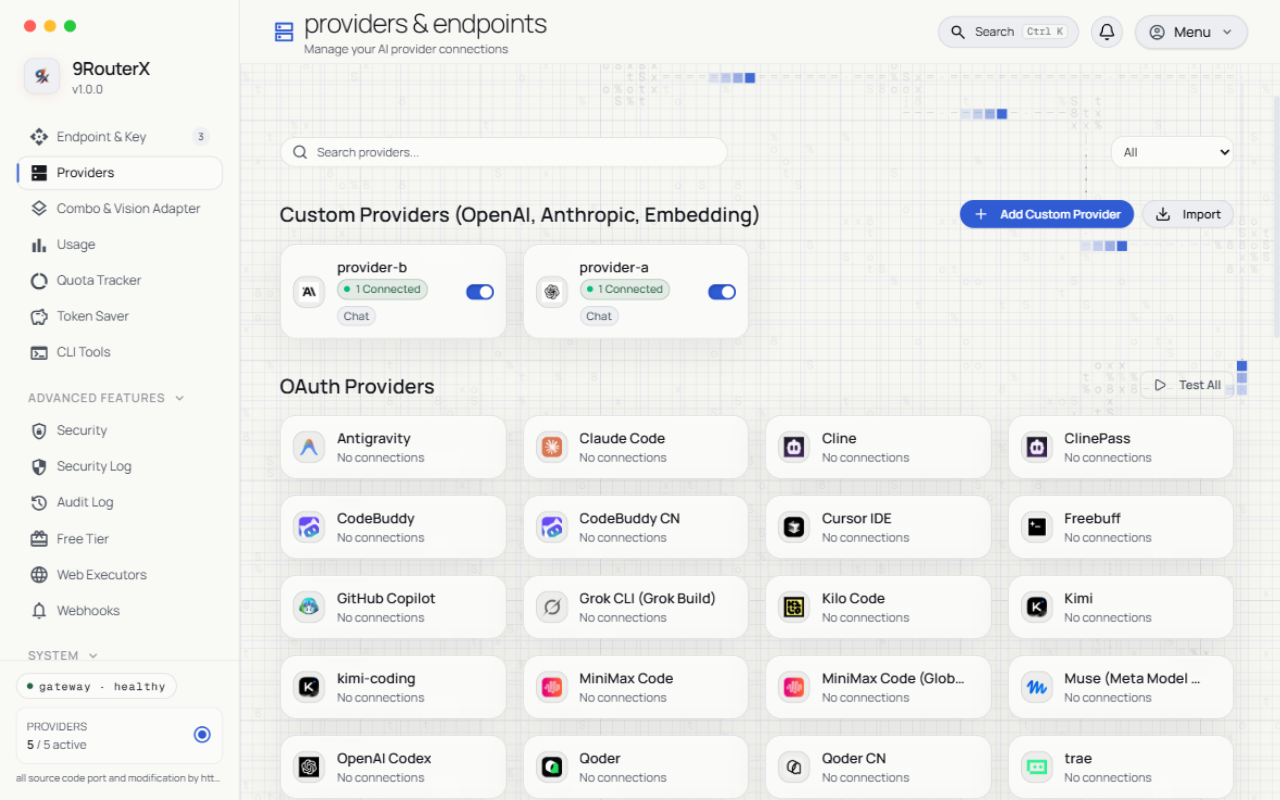
Every screen ships in dark and light themes, at desktop and mobile widths. The
full gallery — with per-page commentary — lives on the wiki's
Screenshots page.
| Dark | Light | |
|---|---|---|
| Providers — connect AI providers and manage custom OpenAI/Anthropic-compatible endpoints | 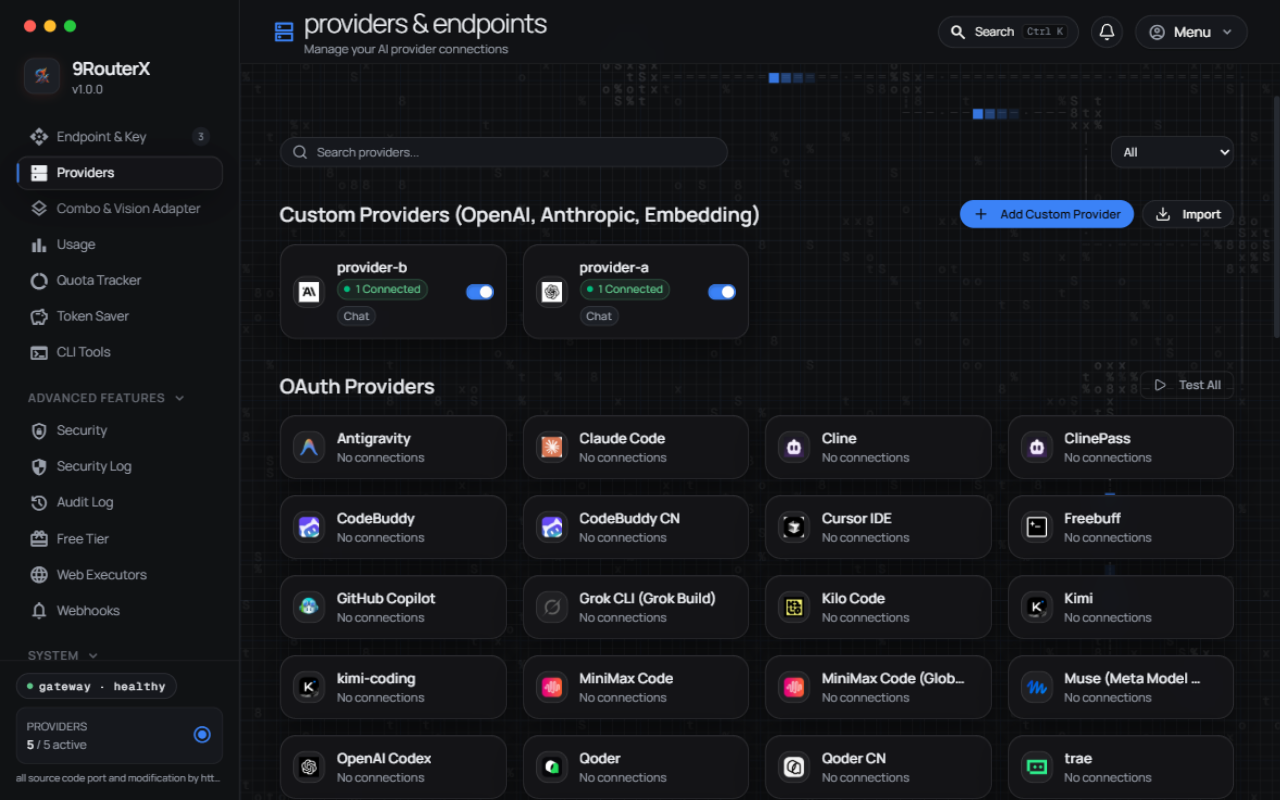 |
 |
Supported AI Coding Clients
9RouterX works out of the box with any OpenAI-compatible, Anthropic-compatible, MCP, or A2A client:
- Claude Code (
@anthropic-ai/claude-code) - OpenAI Codex CLI
- Cursor
- Antigravity
- Gemini CLI
- OpenCode
- Cline / Roo Code
- OpenClaw
IPv6 Resolution Note (
localhostvs127.0.0.1): Some CLI tools (upstream documentation specifically notes OpenClaw and certain Node/Go CLIs) may resolvelocalhostto IPv6::1first and fail to connect. If a client refuses to connect vialocalhost, use explicit IPv4http://127.0.0.1:20128instead.
Example 1: Claude Code Setup
Route Claude Code through http://localhost:20128 to enable 20–40% tool-output token compression, 50+ per-tool filters, and multi-provider failover:
export ANTHROPIC_BASE_URL="http://localhost:20128"
export ANTHROPIC_API_KEY="sk-YOUR-KEY"
claude
Example 2: Codex / OpenCode / OpenClaw (Explicit IPv4 127.0.0.1)
export OPENAI_BASE_URL="http://127.0.0.1:20128/v1"
export OPENAI_API_KEY="sk-YOUR-KEY"
Example 3: Cline / Cursor JSON Configuration
{
  "apiProvider": "openai-compatible",
  "openAiBaseUrl": "http://127.0.0.1:20128/v1",
  "openAiApiKey": "sk-YOUR-KEY",
  "openAiModelId": "antigravity/gemini-3.7-flash-medium"
}
Example 4: Gemini CLI / Custom Anthropic-Compatible Clients
export GEMINI_API_BASE_URL="http://127.0.0.1:20128/v1"
export GEMINI_API_KEY="sk-YOUR-KEY"
Free AI Providers & Keyless Models Catalog
9RouterX includes a built-in catalog of 248 free models across 36 providers (verified in freemodels.go), featuring 24 keyless models (antigravity, opencode, blackbox) that work out of the box without upstream provider registration or external API keys.
Supported Free Quota Regimes
keyless: Zero upstream provider API key or account signup required (antigravity,opencode,blackbox).recurring-daily: Free request or token allowance resets automatically every 24 hours.recurring-monthly: Free quota refreshes each calendar or billing month.recurring-credit: Periodic free credit grants replenished by the provider.recurring-uncapped: Rate-limited free endpoints without hard lifetime exhaustion caps.one-time-initial: Initial trial credit pool granted upon account creation.
Complete Free Provider Directory (36 Providers · 248 Free Models)
| Provider | Model free | Keyless | Quota / Access Regime |
|---|---|---|---|
bazaarlink |
32 | — | Free API tier (recurring-daily / recurring-uncapped) |
bluesminds |
22 | — | Free API tier (recurring-daily / recurring-uncapped) |
vertex |
21 | — | Google Cloud credits / free tier (one-time-initial / recurring-credit) |
kilo-gateway |
12 | — | Free gateway tier (recurring-daily) |
fireworks |
10 | — | Initial / recurring free inference credits (one-time-initial) |
antigravity |
9 | 9 | Keyless (keyless — zero upstream setup, e.g. gemini-3.7-flash-high/medium/low) |
opencode |
9 | 9 | Keyless (keyless — zero upstream setup) |
cloudflare-ai |
9 | — | Recurring daily free Workers AI neurons (recurring-daily) |
qoder |
9 | — | One-click OAuth free coding tier (recurring-daily / recurring-monthly) |
opencode-zen |
9 | — | Free developer coding tier (recurring-daily) |
ollama |
8 | — | Local / free cloud endpoints (recurring-uncapped) |
hyperbolic |
8 | — | Initial trial inference credits (one-time-initial) |
nous |
7 | — | Nous Research free API tier (recurring-credit / one-time-initial) |
api-airforce |
7 | — | Recurring daily / uncapped free tier (recurring-daily) |
kiro |
7 | — | Free developer tier + external_idp auth support (recurring-monthly) |
blackbox |
6 | 6 | Keyless (keyless — zero upstream setup) |
cohere |
6 | — | Recurring monthly trial evaluation key (recurring-monthly) |
huggingface |
6 | — | Serverless inference API free tier (recurring-daily) |
groq |
5 | — | Recurring daily high-speed LPU free tier (recurring-daily) |
mistral |
5 | — | La Plateforme experiment free tier (recurring-monthly) |
sambanova |
5 | — | Recurring free developer cloud tier (recurring-daily) |
glm-cn |
4 | — | One-click OAuth / Zhipu CN free models (recurring-daily) |
gemini |
4 | — | Google AI Studio recurring daily free tier (recurring-daily) |
nvidia |
4 | — | NVIDIA NIM developer free credit tier (one-time-initial / recurring-credit) |
llm7 |
4 | — | One-click OAuth free routing tier (recurring-daily) |
openrouter |
3 | — | Recurring :free and openrouter/auto model endpoints (recurring-daily) |
agnes |
3 | — | Free API inference tier (recurring-daily) |
glm |
2 | — | Zhipu GLM global free models (recurring-daily) |
cerebras |
2 | — | Recurring daily wafer-scale free inference tier (recurring-daily) |
deepseek |
2 | — | Initial credit / off-peak developer tier (one-time-initial) |
morph |
2 | — | Fast code-apply free developer tier (recurring-monthly) |
tokenharbor |
2 | — | Free API routing tier (recurring-daily) |
baidu |
1 | — | Ernie / Qianfan free model (recurring-daily) |
nebius |
1 | — | Nebius AI Studio trial credit free model (one-time-initial) |
sensenova |
1 | — | SenseTime free model endpoint (recurring-daily) |
tencent |
1 | — | Tencent Hunyuan free model endpoint (recurring-daily) |
| Total (36 Providers) | 248 | 24 | Verified in freemodels.go |
Provider Categories Breakdown (155 Providers)
9RouterX organizes its 155 supported providers into four distinct authentication architectures:
- 91 API Key Providers: Standard bearer token providers including OpenAI, Anthropic, Google Gemini, Groq, DeepSeek, Fireworks, Mistral, Cohere, Cerebras, SambaNova, NVIDIA NIM, OpenRouter, xAI, Together AI, Perplexity, Hyperbolic, Nebius, Cloudflare Workers AI, and 70+ global and regional inference platforms.
- 28 One-Click OAuth Providers: Authenticate directly from the web dashboard without manually copying static tokens:
antigravity,claude,cline,clinepass,codebuddy-cn,codebuddy-intl,codex,cursor,github,gitlab,glm-cn,grok-cli,iflow,jina-reader,kilocode,kimi,llm7,minimax-code-global,muse,qoder,qoder-cn,runcrate,topaz,voyage-ai,xai,xiaomi-mimo,zcode,zed. - 29 Free-Tier Providers: Dedicated zero-cost provider configurations (23
CategoryFreeTier+ 6CategoryFree) engineered for automated fallback routing when paid quotas expire. - 4 Web Cookie Providers: Session-authenticated browser integrations powered by the internal
browsercookiesandbrowserloginencrypted vault modules.
Adding a Custom Provider
You can register any custom OpenAI-compatible or Anthropic-compatible upstream server directly in the dashboard (http://localhost:20128 → Providers → Add Custom):
- Set custom base URLs for local or private inference servers (vLLM, Ollama, llama.cpp, LM Studio, LiteLLM, or enterprise gateways).
- Inject custom HTTP authentication or routing headers per provider.
- Attach dedicated per-key outbound HTTP/SOCKS5 proxy pools and configure SSRF dispatch guard rules.
Embedded Dashboard Overview
9RouterX compiles a reactive Svelte 5 + Vite + Tailwind 4 management interface (built with shadcn-svelte, bits-ui, and layerchart) directly into the Go binary at http://localhost:20128 (default password: 123456):
- Token Saver & Compression Analytics: Monitor real-time 20–40% token reduction ratios, RTK compression metrics, 50+ ready-made per-tool output filters, GCF/tabular headroom stats, output style directives (
Caveman,Ponytail,ADHD,Anti-Slop), context squeezer activity, and semantic cache hit rates. - Connections & 1-Click OAuth Manager: Configure all 155 providers, trigger browser OAuth flows for 28 providers, import Kiro
external_idpJSON credentials, inspect live model health latency, and assemble multi-tier combo routing presets (fallback,round-robin,sticky,capacity,fusion). - Per-Key Governance & Custom Usage Ranges: Issue client API keys (
sk-...) with daily USD hard cutoffs, request rate limits, IP whitelists, and custom system prompts; inspect Tremor-style usage charts across12h,14d, or custom date ranges; and inspect full request/response JSON payloads in the Extended Logging & Payload Inspector.
Setup Guide Summary & Wiki Documentation
For advanced deployment and module configuration, refer to the Official 9RouterX Documentation & Wiki:
- Installation, Background CLI & Docker Guide — Custom port configuration (default
20128), daemon commands (start/stop/restart/status/logs), autostart on boot, desktop tray mode, and GHCR containers. - Combo Routing & 3-Tier Failover — Setting up
Subscription → Cheap → Freecascades plusfallback,round-robin,sticky,capacity, andfusionstrategies. - Token Saver, RTK Compression & 50+ Tool Filters — Tuning compression aggressiveness, per-tool CLI output filters, GCF tabular compression, Caveman/Ponytail/ADHD directives, anti-slop rules, and tool-call repair.
- Key Governance, Budgets & Alerts — Configuring daily USD cost cutoffs, plan templates, SSRF/PII guards, multi-target webhooks, and Telegram bot notifications.
- MCP Server, A2A, MITM & TLS Stealth — Connecting Model Context Protocol clients, Agent-to-Agent workflows, inspecting traffic on
http://localhost:20128, and syncing encrypted configuration bundles.
Architecture Comparison
Factual comparison between 9RouterX, upstream 9router-go, and the original 9Router (Next.js):
| Capability / Metric | 9RouterX (This Repository) | 9router-go (Upstream Port) | 9Router (Original Next.js) |
|---|---|---|---|
| Runtime Binary | Single Native Go Binary | Single Native Go Binary | Node.js + Next.js Runtime |
| Default Port | 20128 |
20128 |
20128 |
| Database Compatibility | Drop-in DATA_DIR/db/data.sqlite sharing |
DATA_DIR/db/data.sqlite |
~/.9router/db/data.sqlite |
| Embedded Dashboard | Svelte 5 + Vite + Tailwind 4 (shadcn-svelte + layerchart) |
Embedded Web UI | Next.js React Web App |
| Supported Providers | 155 Providers (91 API · 28 OAuth · 29 Free · 4 Cookie) | Core Provider Subset | Core JS Providers |
| Cataloged Free Models | 248 Free Models across 36 Providers (24 Keyless) | Static Subset | Manual Configuration |
| Token Saver Suite | 20–40% RTK Compression, 50+ Tool Filters, GCF Headroom, Context Squeezer, Tool Repair | Not Included | Not Included |
| Per-Key Governance | Daily Cost Cutoff, Request Limits, IP Whitelist, Plan Templates, PII Masking | Basic Key Auth | Basic Key Auth |
| Caching Layer | Semantic Cache + Prompt Cache + FastJSON | Passthrough | Passthrough |
| Advanced Modules | MCP Server, A2A, TLS Stealth, MITM Inspector, Multi-Target Webhooks, Telegram Bot, Vault | Core Proxy Routing | Core Proxy Routing |
| Supported Platforms | 5 Platforms (linux-x64, linux-arm64, win32-x64, darwin-x64, darwin-arm64) |
Go Target Builds | Requires Node.js Environment |
Frequently Asked Questions (FAQ)
1. Does 9RouterX support Claude Code, Cursor, Codex, and Cline?Yes. 9RouterX exposes both Anthropic-compatible (http://localhost:20128) and OpenAI-compatible (http://localhost:20128/v1) endpoints, alongside built-in MCP Server and A2A protocol support. You can connect Claude Code, Cursor, OpenAI Codex CLI, Cline, Roo Code, OpenCode, OpenClaw (use explicit IPv4 http://127.0.0.1:20128), Antigravity, and Gemini CLI directly to port 20128.
Yes. 9RouterX is 100% free and open-source software (MIT License) that runs locally as a single binary with zero proxy markup fees. It ships with 29 free-tier providers and 248 cataloged free models across 36 providers—including 24 keyless models (antigravity, opencode, blackbox, such as antigravity/gemini-3.7-flash-medium) that require no external provider API key. You only need to generate a local 9RouterX gateway key (sk-...) in the dashboard (http://localhost:20128, default password 123456) to authenticate your local client against RequireApiKey.
- Versus OpenRouter: OpenRouter is a cloud intermediary that adds per-token markup fees and routes prompts through external third-party servers. 9RouterX runs 100% locally on your machine as a single binary with zero markup.
- Versus LiteLLM: LiteLLM requires a Python environment; advanced budget/usage tracking needs external databases (PostgreSQL/Redis). 9RouterX compiles a full AI gateway, Svelte 5 dashboard, 20–40% Token Saver suite (with 50+ per-tool filters), semantic cache, per-key USD budget cutoffs, and 28 one-click OAuth flows into a single zero-dependency Go binary backed by an embedded SQLite file.
AI coding agents consume massive context windows when reading CLI outputs, directory listings, and tool responses. 9RouterX's tokensaver and compression modules apply RTK compression, 50+ ready-made per-tool output filters (git diff, grep, docker logs, npm install, terraform plan), GCF tabular headroom compression, context squeezing, output style directives (Caveman, Ponytail, ADHD), and anti-slop rules to tool outputs in transit—cutting 20–40% of token volume while repairing malformed JSON tool calls automatically.
Yes. 9RouterX shares the exact same default port (20128) and SQLite database schema (DATA_DIR/db/data.sqlite). Stop your existing 9Router instance and start 9RouterX—all providers, OAuth connections, combos, client API keys, and usage statistics carry over immediately without migration scripts.
When a request hits a 429 rate limit, quota exhaustion, or upstream 5xx error, 9RouterX's resilience circuit breaker and modelhealth probes automatically cascade the request through your configured combo tier (Subscription OAuth → Cheap API Key → Free-Tier / Keyless) without dropping your active coding session.
Use the built-in daemon commands: 9routerx start, 9routerx status, 9routerx restart, 9routerx logs -n 100, and 9routerx stop. To update, run npm install -g 9routerx@latest, 9routerx update, or pull the latest GHCR container (ghcr.io/yanstd888/9routerx:latest).
Contributing
Issues and pull requests use templates, so pick the right one rather than opening a blank report:
- Bug report — something behaves incorrectly. Include a reproduction,
9routerx version, OS, and the log excerpt around the failure. - Feature request — the problem you cannot solve today, the surface it touches, and whether upstream already has it.
- Question — configuration and usage help.
PRs follow the checks CI runs: go vet ./..., go test -count=1 ./..., make test-integration, plus cd web && bun test and make vet-svelte for anything touching the dashboard. Before writing code, skim AGENTS.md — provider isolation and the Go/Svelte conventions keep reviews fast.
Docs
Full documentation, searchable: 9routerx Wiki — installation, usage, API reference, dashboard, providers, governance, architecture, database, CLI, and a screenshot gallery. Every page supports ?q= search and #section deep links.
Repository references:
ARCHITECTURE.md— routing, providers, runtime layoutDATABASE.md— SQLite schema & operator contractCHANGELOG.md— release history. Work merged since the last tag lives in.changes/fragments and is folded in at the next release; the dashboard's changelog modal shows both. Check what you are running with9routerx version.
Acknowledgments
| Repository | Stars | Contribution to 9RouterX |
|---|---|---|
| decolua/9router |  |
the original Next.js gateway & dashboard that 9RouterX preserves compatibility with (same SQLite data dir, no-migration upgrade path) |
| luqman-v1/9router-go |  |
the Go + Svelte port 9RouterX continues from; gateway core, provider lanes, CLI |
| serenhope/9router |  |
per-key governance, token-saver suite, security log, web executors, dashboard features ported into 9RouterX |
| cheaper-inference/OmniRoute |  |
SSRF dispatch guard + PII masking, routing strategies, circuit breaker, multi-target webhooks, Tremor-style data-viz patterns |
| router-for-me/CLIProxyAPI |  |
Kiro external_idp auth JSON importer (port of their auth format, see internal/handlers/oauth/kiro_external_idp.go) |
| rtk-ai/rtk |  |
the request-side token-compression concept behind the RTK Token Saver (20-40% input savings) |
| headroomlabs-ai/headroom |  |
GCF/tabular compression concepts ported into internal/compression/gcf and internal/headroom |
| JuliusBrussee/caveman |  |
the terse-output style directive (Caveman mode, internal/tokensaver/caveman.go) |
| DietrichGebert/ponytail |  |
the structured-output style directive (Ponytail mode) |
| ayghri/i-have-adhd |  |
the scannable/bulleted output style (ADHD mode) |
| miqdadbadjuber/anti-slop |  |
antislop injector rules bundled in internal/tokensaver/antislop with their original text and attribution preserved |
| huntabyte/shadcn-svelte |  |
the dashboard component layer (chart, table, tooltip, separator via bits-ui + layerchart) |
9RouterX stands on this lineage — thank you to the upstream maintainers and their communities for the gateway, the port, and the ideas this project builds on. The complete three-layer ownership inventory (inherited / ported / original) lives in ATTRIBUTION.md, and everyone whose commit landed in the repository is credited on the wiki's Owner & Contributors page.
License
MIT License — see LICENSE.
Attribution
9RouterX — all source code port and modification by yanstd888 — t.me/aiclub_id.
This repository is an independent Go + Svelte port of 9Router (MIT); all port and modification work is by Muhammad Dian (yanstd888). Re-hosting this code without the LICENSE copyright notice and this attribution violates the MIT license terms. For the full file-by-file ownership breakdown, see ATTRIBUTION.md.
Yorumlar (0)
Yorum birakmak icin giris yap.
Yorum birakSonuc bulunamadi