auto-qa
Health Warn
- License — License: MIT
- Description — Repository has a description
- Active repo — Last push 0 days ago
- Low visibility — Only 6 GitHub stars
Code Warn
- process.env — Environment variable access in scripts/compiler.js
- process.env — Environment variable access in scripts/context-freshness.js
- process.env — Environment variable access in scripts/env-utils.js
Permissions Pass
- Permissions — No dangerous permissions requested
No AI report is available for this listing yet.
Zero-token ($0) E2E Playwright QA engine for Claude Code, Google Antigravity & Cursor. Crawls live DOMs into ~1.2k-token accessibility maps, runs self-healing intent plans locally, and compiles to native .spec.ts. Dual-mode: Agent Skill CLI + Stdio MCP Server.
Auto-QA: Zero-Token Playwright QA Engine & MCP Server for AI Agents






If you have ever asked Claude Code, Google Antigravity, or Cursor to run end-to-end QA on your web app, you already know the two ways it goes wrong:
- The "Blind Selector Guess" Loop: The agent reads your React/Next.js source files, guesses what the rendered DOM looks like, writes a
.spec.tsfile, and hitsTimeoutError: locator('button.submit-btn') not foundfive times in a row because of client hydration, portals, or CSS modules. - The Turn-by-Turn Browser Loop (Chrome DevTools MCP, Puppeteer MCP, Stagehand, Browser-Use): The agent opens a live browser and takes a DOM snapshot or screenshot after every single click. By step 12, it has burned 35,000+ context tokens, taken 90 seconds of round-trip LLM latency, and forced your coding session into
/compact—only to spend another $0.85 in tokens the next time you re-run the exact same test.
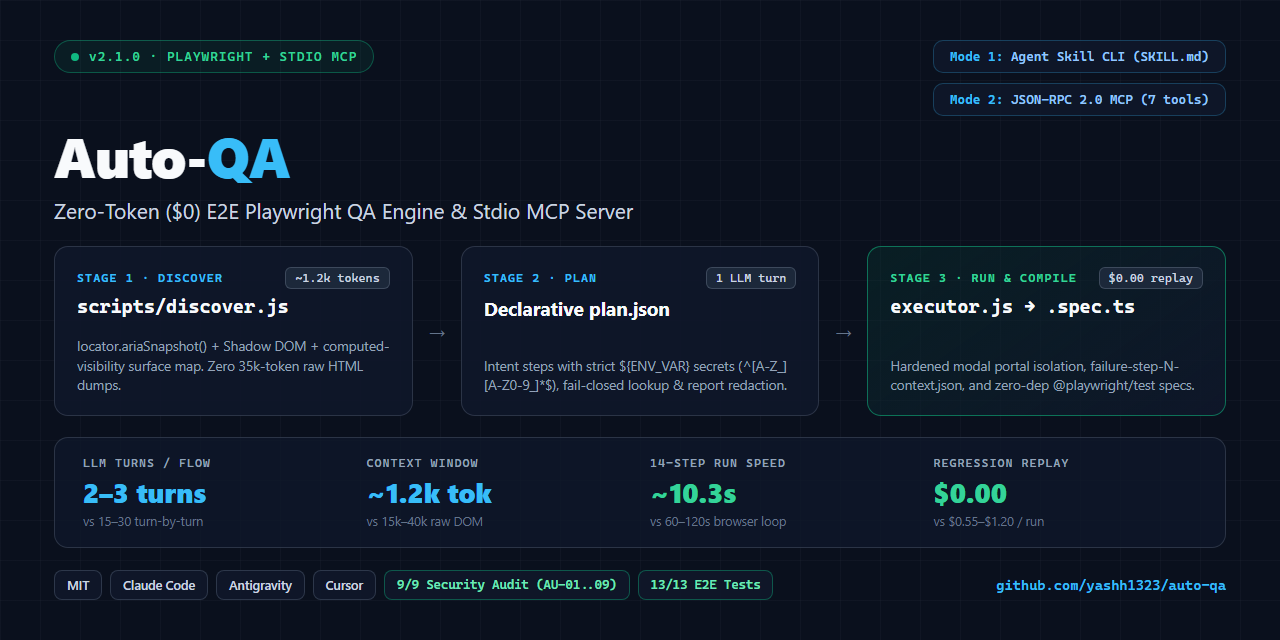
Auto-QA fixes this by splitting Test Planning (1 LLM turn) from Test Execution (0 LLM turns, 100% local Node.js + Playwright).
Why Turn-by-Turn Browser Agents Break in Production
| Metric / Architecture | Turn-by-Turn Browser MCP (DevTools / Browser-Use) |
Blind Source-to-Test Authoring | Auto-QA (Skill CLI + Stdio MCP) |
|---|---|---|---|
| LLM Round-Trip Turns | 15 – 30 turns per user flow | 4 – 8 retry turns fixing broken selectors | 2 – 3 turns total (Discover → Plan → Run) |
| Context Window Burn | 15,000 – 40,000 tokens (raw DOM dumps) | 5,000 – 12,000 tokens (stack traces) | ~1,200 tokens (sanitized W3C accessibility map) |
| Execution Speed (14 steps) | 60 – 120 seconds | Fails on dynamic modals / sticky navs | ~10.3 seconds (local headless Chromium) |
| Replay / Regression Cost | $0.55 – $1.20 per run in API tokens | $0.00 (once manually fixed) | $0.00 forever (0 LLM calls during execution) |
position: fixed Modals |
Often missed by offsetParent filters |
Fails when backdrop overlaps buttons | Scoped modal isolation + getBoundingClientRect() |
| CI/CD Output | Locked to live agent runtime | .spec.ts (brittle selectors) |
Compiles to native @playwright/test .spec.ts |
How Auto-QA Works (The 3 Atomic Stages)
flowchart LR
    S1["1. Discover Surface (discover.js -> ~1.2k tokens)"] --> S2["2. Author Intent Plan (Declarative plan.json)"]
    S2 --> S3["3. Execute, Heal & Compile (executor.js -> .spec.ts)"]
Stage 1: Black-Box Surface Discovery (scripts/discover.js)
Instead of dumping raw HTML, Auto-QA launches headless Chromium, waits for hydration, and extracts interactive elements (button, input, textarea, select, a[href]) alongside modal containers ([aria-modal="true"], [role="dialog"], [role="alertdialog"], dialog[open], .modal) and Playwright's accessibility snapshot (locator.ariaSnapshot(), capped at 16,384 chars).
- Discovery and execution use native
checkVisibility()where available. They check rendered child boxes fordisplay: contents, include fixed controls, skip content Chromium has deferred off screen, and follow open shadow hosts for hidden, inert, and ARIA-hidden ancestors. - Output:
cli.js discoverprints summary counts by default or writes the JSON surface map (elements.buttons,elements.inputs,elements.links,elements.modals, andaccessibilityTree) when-o <file>is passed, whileauto_qa_generate_code_summaryin MCP mode writes a compactauto_qa_tests/tmp/code_summary.yaml(buttons,inputs, andlinks).
Stage 2: Declarative Intent Plan (plan.json)
Your coding agent reads the ~1,200-token discovery map and authors a declarative JSON test plan conforming to references/plan-schema.json—either by writing auto_qa_tests/auto_qa_frontend_test_plan.json directly in Skill CLI mode, or by calling auto_qa_generate_frontend_test_plan in MCP mode:
{
  "projectId": "sprintdesk-e2e",
  "type": "frontend",
  "name": "SprintDesk Login & Task Creation Flow",
  "targetUrl": "http://localhost:3000",
  "priority": "p0",
  "planSteps": [
    { "type": "assertion", "description": "Assert that \"SprintDesk\" is visible" },
    { "type": "action", "description": "Click \"Sign In\"" },
    { "type": "action", "description": "Type \"${QA_EMAIL}\" into \"Email\"" },
    { "type": "action", "description": "Type \"${QA_PASSWORD}\" into \"Password\"" },
    { "type": "action", "description": "Click \"Sign In\"" },
    { "type": "assertion", "description": "Assert that \"Workspace Overview\" is visible" },
    { "type": "action", "description": "Type \"Verify zero-token replay\" into \"What needs testing?\"" },
    { "type": "action", "description": "Click \"Add Task\"" },
    { "type": "assertion", "description": "Assert that \"Verify zero-token replay\" is visible" }
  ]
}
Stage 3: Self-Healing Execution (scripts/executor.js) & Native Compiler (scripts/compiler.js)
Both executor.js and compiler.js share scripts/intent-parser.js so runtime execution and generated code never drift. When executing a step like Type "${QA_EMAIL}" into "Email", executor.js resolves the target locally without calling an LLM:
- Direct Selector Passthrough: Immediately resolves explicit
#id,.class, or[attr]selectors (filtered to visible nodes) if provided. - Hardened Active Modal Isolation: Traverses light and open Shadow DOM across
[aria-modal="true"],[role="dialog"],[role="alertdialog"],dialog[open], and.modal, verifying real computed visibility (display !== 'none',visibility !== 'hidden', non-zero rect, ancestor visibility, and no[hidden]/[inert]/aria-hidden="true", without failing on Tailwind utility tokens like.hidden), picking the top-most visible dialog by full CSS stacking-context (z-index,fixed/sticky,transform,opacity < 1,isolation,filter) / DOM order, ignoring nested.modalwrappers inside semantic dialogs, tagging the winner withdata-auto-qa-active-modal="true", and keeping blocking-modal isolation enforced onassert-visiblefallbacks. - Action-Specific Semantic Chains:
- For
fill/type:<label>(getByLabel) →placeholder(getByPlaceholder) → ARIAtextboxrole (getByRole) → attribute substring (input[name*="..." i], textarea[name*="..." i],id*="...",type="..."). - For
click,select, andcheck: Resolves via ARIAbutton/link/combobox/checkboxroles,aria-label, and exact-then-fuzzy text matching, filtered via:visiblesemantics so inert DOM duplicates never win. - After exact and substring locators miss, the executor also matches labels with changed trailing counts, such as
Cart (1)andCart (2). This fallback stays inside a blocking dialog and requires a label with a letter and at least two characters.
- For
- Strict
${ENV_VAR}Secret Placeholders: Bothexecutor.js(runtime) andcompiler.js(generated.spec.tsviarequireEnv("VAR", process.env["VAR"])) accept${ENV_VAR}matching^[A-Z_][A-Z0-9_]*$, enforceAUTO_QA_ALLOWED_ENV_PREFIXES(MCP defaults toQA_,AUTO_QA_,TEST_unless*; optional in CLI), fail closed when unset, reject arbitrary JS expressions, and scrub raw, URL-encoded (encodeURIComponent/encodeURI),URLSearchParams(+), and lowercase percent-hex resolved values (>= 3chars; values< 3chars are skipped to avoid false-positive corruption) BEFORE truncation across stdout, pre-loop errors,failure-step-N-context.json,auto-qa-test-report.md, andtest-report-*.json. - Failure-Time Scoped Context Snapshots: Inside the step
catchblock—before tearing down the browser—executor.jswritesfailure-step-N-context.jsonalongsidefailure-step-N.pngcontaining the current URL/title, error,scopedToModal, capped visible interactive elements (50buttons,50inputs,30links, including Shadow DOM labels/controls) scoped to the active visible modal if open, and the live accessibility snapshot (locator.ariaSnapshot(), capped at 16,384 chars), with text redacted before length caps are applied. Snapshots recordcapturedAtand the application’s Git HEAD when available.
Before patching from an older snapshot, run the following command from the project root. Use --project <dir> to select another application root for capture or checking. The check prints JSON and warns on stderr if project files are newer or Git HEAD changed. A stale snapshot still returns exit code 0. The scan skips dependencies, Git metadata, build and QA output directories, and generated report and screenshot filenames.
node scripts/cli.js check-context-freshness auto_qa_tests/artifacts/failure-step-1-context.json
- Native Playwright
.spec.tsExport: Once the flow passes,compiler.jscompilesplan.jsoninto a standalone@playwright/testTypeScript file using chained.or()locators (with.locator('visible=true')assertion parity), parameterizedrequireEnv("VAR", process.env["VAR"])calls,assertSafeHttpUrl()navigation guards (including static relative URLs), accurateassert-urlassertions, and nestedtest.step()blocks.- Running compiled
.spec.tsfiles: Ensure@playwright/test(and@types/nodeforprocess.envin strict TypeScript) is installed in your target project, and export referenced${ENV_VAR}variables before running (Bash:export QA_EMAIL="[email protected]"; PowerShell:$env:QA_EMAIL="[email protected]"). SetAUTO_QA_ALLOW_PRIVATE_NETWORK=1if targeting internal RFC1918/ULA intranet hosts.
- Running compiled
Quick Start (60 Seconds)
git clone https://github.com/yashh1323/auto-qa.git
cd auto-qa
npm install
npx playwright install chromium

# Verify runtime, Chromium binary, MCP server, and compiler health
npm run doctor

# Run the security audit (AU-01–AU-09) + 17 v2.1.0 feature tests
npm test
Dual-Mode Integration: Agent Skill CLI + Stdio MCP Server
Auto-QA runs in two modes. When you prompt your agent (e.g., "Use Auto-QA to test the login and checkout flow on http://localhost:3000 and export a Playwright spec"), SKILL.md instructs the agent to check its declared tools: if auto_qa_* MCP tools are registered, it uses MCP Mode; otherwise, it falls back to Skill CLI Mode via terminal commands.
Option 1: Standalone Agent Skill / CLI Mode (Zero Config)
Install as an agent skill in Google Antigravity / Gemini CLI by cloning into your skills folder and installing dependencies (the agent automatically reads SKILL.md to invoke scripts/cli.js):
git clone https://github.com/yashh1323/auto-qa.git ~/.gemini/config/skills/auto-qa
cd ~/.gemini/config/skills/auto-qa && npm install && npx playwright install chromium
(For Claude Code or Cursor, either install the full cloned auto-qa directory with npm install && npx playwright install chromium where your skill path points—not SKILL.md alone, since it invokes scripts/cli.js—or use Option 2: MCP Server Mode below).
Or run any subcommand (discover, run, compile, bootstrap, doctor, mcp) directly from your terminal:
# 1. Compile an example plan into native @playwright/test TypeScript (.spec.ts) — works offline immediately
node scripts/cli.js compile examples/client-login-checkout.json -o tests/e2e/checkout.spec.ts

# 2. Crawl any live URL (or your local dev server) into a compact JSON surface map
node scripts/cli.js discover https://example.com -o auto_qa_tests/tmp/surface.json

# 3. Execute an intent test plan against a running target URL (add --no-headless to watch live)
node scripts/cli.js run examples/client-login-checkout.json -u http://localhost:3000
Option 2: Model Context Protocol (MCP) Server Mode
Auto-QA includes a dependency-free JSON-RPC 2.0 stdio MCP server (scripts/mcp-server.js) exposing 8 structured tools.
Claude Code
claude mcp add auto-qa node "/absolute/path/to/auto-qa/scripts/mcp-server.js"
Cursor / Windsurf / Antigravity (mcp.json)
{
  "mcpServers": {
    "auto-qa": {
      "command": "node",
      "args": ["/absolute/path/to/auto-qa/scripts/mcp-server.js"]
    }
  }
}
Exposed MCP Tools
| Tool Name | Purpose |
|---|---|
auto_qa_bootstrap |
Initializes auto_qa_tests/tmp/config.json with target project root and base URL. |
auto_qa_generate_code_summary |
Crawls live URL and writes sanitized interactive buttons, inputs, and links to auto_qa_tests/tmp/code_summary.yaml. |
auto_qa_generate_standardized_prd |
Generates a TestSprite-schema-compatible PRD scaffold (standard_prd.json). |
auto_qa_generate_frontend_test_plan |
Saves declarative frontend test steps (auto_qa_frontend_test_plan.json). |
auto_qa_generate_backend_test_plan |
Saves a TestSprite-schema-compatible backend endpoint assertion manifest (auto_qa_backend_test_plan.json). |
auto_qa_execute_and_heal |
Executes frontend planSteps in headless Chromium, captures failure-step-N.png + failure-step-N-context.json, and writes auto-qa-test-report.md. |
auto_qa_check_context_freshness |
Checks a failure snapshot against the application using projectPath and contextFilePath. Returns a non-blocking warning when stale. |
auto_qa_compile_to_playwright |
Compiles planPath into native @playwright/test TypeScript (outputPath) confined to projectPath (AUTO_QA_WORKSPACE_ROOT). |
Note: All MCP artifacts (auto_qa_tests/tmp/code_summary.yaml, auto_qa_tests/tmp/config.json, standard_prd.json, auto_qa_frontend_test_plan.json, auto_qa_backend_test_plan.json, auto_qa_tests/artifacts/failure-step-N.png + failure-step-N-context.json, and auto-qa-test-report.md) are written inside <projectPath>/auto_qa_tests/.
Supported Intent Grammar
Intent matching in executor.js and compiler.js is case-insensitive and accepts either single quotes ('...') or escaped double quotes (\"...\") around target labels and values:
| Intent Type | Plain-English Syntax Examples |
|---|---|
| Navigation | navigate to https://example.com/login · go to /dashboard |
Text Input (<input> & <textarea>) |
type "[email protected]" into "Work Email" · fill "${QA_EMAIL}" into "Email" · fill "Sprint Goal" into "Description" |
| Clicks & Triggers | click "Sign In" · press button "Create Project" |
Dropdowns (<select>) |
select "Enterprise Plan" from "Plan Type" |
| Checkboxes | check "Remember me" · tick checkbox "Accept Terms" |
| Positive Visibility Assertions | verify "Dashboard" is visible · assert that "Added to cart" appears |
| Negative Visibility Assertions | verify "Loading..." is not visible · assert that "Error modal" disappears |
| Text Substring Assertions | verify text "Order Confirmed" · assert page contains "1 Item" |
| URL Assertions | verify URL contains "/checkout" |
Security & Hardening Architecture
Because QA automation tools bridge untrusted web DOMs, LLM inputs, and the local filesystem, Auto-QA enforces nine security controls verified by AU-01 – AU-09 in tests/security_audit_runner.mjs:
- Parameterized Code Generation (
AU-01):compiler.jsserializes all user strings viaJSON.stringify()and constructs regexes vianew RegExp(...)with escaped forward slashes and metacharacters, preventing template or code injection in generated.spec.tsfiles. - MCP Workspace Path Confinement (
AU-02):assertInsideDirectory()inmcp-server.jsperforms lexical..checks plus a component-by-componentlstatSync()/realpathSync()walk enforcingAUTO_QA_WORKSPACE_ROOTconfinement on MCP plan reads and.spec.tscompilation output paths, blocking relative (../../), absolute (/etc/passwd,C:\Windows\...), cross-drive, live symlink/junction, and dangling symlink/junction escapes. - Protocol Scheme Allowlisting, CIDR/DNS Validation & Redirect SSRF Guard (
AU-03):assertValidHttpUrl()andassertSafeResolvedUrl()inurl-utils.jsrestrict navigation tohttp:andhttps:(blockingfile:///,javascript:,data:, UNC\\, protocol-relative//, backslash/control-character relative paths, cloud IMDS ranges169.254.0.0/16,100.100.100.200,168.63.129.16,192.0.0.192,fe80::/10,fd00:ec2::/32, embedded IPv6 forms, DNS-resolved metadata/private rebinds, and RFC1918/CGNAT/ULA private networks unlessAUTO_QA_ALLOW_PRIVATE_NETWORK=1is set), whileattachSsrfRouteGuard()pairscontext.route,context.routeWebSocket, and CDPFetch.enableto block unsafe multi-hop HTTP 3xx redirects andws://connections while keeping initiallocalhost/127.0.0.1/[::1]allowed. - YAML 1.2 & Markdown Link/Cell Sanitization (
AU-04):formatCodeSummaryYaml()emits valid double-quoted YAML 1.2 key-value mappings (code_summary.yaml) with full newline and C1 control-character (\x7f-\x9f,\u2028-\u2029) escaping, whilesanitizeMdCell()andtoRelativeArtifactLink()neutralize Markdown/link injection in reports. - CSS Attribute & Regex Escaping (
AU-05): Double quotes, backslashes, newlines, and regex metacharacters in target names are sanitized viaescapeCssString()andescapeRegex()before building selectors. - Repository Hygiene & Resource Cleanup (
AU-06):AU-06scans shipped repository files to assert zero hardcoded personal local home paths or credentials exist; at runtime,executor.jsanddiscover.jsauto-dismiss synchronousalert()/confirm()/beforeunloaddialogs, block background Service Workers (serviceWorkers: 'block'), guardchromium.launch()shutdown epochs, drain in-flight MCP RPCs onstdinEOF, and guaranteebrowser.close()viatry / finally(closeAllBrowsers()/closeAllDiscoverBrowsers()). - Strict
${ENV_VAR}Secret & Prefix Policy (AU-07):env-utils.jsrestricts placeholders strictly to^[A-Z_][A-Z0-9_]*$, rejects arbitrary expressions, enforcesAUTO_QA_ALLOWED_ENV_PREFIXESin MCP (QA_,AUTO_QA_,TEST_by default,*to widen) and CLI/compiler, emits fail-closedrequireEnv("VAR", process.env["VAR"])calls in compiled specs, and redacts resolved secrets (>= 3chars) from stdout, stderr logs, andtest-report-*.json. - Pre-Redaction Truncation Order & Encoded Leak Scrubbing (
AU-08):redactSecrets()scrubs raw,encodeURIComponent,encodeURI,URLSearchParams(+), and lowercase percent-hex secret variants (>= 3chars; values< 3chars are skipped to avoid false-positive text corruption) BEFORE truncation limits across pre-loop errors,report.testName,step.description/error,failure-step-N-context.json,auto-qa-test-report.md, andtest-report-*.json. - Linear Intent Parsing & Bounded Loop Guards (
AU-09):intent-parser.jsuses a linear-time $O(N)$ quoted-literal scanner, isolates classification keywords outside quoted literals, recognizes negative contractions (isn't,doesn't), throws on unsupported verbs instead of silently passing, enforcesmaxSteps(200in both executor & compiler) andrunTimeoutMs(300000ms), and capsreport.consoleErrorsat100entries (1000chars each, trackingconsoleErrorsTruncated).
When NOT to Use Auto-QA
- WebGL / HTML5
<canvas>Applications: If your UI renders entirely inside a single<canvas>element (e.g., Three.js games, Figma-like vector editors) without DOM nodes or W3C accessibility labels, semantic locators cannot see inside the canvas. Use a coordinate-based vision model instead. - Unstructured Chaos Fuzzing: If you have no target user story and want an agent to randomly click around an unfamiliar site to see what breaks, an interactive turn-by-turn browser loop is a better fit than a declarative plan runner.
Repository Layout
auto-qa/
├── scripts/
│   ├── cli.js                # Unified CLI (mcp, discover, run, check-context-freshness, compile, bootstrap, doctor)
│   ├── mcp-server.js         # Zero-dependency JSON-RPC 2.0 stdio MCP server (8 tools)
│   ├── discover.js           # Headless Chromium light/Shadow DOM + ariaSnapshot() surface crawler
│   ├── browser-dom.js        # Shared Chromium checkVisibility(), display: contents & shadow DOM helpers
│   ├── context-freshness.js  # Failure-context capturedAt & Git HEAD staleness checker
│   ├── env-utils.js          # Strict ${ENV_VAR} tokenizer, prefix policy, requireEnv() & redactor
│   ├── intent-parser.js      # Shared single-source intent IR for executor & compiler
│   ├── url-utils.js          # URL/DNS/CIDR validator, CDP/WS SSRF guard & MD escaping
│   ├── write-output.js       # Atomic link-safe writer for reports, snapshots & compiled specs
│   ├── executor.js           # Self-healing intent runner, modal portal hardening & failure snapshots
│   └── compiler.js           # Declarative plan.json -> native @playwright/test .spec.ts compiler
├── tests/
│   ├── security_audit_runner.mjs  # 9-unit automated security & hygiene test suite (AU-01–AU-09)
│   └── v2_1_features.test.mjs     # 17-test Playwright/CLI/MCP suite for v2.1.0 features
├── examples/
│   ├── client-lead-gen.json       # Sample B2B lead funnel test plan
│   ├── client-login-checkout.json # Sample e-commerce cart & checkout test plan
│   └── env-var-login.json         # Sample ${QA_EMAIL} / ${QA_PASSWORD} secret-placeholder plan
├── references/
│   ├── blackbox-testing-guide.md  # Pre-flight credential & 5-step black-box QA guide
│   └── plan-schema.json           # JSON Schema Draft-07 specification for test plans
├── SKILL.md                # Dual-mode operational instructions for AI coding agents
├── package.json
└── LICENSE                 # MIT
License
MIT — see LICENSE.
Reviews (0)
Sign in to leave a review.
Leave a reviewNo results found