polis-protocol
Health Warn
- License — License: MIT
- Description — Repository has a description
- Active repo — Last push 0 days ago
- Low visibility — Only 5 GitHub stars
Code Fail
- child_process — Shell command execution capability in editors/antigravity/extension.js
- os.homedir — User home directory access in editors/antigravity/extension.js
- fs module — File system access in editors/antigravity/extension.js
Permissions Pass
- Permissions — No dangerous permissions requested
No AI report is available for this listing yet.
Markdown protocol for multi-vendor AI agent teams — capability cards, bandit routing, and lessons that compound.
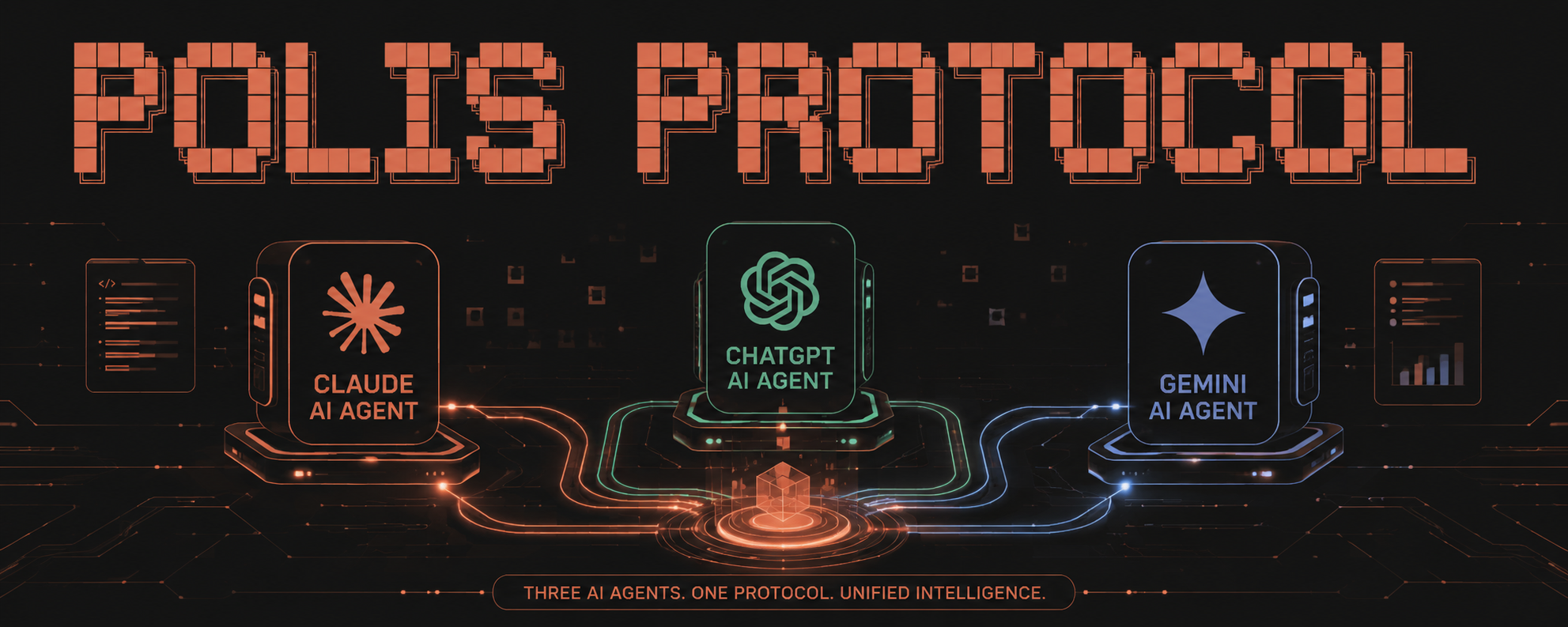
Polis Protocol
The local-first control plane for coding agents. Run Claude, Codex, Gemini, and Cursor against one repo — each claimed contract records an owner, agents can record evidence, and shared lessons help reduce repeated failures. Plain markdown, in git, across every vendor.






🌐 Website → polis-protocol.ymlsora.chatgpt.site · Install · Proof · Plug into your agent (MCP)
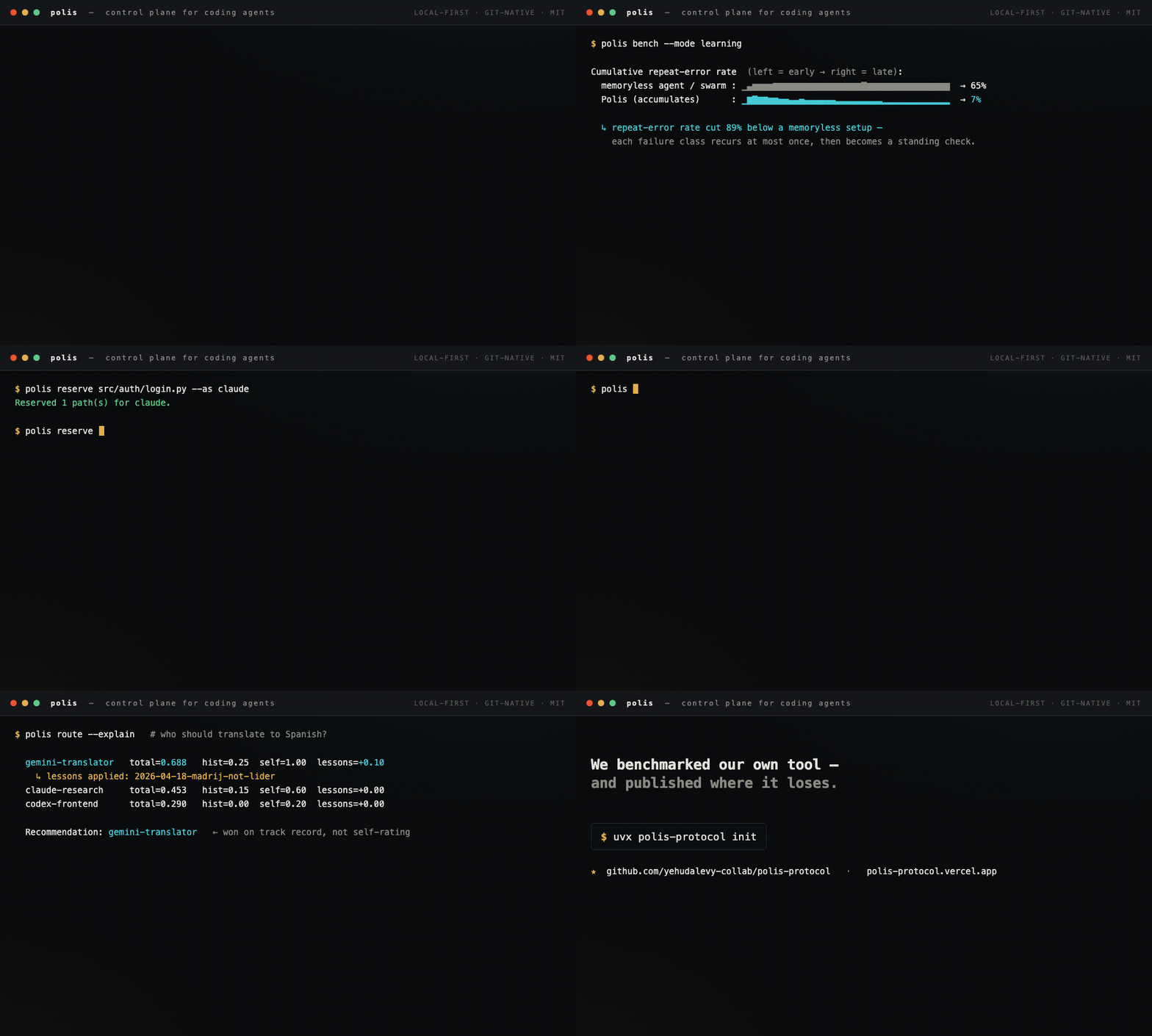
Synthetic simulation: repeat errors 65% → 7% · Advisory overlap conflicts detected · reproduce in 5s: polis bench --mode learning
Modeled run with synthetic tasks and seed 0 — assumptions and limitations are published below.
uvx polis-protocol init # one command · no server · no database · just markdown in your repo
Shared by Claude · Codex · Gemini · Cursor, all reading one _polis/ folder. MIT.
⭐ If the loop below clicks, a star helps other multi-agent builders find this.
The 10-second version
Three AI agents share one project: Claude (research), Codex (frontend), Gemini (translation).
A Spanish-translation task comes in. Who gets it?
Early on, Claude did — it rated itself highly. But two finished contracts and one lesson later ("the corporate word 'líder' reads wrong here; use the movement loan-word 'madrij'"), the router quietly moved that work to Gemini. Nobody reassigned it. The team learned, and the routing followed.
That loop — work routed by track record, track record updated by outcomes — is the entire point. See it yourself in one command, no install, no API keys:
git clone https://github.com/ymxlx/polis-protocol.git
cd polis-protocol && bash scripts/demo.sh
Score breakdown (sorted by total):
  gemini-translator-pesaj   total=0.688  hist=0.25  self=1.00  cost=1.00  avail=1.00  lessons=+0.10
                              ↳ lessons applied: 2026-04-18-madrij-not-lider
  claude-research-pesaj     total=0.453  hist=0.15  self=0.60  cost=1.00  avail=1.00  lessons=+0.00
  codex-frontend-pesaj      total=0.290  hist=0.00  self=0.20  cost=1.00  avail=1.00  lessons=+0.00

Recommendation: gemini-translator-pesaj   ← won on history + an applied lesson, not self-rating
If that loop is interesting to you, a ⭐ genuinely helps other multi-agent builders find this.
What it is
There is now a wave of git-and-markdown task boards for AI agents — claim a task, do it, mark it done. They're good, and Polis can write to them. But a board is passive: it records what happened and never gets smarter. The protocol is frozen the day it ships.
Polis adds an active coordination layer to the shared record:
- Communication — every meaningful action lands in an append-only
chronicle.md. (Every board does this.) - Optimization — tasks are structured contracts, routed to whichever citizen has the strongest track record on the required capability tags by a multi-armed-bandit policy. (A board can't; it has no notion of who's best.)
- Self-development — settled contracts can produce structured lessons; lessons feed back into the router and can help reduce repeated failures when the records are maintained consistently.
- Constitutional evolution — when a rule stops working, citizens can propose, vote on, and ratify amendments to the protocol itself.
A board is something you fill in. Polis is a team that develops. It learns who's best, and it can rewrite its own rules.
The whole thing lives in a folder. There is no central server, no required runtime, no proprietary format. If a tool can read and write markdown, it can participate.
If you are wondering how Polis compares with AGENTS.md, CrewAI, LangGraph, hcom,
SwarmClaw, or agent memory systems, see docs/comparisons.md.
Why "polis"
A polis is a small Greek city — a few thousand people who all know each other and run their own affairs. The metaphor maps cleanly:
| Polis | Polis Protocol |
|---|---|
| Citizen | An AI agent from any vendor |
| Capability card | A content-hashed YAML manifest of what an agent can do |
| Contract | A structured task with intent, assignment, and settlement |
| Chronicle | An append-only event log every citizen reads on session start |
| Lesson | A retrospective filed by capability tag |
| Chavruta | A paired critique by a citizen from a different vendor before a high-stakes action |
| Amendment | A vote-ratified change to the constitution |
It is opinionated on purpose. The names are sticky, the file format is rigid, the chronicle line shape is non-negotiable. Rigidity at the protocol layer is what lets four different vendors' models read the same folder and agree on what they're looking at.
Quick start
Install
From the root of any project:
# zero-install, one command
uvx polis-protocol init

# or install the CLI
pipx install polis-protocol      # isolated
pip install polis-protocol       # into the current env
init scaffolds _polis/, writes bridge files for Claude/Codex/Gemini, and
registers you as a citizen. Pass an identity when you want one:
uvx polis-protocol init \
  --agent-id claude-research-yourproject \
  --vendor anthropic --model claude-opus-4-7 --tool "claude code"
Preview the scaffold without writing files using --dry-run. Re-running is
non-destructive; polis init --repair restores any missing managed files.
(Hacking on the protocol itself? git clone + python scripts/init_polis.py
still works.)
You now have:
your-project/
├── CLAUDE.md / AGENTS.md / GEMINI.md / AIDER.md ← cross-tool entry pointers
├── .agents/skills/polis-protocol/SKILL.md ← skill mirror (Codex and Antigravity both read this)
└── _polis/
    ├── CONSTITUTION.md                    ← canonical protocol
    ├── README.md
    ├── index.md                           ← "where things stand"
    ├── chronicle.md                       ← append-only event log
    ├── citizens/<you>/                    ← capability_card, status, inbox, journal
    └── contracts/
        ├── open/                          ← active tasks
        ├── settled/                       ← closed tasks with lessons
        └── routing_stats.yml              ← learned routing policy
Open a contract
polis contract open --title "Literature review" \
  --tags long-context-reading,source-checking --by claude-research-yourproject
Or drop a file in _polis/contracts/open/ by hand — it's just markdown:
---
contract_id: literature-review
opened_by: claude-research-yourproject
status: proposed
stakes: medium
required_tags: [long-context-reading, source-checking]
cost_ceiling: medium
---

# Literature review of multi-agent coordination protocols
...
Route it
polis route --polis-root _polis \
  --contract _polis/contracts/open/literature-review.md --explain
Output:
Score breakdown:
  claude-research-yourproject  total=0.430  hist=0.00  self=0.90  cost=1.00  avail=1.00  lessons=+0.00
  codex-frontend-yourproject   total=0.350  hist=0.00  self=0.50  cost=1.00  avail=1.00  lessons=+0.00

Recommendation: claude-research-yourproject
Settle and learn
polis contract settle literature-review --quality 5 --minutes 90
polis reconcile --polis-root _polis
The bandit's routing_stats.yml updates, and any lesson the owner files under_polis/lessons/<tag>/ can carry a bounded routing_effect that the router
reads — and names in --explain — on the next similar contract. Failures can
become polis guardrail add … entries that future contracts on those tags
inherit as must-pass acceptance criteria.
Don't collide
polis reserve src/auth --as claude-research-yourproject --note "refactoring login"
# another cooperating Polis client receives a conflict warning with the holder named
polis release src/auth --as claude-research-yourproject
Reservations are advisory coordination recorded in shared state. They are not
filesystem locks, a security boundary, or a guarantee against races from tools
that do not participate in Polis.
Plug it into your agent over MCP
Every polis is also an MCP server — polis mcp speaks MCP over stdio with zero
extra dependencies. It exposes the whole lifecycle as tools (status, open / route /
claim / settle / abandon, context packets, reserve / release, guardrails) plus
read-only resources (polis://state, polis://replay, polis://replay/redacted,polis://constitution):
# Claude Code
claude mcp add polis -- uvx --from polis-protocol polis mcp

# any other MCP client: command `uvx`, args `--from polis-protocol polis mcp`
# (run it from inside the project, or add `--polis-root /path/to/_polis`)
Agents that can't shell out to a CLI can now open contracts, get an explainable
routing recommendation, reserve files, and settle with evidence — through the
same shared application layer the CLI and dashboard use. Nothing ever hand-edits_polis/ files.
Proof, measured honestly
polis bench ships in the box — we benchmarked our own claims instead of asserting them:
- Repeat errors: −89%. With lessons and guardrails auto-injected into matching future
tasks, the repeat-error rate falls from ~65% (a memoryless agent or unmanaged swarm) to ~7%
— each failure class recurs at most once, then becomes a standing check. Reproduce it:polis bench --mode learning. - Deterministic advisory conflict detection. Within the benchmark,
polis reserve
rejects overlapping claims and names the holder when every participant uses the same
shared state. Reservations are not filesystem locks or race prevention. - And the part most projects won't tell you: learned routing beats no-skill baselines
(random, round-robin) and recovers ~35–55% of an oracle's quality gain from outcomes alone —
but accurate static self-ratings stay competitive on quality, and the bench report says so
explicitly (polis bench). Polis's edge is learning without having to trust the cards,
a transparent reason for every pick, and the coordination layer the baselines lack.
The four institutions
The Register
Every citizen publishes one file: _polis/citizens/<agent-id>/capability_card.yml. Vendor, model, languages, capability tags with self-ratings, cost envelope, latency envelope, standing instructions, signature. The card is the polis's answer to "who can do what". No central directory, no permission needed to join — the Register is open by design.
The Contract
Tasks are three-section markdown files:
- Intent — goal, acceptance criteria, required tags, deadline, cost ceiling, stakes
- Assignment — owner, plan, estimated effort (filled when claimed)
- Settlement — outcome, quality self-score, what worked, what bit (filled when closed)
Open contracts live in contracts/open/. Settled contracts move to contracts/settled/ and never get deleted. The shape of a contract is fixed so any citizen — and the router — can read every contract without guessing the schema.
The Chronicle
_polis/chronicle.md is an append-only event log. One line per meaningful action:
- 2026-05-14 09:12 | claude-research-pesaj | drafted outline | [[contracts/open/literature-review]] | covers 2019-2025, 14 papers
- 2026-05-14 09:15 | codex-frontend-pesaj  | settled contract | [[contracts/settled/auth-refactor]] | tests passing, lesson filed
- 2026-05-14 09:18 | gemini-translator-es  | requested review | [[reviews/2026-05-14-0918-spanish-rollout]] | high-stakes, needs chavruta
Reserved verbs (opened contract, claimed contract, settled contract, filed lesson, requested review, proposed amendment, blocked on <thing>, …) carry semantic weight that the router and other citizens parse on.
Lessons live separately in _polis/lessons/<capability-tag>/. The chronicle records what happened; the lessons record what was learned. Most events are not lessons, and most lessons distill many events.
The Amendment
When a rule stops working, any citizen can propose a change. The proposal goes in _polis/amendments/proposed/<id>.md. Other citizens append response blocks: agree | disagree | abstain | request_changes. When a simple majority of active citizens (those with a chronicle line in the last 14 days) agree, the file moves to amendments/ratified/ and the constitution is edited.
The protocol changes itself. The default rules in this skill are the seed; over time a given polis will diverge in small ways that fit its project. That divergence is the point.
Chavruta review
Borrowed from the paired-study model of the beit midrash, chavruta review is the polis's safeguard against single-model failure. Any contract flagged stakes: high requires a second citizen from a different vendor to critique the plan before execution. The critique answers three questions:
What is the owner getting right? What might they be missing? Decision: signed_off, requested_changes, or rejected.
Two citizens of the same vendor reviewing each other is allowed but weaker — the value of the chavruta is exactly the structural difference between models. Use it sparingly. Most contracts are low-stakes.
How the router learns
The default router is a multi-armed bandit:
- Exploit (85%): route to the citizen with the highest combined score on the required tags. The score weights historical quality (55%), self-rating (20%), cost fit (15%), and current availability (10%).
- Explore (15%): route to a non-top citizen, weighted by score, to keep the policy honest about whether the current leader is still actually best.
- Cold start: when no history exists for a tag, self-ratings dominate. Self-ratings get displaced within a handful of contracts per tag.
When a contract settles, routing_stats.yml updates with the new quality score and minutes. That evidence can improve future recommendations as the record grows. The full math is in references/routing.md.
You can run the router as:
- a 60-line Python script (
scripts/route_contract.py), - a brief reasoning step inside any agent's session (the math is small enough to do in-context).
Both produce the same recommendation. Citizens can always override.
Repository contents
| Path | What it is |
|---|---|
polis/ |
The installable package behind the polis CLI — routing, contracts, reservations, guardrails, context packets, bench, doctor, verify, migrate |
SKILL.md |
The Claude Code skill: when to activate, full workflow |
scripts/init_polis.py |
Bootstrap a new polis (idempotent, content-hashed cards, bridge pointers); thin shim over polis/initializer.py |
scripts/route_contract.py |
The bandit router and the --reconcile job; thin shim over polis/routing.py |
scripts/benchmark.py |
Polis Bench — routing vs baselines, and the repeat-error learning curve |
templates/POLIS_CONSTITUTION.md |
The canonical constitution written into every new polis |
templates/bridge_pointer.md |
The short CLAUDE.md / AGENTS.md / GEMINI.md that points each tool at the constitution |
references/protocol-spec.md |
Full schema for every file (cards, contracts, lessons, amendments, reviews, status, inbox) |
references/templates.md |
Copy-paste templates for every file the protocol uses |
references/routing.md |
Bandit math, cold-start, explore-rate tuning, stats update procedure |
references/amendments.md |
When to amend vs. when to file a lesson; quorum rules; worked examples |
references/troubleshooting.md |
Failure modes, recovery, scaling, and the migration path from agent-vault |
Working across vendors
The protocol is vendor-agnostic. The same polis can be shared by Claude, Codex, Gemini CLI, Google Antigravity, Aider, GPT-based tools, and anything else that reads markdown. Bootstrap writes these discovery pointers:
CLAUDE.md— entry point for Claude CodeAGENTS.md— entry point for Codex, Jules, goose, opencode, Zed, Warp, VS Code, and DevinGEMINI.md— entry point for Gemini CLI and Google AntigravityAIDER.md— entry point for Aider.agents/skills/polis-protocol/SKILL.md— skill mirror read by both Codex and Google Antigravity (integration guide)
They all point at one place: _polis/CONSTITUTION.md. Updating the protocol means editing that one file.
Cross-vendor routing is where this protocol earns its keep. A Spanish translation goes to whichever citizen has the best track record on spanish-translation, not whichever happens to be the user's current chat. Over time, that means team output stops being bottlenecked by any single model's blind spots.
Relationship to agent-vault
agent-vault is a sister project: a simpler, communication-only protocol where agents share an Obsidian-style markdown blackboard. If you only need agents to leave each other notes, agent-vault is enough.
Pick Polis Protocol when:
- You have agents from multiple vendors and routing matters.
- You want recorded outcomes and lessons to inform future routing.
- You want a way to amend the protocol itself when reality demands it.
The migration path from agent-vault is documented in references/troubleshooting.md.
Status
v2.0 (stable) — on PyPI · MCP registry · website.
The protocol stays intentionally minimal — every file is markdown in your repo, the only dependency
is PyYAML, and there is no required server or database. The polis CLI coversinit · route · reconcile · status · contract · reserve/release · guardrail · bench · serve · mcp · report · reflect · doctor · verify · migrate,
backed by the full test suite in CI across Python 3.10–3.13. Schema v2 (_polis/polis.yml) migrates
reversibly via polis migrate --plan|--apply|--rollback. Listing polis mcp in the official MCP
registry is a one-time manual step — see docs/publishing-mcp-registry.md.
Forks, issues, and amendments welcome.
Roadmap
The protocol layer is stable. Work in flight, in rough order of expected impact:
examples/gallery — 3 worked polises (research team, product team, OSS maintainer trio) to teach by example. Contributions welcome.- Alternate routers — UCB and Thompson-sampling variants of
route_contract.py, side-by-side with the default ε-greedy bandit. Benchmark harness on synthetic capability traces. - Contextual bandit — incorporate per-contract features (deadline pressure, stakes level, language) into the routing decision, not just per-tag history.
- Auto-rollover — quarterly chronicle rollover and 90-day settled-contract archival as a one-line cron, so a year-long polis stays bounded without manual hygiene.
- Bridge expansions — first-class entry pointers for Aider, opencode, Zed, Devin, Cursor agent mode. Each is a 30-line markdown stub.
- Polis-of-polises — a documented pattern for multi-team projects where each subteam is its own polis and a thin meta-polis routes cross-team contracts.
- Visualizer — small static dashboard that reads
routing_stats.yml+ the chronicle and shows the team's growth over time. (Bonus: dogfood it by opening it as the first contract in a fresh polis.) - Academic write-up — short paper situating Polis in the multi-agent-coordination literature (bandit-based task assignment, blackboard architectures, agent-based simulation).
File an amendment-proposal issue if your need isn't on this list.
Contributing
See CONTRIBUTING.md. Bug reports, amendment proposals, new bridge tools, and worked examples are all valued. Security reports go to SECURITY.md.
Citing
If you use Polis Protocol in academic work, please cite it via CITATION.cff or the "Cite this repository" button on GitHub.
License
MIT — Yehuda Levy, 2026.
Reviews (0)
Sign in to leave a review.
Leave a reviewNo results found