blueclaw
Health Warn
- License — License: Apache-2.0
- Description — Repository has a description
- Active repo — Last push 0 days ago
- Low visibility — Only 5 GitHub stars
Code Warn
- network request — Outbound network request in admin/src/lib/api/admin_api_client.ts
- network request — Outbound network request in admin/src/lib/api/task_api_client.ts
Permissions Pass
- Permissions — No dangerous permissions requested
No AI report is available for this listing yet.
A POSIX-isolated agent host: a Go daemon that runs an AI agent harness on behalf of the person who asked, executes every tool call as that person's own unprivileged Linux user, holds side-effecting calls at an approval gate, and writes every step to a durable event ledger.

blueclaw — a POSIX-isolated, multi-user agent host



Status: pre-alpha, under active development. The interfaces, the wire
grammar, the configuration keys and the database schema all still change
without notice, and there is no release, no versioning policy and no upgrade
path between commits. It is published so the design can be read and argued
with, not so it can be depended on. If you run it, pin a commit and expect to
read diffs.
A company runs one agent on one machine and everyone talks to it. To a harness
that runs as whoever started it, the whole company is one Unix account: one home
directory, one set of files, one view of every secret, and no record of which
person authorized which side effect. Sales can read engineering's drafts because
nothing on the machine knows they are different people.
blueclaw is the host that makes them different people, and POSIX is how. It is
an open source, self-hosted Go daemon that runs an AI agent harness on behalf of
whichever person asked, executes each requester's tool calls as their own
unprivileged Linux user, holds side-effecting calls at an approval gate, and
writes every step to a durable event ledger. It owns identity, isolation, task
state, the tool catalog, and delivery.
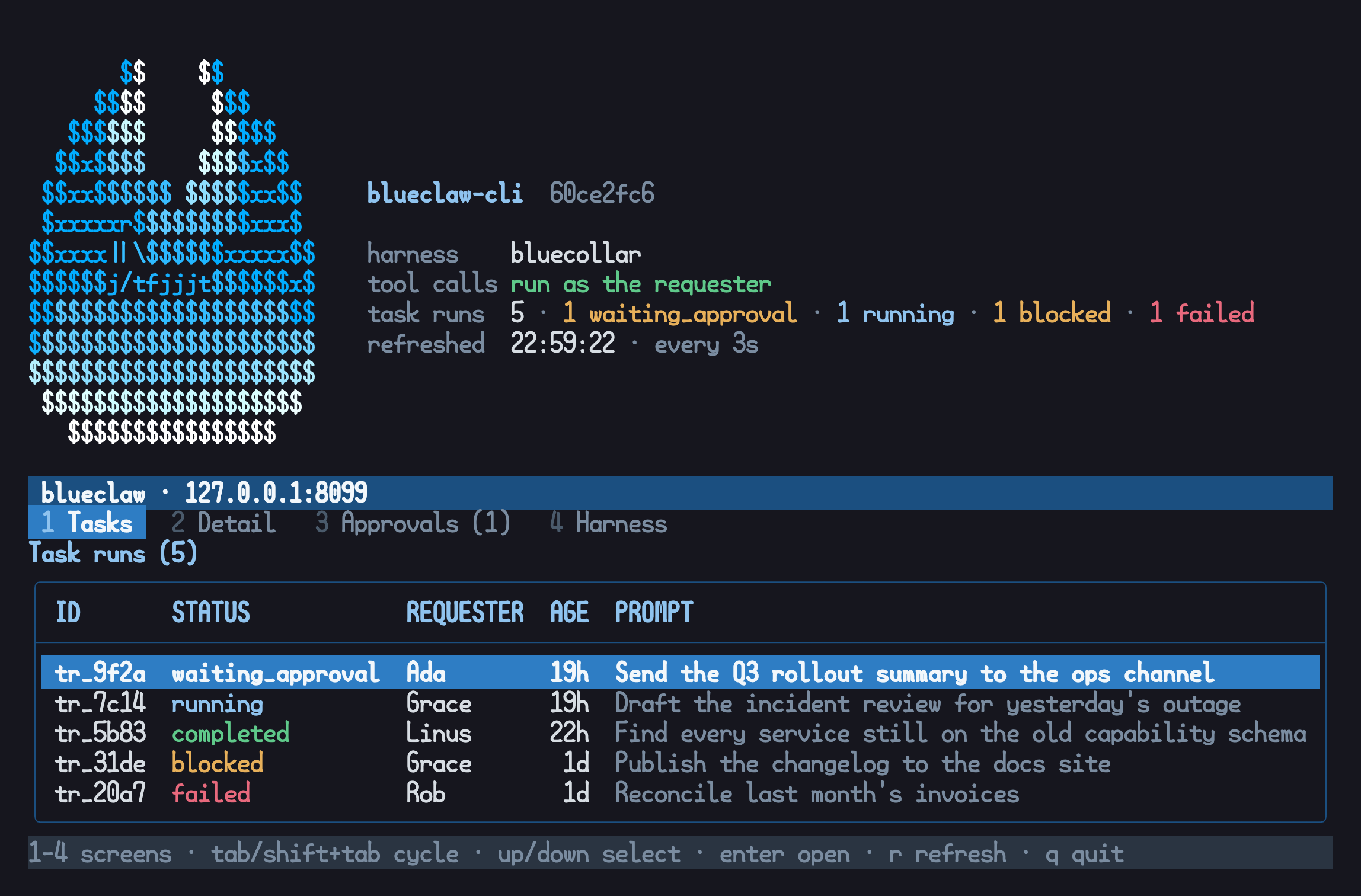
blueclaw-cli is the terminal client above; the host is what it connects to.
The agent loop is a replaceable component behind a Go interface
(agentcontract.Harness, one method). Five harnesses are selectable, one of them in this
repository. Swapping it does not move the isolation boundary, because tool
execution never leaves blueclaw.
What blueclaw is, and what it is not
| It is | It is not |
|---|---|
| a host process that runs an agent harness on other people's behalf | an agent, an agent loop, or a model |
| a POSIX identity boundary between the people sharing one machine | a container runtime or a sandbox technology |
| a durable task store with an append-only event ledger | a chat client |
| an MCP client that mounts external tool servers into the catalog, and an MCP server that publishes the requester's catalog to an external harness | a general-purpose MCP server for arbitrary clients |
| a Go binary you build from source and self-host | a hosted service or a packaged binary release |
Read the right-hand column literally. blueclaw separates requesters from each
other, not the agent from the machine; a container does the latter, and the two
compose.
blueclaw is the agent host inside InternKim, an on-premise AI automation
appliance.
Why an agent host, not another agent
Agent harnesses are already abundant: Claude Code, Codex, opencode, Gemini CLI,
and the loop bundled here. They all run as whoever started them. On a shared,
multi-user machine that means one Unix account for every requester, no
per-person file separation, and no record of which human authorized which side
effect.
Self-hosted assistants have the same shape from the other direction.
openclaw and the projects around it put
a capable agent on your own machine, and that is the right answer for one
person. Nothing stops a team pointing several people at one of them. They were
simply not designed for it, so the second person who asks for something gets the
first person's home directory, the first person's secrets, and a ledger that
cannot say who authorized what. blueclaw starts from the assumption those
projects do not make.
blueclaw takes the opposite split. The harness decides what to call. blueclaw
decides who it runs as, whether it runs at all, and what is written down.
A harness that executes tools inside its own process is not an acceptable
integration, because it takes back the only thing the host exists to provide.
The mechanical claim is narrow and testable: tool execution runs as an
unprivileged POSIX user derived from each requester's identity, and
POSIX ownership and mode
bits are the only access boundary. There is no executable allowlist, no denied
command list, no denied path prefix, and no instruction anywhere in a prompt
telling the model what it may not touch. A command the requester may not run is
not refused by blueclaw; it fails at the kernel, the same way it would fail for
that person at a shell.
That is an opinion, and it cuts both ways. Inside the requester's permissions
the agent is left alone — it may install a package, walk the filesystem, run a
build, try something and undo it, without asking a policy engine whether each
step is on a list. Every such list is a second, worse copy of the permissions
the kernel already enforces: it goes stale, it blocks work the person is
entitled to do, and the model learns to route around it. Confining a process is
a solved problem, and the solution is fifty years old.
So the boundary is drawn once, at identity, and it is absolute. What is left is
judgment about effects that leave the machine — sending a message, publishing a
site, changing a shared calendar — and that goes to a person at the approval
gate.
How it works
- connector — a platform adapter; normalizes an inbound message.
- task run — a durable record of one unit of work.
- event ledger — the append-only events belonging to a task run.
- approval gate — holds a tool call until a human authorizes it.
- POSIX projection — maps policy objects to real Linux users and groups.
  chat platform / HTTP ingress
            |
            v
  blueclaw (Go daemon)
    connectors · policy · task store · approvals · tool catalog · POSIX projection
            |
            +-- agentcontract.Harness --+-- .dependency/bluecollar   (Go, in-process)
            |                           +-- an ACP or CLI agent, started as the requester
            |
            +-- tool execution --> blueclaw-posix-helper --> each requester's UID/GID/groups
Intake: connectors normalize a message
Four connector adapters are registered at boot — mattermost, slack,signal, and api — plus buzz when connectors.buzz.enabled is set
(internal/app/application.go). Each turns a
platform-specific payload into the same normalized conversation turn. The api
connector needs no chat platform at all and is the way to drive blueclaw fromcurl or a test.
Intake resolves the sender to a person in the policy document. That resolved
person, not the daemon account, is the identity every later step runs under.
Task runs and the event ledger
A task run is a row in the task store with one of nine statuses
(.dependency/bluecollar/taskstate/task_type.go): planned, running, waiting_user_input,waiting_approval, blocked, interrupted, completed, failed,cancelled.
Every step appends an event through TaskEventService.AppendTaskEvent
(.dependency/bluecollar/taskstate/task_event_service.go). Event names follow a fixed wire grammar —tool.<name>.requested, tool.<name>.result, approval.pending_call,approval.executed, agent.task_launched, and, for a tool an external harness
ran outside the catalog, harness.tool_permitted and harness.tool_refused. A
reader can reconstruct what happened without access to the harness's internal
types.
Approval gates
An approval gate pauses a task run before a side-effecting tool call executes
and records approval.pending_call with the exact call
(internal/approvalgate, taskstate.TaskRunService.PauseTaskRun). Because the
held call is persisted, approval survives a daemon restart and does not block a
live request.
How the approved call then runs depends on which harness held it. The bundled
loop replays the recorded call verbatim
(.dependency/bluecollar/approval_gate.go). Every other harness is told in its
next prompt that the approval arrived and asked to issue that exact call again,
so the replay depends on the agent reproducing its own arguments. Levelling
every harness up to a verbatim replay needs the result of a host-executed call
to reach the agent, and the only channel for that today is the loop's own
in-process observation format, so it waits for the ledger to cross the harness
boundary.
Which calls are gated comes from descriptor metadata, not from the tool's name.toolcontract carries an ApprovalScope and one of 14 SideEffectClass values
per tool (.dependency/bluecollar/toolcontract/registry.go), from none and read throughworkspace_write, external_send, site_publish, and destructive.
The gate belongs to the host, not to a harness. internal/approvalgate holds
the call and internal/mcpserver consults it before invoking anything from the
catalog, so every harness meets the same gate on the same calls.
Sending a message,
changing a calendar, publishing a site — every outward or irreversible effect
exists only as a catalog tool, and an external agent has no other route to one.internal/acpharness also refuses ACP's own filesystem and terminal methods,
which pushes an agent's file and shell work back onto the catalog rather than
letting it run beside the gate.
What remains outside is the tools an agent runs inside its own process: goose's
shell, Claude Code's editor. Those are answered yes. The boundary there is
POSIX — the agent runs as the requester's unprivileged user, and a shell call it
makes itself can do no more than one made through terminal_run. The answer is
recorded: harness.tool_permitted and harness.tool_refused
go to the event ledger, so reading a task afterwards shows the calls the catalog
never saw.
One asymmetry is not ours to fix. ACP has a permission channel and a command
line does not, so a CLI harness offers nothing to record.
POSIX identity projection
Every person in the policy document projects to a real Linux user and every
circle to a real group (internal/security/posix_identity.go):
| Policy object | Linux object | Symbol |
|---|---|---|
| person | bc_person_<shortID> user with a primary group of the same name |
LinuxPersonUserName |
| circle | bc_circle_<circleID> group |
LinuxCircleGroupName |
| everyone | bc_shared supplementary group |
posixSharedGroupName |
| service internals | blueclaw user |
blueclawServiceUserName |
Names are lowercased, reduced to [a-z0-9_-], and capped at 31 characters. A
lossy or truncated normalization gets a hash suffix, so two people cannot
collide onto one account (shortenedLinuxName).
POSIXStateForPolicy compiles the policy into the users, groups, and directory
modes the daemon applies at every boot:
| Path | Owner:group | Mode |
|---|---|---|
<workspace>/private/people/<personID> (and tmp/, artifacts/) |
the person | 0700 |
<workspace>/circles/<circleID> |
blueclaw:bc_circle_<id> |
2770 |
<workspace>/shared |
blueclaw:bc_shared |
2755 |
<workspace>/shared/public, <workspace>/shared/cache/** |
blueclaw:bc_shared |
2775 |
<workspace>/private, <workspace>/private/people, <workspace>/circles |
blueclaw:blueclaw |
0711 |
<workspace>/.blueclaw — the daemon's own state, logs, configuration, and
identity map — appears in no projected directory entry, so it is never chowned
or chgrped to a task user and stays owned by the service account.
UIDs and GIDs are allocated from 100000 upward through a persisted allocation
table (cmd/blueclaw-posix-helper/main.go), so a person keeps the same numeric
identity across restarts and reprovisions and existing file ownership does not
drift.
Quickstart
There is no packaged install path in this repository: no Makefile, no
Dockerfile, no service unit, no release binaries. Running blueclaw means
building from source. The appliance tooling that provisions, packages, and
deploys it lives in a separate private repository.
Requirements: Go 1.26, Bun 1.3, Postgres, and one
OpenAI-compatible model endpoint — Ollama, vLLM, LM Studio, OpenRouter, or
anything else speaking that API.
1. Start llmd, the model sidecar. It holds the provider credentials and
runs beside the daemon.
cd llmd
printf 'a-local-secret' > /tmp/llmd-auth
BLUECLAW_LLMD_AUTH_KEY_PATH=/tmp/llmd-auth \
BLUECLAW_LLMD_SOCKET_PATH=/tmp/llmd.sock \
BLUECLAW_LLMD_LLAMA_BASE_URL=http://127.0.0.1:11434/v1 \
BLUECLAW_LLMD_LLAMA_MODEL=your-model \
BLUECLAW_LLMD_LLAMA_STRUCTURED_OUTPUTS_ENABLED=true \
BLUECLAW_LLMD_LOCAL_ONLY=true \
bun run src/main.ts
LLAMA_BASE_URL points at any OpenAI-compatible server; the name is historical.http://127.0.0.1:11434/v1 is Ollama. For a hosted provider, setOPENROUTER_API_KEY and drop the local variables. llmd/README.md lists the credential
setting.
Treat a local model as a development convenience. The runtime asks for
structured output natively and falls back to a forced tool call when the server
rejects that; Ollama treats the forced choice as a hint, so a model may answer
in prose and fail the turn. Small models also struggle with the larger runtime
schemas.
2. Start the daemon. Copy config/runtime.standalone.example.json, set your
Postgres connection string and the llmd socket and key paths, then:
go run ./cmd/blueclaw --runtime runtime.json --policy config/policy.example.json
curl -s localhost:8081/admin/api/health | jq '.status, .protocolIdentity.passed'
cmd/blueclaw takes exactly two flags, --runtime and --policy; everything
else is configuration. The 29 migrations under migrations/ are applied in
order at boot.
A standalone deployment reports capabilityd: not_configured and checks onlyllmd. There is no capability service, so the calendar, task, mail, and site
operations an appliance supplies are simply absent. The agent loop, skills, the
terminal, and files work.
3. Enable per-person POSIX isolation. Until this step every requester shares
the daemon's account; this is the step that makes blueclaw multi-user. The
projection is applied only whenterminal.posixHelperPath is set. Build and install the setuid helper, then
point the configuration at it:
go build -o /usr/local/bin/blueclaw-posix-helper ./cmd/blueclaw-posix-helper
sudo chown root:root /usr/local/bin/blueclaw-posix-helper
sudo chmod 4755 /usr/local/bin/blueclaw-posix-helper
The daemon then synchronizes users, groups, and directory modes from the policy
document at every boot (internal/app/application.go).
4. Give it work, as two different people. Address two people from your
policy by email through the api connector:
for sender in [email protected] [email protected]; do
  curl -s -X POST localhost:8081/connectors/api/events -H 'content-type: application/json' \
    -d "{\"conversationID\":\"dm:api:$sender\",\"messageID\":\"m1\",\"senderID\":\"$sender\",
         \"replyTargetID\":\"dm:api:$sender\",\"prompt\":\"Write your name to a file in your home directory.\"}"
done

curl -s 'localhost:8081/agent/api/replies?conversationID=dm:api:[email protected]'
The two runs execute as different Linux users with different 0700 home
directories. Neither can read the other's file, and the ledger records which of
them authorized which side effect. That is the whole claim, and it takes about
thirty seconds to watch.
To watch a whole scenario instead, the lab runner drives the agent loop and
writes every request, response, tool call, and artifact to a directory:
go run ./cmd/blueclaw-lab virtual-session --scenario presentation \
  --artifact-dir .artifacts/blueclaw-e2e --live-llm --llm-unix-socket /tmp/llmd.sock
Live runs spend money, so they are never enabled by configuration alone. The
explicit --live-llm flag or BLUECLAW_E2E_LIVE=1 is required
(cmd/blueclaw-lab/main.go). Scenario names resolve throughe2e.BuiltinScenario; the scenarios are defined in internal/e2e/scenarios.go,
and --scenario-file loads one from JSON instead.
Terminal interface
cmd/blueclaw-cli is how you watch and answer a running daemon from a terminal.
It talks to the admin API over HTTP, so it runs wherever you can reach the
daemon.
go build -o blueclaw-cli ./cmd/blueclaw-cli
./blueclaw-cli --base-url http://127.0.0.1:8081
With no --base-url it reads the one recorded at enrollment. --runtime
points at the daemon's runtime configuration and is only needed when the
daemon is unreachable and you still want to see which harness is configured.
Four screens, switched with 1-4 or tab; up/down selects, enter
opens, r refreshes, q quits.
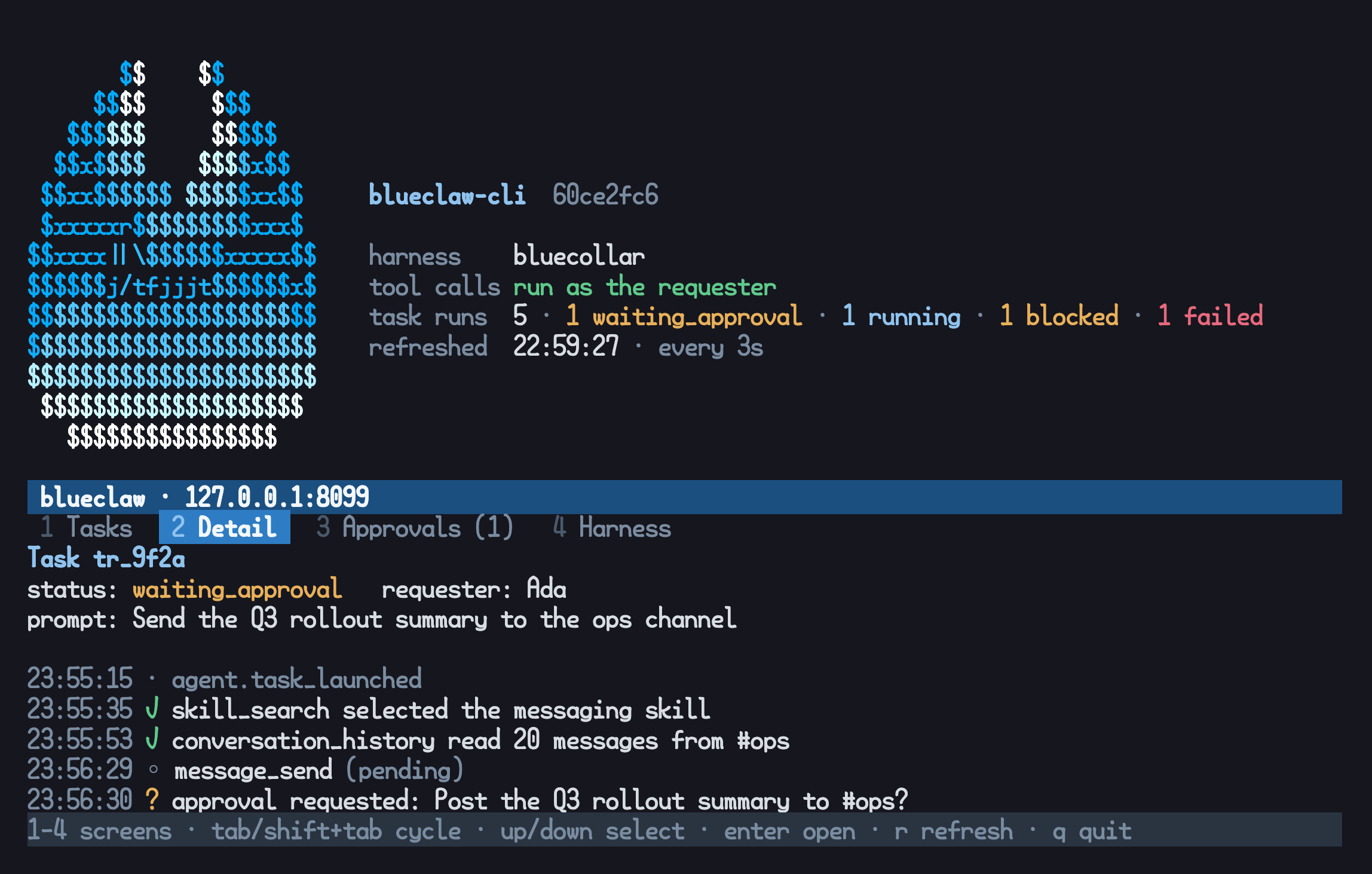
Detail replays one task run from its event ledger — every tool call, its
result, and the approval that is holding the run open.
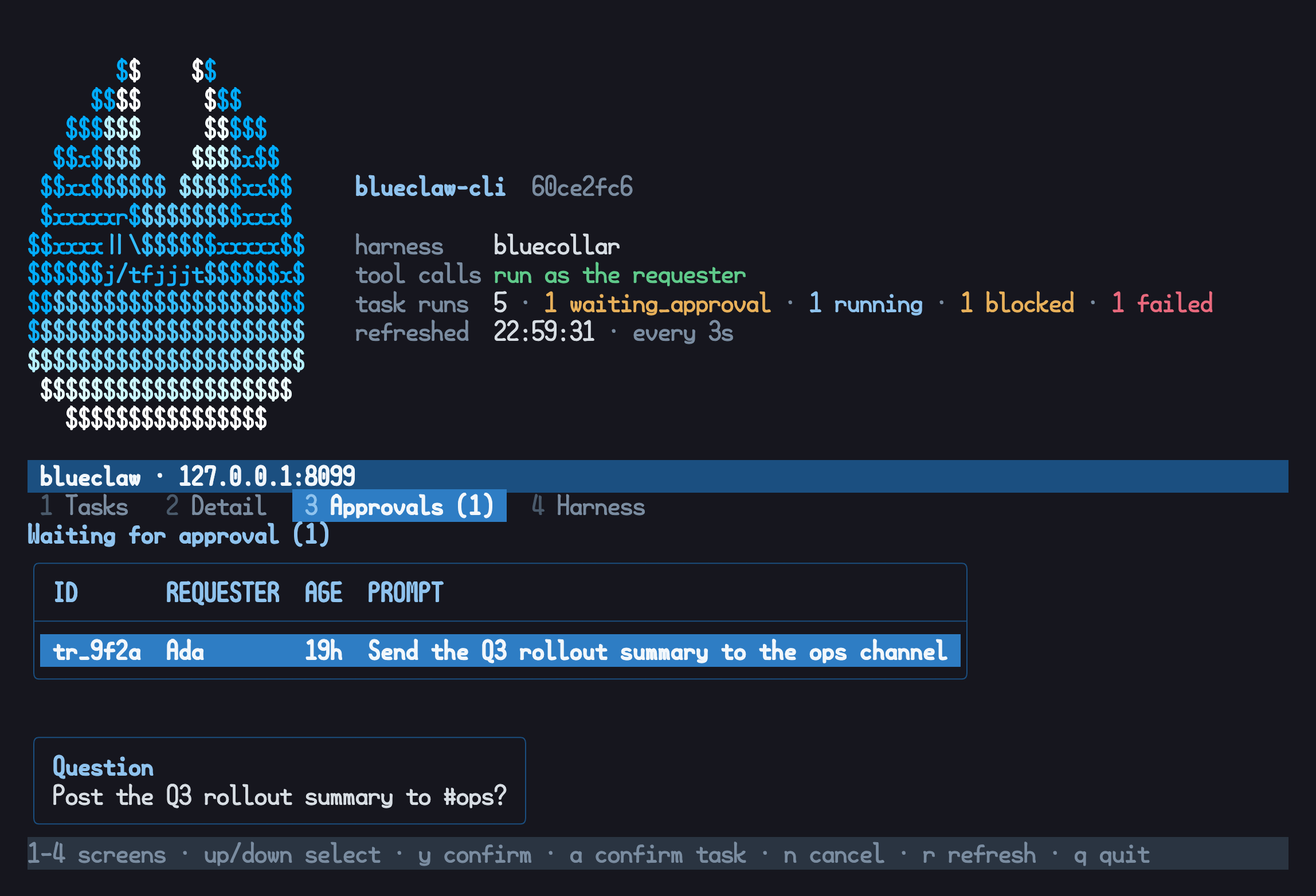
Approvals lists every run waiting on a person and shows the question the
daemon asked. y confirms the held call, a confirms every held call in that
task, n cancels. The answer is written to the ledger, so approving survives a
daemon restart; see Approvals for how the held call then runs.
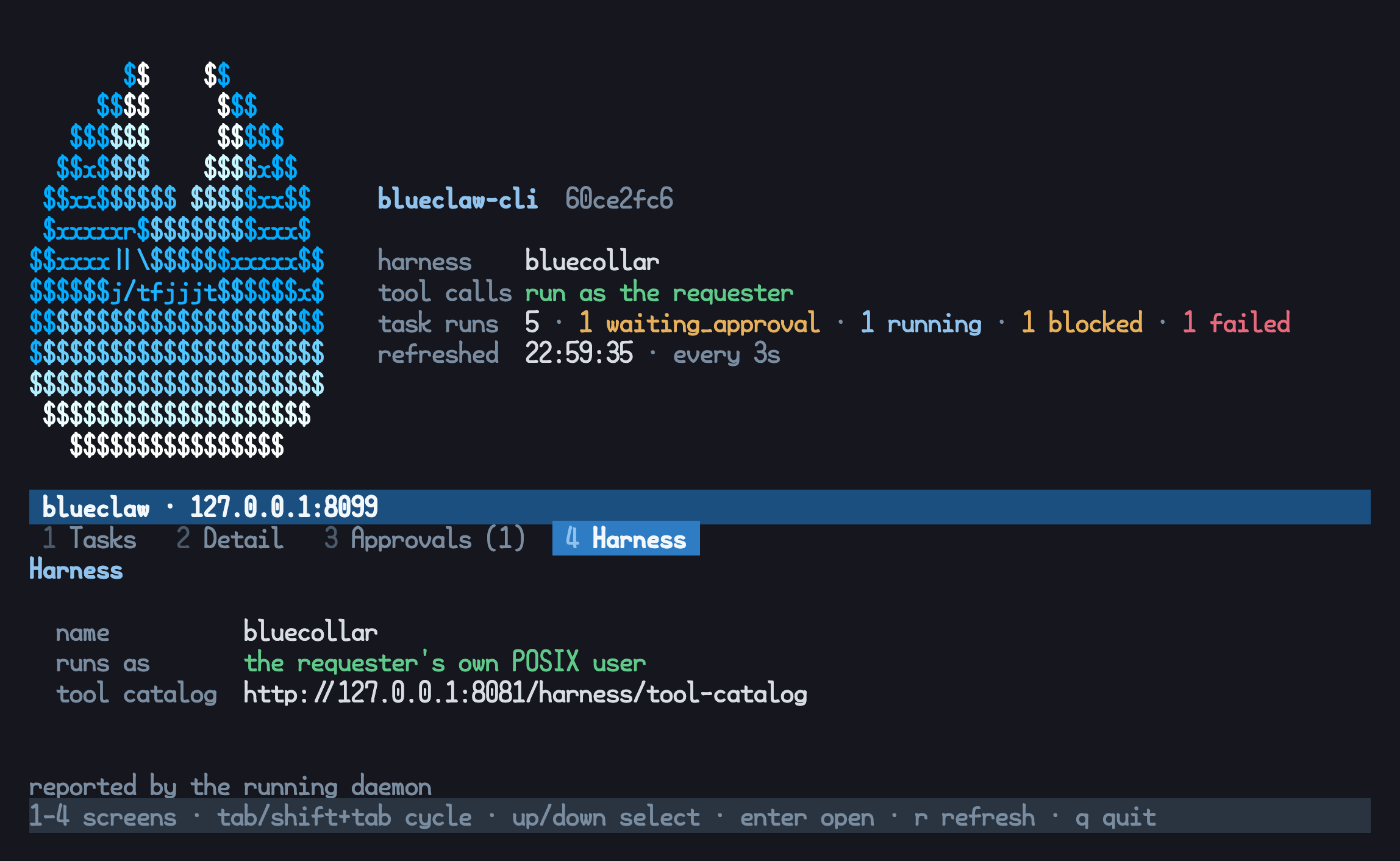
Harness reports which loop the running daemon is using and
whether tool calls execute as the requester's own POSIX user or as the daemon
account.
Harnesses
A harness is the agent loop: it runs a turn and reports what happened. In
blueclaw a harness is anything satisfying agentcontract.Harness
(.dependency/bluecollar/agentcontract/harness.go), a single method:
type Harness interface {
	RunTurn(context.Context, AgentTurnRequest) (AgentTurnResult, error)
}
The port was deliberately shrunk. It began at nine methods. Most of them
asked a model a question instead of asking an agent to work: classify whether a
chat message was addressed to the bot, write a reply sentence, refresh a skill
index, route a turn, complete a launch failure. No external harness could answer
those honestly, so nothing but blueclaw's own loop could implement the port.
Those are host policy now. internal/reply and internal/agentruntime hold
most of them; turn routing is still a package in the bluecollar repository
(.dependency/bluecollar/intake) that the host runs before every turn, becauseAgentTurnRequest.PrecomputedTurnDecision is required and a harness that
arrives without one is refused. See Project status.
The host opens the task run. Every harness is handed an ExistingTaskRunID and
settles the run it was given, so a first turn is recorded the same way whichever
loop ran it.
A harness that only ever sees a prompt is briefed in it. The standing
instructions the host assembles, the agent's own name and handle, the company,
who is asking, the language to answer in, and the facts already recalled arrive
as a preamble ahead of the request (internal/turnbriefing). The bundled loop
takes the same material through its instruction bundle and turn request.
The ledger is not owned that cleanly yet. Of 126 event names, the host writes 42
from what it observes at its own boundaries, the bundled loop writes 73 from
inside the turn, and 11 have a writer on each side, so which one fires depends
on the configured harness. Six of the 11 are the approval family, where a second
gate lives in the loop; five are the failure family, split betweeninternal/launchfailure for a failure before the turn and the loop for one
during it. An external harness produces none of the loop's 73, which is why a
turn under one reads thinner than the same turn under bluecollar. Consolidating
that is the current work.
Everything else the host needs — task events, cancellation, run lookup — it
takes from the task store.
The harness is injected at the top. main passes a factory:
application := app.NewApplication(runtimeConfiguration, *policyPath, bundledHarnessFactory())
bluecollar is the bundled
implementation. It lives in its own repository, pinned here as a submodule at.dependency/bluecollar, and carries agentcontract with it because both sides
compile against it.
Building with -tags nobundledharness leaves the loop out of the binary, soagent.harness.name has to name one of the others. agentcontract and intake
still compile in as contract and host routing; a test in cmd/blueclaw fails if
the loop creeps back.
The scenario rig binds the same factory production does. It used to have a
harness port of its own, because a scenario pins a turn budget and a runtime
configuration has no way to say "two iterations". That budget is a host
capability now, so harnessdriver has one Dependencies and one Factory, and
the rig reaches its harness through the door production uses.
agent.harness.name in the runtime configuration selects which harness runs:
| Name | What it runs |
|---|---|
bluecollar (default) |
the bundled in-process loop |
acp |
any ACP agent named by agentCommandPath |
claude-code |
the claude CLI in headless mode |
codex |
the codex CLI |
antigravity |
the agy CLI |
The catalog reaches an ACP agent over whichever MCP transport it takes. Agents
that advertise mcpCapabilities.http are handed the endpoint and a session
token directly. Everyone else is handed a stdio server: the daemon binary inmcp-tool-catalog mode, spawned by the agent under its own identity, proxying
to that same endpoint. The Agent Client Protocol requires every agent to support
stdio and leaves http optional, so stdio is the floor.
internal/acpharness, built on coder/acp-go-sdk, is blueclaw acting as an ACP
client: it starts the external agent inside the requester's POSIX identity,
publishes the requester's tool catalog over MCP, and lets the kernel — not a
deny list — decide what that agent may do. internal/cliharness does the same
for agents that speak a command line; each one is a descriptor of flags and an
output parser.
An external harness brings tools of its own, so both refuse to run at all
unless the requester's POSIX boundary is configured. Neither can report a task's outcome
the way the bundled loop does. A CLI agent that ends its turn has said its
piece, not finished the work, so blueclaw decides the outcome itself from the
agent's final message and the catalog tools that actually ran
(internal/turnoutcome).
blueclaw versus Claude Code, Codex, opencode, and Gemini CLI
These are agent harnesses. blueclaw is the host they are intended to run inside.
The question is which layer owns what.
| Concern | Claude Code, Codex, opencode, Gemini CLI | blueclaw |
|---|---|---|
| Agent loop | yes, that is the product | delegated to a harness behind an interface |
| Model choice | yes | delegated to llmd, swappable mid-run |
| Runs as | the operating system user who started it | an unprivileged user derived from the requester |
| Multi-person separation | none; one process, one account | per-person Linux user, group, and 0700 home |
| Approval | in-process prompt, lost on exit | persisted approval.pending_call, carried out later |
| Audit record | terminal scrollback and local session files | append-only event ledger in Postgres, per task run |
| Inbound surface | a terminal | chat connectors and HTTP ingress |
| Work lifetime | one interactive session | durable task runs across restarts |
Security model
Report security problems through SECURITY.md, not a public issue.
Applying the identity
CommandGuardrailService.BuildCommandPlan
(internal/security/command_guardrail_service.go) builds the plan;applyPOSIXRunner rewrites it to invoke the setuid helper:
blueclaw-posix-helper exec --uid <uid> --gid <gid> --groups <gids> --cwd <dir> -- <argv>
The helper (cmd/blueclaw-posix-helper/main.go) is installed root:root 4755.
It authorizes only a real UID of root or blueclaw
(authorizeHelperCaller, isAuthorizedHelperCaller), then calls setgroups,setgid, and setuid in that order (applyIdentity) before syscall.Exec.
After that call the process is the requester and cannot regain privilege.
File tools are not a separate code path. file_read, file_write, file_edit
and the rest build a shell command and run it through the same requester
primitive (internal/agentruntime/requester_shell.go), starting in the
requester's own $HOME (requesterShellScript), so tilde expansion, globs, and
relative paths carry native POSIX semantics instead of a hand-written path
vocabulary.
What the guardrail actually enforces
TerminalConfiguration (internal/config/runtime_configuration.go) has 9
fields: mode, sandbox provider, workspace root, POSIX helper path, timeout,
output cap, session cap, and the network and interactive-shell switches. None of
them is a list of commands or paths. What the guardrail does is structural:
| Check | Where |
|---|---|
| refuses to execute at all when the daemon is effectively root | BuildCommandPlan |
| resolves the working directory against the workspace root | resolveWorkingDirectoryPath |
replaces the environment with a fixed allowlist of variable names (not values) and forces a canonical PATH |
sanitizeEnvironmentVariables |
| caps the timeout | timeoutSecond |
requires bubblewrap when terminal.mode is sandbox |
BuildCommandPlan |
Executable resolution is a PATH lookup, not a permission decision. An absolute
path is resolved verbatim through EvalSymlinks; a bare name is searched in the
canonical runtime PATH (resolveExecutablePath).
Two things in this path look like string filters and are not access decisions.requesterShellOutcome.failureCode (internal/agentruntime/requester_shell.go)
matches stderr text to classify an already-failed command into a diagnostic
code, and shell arguments are quoted (shellPathArgument) as serialization.
Neither runs before the kernel decides.
Known gaps in the boundary
- The projection is applied only when
terminal.posixHelperPathis configured.
With it empty,applyPOSIXRunnerreturns the plan unchanged and everything
runs as the daemon user. The shippedconfig/runtime.standalone.example.json
does not set it, so a default standalone deployment runs everything as the
daemon user on either platform. cmd/bluecollardeliberately usesDirectWorkspaceActorFactory
(internal/security/direct_workspace_actor.go), which has no projection at
all. It is a single-directory batch runner, not a multi-person daemon.internal/access/access.goexposesCanAccess, consulted before exposing
capability and MCP tools and before memory reads. This README used to call it
a migration leftover awaiting deletion. That was wrong: POSIX confines what a
process may touch on this machine, and says nothing about whether a person may
send a message as the company or change a shared calendar. Those effects
happen incapabilityd, which takes the requester's identifier for
attribution and never for authorization, soCanAccessis the only thing
deciding which capability operations a requester may invoke. It sits in front of
the socket and belongs behind it, which is work to move.- The POSIX separation tests need root and a setuid helper, so an ordinary
go test ./...skips all three and says nothing about the isolation
boundary. They run on Linux and macOS
(tests/integration/posix_separation_test.go).
Configuration
Two files, both passed as flags. --runtime points at a runtime configuration
(start from config/runtime.standalone.example.json); --policy points at a
policy document (config/policy.example.json). The policy document is the
source of the people and circles the POSIX projection compiles.
The terminal section is the one that decides whether isolation is on:
{
  "terminal": {
    "mode": "native",
    "workspaceRootPath": "/workspace",
    "posixHelperPath": "/usr/local/bin/blueclaw-posix-helper",
    "timeoutSecond": 600,
    "allowNetwork": true,
    "allowInteractiveShell": false
  }
}
The agent section decides which loop runs and what it is allowed to assume:
{
  "agent": {
    "defaultTaskLevel": "low",
    "harness": {
      "name": "claude-code",
      "agentCommandPath": "/usr/local/bin/claude"
    },
    "optionalFileReadPathSuffixes": [".myapp/site.json"]
  }
}
harness.name is the one in Harnesses; omit the block and the
bundled loop runs. defaultTaskLevel is the effort a task starts at
(xlow through max) before the tier ladder moves it.optionalFileReadPathSuffixes names files whose absence is a state — a
deployment's own control files, which the daemon knows about and
the harness does not; the default is empty.
External MCP servers mount into the tool
catalog through mcpServers in the same runtime configuration
(MCPServerConfiguration, internal/config/runtime_configuration.go). Each
server's tools can carry a result contract and policy metadata, so an external
tool participates in the same approval and evidence rules as a built-in one.
Repository layout
| Path | What lives there |
|---|---|
.dependency/bluecollar/agentcontract/ |
the harness port and the turn, context, and instruction types both sides compile against |
.dependency/bluecollar/toolcontract/ |
tool descriptors, registry, validation, kernel tool names |
.dependency/bluecollar/taskstate/ |
task run, step, event, and artifact stores |
.dependency/bluecollar/model/ |
language model, chat completion, structured output, and embedding interfaces |
agenttest/ |
scripted language model for deterministic tests |
cmd/ |
10 binaries; see the table below |
internal/ |
daemon implementation: connectors, agent runtime, security, policy, identity, memory, HTTP, storage |
.dependency/bluecollar/ |
the agent loop, as its own repository pinned here |
internal/acpharness/ |
blueclaw as an ACP client, plugging an external agent into the daemon |
protocol/ |
Zod contracts shared across processes; generates the JSON Schema artifacts |
llmd/ |
AI SDK sidecar: structured output and chat generation over a Unix socket |
chatd/ |
chat bridge and platform adapters (Mattermost, Buzz) |
admin/ |
Svelte admin and task console sources |
web/ |
build output of admin/, untracked; run cd admin && bun run build before serving the console |
migrations/ |
29 Postgres migrations, applied in order at boot |
tests/ |
integration suite and fixtures |
lab/ |
provisioning and scenario scripts for the development VM |
config/ |
example policy, runtime, and lab configuration |
tools/ |
Python sidecars, currently the Graphiti memory daemon |
docs/ |
architecture.md |
| Binary | Purpose |
|---|---|
cmd/blueclaw |
the daemon |
cmd/blueclaw-posix-helper |
setuid identity switch, POSIX state sync, filesystem operations |
cmd/blueclaw-lab |
development VM lifecycle and scenario runner |
cmd/blueclaw-supervisor |
boots and watches the Firecracker guest, proxies host and guest HTTP, handles workspace image sync and restore |
cmd/blueclaw-backup, cmd/blueclaw-restore |
workspace and database snapshot bundles |
cmd/blueclaw-guest-healthd, cmd/blueclaw-vsock-http-proxy |
guest health and host-to-guest transport |
cmd/bluecollar |
runs the agent loop alone against one directory, for benchmarking; no database, connectors, policy, or POSIX projection |
Development
go build ./...
go vet ./...
go test ./...
bun install
bun run test
The four TypeScript packages are one Bun workspace, so a single bun install at
the root covers them. bun run test typechecks, then runs protocol, llmd,chatd, and admin in turn. CI runs exactly these
commands (.github/workflows/ci.yml), with Postgres 16 as a service. It checks
out the bluecollar submodule with SUBMODULE_READ_TOKEN when that secret
exists, falling back to the repository token — which is enough as soon as
bluecollar is readable without one.
| Test tier | How it runs | Gate |
|---|---|---|
| Unit | go test ./..., bun run test |
none; no external service needed |
| Integration | go test ./tests/integration/... |
Postgres-backed cases skip unless BLUECLAW_TEST_POSTGRES_URL is set |
| Live model | same go test invocation |
skipped unless BLUECLAW_LLMD_LIVE_SOCKET and BLUECLAW_LLMD_LIVE_AUTH_KEY, or BLUECLAW_LIVE_LLM_TEST=1, are set — these call a real model and cost money |
| Virtual session | go run ./cmd/blueclaw-lab virtual-session |
requires --live-llm or BLUECLAW_E2E_LIVE=1 |
| Fleet and VM | go run ./cmd/blueclaw-lab vm-up, smoke-firecracker |
needs the development VM from config/lab.example.json |
Regenerating the cross-process contracts:
cd protocol && bun install && bun run generate && bun run build && bun test
AGENTS.md documents the conventions this codebase holds itself to:
descriptive names over abbreviations, no explanatory comments, one source of
truth per shared contract.
Project status
Shipped and working: the daemon, the five connectors, the task store and event
ledger, the POSIX projection and setuid helper, the approval gate, the MCP
client and server, the llmd model sidecar with mid-run model swapping, the
terminal user interface, and five selectable harnesses.
| Item | State |
|---|---|
| A harness port narrow enough for an external harness | done. Down from nine methods to one, RunTurn. Turn routing (deciding whether an inbound message becomes a task at all) and launch-failure completion are daemon policy now and live in internal/agentruntime. |
| External harnesses plugging in | done. agent.harness.name selects bluecollar (in-process), acp (any Agent Client Protocol agent), claude-code, codex, or antigravity; see Harnesses. opencode over ACP and Claude Code over its CLI both run a full turn against this daemon's tool catalog with no harness-specific code beyond a command descriptor. |
| MCP server exposing blueclaw's tool catalog | done. internal/mcpserver publishes a per-requester catalog at /harness/tool-catalog, authenticated by a session token that is revoked when the turn ends. It is how an external harness reaches tools it may not execute itself. |
| CLI and terminal user interface | done. cmd/blueclaw-cli on charm.land/bubbletea/v2: task timeline, approval queue, live tool calls, and the enrollment flow. |
| bluecollar moving to its own repository | done. The loop, its routing, the turn stream, and the contract packages live in the bluecollar repository and are pinned here as a submodule. |
Removal of the internal/access Go-side ACL pre-check |
withdrawn. It is not a POSIX duplicate; it is the only per-person authorization for capability operations, and nothing downstream repeats it. See Known gaps in the boundary. |
Publishing blockers, in order:
- Publish bluecollar in the same release. It is a private repository, and
this one requires it, sogo build ./...fails on a fresh clone by anyone
outside the organization. Publishing both together is what makes the
submodule checkout — here and in CI — need no token at all. Everything else
is secondary to this. - Complete a secrets and history audit.
- Move authorization for capability operations to the service that performs
them. Not a publishing blocker: the check exists and works.
FAQ
Can I run Claude Code or Codex inside blueclaw today?
Yes. Set agent.harness.name to claude-code, codex, antigravity, or acp
(for any Agent Client Protocol agent) and point agentCommandPath at the
executable. The agent starts inside the requester's POSIX identity and reaches
this daemon's tools through an MCP catalog published for that turn only.
Two things to know. The external agent brings tools of its own, so blueclaw
refuses to start it at all unless the POSIX boundary is configured — the kernel,
not a deny list, is what confines it. And the coverage of these adapters is
thinner than the bundled loop's: the live tests are skipped unless the CLI is on
your PATH.
How is this different from running an agent in a container?
A container isolates the agent from the machine. blueclaw isolates requesters from
each other inside the workspace. Two people talking to the same daemon get
different Linux users, different 0700 home directories, and different group
memberships, so one person's agent run cannot read the other's files even though
both run in the same container. blueclaw also
supports bubblewrap when terminal.mode is sandbox.
What stops the agent from running a dangerous command?
Nothing in blueclaw, by design. There is no executable allowlist and no denied
command list. The command runs as an unprivileged user with that user's
permissions, and the kernel refuses what that user may not do. Wide or
irreversible tool calls are handled separately, by the approval gate, which
requires a human before the call executes.
Does it need Linux?
No. Linux is where it is deployed and where the fleet tests run, and
macOS works too, and the same three tests prove it there
(#18). The helper creates
identities through dscl and dseditgroup on macOS and through useradd,groupadd and usermod on Linux, and it reads the account database from
Directory Service, which on macOS is the only place every account appears;/etc/passwd there lists system accounts alone.
Two differences are forced by the platform. macOS ships no /usr/sbin/nologin,
so projected people get /usr/bin/false, which is what its own service accounts
use. And macOS hides accounts below uid 500 from the login window while the
projection allocates from 100000, so each record carries IsHidden.
What macOS does not have is bubblewrap, so terminal.mode stays native there.
That is optional narrowing, and the boundary is the POSIX identity either way.
Do I need Postgres and a chat platform?
Postgres, yes; the task store and event ledger live there. A chat platform, no.
The api connector accepts a JSON POST and returns replies over HTTP, which is
enough to drive a task run from curl.
Is there a binary release or a Docker image?
No. There is no Makefile, Dockerfile, service unit, or release binary in this
repository. Build from source with go build ./....
Contributing
Pull requests open at alpha. Until then the design is moving too fast for
outside patches to be a kindness to whoever sends them. Issues are welcome now
— tell us what broke. For a security problem, follow SECURITY.md
instead of opening an issue.
License
Apache License 2.0. See LICENSE.
The bundled agent loop is a separate project under the same licence:
bluecollar is Apache 2.0 as
well, pinned here as a submodule at .dependency/bluecollar. A build that ships
the bundled harness ships both.
The Mattermost adapter under chatd/src/adapters/mattermost/ vendors
MIT-licensed third-party code; its license is kept alongside it.
Reviews (0)
Sign in to leave a review.
Leave a reviewNo results found