ghostapi
Health Pass
- License — License: MIT
- Description — Repository has a description
- Active repo — Last push 0 days ago
- Community trust — 30 GitHub stars
Code Pass
- Code scan — Scanned 12 files during light audit, no dangerous patterns found
Permissions Pass
- Permissions — No dangerous permissions requested
No AI report is available for this listing yet.
Local API simulation and test evidence for AI-assisted development.

GhostAPI
The local internet for AI coding agents.
Build and test third-party API integrations locally, without charging cards, sending messages, leaking production keys, or mutating real services.


Quickstart · Features · Providers · MCP · Safety · Enterprise
npx @yiaany/ghostapi start --open
Why GhostAPI
Coding agents can write a Stripe checkout, an OpenAI workflow, a GitHub automation, or an email integration in minutes. The dangerous part is what happens when they run that code.
Without a safe local target, a test can:
- charge a real card;
- send a real email or SMS;
- create or modify real GitHub resources;
- spend API credits;
- leak credentials into logs, prompts, screenshots, or test fixtures.
GhostAPI gives your application and coding agent a local API world at 127.0.0.1:8080. Requests are detected, sanitized, recorded, and answered with deterministic provider-shaped responses. You can inspect the result in the dashboard, control behavior through MCP, and turn failures into repeatable tests.
Quickstart
Start the local server and dashboard:
npx @yiaany/ghostapi start --open
Send a Stripe-shaped request:
curl -X POST http://127.0.0.1:8080/v1/customers \
  -H "content-type: application/json" \
  -H "authorization: Bearer stripe_test_ghostapi" \
  -d '{"email":"[email protected]","name":"Ada Lovelace"}'
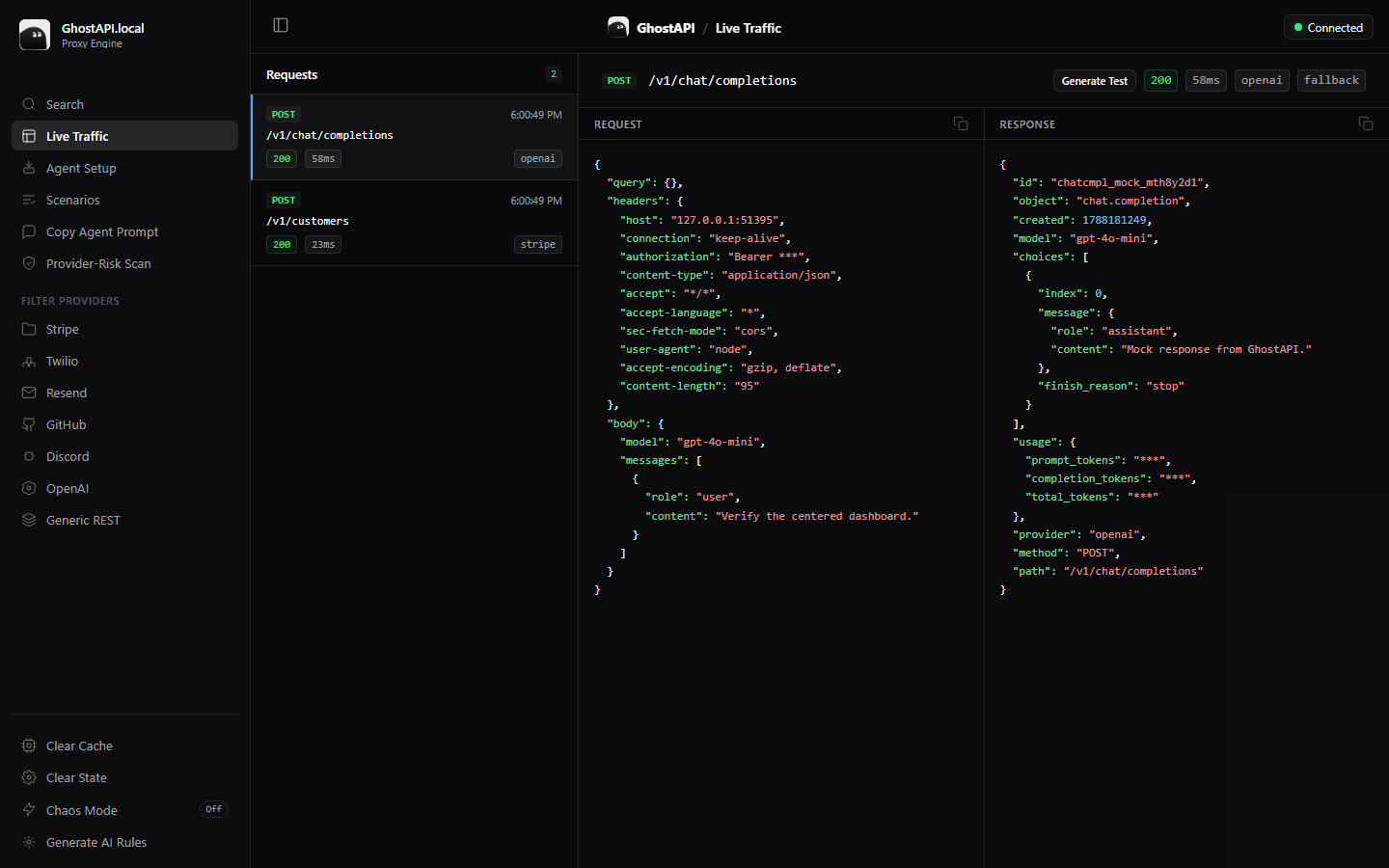
Open the dashboard at http://127.0.0.1:8080/dashboard. The request appears in live traffic with its provider, request body, generated response, source, status, and timing.
Initialize GhostAPI inside an existing repository:
npx @yiaany/ghostapi init
npx @yiaany/ghostapi doctor
init creates local configuration, a versioned safety policy, MCP snippets, and agent instructions without overwriting existing files.
On a supported Linux host, run a command inside the loopback-only network namespace:
npx @yiaany/ghostapi run -- npm test
On Windows and macOS, ghostapi run fails closed because an equivalent process-isolation backend is not implemented. The local API server and dashboard still work normally.
What You Get
| Feature | What it does |
|---|---|
| Local API sandbox | Gives SDKs and applications a local target instead of a live provider. |
| Provider-shaped behavior | Returns realistic objects, validation errors, rate limits, declines, and failure payloads. |
| Live dashboard | Shows requests and responses, filters traffic by provider, generates tests, and arms scenarios. |
| MCP control plane | Lets compatible coding agents inspect state, read traffic, configure responses, and toggle Chaos Mode. |
| Stateful synthetic worlds | Maintains deterministic local identities and state across Stripe, GitHub, email, and REST projections. |
| Scenarios and record/replay | Saves sanitized sandbox traffic and replays it offline as deterministic fixtures. |
| Contract drift checks | Imports bounded OpenAPI/HAR contracts and classifies breaking, non-breaking, and uncertain changes. |
| Agent evals and evidence | Produces redacted, tamper-evident reports for local review and CI policy gates. |
| Secret protection | Masks secret-shaped headers, query parameters, bodies, paths, events, prompts, and cache inputs. |
| Fault testing | Forces latency, provider errors, card declines, rate limits, and other unhappy paths. |
| Safety controls | Includes local approvals, scoped budgets, kill switches, circuit breakers, ledgers, and reconciliation for synthetic actions. |
| Reliability tooling | Tracks local SLO samples, cost attribution, runtime health, backups, inventory, and attack-path metadata. |
Dashboard
The dashboard is the fastest way to understand what an agent or application actually did.
- Watch traffic arrive in real time over SSE.
- Inspect sanitized request and response JSON.
- Filter by Stripe, Twilio, Resend, GitHub, Discord, OpenAI, or generic REST.
- Generate a Vitest test from a captured request.
- Generate and copy setup files for supported coding agents.
- Arm deterministic scenario presets.
- Toggle Chaos Mode and inspect the local safety report.
Dashboard and API routes are token-protected on every non-loopback bind. Use HTTPS or a secure tunnel when exposing GhostAPI beyond localhost.
Provider Support
GhostAPI has two levels of provider support.
Stateful provider packs
| Provider | Included behavior |
|---|---|
| Stripe | Customers, products, prices, subscriptions, invoices, payment intents, payment methods, checkout sessions, refunds, pagination, lifecycle scenarios, and signed local webhooks. |
| Resend | Deterministic email-shaped requests, responses, validation, and failure behavior. |
Provider-shaped adapters and generic inference
OpenAI, Twilio, GitHub, Discord, and generic REST routes are detected and receive provider-shaped mock responses and errors. These adapters are useful for local development, but they do not claim complete parity with every live-provider endpoint.
Unsupported endpoints fail diagnostically instead of silently pretending that an operation succeeded.
SDK Setup
Stripe:
import Stripe from "stripe";

export const stripe = new Stripe(
  process.env.STRIPE_SECRET_KEY ?? "stripe_test_ghostapi",
  {
    host: process.env.GHOSTAPI_HOST ?? "127.0.0.1",
    port: Number(process.env.GHOSTAPI_PORT ?? "8080"),
    protocol: process.env.GHOSTAPI_PROTOCOL ?? "http"
  }
);
OpenAI:
import OpenAI from "openai";

export const openai = new OpenAI({
  apiKey: process.env.OPENAI_API_KEY ?? "sk-ghostapi",
  baseURL: process.env.GHOSTAPI_OPENAI_BASE_URL ?? "http://127.0.0.1:8080/v1"
});
Generic REST:
curl -X POST http://127.0.0.1:8080/tasks \
  -H "content-type: application/json" \
  -d '{"title":"Add integration tests","status":"open"}'
MCP For Agents
Start the MCP server:
npx @yiaany/ghostapi mcp
Generic MCP configuration:
{
  "mcpServers": {
    "ghostapi": {
      "command": "npx",
      "args": ["-y", "@yiaany/ghostapi", "mcp"]
    }
  }
}
Available tools:
| Tool | Purpose |
|---|---|
inspect_state |
Read current local API objects. |
get_traffic_logs |
Inspect sanitized recent traffic. |
set_api_behavior |
Force a deterministic response for a method and path. |
toggle_chaos_mode |
Enable or disable local latency and failure injection. |
Generate setup snippets for Cursor, Claude, Cline, Aider, Codex, OpenCode, Gemini CLI, Goose, OpenClaw, Hermes, and generic MCP clients:
npx @yiaany/ghostapi setup --write
Scenarios, Contracts, And Evals
Record approved sandbox traffic into a sanitized offline bundle:
ghostapi record \
  --input capture.har \
  --allow-sandbox-host api.sandbox.example \
  --approve
Replay it without network access:
ghostapi replay bundle.json --requests requests.json
Import and compare API contracts:
ghostapi contract import-openapi --input openapi.json
ghostapi contract diff \
  --baseline base.contract.json \
  --candidate head.contract.json \
  --policy ghostapi.policy.yaml \
  --ci
Generate sanitized CI evidence:
ghostapi evidence generate --policy ghostapi.policy.yaml --ci
Run a deterministic agent eval:
ghostapi eval \
  --template retry-after \
  --evidence .ghostapi/reports/latest.json \
  --ci
Safety Boundaries
GhostAPI is designed to fail closed, but its boundaries are explicit:
- Real provider calls are disabled by default.
- Ambient
OPENAI_API_KEYdoes not enable external generation. - External LLM generation requires an explicit flag plus a separate
GHOSTAPI_LLM_API_KEY. - Non-loopback access requires a strong dashboard token.
- External response redirects, unsafe response headers, traversal, remote schema references, symlinks, archives, and oversized inputs are rejected where applicable.
- Persistent stores have size, entry, retention, or rotation limits.
- The Linux
runbackend provides loopback-only process network isolation when namespace preflight succeeds. runis not a hostile-code filesystem sandbox.- Secret masking is heuristic. Use synthetic credentials and data even in local fixtures.
- Local approval, action, credential, ledger, trust, and safety components execute synthetic operations only. They are not a production-provider executor.
Read the detailed threat models in docs/security and the reporting policy in SECURITY.md.
Platform Support
| Platform | Local API and dashboard | ghostapi run enforcement |
|---|---|---|
| Linux | Supported on Node.js 20+ | Supported when unshare, iproute2, and namespace preflight pass. |
| Windows | Supported on Node.js 20+ | Not implemented; fails closed. |
| macOS | Supported on Node.js 20+ | Not implemented; fails closed. |
Check the current machine:
ghostapi doctor --json
ghostapi doctor --egress
Health Endpoints
GET /health             process liveness, HTTP 200 while state can be evaluated
GET /health/readiness   structural readiness, HTTP 503 when a required store is unsafe
Hosted And Enterprise
The hosted/ directory contains an implemented but not yet deployed team pilot. It includes:
- organizations, projects, invitations, memberships, and role-based access;
- tenant-safe report and scenario APIs;
- hashed and rotatable CI ingest keys;
- bounded request handling, CSRF checks, security headers, quotas, and abuse limits;
- PostgreSQL migrations, idempotency, outbox dispatch, worker leases, retries, dead letters, and retention cleanup;
- Redis-backed rate limiting, QStash verification, readiness checks, and a non-root Docker image.
It is not advertised as a production SaaS yet. Live OAuth, Redis, QStash, load, failover, backup/restore, and disaster-recovery behavior must still be proven in staging before a paid pilot.
The detailed product plan for a complete enterprise edition is available in docs/enterprise-product-roadmap-ru.md.
Development
npm ci
npm run lint
npm run typecheck
npm test
npm run build
npm run smoke:package
Hosted pilot checks:
cd hosted
npm ci
npm run check
See CONTRIBUTING.md, docs/release-readiness.md, and docs/development/verification-0.1.8.md for the complete verification boundary.
Documentation
- Usage guide
- MCP setup
- Policy reference
- GitHub Actions integration
- Generic CI integration
- Stripe provider pack
- Security policy
- Threat models
- Release readiness
- Migration and rollback
- Enterprise roadmap in Russian
License
MIT. See LICENSE.
Reviews (0)
Sign in to leave a review.
Leave a reviewNo results found