prov_ledger
Health Gecti
- License — License: NOASSERTION
- Description — Repository has a description
- Active repo — Last push 0 days ago
- Community trust — 26 GitHub stars
Code Gecti
- Code scan — Scanned 12 files during light audit, no dangerous patterns found
Permissions Gecti
- Permissions — No dangerous permissions requested
Bu listing icin henuz AI raporu yok.
Decision provenance and data-flow tracking for coding agents: computes what changed in your code and data, records why it changed, and surfaces both before a silent failure ships.
provLedger
Lost in a project's decision history? Watching your coding agent walk the same wrong path again?
Someone asks in chat why the churn model splits 70/30 — wasn't it the other way round? You scroll back through four months of threads, find three conversations that nearly say it, and give up.
$ /ledger why is our train/test split 70/30?

  70/30 has been in force since 2026-04-03. Moving to 80/20 was tried on
  2026-08-14 and rejected: the holdout leaked week-52 promotions, so the
  lift was the promotion and not the model.          [#94 · your own words]

  The email that settled it is on the record.
  Sarah Chen, "Q3 rollup scope", 2026-08-14 09:12    [r12 ↗ · checked 6d ago]

  Raised again on 2026-09-17 and dropped without an answer.  [#i9]

  Searched 3 nodes · 2026-04-03 to 2026-09-17 · nothing left out
Every line ends in a record id. The ids are real rows, the search range is counted rather than estimated, and when nothing was recorded the answer says so instead of filling the gap.
Your project, answering for itself — across every node, every task and every month it has existed.
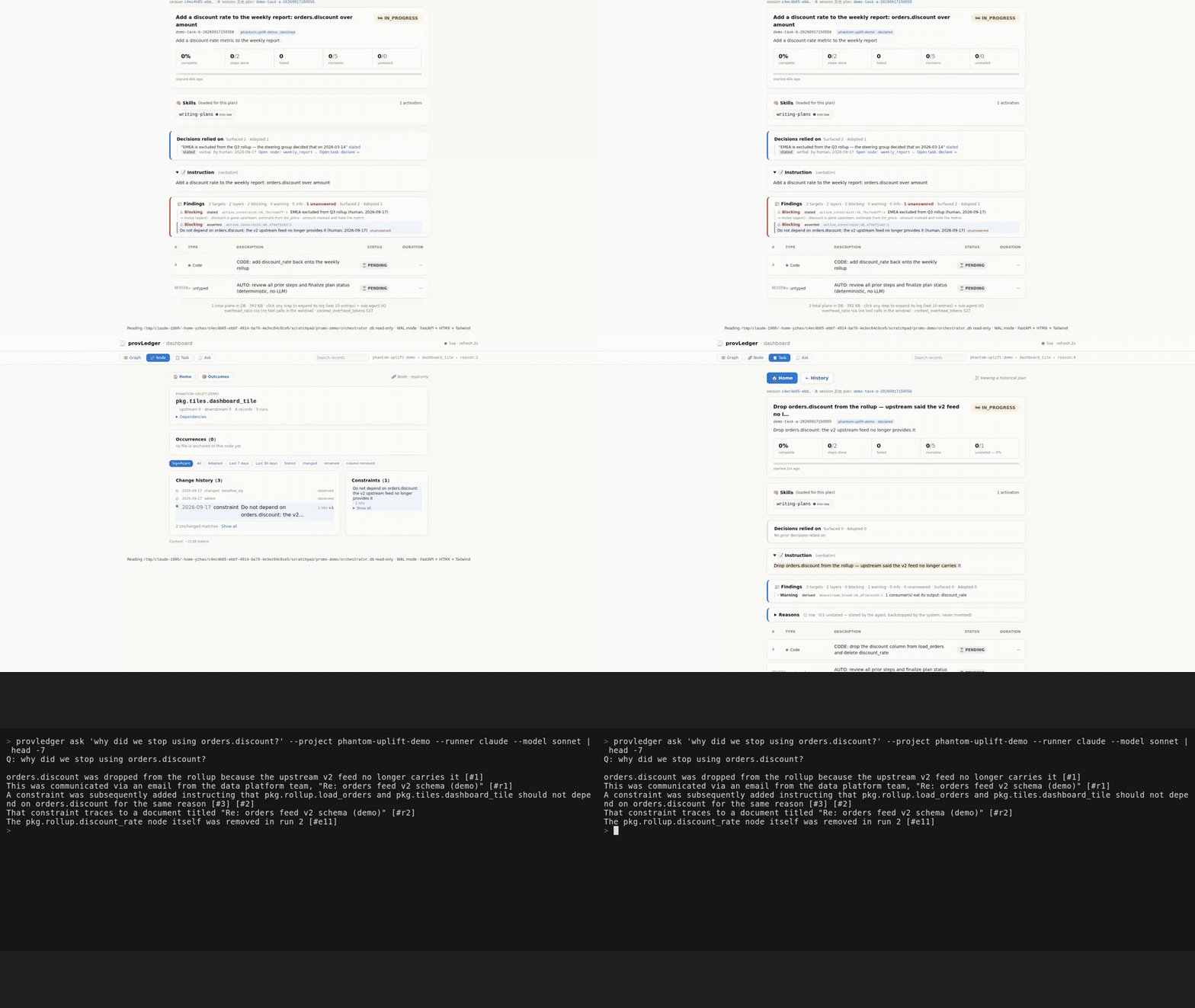
Task → "Decisions relied on" → open the node → the rule with the email → /ledger: "why did we stop using orders.discount?" → a cited answer.
Watch it happen → — two minutes: a colleague asks why the data stops on 18 September, nobody on the team knows, and the record answers with the incident behind it.
A Claude Code plugin for data work. It keeps what was decided and why — your words, the email, the agent's reading, kept apart and never blended — and puts them in front of whoever is about to change the thing again.


1 · The problem
Three months ago someone said, in a meeting, "don't split that dataset randomly — it is a time series." Today a new teammate, or a coding agent, reads the odd-looking rolling-window split, finds no comment and no failing test, and cleans it up. Every test passes. The number on the quarterly deck quietly changes. Nobody knows why.
This is its own kind of failure, and the usual tools each miss it by one step. git blame gives you who and when. Lineage gives you where the column came from. An architecture decision record gives you the shape of the system. None of them connects the line you are looking at to the email, the meeting or the sentence that put it there — because the reason was never inside the code or the data in the first place.
Some decisions only ever happened in one conversation. This gives them a timestamp, a record, and a voice.
2 · What it does
It keeps one view of a project across three axes at once: across nodes (the whole map and what flows through it), across time (what each thing was, and what it became), and across tasks (what every piece of work read, decided, and expected). Graph, Node and Task are three angles on that one view, not three pages — they share a single anchor of project, node and point in time, and switching between them keeps it.
What it is for is the road you took: every step, and every turn you ruled out.
What is in it
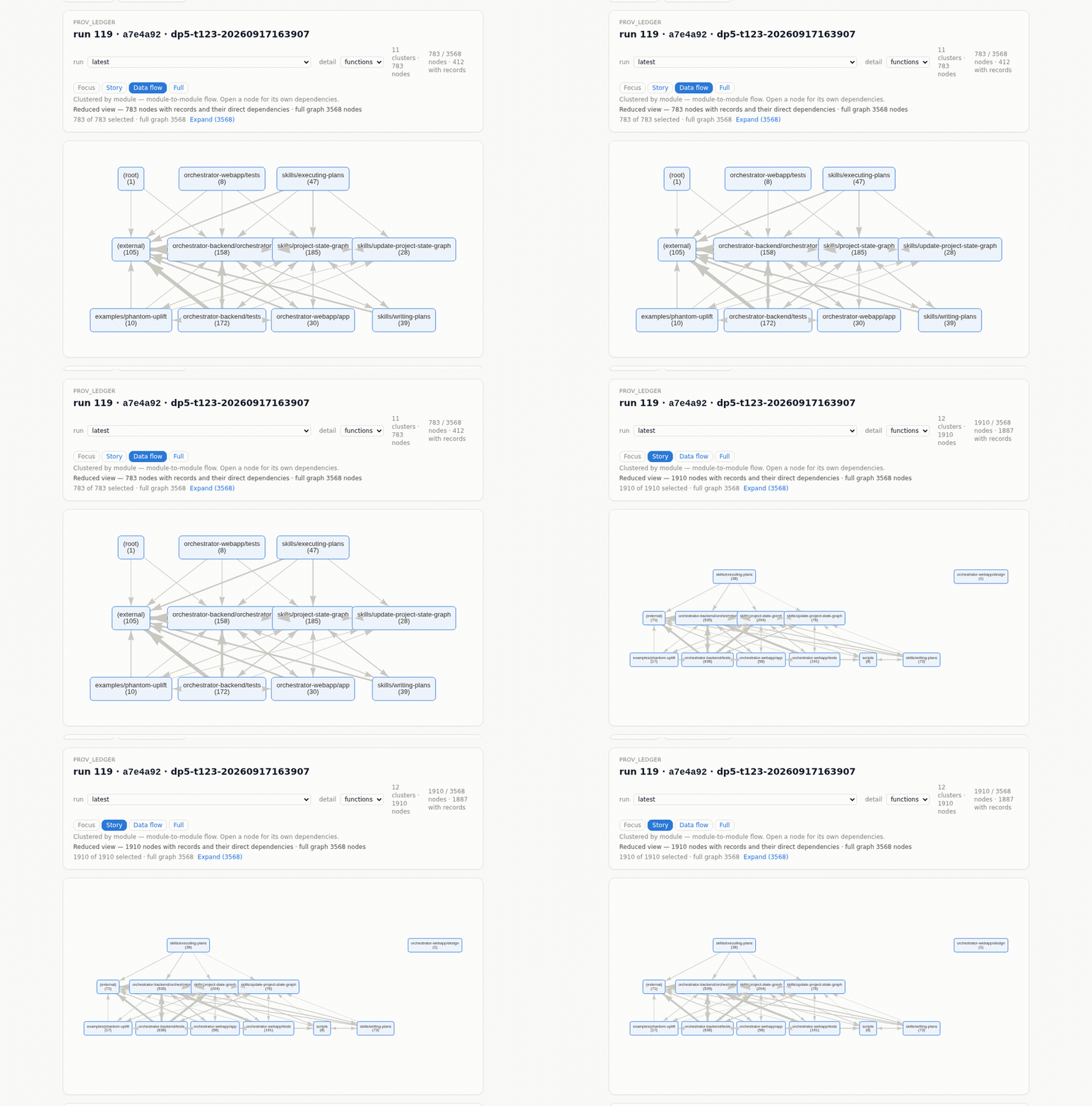
Data flow, not a call graph: 3,568 nodes folded into 11 modules and laid out in three bands — what gets read on one side, what processes it in the middle, what comes out on the other. Only what has a story is drawn, and the page says how much it left out.
Functions are the least of it. A dataset column, a SQL table, an external feed, a metric, and anything you declare in a sentence are all first-class — each with its own page, history and rules.
Around each of them the view holds the decisions: why it changed, the rule that still constrains it, and the paths that were tried and dropped. That last one is the half that is usually missing everywhere else, and the half people ask about most — a failed experiment leaves no trace in a diff, so the only record that it happened at all is the one somebody wrote down at the time.
Most of what decides a number was never in the repository to begin with: a steering group excluded a region, a feed comes from someone else's system, a figure was worked out by hand once. One sentence puts those in the same map, and nothing enters it until you say the words yourself.
$ provledger node declare "EMEA excluded from Q3 rollup, decided in the March review" \
    --type stakeholder_decision --links-to pkg.rollup.weekly_report --attr decided_on=2026-03-14
draft 1: declared:emea-excluded-from-q3-rollup-decided-in-the …
  links declared_constrains -> pkg.rollup.weekly_report (user)
  nothing is in the graph yet. Confirm it with your own words:
  provledger node declare --confirm 1 --words "<the sentence you would say>" --at "<when it was decided>"
From then on it is an ordinary thing in the map: the next run computes its changes, it shows up in all three views, and a rule it carries turns up in the next plan that touches what it constrains.
Where the knowledge comes from
Three sources, kept apart and never blended. What a record counts as is decided by which of them it came from, not by whoever wrote it down.
Measured. The map is rebuilt from the source on every run and compared with the run before, so what changed is counted rather than reported: this column is gone, that function returns a different shape, this one only moved. The arrows are computed the same way — what reads this column, what it feeds — which is how what might this break gets answered before anything is edited.
Said. A hook records your words verbatim as you type them, and the entry point they came through is recorded with them, so a sentence an agent typed into the CLI and a sentence you typed into the session never look alike.
Evidenced. An email, a meeting note, a ticket. Your agent finds these with its own tools and its own credentials; the ledger only ever stores a label, a time and a link, never the body.
Evidence sits where a test sits: it does not change what was decided, it changes how far the decision can be checked. And like a test, it is allowed to fail. An email that cuts against a decision is recorded as contradicting it rather than quietly left out, because dropping the inconvenient half is how a record stops being worth anything. A link that stops opening does not vanish either — it becomes "this stopped opening on this date", which is a fact about the record and not a hole in it.
When none of the three has anything to say, the record says unstated and stops there. A blank is a fact; a fluent guess is a liability.
What you can ask it
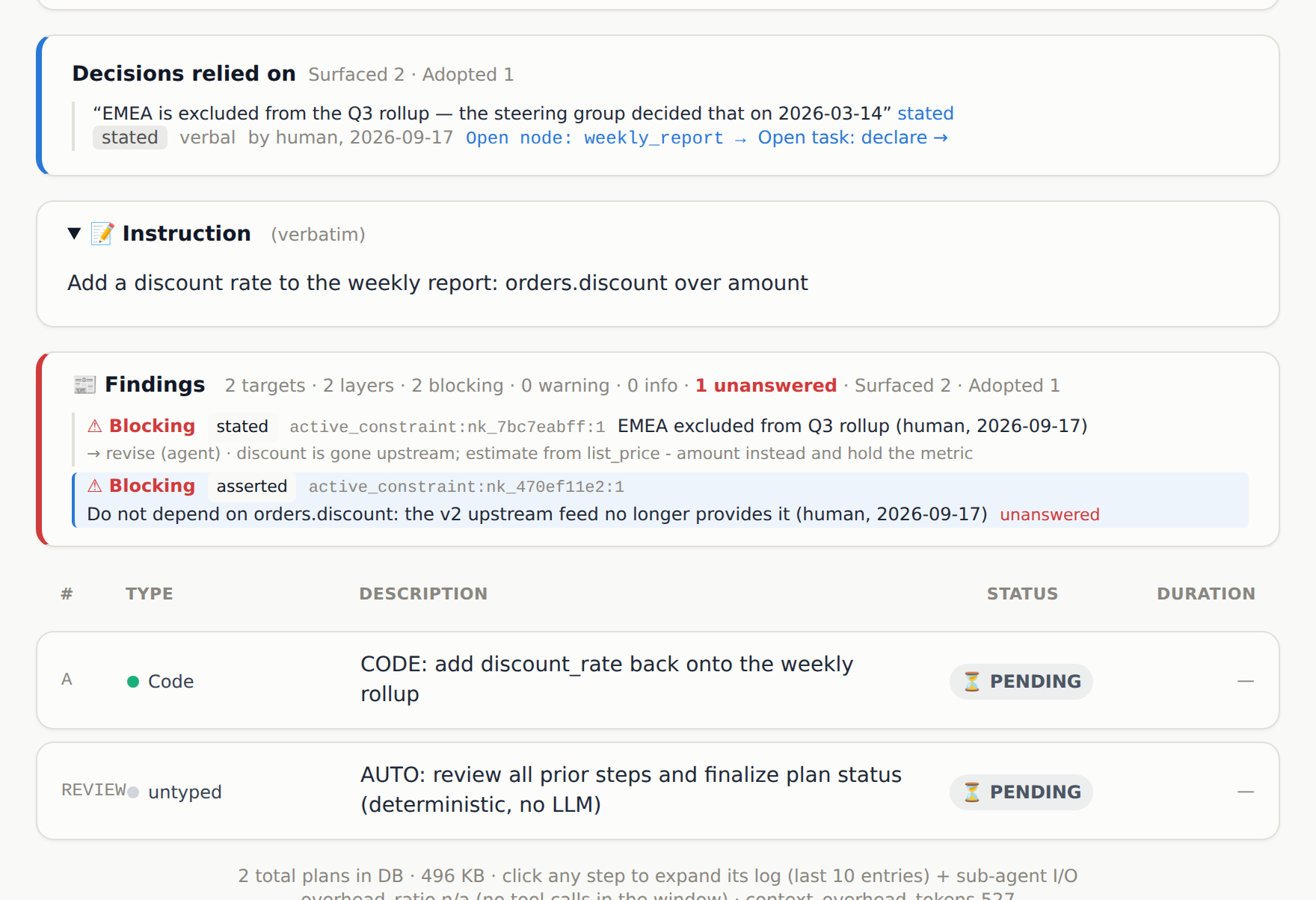
Task — the check runs before the edit, not after it. Here the block is red because an upstream feed has quietly stopped sending a column the work depends on, and a standing rule about the Q3 rollup has not been answered. Underneath sit the decisions this piece of work relied on.
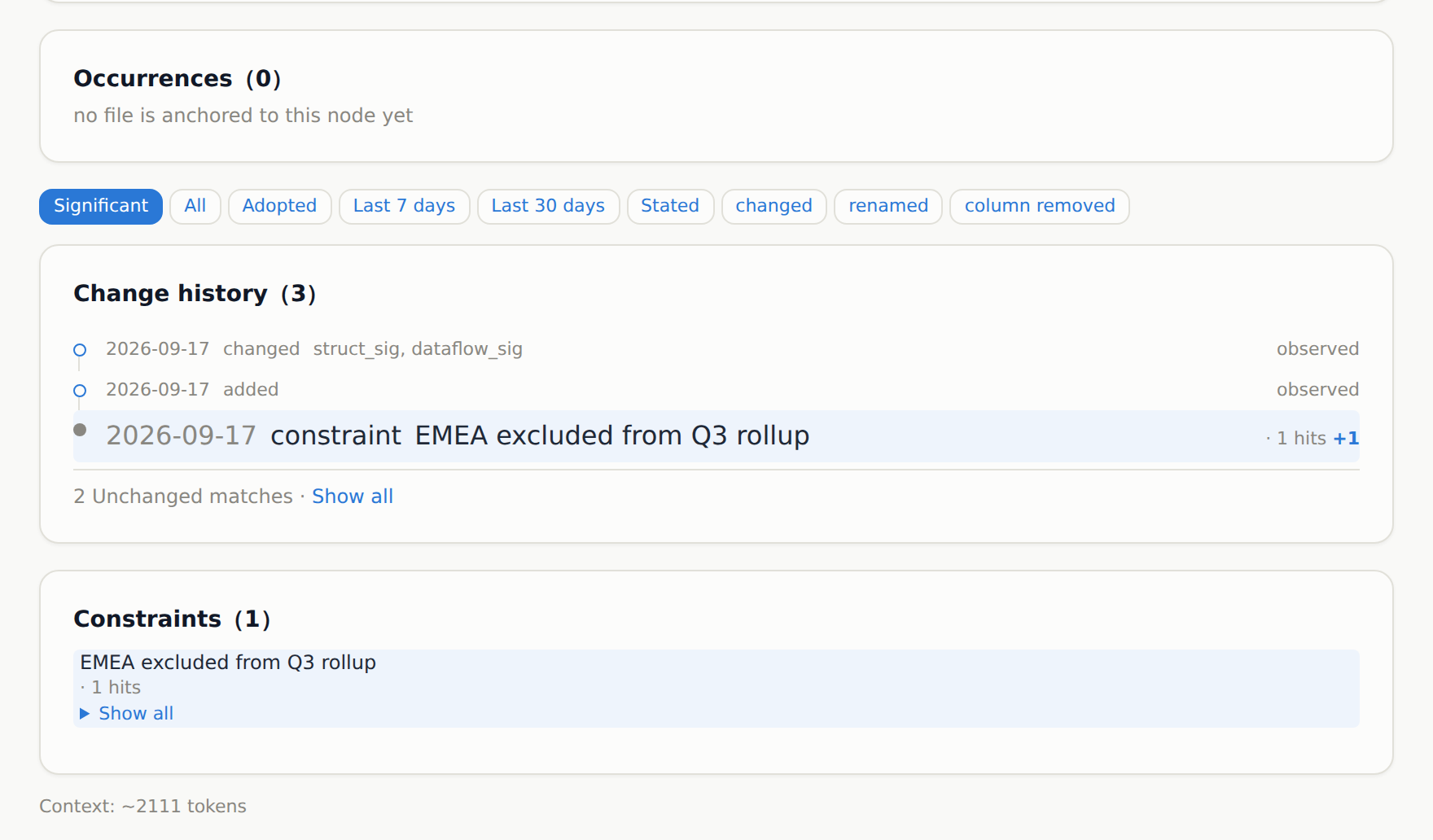
Node — one thing's timeline, and which of its past decisions this change touched. A rule that comes up again raises its hit count by one; the text is never written a second time.
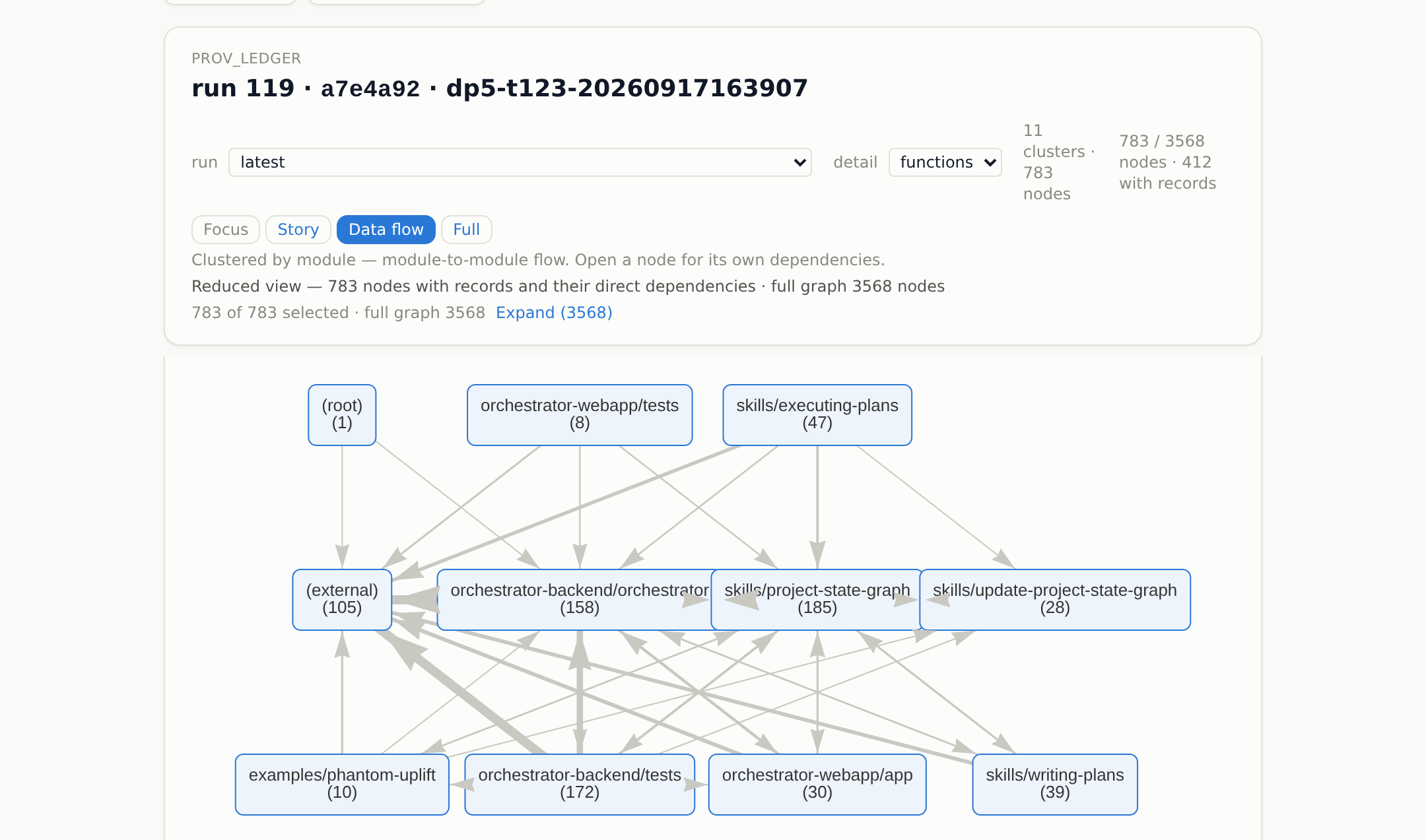
Graph — the same project as a map, so a change can be read against what is upstream and downstream of it. This is the part a diff cannot show, and it is what the warning before an edit is reading.
Graph, Node, Task — one anchor, three angles. One record per decision; a hit count, never a repeat.
| the question | what answers it |
|---|---|
| Why is it this way? | /ledger, and every sentence ends in the id of the record it rests on |
| Have we tried this before? | the rejected paths on the thing you are about to change, surfaced before you edit it |
| What would this change reach? | the computed arrows — consumers, and the metric three steps downstream |
| Someone is asking me to justify this | provledger receipts "<what they said>" — the same records as a timeline with their sources, handed to your own model to write the reply from |
| I just inherited this project | all of the above, without having been in any of the meetings |
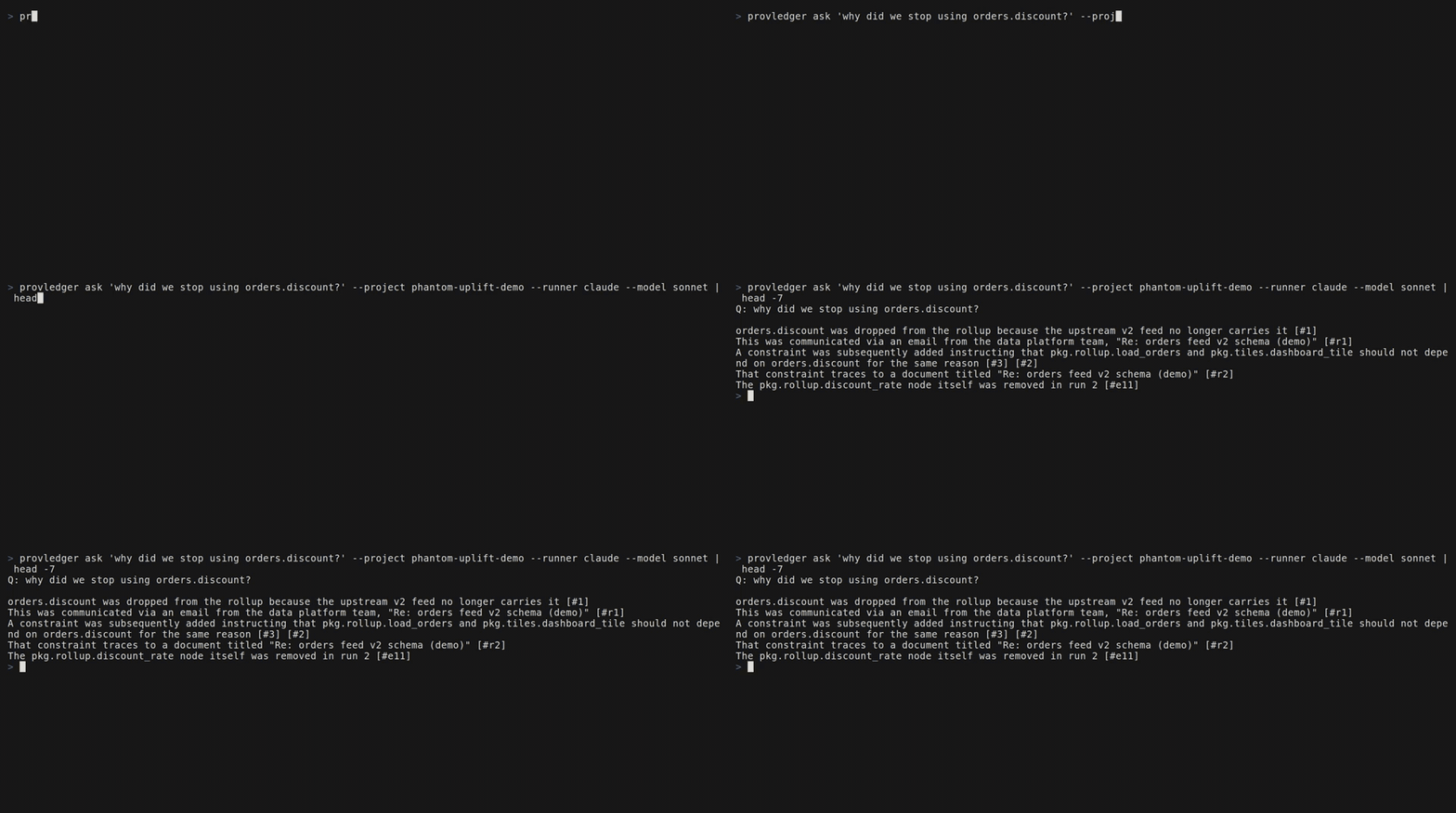
Every sentence cites a record. When nothing is recorded, it says so.
/ledger why is our train/test split 80/20? — the answer comes back in the session you are already in. Code finds the candidates, computes the facts and computes the absences; the model may only restate that table; then code reads the answer back and deletes any sentence that cites nothing, cites an id the table does not hold, or carries a number the table does not state — counting every deletion, so a trimmed answer never reads like a complete one. The same thing is a command (provledger ask) and a page (/ledger?q=).
The dashboard is read-only and opens the database in read-only mode, so it can never block or change what it is showing.
3 · Five minutes
Install
As a Claude Code plugin — this is the one that brings the hooks, the skills and the dashboard:
claude plugin marketplace add yizhao95/prov_ledger
claude plugin install provledger@provledger
Or as a Python library, if you only want the core to read and write a ledger from your own code:
pip install provledger
PyPI still carries 0.1.0 — the stdlib-only core from before decision provenance existed. None of what this README describes is in it: no hooks, no reasons, no /ledger, no dashboard. Those come from the plugin above, and the package will catch up at the next release. Install from PyPI only if the plan and step machinery is genuinely all you want.
Dependencies install themselves on the first session. The full manual install, the per-suite verification and the troubleshooting table are in INSTALL.md.
Five commands
Each command below was run for real against a scratch ledger; the lines under it are what it printed.
1 · Confirm the plugin is in.
$ claude plugin list
  ❯ provledger@provledger
    Version: 0.4.0
    Scope: user
    Status: ✔ enabled
2 · Register a project. This reads the repository into the map and writes the first run.
$ bash skills/project-state-graph/scripts/init_project.sh \
    --name myproj --repo /tmp/myproj --out-dir /tmp/myproj-graph
    registered myproj -> /tmp/myproj-graph/myproj-state-graph.db
Self-check: PASS (/tmp/myproj-graph/myproj-state-graph.db)
3 · Run one plan. The bundled demo is the whole arc in miniature, on its own scratch project under /tmp/provledger-demo: a person removes a column and records why, with the email that carried it; then an agent plans to use that column again.
$ bash examples/phantom-uplift/demo-provenance.sh
     2 findings unanswered · 2 records shown · 0 adopted
Both findings are the heads-up the second plan was given before it wrote a line — the rule against depending on the removed column, and the steering-group decision anchored on the same report. Neither blocks. The agent answers one of them, cites the record, and that citation is what gets written down.
4 · Open the dashboard. Read-only, on your machine, over the ledger you point it at.
$ ORCH_DB=/tmp/provledger-demo/orchestrator.db PROVLEDGER_DASH_PORT=8766 \
    bash orchestrator-webapp/launch_dashboard.sh
🚀 Launching dashboard (PID 567189, log → /tmp/webapp-server.log)
✅ Dashboard ready at http://127.0.0.1:8766
The port is 8765 unless PROVLEDGER_DASH_PORT says otherwise. Inside a session, /provledger-dashboard does the same thing.
5 · Ask one question.
$ provledger ask "why did we stop using orders.discount?" --no-model --project phantom-uplift-demo
`pkg.rollup.load_orders` has never been verified: no outcome is recorded for it in scope. [scope]
Scope: 3 nodes, 2 constraints, 0 influencing records, 6 changes, 2026-09-17 to 2026-09-17; 3 candidates, 3 chosen; nothing truncated. Computed in 0.0 s.
--no-model prints the computed facts, the computed absences and the scope, and says in one line that there is no summary. With a model it adds one paragraph restating that table, and nothing else.

The whole answer, in the terminal you are already in — the facts, the absences, and the range that was searched.
4 · How it works (the honest version)
What is computed and what is said
Everything a node carries is labelled with where it came from. The label is decided by structure, not by whoever wrote the row, and a model cannot award itself one.
| tier | definition | what it requires |
|---|---|---|
observed |
computed from the analysis run — or read off a page by a person | an analysis run, or somebody who looked |
derived |
inferred by a rule, not measured | the id of the rule that fired, and its basis |
asserted |
the agent's reading, recorded as such | an interpretation or a statement |
stated |
the user's own words, with the span | a recorded utterance and a span inside it |
unstated |
nothing was recorded | no text at all |
Alongside the tier, each reason carries a source level computed from its links and never stored: linked (a reference with a uri), verbal (a quoted span, or a verbal source), task_context (only the plan, step, run and time it was recorded in), unstated. Every recorded reason is at least task_context, because it hangs on the plan that closed.
Where it is kept
Two SQLite files. The orchestrator database (ORCH_DB, default ~/skill-workspace/orchestrator.db) holds plans, steps, tool calls, the utterances, the references, the reasons (change_reason), the declared nodes, expectations and outcomes. The project state graph (one per registered project) holds the map and its per-run history. All the provenance tables are append-only: DELETE is refused, the only UPDATEs allowed are a superseded_by pointer and a reference's last_checked, and each table carries its own sha256 chain.
A ledger that only checks itself has checked nothing, so when a plan closes provLedger appends the chain heads to git notes --ref provledger on HEAD — a witness that lives in the repository, not in the database it vouches for.
$ provledger verify --against-notes
chain change_reason: ok · 2308 row(s) walked · head #2308 7f1c05ab93d4
anchors: 2 anchor(s), 2 matched · latest note a91c4e7f0b22 @ 6744c800af13
These records existed at the anchored commit and have not been altered since.
That is not a claim that what they say happened.
ok and anchored stay two different words: a ledger nothing vouches for is still internally sound, and the report says why there is no witness rather than printing a quiet zero. A broken chain names the row and exits 3.
The hooks
Five hooks, and they only ever add.
| hook | what it records |
|---|---|
SessionStart |
installs dependencies once, in the background |
UserPromptSubmit |
your prompt, verbatim, as one utterance attributed to the repo and the open plan |
PostToolUse |
one row per tool call, for the cost numbers below |
PreToolUse (Edit / Write / MultiEdit) |
injects the active constraints anchored on the lines about to change, and one hop downstream — at most 600 characters, and not one byte when nothing anchors there |
Stop |
closes the session record and refreshes the graph |
None of them blocks, executes or decides. The one exception is opt-in: a human constraint declared "block": true in your extensions file. The ledger records what it showed and what was adopted — a record cited by id in a headline response, a reason's because, or an acknowledged constraint.
It cannot record that anyone read it, and it will not pretend a display count is a reading.
The rules are deterministic and their basis is written down; when none applies the system asks, and when nobody answers it records
unstatedrather than inventing.
What it costs
Measured from tool_call_log over completed plans and written to docs/perf-baseline.json (2026-09-16):
| median | p90 | n | |
|---|---|---|---|
| provenance share of a plan's tool calls | 0.0 % | 1.9 % | 8 plans |
| total orchestration + provenance overhead | 0.0 % | 4.4 % | 8 plans |
| extra context per plan | 0 tokens | 1,576 tokens | 102 plans |
| tool calls per step | 4.2 | 8.8 | 8 plans |
The thresholds are tests, not intentions: test_h1_overhead_ratio fails above 10 % provenance or 35 % total, test_h4_context_overhead fails above 3,000 tokens, test_h1_threshold fails when recent plans exceed 1.5 × the baseline's p90 calls per step. Each of them skips out loud when there is nothing to measure. The same file carries a hand-measured reference run with the plugin disabled — 5 tool calls, 10 assistant turns, 266,393 tokens on a three-step task — labelled in the file as "a reference number, never an assertion", because three runs of that task ranged 5 to 26 calls on permission friction alone.
A tool that fights silent failure must not fail silently.
5 · Extending it
Your own node types
A node-type provider is a class. It gets a read-only view of the repository and returns observations; the host does the matching. This one is shipped as provledger.testing.example_provider and turns every Python file into one module node:
from provledger.graph_api import MUTATIONS, NodeObservation, Signature

class ModuleProvider:
    type_id = "provledger.module_example"      # vendor.name, must match the registration
    schema_version = 1
    requires: tuple[str, ...] = ()

    def extract(self, ctx) -> list[NodeObservation]:
        out = []
        for rel in sorted(ctx.file_map):
            if not rel.endswith(".py"):
                continue
            name, sig, n_defs = analyse(ctx.repo_root, rel)   # your own parsing
            out.append(NodeObservation(
                type_id=self.type_id, node_type="module", qualified_name=name,
                file_path=rel, line_start=1, line_end=1,
                signatures=(Signature("qualname", name), Signature("struct", sig),
                            Signature("dataflow", None, trivial=True)),
                attrs={"n_defs": n_defs}))
        return out

    def attributes_schema(self):
        return {"required": ["n_defs"], "types": {"n_defs": "int"}}

    def declared_stability(self) -> dict[str, str]:
        return {m: "preserved" for m in MUTATIONS}
The six contracts
provledger.testing.conformance.run(YourProvider()) puts a provider through a mutation corpus and prints one line per contract:
| contract | what it demands |
|---|---|
determinism |
extracting the same repository twice gives byte-identical observations |
purity |
no write SQL, no file under the repository created or changed |
stability_matches_declaration |
for every mutation that reaches your nodes, what the host observes equals what declared_stability() claims |
schema |
namespaced type_id, valid attributes, known or x- layers |
failure_isolation |
an injected exception degrades you and nothing propagates or leaks |
performance_budget |
the slowest extraction stays inside timeout_s |
The point is honesty, not stability: a provider whose identity breaks on rename_variable passes as long as it says so. What fails is the lie — the package ships a liar_provider whose signature mixes the function name in while declaring rename_function: preserved, and the suite names the mutation that lied.
$ python -c "from provledger.testing import conformance, example_provider; \
    print(conformance.run(example_provider.ModuleProvider()).text())"
Conformance: PASS
  [OK  ] determinism: 3 base(s) extracted twice, byte-identical (7 observations)
  [OK  ] purity: read-only graph, no write SQL, repository untouched
  [OK  ] stability_matches_declaration: declaration holds for ['change_attr', 'delete_function', 'extract_function', 'move_file', 'rename_function', 'rename_variable', 'swap_two_similar'] over 3 case(s)
  [OK  ] schema: type_id namespaced, attrs valid, layers known
  [OK  ] failure_isolation: an injected exception degrades the provider (empty), nothing propagates
  [OK  ] performance_budget: slowest base extraction 0.00s vs budget 30.0s
Registering it
Everything third-party is declared in one file. The first of <repo>/provledger-extensions.json, $PROVLEDGER_EXTENSIONS, ~/skill-workspace/provledger-extensions.json wins — they are never merged, and a malformed file is an error rather than a silent fallback.
{
  "version": 1,
  "providers": [
    {"id": "acme.dataset_comments", "module": "acme_provider:DatasetComments", "priority": 5, "timeout_s": 30},
    {"id": "provledger.owned", "enabled": false}
  ],
  "drift_kinds": [
    {"id": "acme.null_spike_strict", "metric": "null_frac", "op": "delta_gte", "value": 0.1, "priority": 10}
  ],
  "namesets": [
    {"set": "split_funcs", "add": ["my_split", "time_split"]},
    {"set": "fit_methods", "add": ["fit_transform_all"], "remove": ["train"]}
  ],
  "outcome_channels": [
    {"id": "acme.ab_test", "module": "acme_channels:ABTestChannel", "priority": 5}
  ],
  "constraints": [
    {"project": "prov_ledger",
     "statement": "orders.region != 'X' must stay excluded",
     "subjects": ["pkg.pipeline.clean", "orders.region"],
     "why_ref": "https://wiki/decisions/42",
     "why_visibility": "restricted"}
  ]
}
Nothing here can raise at analysis time. An import that fails, a type_id that differs from its declared id, a timeout or a schema violation becomes a degradation record: the run continues without that provider, the analyzer prints WARNING: provider <id> degraded: <reason>, and selfcheck warns providers_degraded. Every run fingerprints the file it loaded, so a graph can be reproduced with the same extensions it was built with.
Declaring the world outside the code
Five declared types — external_system, business_rule, stakeholder_decision, external_dataset, manual_figure. declare() has no tier parameter: a field you typed is stated, a field a model tidied out of your sentence is asserted, and a declared node is never observed, because nobody observed a meeting. A draft holds nothing until you confirm it in your own words.
$ provledger node declare "EMEA excluded from Q3 rollup, decided in the March review" \
    --type stakeholder_decision --links-to pkg.rollup.weekly_report --attr decided_on=2026-03-14
draft 1: declared:emea-excluded-from-q3-rollup-decided-in-the (stakeholder_decision, tier stated)
  attrs {'decided_on': '2026-03-14'}
  links declared_constrains -> pkg.rollup.weekly_report (user)
  nothing is in the graph yet. Confirm it with your own words:
  provledger node declare --confirm 1 --words "<the sentence you would say>" --at "<when it was decided>"
A link naming something the graph does not have is refused, with the name that was wrong.
Deeper: docs/conformance.md (providers and the six contracts), docs/extensions.md (the whole file, discovery, priorities, reproducibility), docs/outcomes.md (expectations, the profile_drift and metric:<name> channels, third-party channels), docs/arbitration.md (the Arbiter interface and the numeric gate an arbiter must clear before it writes anything).
6 · Reference
CLI
provledger <command> — generated from --help, one row per subcommand.
| command | what it does |
|---|---|
metrics plan / metrics baseline |
tool-call cost of one plan; median / p90 over completed plans |
note |
record something that was said, with the time it happened (--node, --ref, --kind) |
node declare |
turn one sentence into a declared node — a draft, until you confirm it in your own words |
node add |
a figure with no traceable data source (--manual-figure, --value, --note) |
node list / node show / node retire |
the project's declared nodes; every version of one; retire one (append-only) |
anchor |
pin a number in a deck, workbook or report to the node it is a reading of |
anchor check |
re-read the files; a lost anchor is reported, never re-pointed |
anchor candidates |
propose readings — off by default, and even on it only proposes |
headline show / respond / ack |
the plan headline; answer one finding (revise / proceed); a person proceeds past one |
why |
one bounded read of a node: history, constraints, rejected paths, prior claims, blast radius (--impact, --all, --pending, --never-read, --search, --json) |
ask |
ask the ledger a question (--no-model, --json, --export, --lang, --runner) |
receipts |
someone challenged a decision: the record as a timeline, the gaps, the range searched — the material a reply needs, never the reply itself (--json, --lang) |
verify |
walk the three hash chains, and with --against-notes the git anchors they must agree with (exit 3 on a broken chain) |
reference add |
pin a decision to where it came from — an email, a meeting, a ticket — as a label and a link, never a copy of the body (--reason or --utterance, --uri, --stance) |
reference pending / mark |
which pointers nobody has opened lately; record that one still opens, or that it stopped (--ok, --gone, --moved, --no-access) |
review evidence-slots |
what still has no checkable source: node, what changed, this plan's own time window, the identifiers to search on, significance. provLedger hands the list over and searches nothing itself (--plan, --json) |
review evidence-log |
what became of each slot — attached, searched and found nothing, timed out, never searched — so a blank can say which kind of blank it is (--plan, --node, --outcome, --tool-hint, --elapsed-ms) |
export |
a whitelisted bundle for someone who was not there (--out, --zip, --include-rationale, --md) |
init --agents-md |
write or refresh the provledger section of ./AGENTS.md |
reason mark |
a person's word on a reason's significance, logged as judged by a human |
significance eval / disagreements |
manual: an LLM verdict on reasons that carry only a hint; where hint and verdict disagree |
reasons reclass-status / ask-basis |
migration state and tier counts; the close-time questions the rules did not recognise |
export never lets verbatim words out: a shareable record that quotes personal words keeps the record, drops the quotation and says which one it withheld; a rationale travels only when you name its id.
Dashboard routes
Read-only, no non-GET route.
| route | shows |
|---|---|
/ |
the live plan and its steps |
/plan/{id}?node=&at= |
one task: what it read, what it decided, its findings and outcomes |
/graph/{project}?focus=&at=&mode=story |
the project map, now or at a past run, marked where there is a story |
/node/{project}/{qualified_name}?at= |
one node's timeline, reasons, constraints and occurrences |
/session/{id} |
what one session said, cost and changed — with or without a plan |
/history |
past plans |
/search |
across plans, steps and records |
/ledger?q= · /ledger/results · /ledger/card |
ask a question; the answer; a markdown evidence card |
/outcomes?project= |
every claim with its latest outcome, tier, delta and who backfilled it |
/api/dashboard · /api/health |
the polled fragment; liveness |
Tests
Eight suites, each with its own pyproject and pythonpath — run them separately.
| suite | tests |
|---|---|
scripts/tests |
27 |
orchestrator-backend |
1074 |
orchestrator-webapp |
267 |
skills/writing-plans/tests |
93 |
skills/executing-plans |
83 |
skills/update-project-state-graph/scripts/tests |
107 |
examples |
18 |
skills/project-state-graph/scripts/tests |
430 |
Total 2099 collected across the eight suites (scripts/count_tests.sh), plus a few deselected (llm_consistency and the manual arbiter evaluations never run in CI). Commands and expected output: INSTALL.md §5.
Origin
The two orchestration skills, writing-plans and executing-plans, are evolved from the Superpowers skill library by Jesse Vincent (obra), which established the plan-then-execute discipline this repository builds on. What provLedger adds is the persistence and the provenance: a validated SQLite state machine instead of ad-hoc markdown, a project state graph with code and data contract gates, runtime profiling and drift detection, the decision ledger, and the read-only dashboard. provLedger also bundles local variants of six superpowers skills; INSTALL.md says how to choose between them in one project.
Contributing
Issues and pull requests are welcome. Good first contributions: run make demo and report anything that does not reproduce; register a drift kind, a name set or a constraint in provledger-extensions.json for your own project; add a second silent-failure scenario to the demo; improve dtype coverage of an analyzer in skills/project-state-graph/. Maintainer: [email protected].
More
INSTALL.md |
plugin install, manual install, the analyzer's own uv environment, per-suite verification, PyPI install, troubleshooting |
docs/NORTH-STAR.md |
the one sentence and the three cores every change is measured against |
docs/decision-provenance.md |
the tables, the tiers, the rules R0–R6, the headline, /ledger, verify and export, anchors, and the honest boundaries |
docs/conformance.md · docs/extensions.md · docs/outcomes.md · docs/arbitration.md |
writing providers, registering everything, outcome channels, identity arbitration |
docs/design.md |
the dashboard's design system: one tokens.json, the component library, the wording table (English default, ?lang=zh) |
docs/benchmark-silent-class-drop.md |
the mini-benchmark for the failure class: a silently dropped column, segment purity 0.31 against 0.91 on the same green pipeline |
examples/phantom-uplift/ |
make demo — a revenue number that goes up for the wrong reason, caught offline and deterministically; plus the provenance demo used in section 3 and the anchor walkthrough |
docs/KNOWN-ISSUES.md |
the confirmed defects and the standing limits, grouped by where you will hit them, with the workaround when there is one |
CHANGELOG.md |
what each phase and release added, 0.1.0 → 0.3.0 |
LICENSE |
MIT |
The superpowers plugin is a recommended companion: the byte-identical verification-before-completion skill is not bundled and comes from superpowers when present. Everything works without it.
The PyPI package is the stdlib-only core library — plans, steps, profiling, drift, the ledger — and the published release is 0.1.0; the plugin, the skills, the hooks, the dashboard and the provledger command come from this repository at 0.4.0.
See it run
Two minutes, no narration. Someone asks in chat why the rollup stops on 18 September and nobody still on the team knows. The record does: an upstream incident, the RCA that found it, the call that decided to cut the data — and that the cutoff was only ever meant to be temporary. Then how a record like that gets made, and what happens when it cannot be.
The same walkthrough with chapters you can jump to, and captions in English or Chinese: yizhao95.github.io/prov_ledger/walkthrough.html. The ledger in it is a worked example, not a live database; every piece of interface wording is the product's own.
Yorumlar (0)
Yorum birakmak icin giris yap.
Yorum birakSonuc bulunamadi