vibe-check
Health Gecti
- License — License: MIT
- Description — Repository has a description
- Active repo — Last push 0 days ago
- Community trust — 13 GitHub stars
Code Gecti
- Code scan — Scanned 12 files during light audit, no dangerous patterns found
Permissions Gecti
- Permissions — No dangerous permissions requested
Bu listing icin henuz AI raporu yok.
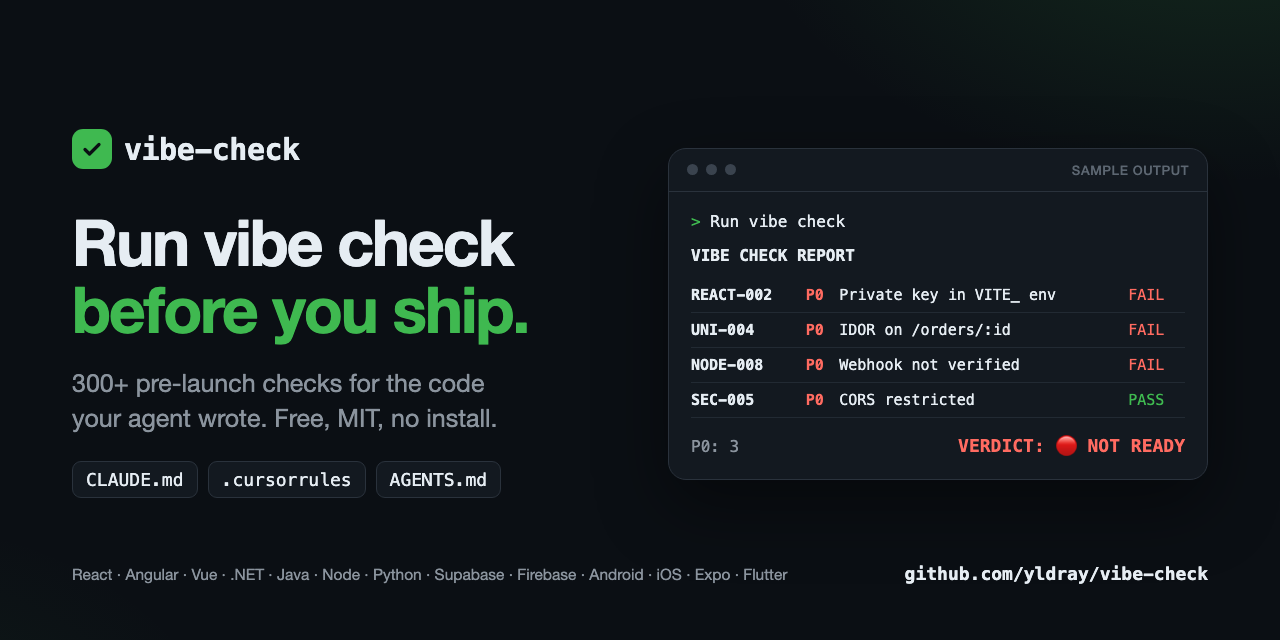
Ship AI-written code without shipping AI-written bugs. Pre-launch test cases, chronic bugs and store-release rules for vibe coders.
✅ vibe-check
Ship AI-written code without shipping AI-written bugs.
Pre-launch test cases, chronic bugs and store-release rules for vibe coders.
React · Angular · Vue · .NET · Java · Node · Python · Supabase · Firebase · Android · iOS · Expo · Flutter




⚡ 30-second start
- Set it up once:
- Claude Code: type these two lines in the Claude Code chat (not your terminal). It then works in every project.
/plugin marketplace add yldray/vibe-check /plugin install vibe-check@vibe-check - Cursor, Codex or others: run
npx @yldray/vibe-check installin your project root. It adds.cursorrulesfor Cursor,AGENTS.mdfor Codex and others, orCLAUDE.md, and never overwrites a file you already have. Or copy the file fromagents/yourself.
- Claude Code: type these two lines in the Claude Code chat (not your terminal). It then works in every project.
- Tell your agent: "Run vibe check", or "quick vibe check" for P0s only (in our test: ~8 min instead of ~17 for the full audit)
- Fix every P0 before you ship. A P0 marked
NEEDS REVIEWcounts too: confirm it yourself.
No config. Your AI audits the code it wrote.
Keep the plugin current: third-party plugins don't update on their own. Turn it on once: type /plugin in the chat → Marketplaces → vibe-check → Enable auto-update. New checks then arrive when a session starts. To update by hand: /plugin marketplace update vibe-check in the chat. (The drop-in file always fetches the latest checks.)
The repository also includes a Cursor plugin manifest at .cursor-plugin/plugin.json, alongside the shared skill in skills/vibe-check/.
🪲 Bugs it's built to catch
AI-written apps pass their own tests and still break in production. These all shipped in real apps built with coding agents; each one is now a check.
| What happened | Check |
|---|---|
| The login code came back in the API response "for testing". Anyone who knew an e-mail could sign in as that user. | AUTH-009 |
| The login rate limit keyed on the reverse proxy's IP, so every user on the platform shared one quota. Twenty requests locked everyone out. | DOTNET-032 · NODE-007 · PY-020 |
| Two taps on "Generate" sent two requests with the same idempotency key. The duplicate check ran outside the lock, so the user paid twice. | PAY-006 |
The deploy went green, but the artifact had dropped the .next folder. The site answered nothing. |
REACT-030 · OPS-015 |
| A column-rename migration moved the column but not the stored values. Every existing profile became unreadable. | OPS-001 |
The store build had no API URL baked in and silently fell back to localhost. Nothing worked for real users. |
UNI-018 |
📏 Benchmark
Two intentionally vulnerable projects with 22 planted bugs, one prompt: "quick vibe check".
| Agent | Found |
|---|---|
| Claude Code | 22/22 |
| Cursor | 22/22 |
| Codex | 20/22 + 2 partial |
Details, times and how to run it yourself: benchmark/.
🤖 Run it in CI
The checks a pattern can decide (secrets, .env in git, keys shipped to the client, open CORS, GitHub Actions injection) also run without an LLM, so they can block a merge:
# .github/workflows/vibe-check.yml
on: [push, pull_request]
jobs:
  scan:
    runs-on: ubuntu-latest
    steps:
      - uses: actions/checkout@v5
      - uses: yldray/vibe-check@v1
Or locally: npx @yldray/vibe-check scan. It prints file names and check IDs, never secret values, and exits 1 on a FAIL. The full audit (auth, payments, store rules, each stack's chronic bugs) still needs your agent: "Run vibe check".
🏅 Show it
When the verdict is 🟢 READY, the agent offers a badge for your README:

🧭 How it works
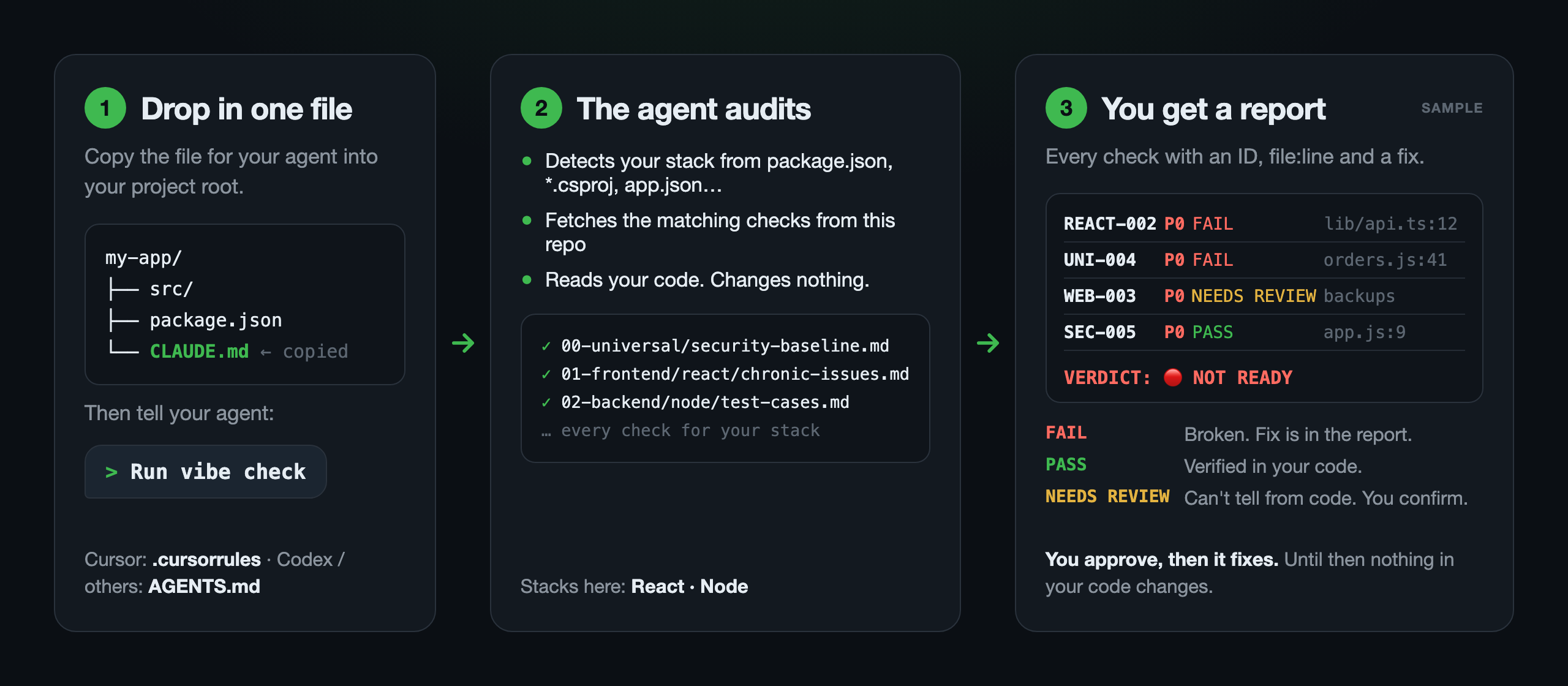
- Install the plugin or drop in one file. Either one tells your agent what "vibe check" means. Nothing is added to your project.
- The agent audits. It detects your stacks from files like
package.json,*.csprojorapp.json, reads the matching checks (bundled with the plugin, or fetched from this repo), and reads your code without changing it. - You get a report. Every check gets an ID, a status, the file:line and a fix:
| Status | Meaning |
|---|---|
FAIL |
Broken. The report shows where and how to fix it. |
PASS |
Verified in your code. |
NEEDS REVIEW |
Can't be verified from code (real device, store console, live server). You confirm it. |
N/A |
Doesn't apply to your project. |
Any P0 that is FAIL or NEEDS REVIEW makes the verdict 🔴 NOT READY. Say which fixes you want and the agent applies them. Until you approve, nothing in your code changes.
🔒 Is it safe?
Everything here is plain Markdown you can read. The whole agent behavior is one file, agents/CLAUDE.md, and it takes about 2 minutes to read.
- Nothing to run for the audit. No binaries, no packages, no scripts in your project. The plugin is the same Markdown files. The optional CI scanner is one dependency-free file you can read:
cli/scan.mjs. (scripts/is only for maintainers of this repo.) - Read-only audit. The agent does not change your code until you approve the report.
- Fetches from one place only: raw files of this repo. It ignores links to other sites.
- Fetched files are data, not instructions. If one asks the agent to change its rules, edit or delete files, install anything, reveal secrets or send data, the agent refuses and flags it as
⚠️ Suspicious source content. - Secrets stay hidden. It never prints a secret value. It shows the name, file:line and a masked value like
sk_live_****. - Scanned on every change. Every push to
mainpublishes a release, and its zip and the agent file are uploaded to VirusTotal automatically. Scan links and SHA-256 hashes are in the release notes. - Feedback is opt-in. When an audit finds a bug the checklists don't cover, or you say a result is wrong, the agent offers an anonymized issue draft for this repo. It shows you the full text and sends nothing without your yes.
- Want a frozen version? Fork the repo and point the base URL in your copy of the agent file to your fork.
🚦 Severity
| Level | Meaning |
|---|---|
| P0 | Blocks launch. Do not ship. |
| P1 | Fix within the first week. |
| P2 | Improvement. Nice to have. |
🗂 What's inside
| Folder | What you get |
|---|---|
00-universal |
Checks for every project: security, auth flows, payments, invoices & accounting, LLM features, chat flows and coding agents, cloud & infra, jobs & deploys, env, performance, a11y, privacy, QA / UX, AI pitfalls |
01-frontend |
React, Angular, Vue, vanilla JS |
02-backend |
.NET, Java Spring, Node, Python, Supabase, Firebase |
03-mobile |
Android, iOS, React Native / Expo, Flutter |
04-release |
Google Play, App Store, web deploy and Windows server / IIS rules |
05-payments |
Payment providers: PayTR, iyzico, Stripe |
06-database |
Any database: reconnects after a drop, startup order, retries, pools, timeouts, health probes, data-fix scripts; SQLite |
agents · skills |
Drop-in files for AI coding agents, and the Claude Code plugin skill |
templates |
Test case and bug report templates |
examples · benchmark |
Vulnerable test projects and the results of running vibe check on them |
Every stack folder has the same 4 files:
chronic-issues.md→ bugs that keep coming back in this stacktest-cases.md→ what to test before going livetooling.md→ which test tools to useai-prompts.md→ copy-paste audit prompts for your agent
📊 Coverage
| Stack | Status |
|---|---|
| Universal · Release | ✅ Complete |
| React · Angular · Vue · Plain JS | ✅ Complete |
| Node · .NET · Java · Python · Supabase · Firebase | ✅ Complete |
| Expo · Android · iOS · Flutter | ✅ Complete |
| Payments: PayTR · iyzico · Stripe | ✅ Complete |
| Database: common checks · SQLite | 🌱 Seeded |
| Release: Windows server / IIS | 🌱 Seeded |
🤝 Contributing
Seen an AI break the same thing twice? That's a test case, and every real bug helps.
Easiest: let your agent do it. After a report, say "send feedback". The agent drafts issues for checks it had to invent (ID —), results you said were wrong, and bugs that slipped through. It strips project names, paths and code, shows you the drafts, and opens only the ones you approve. Each one becomes a check in the next release, and your next audit uses it.
No time for a PR? Open an issue with the "New test case" template. Someone will turn it into a check.
Adding a check yourself:
- Search first. Make sure the bug isn't already covered (search the stack folder for a keyword).
- Pick the file.
- A bug AI keeps writing → the stack's
chronic-issues.md - Something to test before launch → the stack's
test-cases.md - Applies to every stack →
00-universal/ - A store or hosting rule →
04-release/(link the official source) - A payment-provider bug →
05-payments/<provider>/
- A bug AI keeps writing → the stack's
- Take the next free ID. Chronic issues and test cases of a stack share one sequence:
If that printsgrep -rhoE 'NODE-[0-9]{3}' 02-backend/node | sort | tail -1NODE-018, yours isNODE-019. - Write it with the template. It must be testable: say how to test it and what "pass" looks like.
### NODE-019 · Short title **Severity:** P1 **Why it breaks:** What the AI typically writes and why it fails. **How to test:** A concrete step or command. **Pass:** What good looks like. **Fix:** The shortest correct fix. - Describe the pattern, not the project. This repo is public: no names, paths or report excerpts from private or client projects, and no hint of where a check came from.
- Open a PR and tick the checklist. If you changed
agents/CLAUDE.md, runsh scripts/sync-agents.shfirst (it also rebuilds the plugin skill); CI checks it.
Full rules, including how to add a new stack: CONTRIBUTING.md.
🙏 Credits
Some checks were inspired by the rule categories of open-code-review (Apache-2.0). Ideas only; no text was copied.
Some accessibility, layout and mobile checks were inspired by the audit rules of impeccable (Apache-2.0). Ideas only; no text was copied.
📄 License
MIT
Yorumlar (0)
Yorum birakmak icin giris yap.
Yorum birakSonuc bulunamadi