omamori
Health Uyari
- License — License: Apache-2.0
- Description — Repository has a description
- Active repo — Last push 0 days ago
- Low visibility — Only 9 GitHub stars
Code Basarisiz
- rm -rf — Recursive force deletion command in docs/defense-boundary.json
Permissions Gecti
- Permissions — No dangerous permissions requested
Bu listing icin henuz AI raporu yok.
AI Agent's Omamori — protect your system from dangerous commands executed via AI CLI tools
omamori




Deterministic semantic guard for AI CLI tools. Blocks covered destructive commands and self-disablement attempts, with tamper-evident audit trails.
Fast local checks — no model calls, no daemon, no network dependency. macOS only. Commands you type in a plain terminal pass through untouched; omamori acts only when an AI tool environment is detected. It is not a sandbox: run it alongside one (how the two fit together).
Since 1.0, three surfaces are frozen until a major version: which command classes are blocked or redirected, the CLI's subcommands and documented exit codes, and the audit chain's verifiability across upgrades. The config.toml schema and the Rust library API are not frozen. The full statement is docs/CONTRACT.md.
Demo
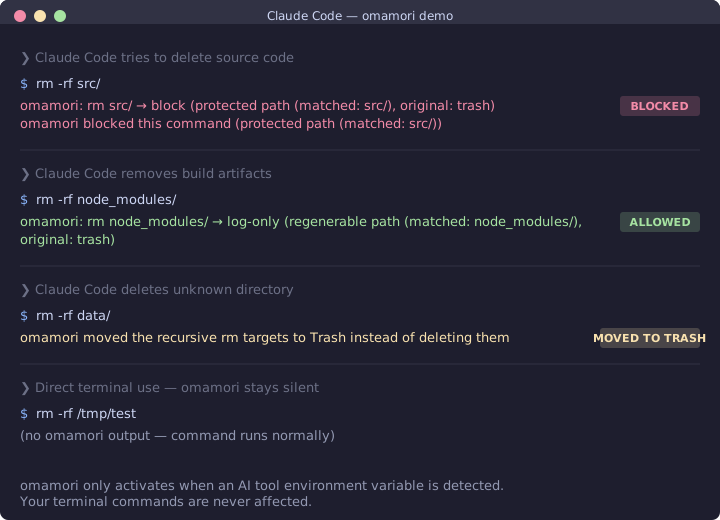
A Claude Code session. Codex CLI and Cursor get the same block / log-only / trash behavior when detected.
Quick start
brew install yottayoshida/tap/omamori
omamori setup
setup installs the shims and hooks, adds $HOME/.omamori/shim to your shell profile, and runs omamori doctor. It is safe to re-run after upgrades. Preview with --dry-run; use --non-interactive in CI and scripts.
To see what omamori would do with a command, without running it:
omamori explain -- rm -rf src/
What it does
- Blocks destructive commands before they run.
rm -rfgoes to the macOS Trash,git reset --hardstashes first, andgit push --force,git clean -f,chmod 777,find -deleteandrsync --deleteare blocked. Hooks also block obfuscated and dynamically generated forms such as$'rm'andbash -c "$(cmd)". - Stops the agent from switching it off.
config disable,uninstall, PATH overrides and environment-variable tampering are blocked while an AI tool is detected. Built-in rules cannot be disabled fromconfig.toml. - Keeps a record you can check. Hook denies from Claude Code and Codex go into an HMAC-signed, hash-chained audit log that
omamori audit verifychecks, andomamori doctorchecks that every defense layer is still installed.
Claude Code is supported at Tier 1, Codex CLI and Cursor at Tier 2; other tools get the PATH shim only (tool compatibility).
Verifiable claims
What omamori claims, and how to verify each one. The CI column is a job id in .github/workflows/ci.yml that turns red on a regression, or a documented reason it cannot (see how these are checked):
| Claim | Verify yourself | CI | G-N |
|---|---|---|---|
| Covered destructive command classes are blocked or redirected | omamori test |
test | G-1 |
| Supported hook deny events are written to a tamper-evident audit chain | omamori audit verify |
test | G-2 |
| Installed defense layers are present and intact | omamori doctor, omamori status |
test | G-3 |
| Hook checks are local and deterministic — no model calls, no network dependency | source inspection | claims-check | G-4 |
| AI-driven self-disablement attempts are blocked in supported tool paths | CLAUDECODE=1 omamori config disable rm-recursive-to-trash (expect: blocked) |
test | G-5 |
Where CI cannot reach:
- Claim 2 covers Claude Code and Codex hook denies only. Cursor's Layer 2 denies are stderr-only and do not reach the audit chain.
- Claim 3: CI tests the detection logic on an isolated install. Checking a real user's
$HOMEand shell profile is something only you can do, withomamori doctor. - Claim 4 is a negative claim, and there is no single push-button command that proves an absence. CI enforces it with a dependency allowlist and a source tripwire instead.
Run ./scripts/verify-claims.sh to reproduce the machine-checkable rows. Which tests back each claim, claim 5's two layers, and G-6 are in docs/verifying-claims.md. Bypass classes outside this scope remain possible: see SECURITY.md for the bypass corpus and defense boundary, also published as docs/defense-boundary.json.
Docs
- How omamori works — what it blocks, supported tools, defense layers, performance, and what it does not catch
- Configuration — context-aware actions, custom rules, audit retention, strict mode
- CLI reference
- Troubleshooting for hook errors, and the FAQ for everything else
- Contract — what 1.0 guarantees and what it does not
- Security — threat model, bypass corpus, and reporting a vulnerability
- Using omamori with a sandbox
- 30-day evaluation kit — a checklist and feedback template
- Field notes — what omamori caught in daily use
- Contributing
License
Licensed under either of Apache License, Version 2.0 or MIT license at your option.
Yorumlar (0)
Yorum birakmak icin giris yap.
Yorum birakSonuc bulunamadi