X-Forge-Factory
Health Uyari
- License — License: AGPL-3.0
- Description — Repository has a description
- Active repo — Last push 0 days ago
- Low visibility — Only 5 GitHub stars
Code Uyari
- process.env — Environment variable access in scripts/capability-sweep.mjs
- network request — Outbound network request in scripts/capability-sweep.mjs
- process.env — Environment variable access in scripts/capture-screens.mjs
- process.env — Environment variable access in scripts/dev.mjs
- process.env — Environment variable access in scripts/make-pdf.mjs
- network request — Outbound network request in scripts/setup.mjs
Permissions Gecti
- Permissions — No dangerous permissions requested
Bu listing icin henuz AI raporu yok.
Operator console for Magnific — REST + MCP on one surface, with a job engine that reserves credits, gates spending behind human approval, and never re-runs work that may already have been paid for.
◆ X-FORGE
An operator console for Magnific — every capability on one surface, with an engine that
treats credits like money.







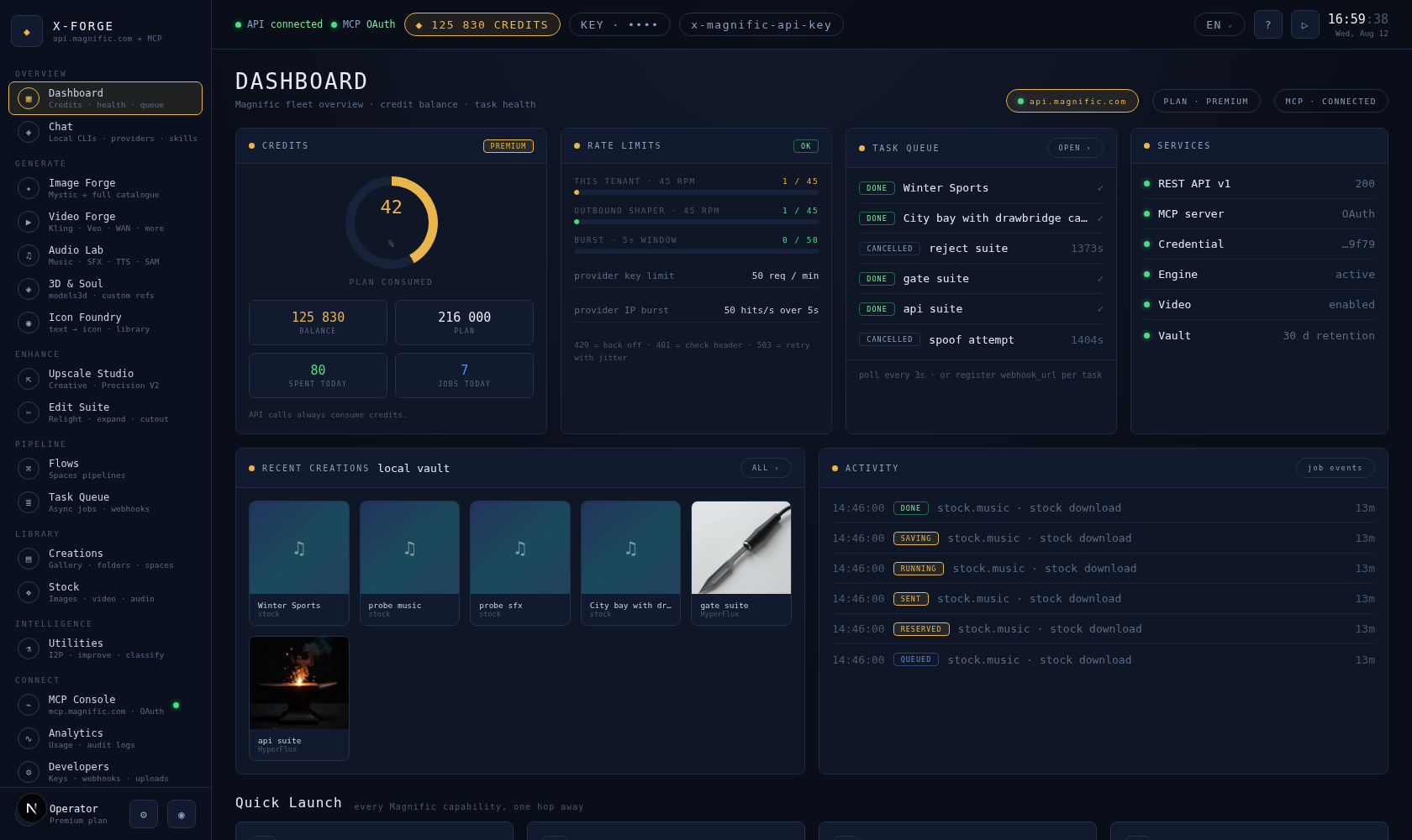
X-Forge talks to Magnific over both of its surfaces at once: the REST API atapi.magnific.com with your own key, and the MCP server at mcp.magnific.com over OAuth.
Between them you reach the full catalogue — 48 image models, 52 video models, ~600 voices,
88 MCP tools — instead of the handful any single surface exposes.
Behind the seventeen screens sits a job engine built to a specification rather than to a demo:
credits are reserved before work starts, charged exactly once when it finishes, gated behind
a human when the estimate is large, and never spent twice on work that may already have
completed.
git clone https://github.com/yuriiss/X-Forge-Factory.git
cd X-Forge-Factory
npm install
npm run setup     # writes .env.local, verifies your key against the live API
npm run dev       # → http://127.0.0.1:7777
Then open MCP Console → CONNECT and sign in once. Without it the console still generates
images and video on the REST key, but you lose the balance, cost estimates, the full
catalogue, text-to-speech, 3D and most of Edit Suite.
New here?
GUIDEBOOK.mdwalks through every screen and every control,
with screenshots — also built as a printable PDF atdocs/X-Forge-Guidebook.pdf.Українською:
GUIDEBOOK.uk.md· PDF.
The console itself speaks both languages — the picker sits in the topbar.
What it does
Nothing in the console is mocked. Every panel is reading something.
| Screen | What it actually does | |
|---|---|---|
| ◈ | Chat | The coding CLIs installed on this machine — Claude, Grok, Kimi, Qwen, Codex — plus any OpenAI-shaped provider. Attach a picture, get a prompt, send it to a generator with one button. Skills pass a scanner first |
| ▦ | Dashboard | Live balance, the console's own rate meters, the job table, service health, vault thumbnails |
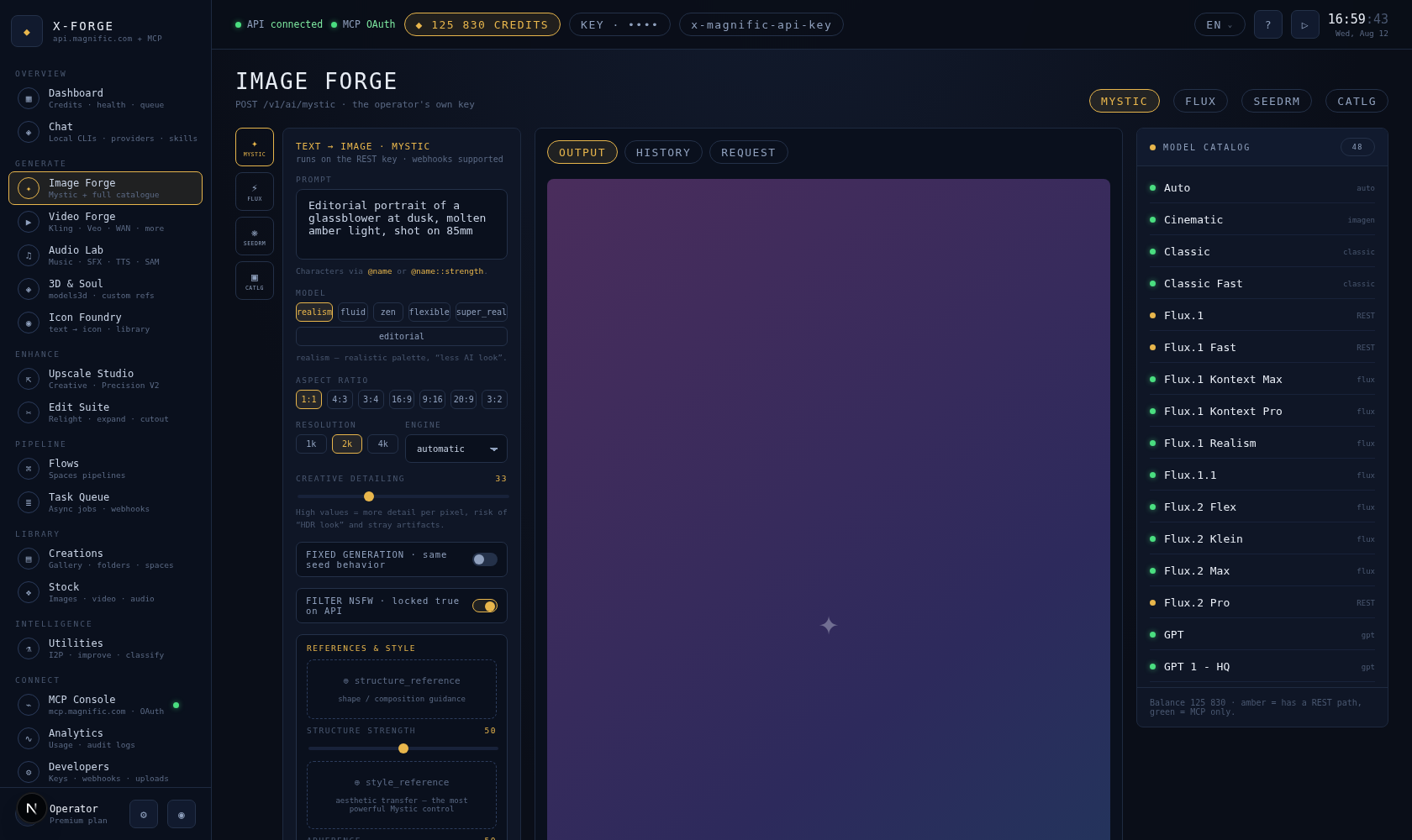
| ✦ | Image Forge | Mystic, FLUX and Seedream with their full parameter sets; the whole 48-model catalogue over MCP |
| ▶ | Video Forge | 52 models, text- and image-to-video, a free planning pass, per-model pricing before you commit |
| ♫ | Audio Lab | Music, sound effects, SAM isolation, TTS across ~600 voices, stock libraries |
| ◈ | 3D & Soul | Image-to-GLB, Soul reference training, every trained character and style |
| ◉ | Icon Foundry | Text-to-SVG beside a search of finished vectors — check before you pay |
| ⇱ | Upscale Studio | Creative · Precision · Precision V2 · Skin Enhancer, 2× to 16×, priced first |
| ✂ | Edit Suite | Relight, expand, cutout, reimagine, camera, retouch, vectorise, crop |
| ⌘ | Flows | Published Spaces pipelines, with forms built from each flow's own declared inputs |
| ≣ | Task Queue | Every job in its real state, transition history, cancel and reconcile |
| ▤ | Creations | The local library and the account's history, never merged · full-size viewer with zoom, orbit for 3D |
| ❖ | Stock | Images, video, music, sound effects, icons |
| ⚗ | Utilities | Image → prompt, prompt improver, AI classifier |
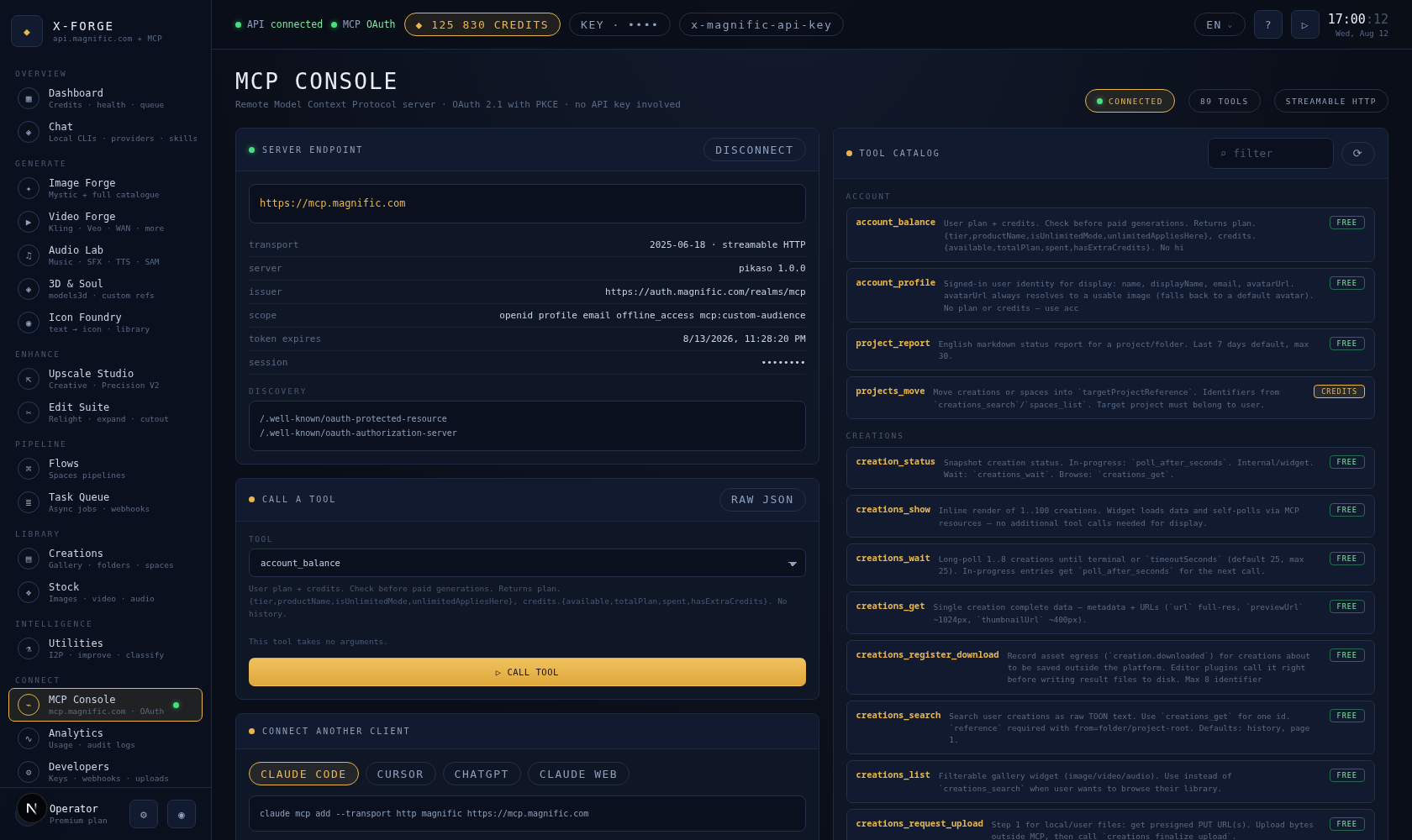
| ⌁ | MCP Console | Live tool catalogue, schema-driven argument forms, priced calls |
| ∿ | Analytics | The engine's own ledger, outcome mix, audit trail |
| ⚙ | Developers | Credential, engine limits, webhook receiver, staging, reconciler |
The engine
The rules it enforces, and where they live.
Idempotency is per tenant. UNIQUE(tenant_id, idem_key) — an identical request returns
the original job rather than a second charge, and two tenants writing the same prompt get
two different jobs. src/lib/server/repo.ts
The tenant comes from the server. Every repository call takes a context and throws
without one; a tenant_id in a request body, header or query string is stripped before it
reaches a handler. A foreign id answers 404, never 403.
Credentials are envelope-encrypted. Per-tenant DEK, master key from the environment,
decryption only inside the closure that makes the outbound call. Master-key rotation
re-wraps DEKs without touching ciphertext. src/lib/server/secrets.ts
Redaction is a filter, not a habit. Every log line passes through redact(), which
matches key formats, bearer tokens, JWTs and the live key by value. A test logs a key
deliberately and asserts the output is masked.
The ledger is written once, in downloading → succeeded, in the same transaction that
closes the reservation. An estimate is not a charge.
Lost contact is not failure. A timeout or 5xx after submission goes to needs_recon,
never back to the queue — the work may have happened and may already have cost money.
Reconciliation asks the provider and adopts the result.
The gate cannot be lifted by software. Anything over your threshold, or with a price the
provider will not quote, produces a one-time fifteen-minute link. There is no API endpoint
and no MCP tool that approves a job on a human's behalf.
Nothing is downgraded to fit a budget. A job that would breach the credit floor is
rejected with the reason. It does not quietly drop from 4k to 2k.
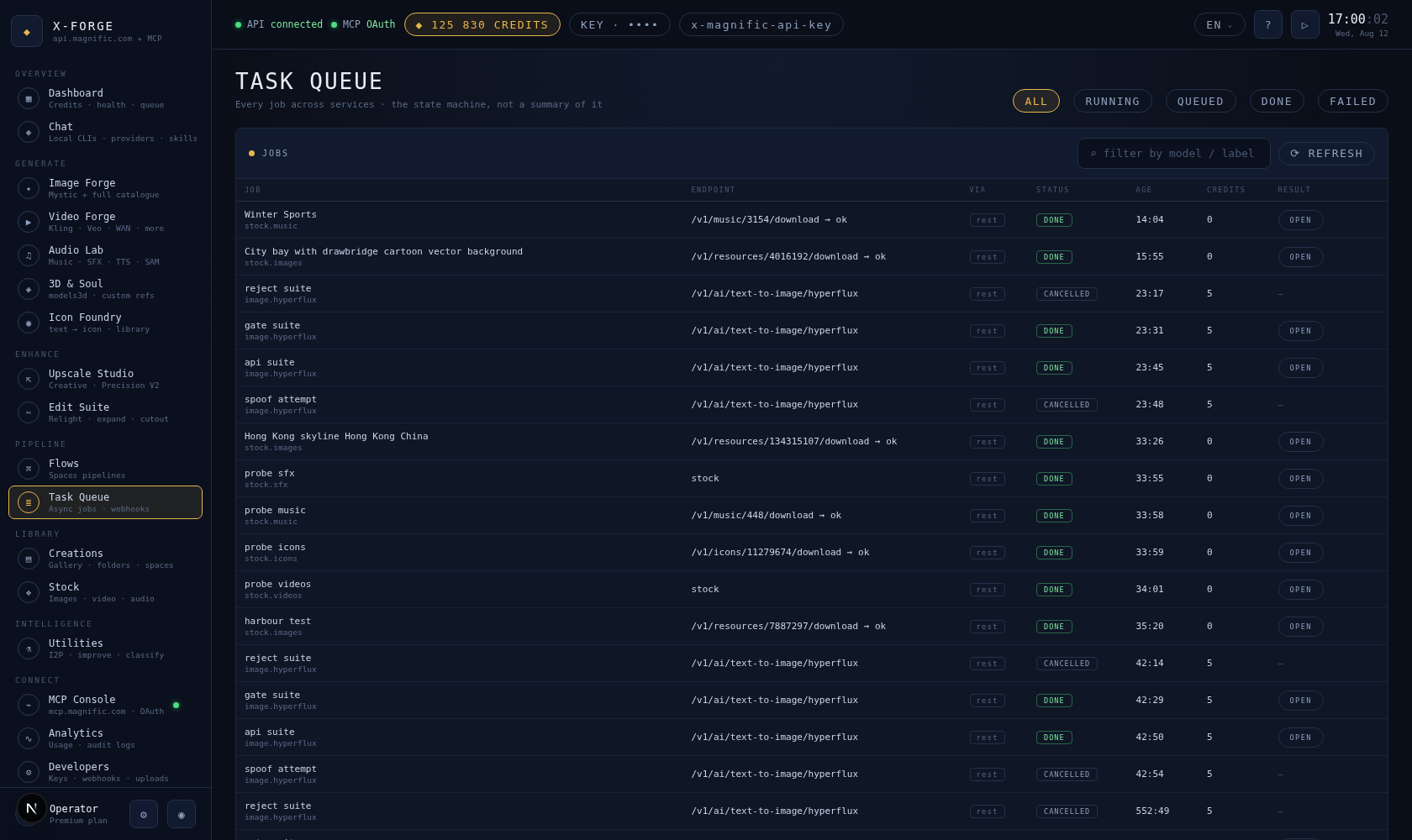 Every job, in its real state, with the endpoint it used and what it cost.
Pricing and rate shaping
Estimates come from Magnific's own simulate_cost — read-only, never charges — so the number
on the button is the provider's, not a price list in this repository. Where it cannot price a
call the capability table's figure is used and labelled as such; where the price is genuinely
unknown the job goes to the approval gate rather than being guessed at.
Two counters guard the provider's limits (50 requests per minute per key, plus IP burst and
average ceilings): a per-tenant RPM and a global outbound shaper, both consulted before a job
is admitted. Poll intervals back off with job age — six seconds for a fast image, thirty for a
video that will take minutes either way.
Things the API does not document
Established by running it, and pinned by tests — a tidy-up toward the published reference
would break them silently.
- Published names are not URLs. The creative upscaler answers on
/v1/ai/image-upscaler;
text-to-image models need thetext-to-imagesegment while Mystic alone sits on the flat
path; background removal is still under/v1/ai/beta/and is form-encoded. - Video endpoints spell aspect ratios out —
widescreen_16_9, not16:9— and takedurationas the string'5'or'10', never the number. kling-v2-6-proaccepts a POST and has no status route.GET …/kling-v2-6-pro/{id}is
a hard 404 whilekling-v2-5-pro/{id}answers "task not found". Its result can only arrive
by webhook, so the REST path runs 2.5 and 2.6 is reached over MCP.- Image → video refuses base64. The still must be staged to a URL first.
improve-promptrequires an undocumentedtypefield; without it every call is a
validation error.- MCP list tools answer in an indented outline, not JSON, and send no
structuredContent—
the outline is the payload. simulate_costtakes different arguments from the tool it prices. Video is priced flat,
not with the nestedclips[]the generator needs. Calling it with{}makes it list its own
required fields.- Background removal serves a PNG as
application/octet-stream, so the vault sniffs magic
bytes rather than believing the header.
Tests
npm run test:unit    # 34 — engine rules, tenant isolation, secrets, redaction, parsing
npm run test:api     # 24 — live, against your account, on the cheapest models
npm run test:e2e     #  4 — browser: every view, live data, no console errors
The API and browser suites need the console running. They spend about twenty credits per run —
a five-credit image, a two-credit voice line, a three-credit cutout — and never generate video.
And the acceptance run, which exercises every capability once for real:
node scripts/capability-sweep.mjs          # ~1 700 credits
node scripts/capability-sweep.mjs --all    # adds video and 3D
Last full run: 30 of 30 capabilities working.
Stack
Next.js 16 · React 19 · TypeScript · Tailwind v4 · node:sqlite — no ORM, no external
database, no build step beyond Next. Engine state lives in ~/.x-forge; generated assets go
wherever FORGE_VAULT_DIR points — sorted into image/ video/ audio/ 3D/ vector/, named by
date and label, each with a markdown note beside it, so an Obsidian vault is a first-class
destination rather than a dumping ground.
src/
  app/            routes and API handlers
  components/     the console — one file per screen
  lib/server/     engine, repository, adapters, MCP client, vault, secrets
scripts/          setup, capability sweep, screenshot capture, PDF build
tests/            unit · api · e2e
Documentation
GUIDEBOOK.md |
Every screen and control, with screenshots — 22 sections |
docs/X-Forge-Guidebook.pdf |
The same, typeset for print — 31 pages |
GUIDEBOOK.uk.md |
Те саме українською — 22 розділи |
docs/X-Forge-Guidebook-UK.pdf |
Українською, для друку — 32 сторінки |
CHANGELOG.md |
What shipped, and when |
.env.example |
Every setting, explained |
Rebuild the documentation with npm run docs — it recaptures the screenshots from a running
console, then rebuilds the PDF.
Security
The API key never reaches the browser. It is sealed with envelope encryption at rest,
decrypted only in memory at the moment of an outbound request, redacted from every log line
by a filter rather than by convention, and returned by no endpoint. Revoking it erases the
ciphertext immediately and cancels everything queued.
.env.local is git-ignored and written with mode 600. If you fork this repository, runnpm run setup rather than copying anyone else's environment.
Credits
Built by Yurii S. — @yuriiss.
Released under the GNU Affero General Public License v3.0 — free software in
the full sense: run it, read it, modify it, share it, use it commercially. The one condition
that matters is copyleft: if you distribute a modified version, or run one as a network
service that other people use, those people must be able to get your source.
For the ordinary case — one operator running the console on 127.0.0.1 — the licence asks
nothing of you at all, whatever you generate and whoever you generate it for.
Issues and pull requests are welcome — see CONTRIBUTING.md; for anything
touching credentials or the approval gate, read SECURITY.md first.
Magnific and Freepik are trademarks of their respective owners. This project is an
independent client built against their public API and MCP server, and is not affiliated
with, endorsed by, or supported by either.
Yorumlar (0)
Yorum birakmak icin giris yap.
Yorum birakSonuc bulunamadi