Prompt-Tree
Health Uyari
- No license — Repository has no license file
- Description — Repository has a description
- Active repo — Last push 0 days ago
- Community trust — 86 GitHub stars
Code Basarisiz
- process.env — Environment variable access in ai-chat-client/bin/prompt-tree.mjs
- spawnSync — Synchronous process spawning in ai-chat-client/src/__tests__/cli/launcher.test.ts
Permissions Gecti
- Permissions — No dangerous permissions requested
Bu listing icin henuz AI raporu yok.
A local AI client with Git‑style tree context. Branch conversations, compress long chats, and visually assemble per‑request context to avoid LLM “long-chat degradation.
Prompt Tree
English · 中文




Prompt Tree is a local-first AI chat client that models each conversation as a node-based DAG (a tree with branches) and provides an explicit Context Box for prompt assembly.
Motivation
Most chat UIs are linear:
- Exploring alternatives means copy/paste, losing context, or starting over.
- Long threads are hard to navigate and expensive in tokens.
- “Context management” is implicit, fragile, and hard to audit.
Prompt Tree turns a conversation into a canvas you can branch, compress, and curate.
Key Features
- Conversation DAG (tree + branches): continue from any node and compare outcomes.
- Canvas + chat in one place: visualize the thread while you talk.
- Context Box: drag nodes into a curated context, reorder, preview, and track tokens.
- Long-term memory (3-layer):
- User Profile (JSON → derived Markdown): persistent preferences/identity, fully visible & editable in Settings.
- Memory Bank (items): atomic memories with tags, status, confidence, and sources; supports user/folder scope.
- Folder Doc (JSON → derived Markdown): per-folder long-term doc, visible & editable in the folder page.
- First-message base injection + per-message memory refresh: on a thread’s first user message, inject Profile/Folder Doc + initial
topK(folder) + topK(user)memories; on every user message, refresh auto memory hits in the Context Box. - Recent messages continuity (optional): on a thread’s first user message, copy the last N messages from your most recent thread (same folder) into the Context Box.
- Async memory writer: runs on every user message; reads system prompt + all USER messages + a live memory snapshot resolved at execution time; can patch Profile/Folder Doc and upsert memories (first message can be forced to write at least 1 memory).
search_memorytool + pin: the model can search the full memory library during the tool loop; retrieved memories are added into the Context Box and can be pinned; per-thread caps are enforced (pinned wins over auto).- Embeddings (optional): embedding model is configurable; lexical fallback is used when embeddings are disabled/unavailable.
- Multi-model branching: select multiple models and send once to get parallel branches.
- Compression: compress a selected chain (or the Context Box) into a compact node; decompress when needed.
- Tools (optional): Web Search (Tavily/Exa), MCP servers, local Python execution.
- Local-first storage: conversations in IndexedDB; settings (providers/tools) in localStorage.
Install
Prerequisites
- Node.js 18+
Install (npm / pnpm)
npm i -g @yxp934/prompt-tree
# or
pnpm add -g @yxp934/prompt-tree
Update
npm i -g @yxp934/prompt-tree@latest
# or
pnpm up -g @yxp934/prompt-tree
Uninstall
npm rm -g @yxp934/prompt-tree
# or
pnpm rm -g @yxp934/prompt-tree
Run
Start the app:
prompt-tree
Open: http://localhost:1666
Change the port
prompt-tree --port 7777
CLI help / version
prompt-tree --help
prompt-tree --version
Run without installing globally (optional)
Useful for a one-off run without changing your global installation:
npx -y --package @yxp934/prompt-tree prompt-tree
# or
pnpm dlx --package @yxp934/prompt-tree prompt-tree
Usage Guide
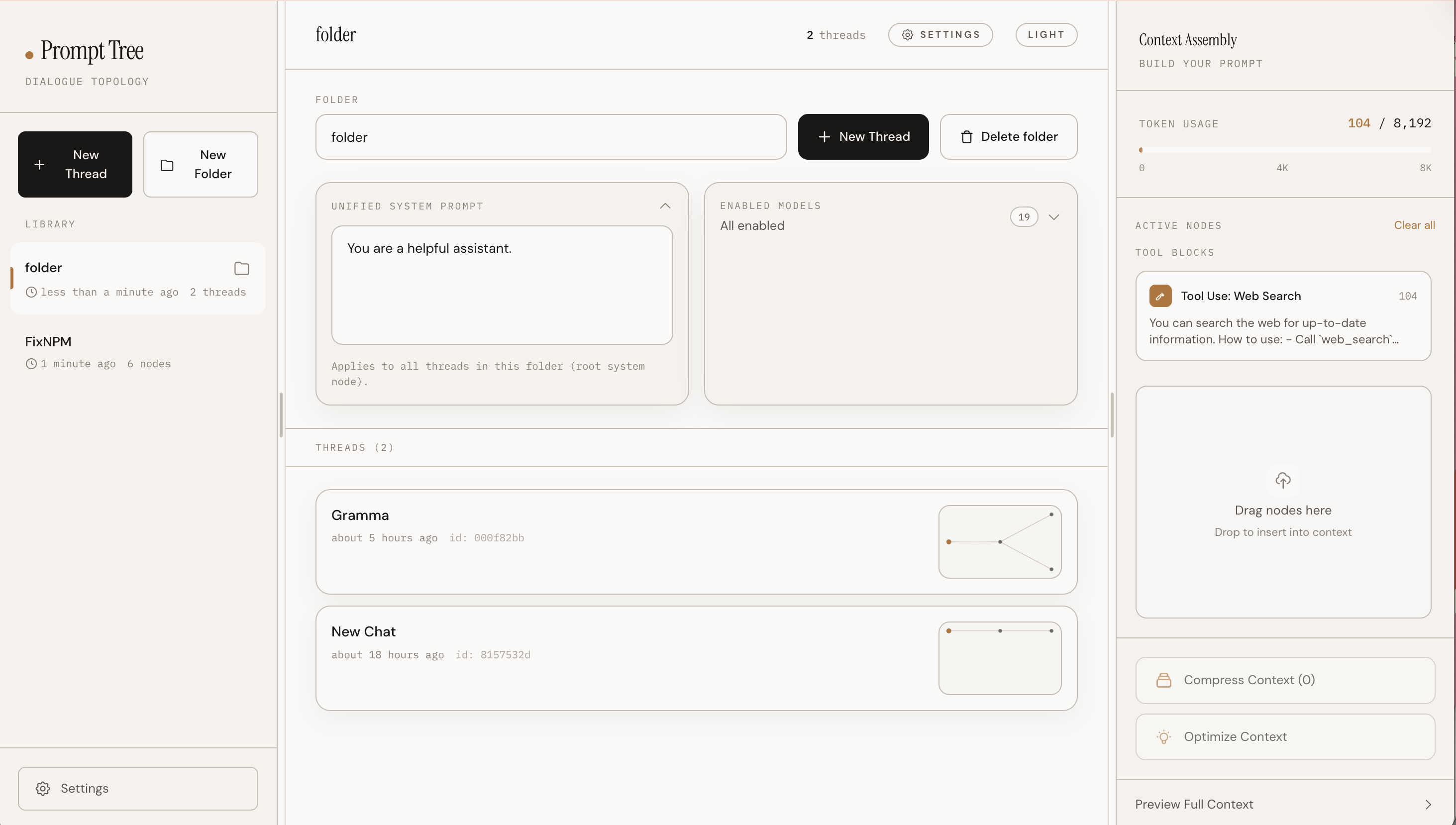
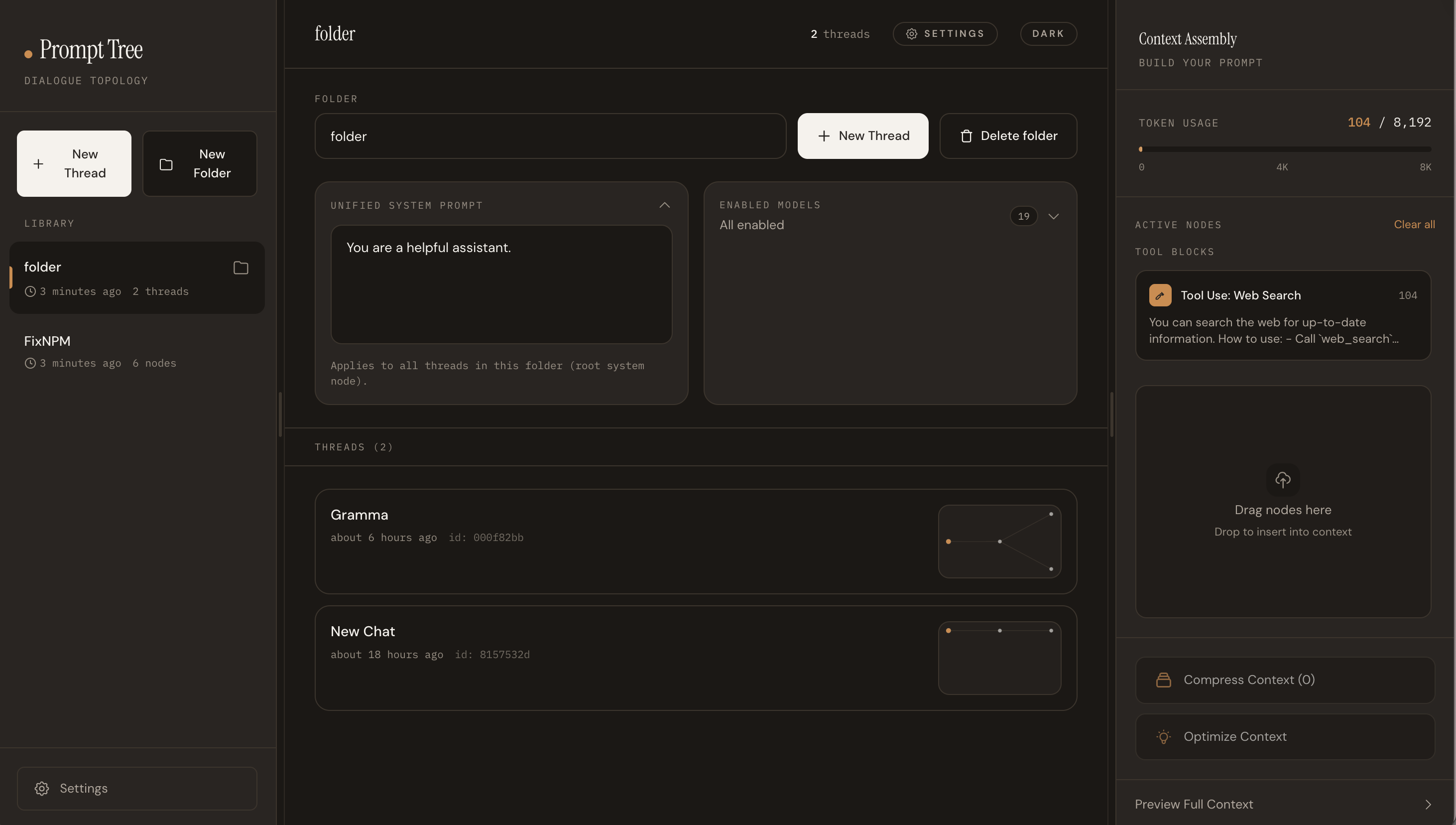
1) Create folders & threads
- Create a folder (Library) to group threads.
- Optionally set a Unified System Prompt for the folder (applies to every new thread in that folder).
2) Configure providers (Model Service)
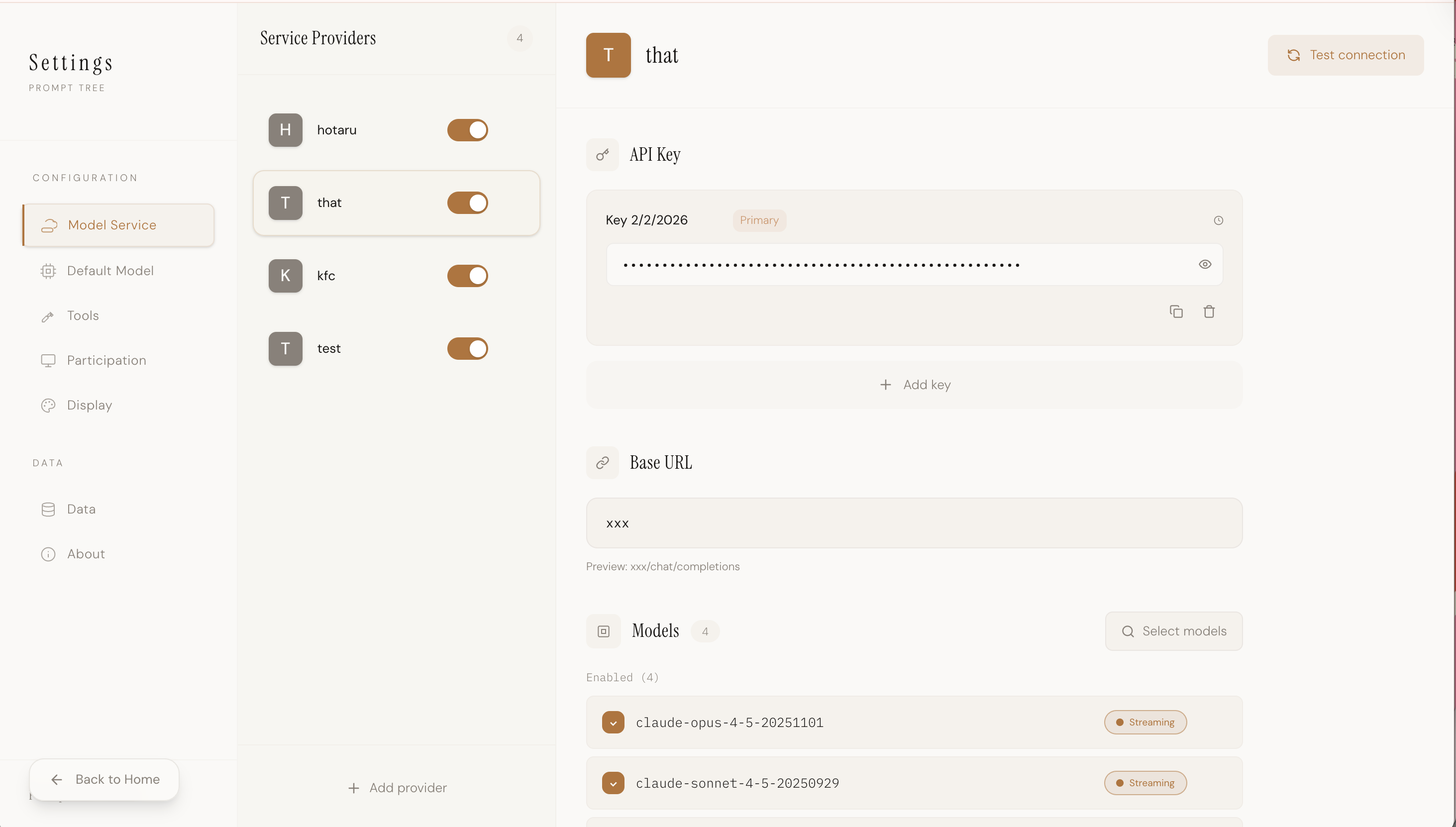
In Settings → Model Service:
- Add a provider
- Add one or more API keys (set a primary key)
- Set Base URL (OpenAI-compatible)
- Fetch/enable models and test connection
3) Select default models
In Settings → Default Model:
- Pick one or more enabled models (sending one message creates parallel branches)
- Pick a compression model (for summaries/meta instructions)
- Pick a title model (for thread titles)
4) Chat + branches
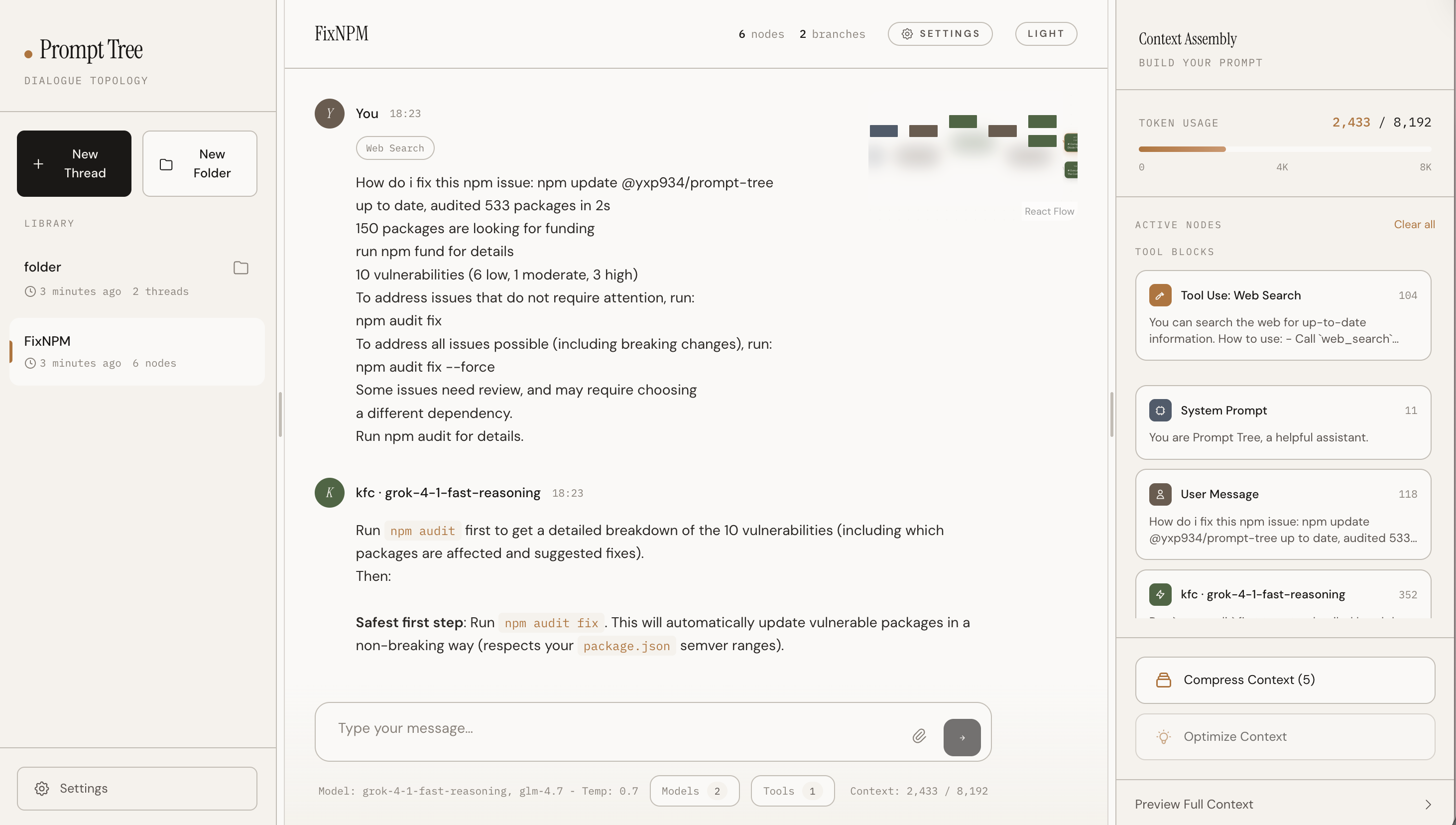
- Send a message once; if multiple models are selected, you’ll get multiple assistant branches.
- Use the branch list to switch, or continue from any node.
5) Navigate on the canvas
- The canvas shows the node graph of the current thread.
- Common actions: continue from here, compress branch, decompress, edit node, delete subtree.
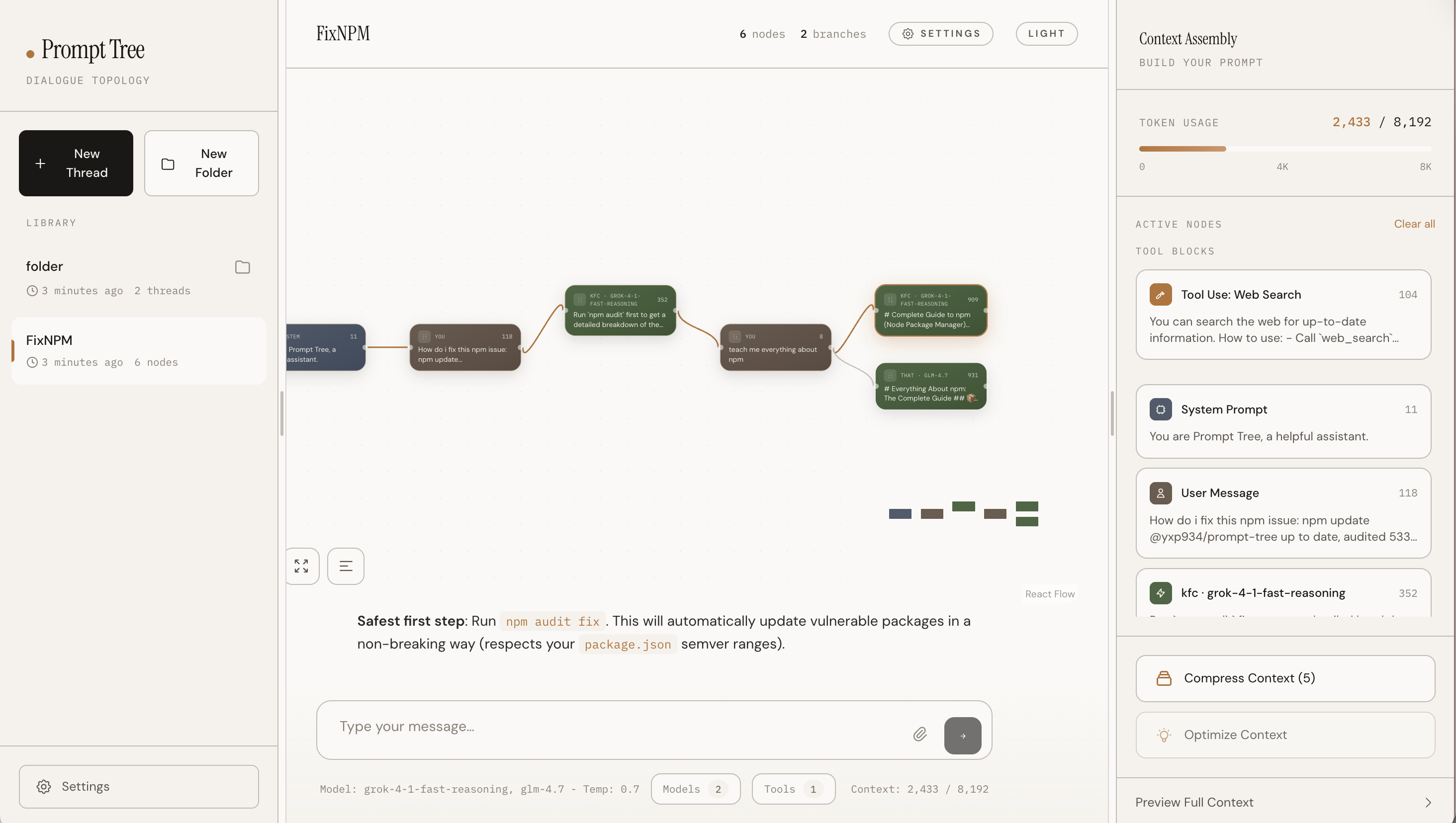
6) Context Box (prompt assembly)
- Open the Context panel from the top bar.
- Drag nodes from the canvas into the Context Box.
- Reorder items, preview the compiled context, and track token usage.
- Compress either the whole context or a selected chain (must be a single continuous path).
7) Long-term memory (Profile / Memory Bank / Folder Doc)
- Configure in
Settings → Memory:- Toggle long-term memory, auto-inject on first message, auto-add recent messages (last N), and the
search_memorytool. - When auto-add recent messages is enabled, a new thread’s first user message will copy the last N messages from your most recent thread (same folder) into the Context Box.
- In the chat composer
Toolsmenu, you can togglesearch_memoryper message (default enabled on new installs). When enabled, it appears in the Context Box as a Tool Block and is included in Context Preview. - Pick Memory Writer model and (optional) Embedding model.
- Edit/view User Profile JSON and its derived Markdown.
- Browse/edit/delete/restore memories; optionally re-embed memories when you change embedding model.
- Toggle long-term memory, auto-inject on first message, auto-add recent messages (last N), and the
- In folder threads:
- Configure the first-message RAG ratio (
topKFolder/topKUser) in the folder page. - Edit/view Folder Doc JSON and manage folder-scoped memories.
- Configure the first-message RAG ratio (
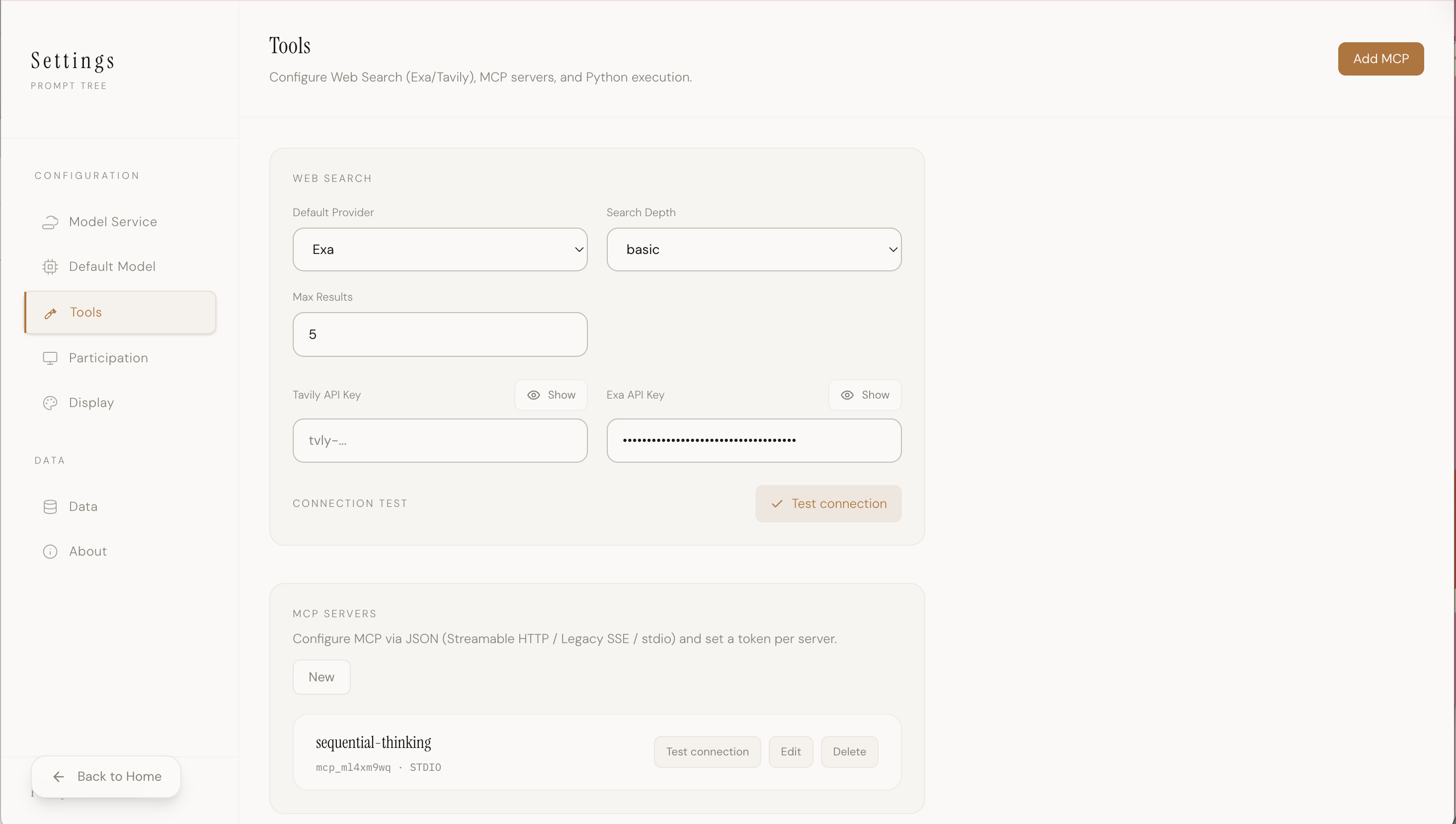
8) Tools (Web Search / MCP / Python)
In Settings → Tools, configure:
- Web Search: Tavily / Exa API keys
- MCP: add server JSON + token
- Python: python command, timeouts, output limits
Privacy & Data (based on current code)
- Conversations are stored locally in your browser’s IndexedDB database:
AIChatClientDB. - Long-term memory artifacts (User Profile / Folder Docs / Memory Bank + optional embeddings) are stored locally in the same IndexedDB database.
- Providers, API keys, and tool settings are stored locally in
localStorage(keys prefixed withprompt-tree.*). - The app runs locally; when you generate responses or use tools, requests are sent only to the model/tool endpoints you configure (this repo contains no built-in analytics/telemetry code).
- If you enable Memory Writer or Embeddings, the app will call the configured model endpoints for those operations.
- If you enable the Python tool, it executes code by spawning a local Python process on your machine—enable it only if you understand the risk.
Development
cd ai-chat-client
npm install
npm run dev
Open: http://localhost:1666
Useful scripts:
npm run build
npm run start
npm run test
npm run lint
npm run typecheck
Docs
- Product: 需求文档
- Technical design: TECHNICAL_DESIGN
- API design: API_DESIGN
- Roadmap: ROADMAP
Changelog
0.7.0 (2026-08-17)
- CLI (breaking): renamed the global executable from
treetoprompt-treeto avoid conflicts with operating-system commands, especially Windowstree.com; the oldtreealias has been removed. - Packaging and docs: updated the npm bin metadata, launcher help, and npm/pnpm examples to use
prompt-tree. - Markdown rendering: added
remark-math+rehype-katex+katexto support inline ($...$) and block ($$...$$) formulas. - Typography: added explicit
h1-h6styles under.prose-prompt-treeso heading levels render with distinct sizes. - Formula display: improved
.katex-displayoverflow handling to keep long equations readable in chat messages.
0.6.7 (2026-02-06)
- Settings: Max Tokens now supports empty value persistence; leaving it blank no longer resets to
1024after saving. - Defaults: for new settings, chat Max Tokens is now unset by default.
- Request pipeline: when Max Tokens is unset, chat and agent routes omit
max_tokensinstead of applying a fixed fallback.
0.6.6 (2026-02-06)
- Default Model settings: add an adjustable Prompt optimizer model selector.
- Prompt optimization request routing: now prioritizes the configured optimizer model; falls back to selected chat model, then chat default model.
0.6.5 (2026-02-06)
- Chat input: add one-click prompt optimization with loading state, cancel, undo replace, empty-input disable, and anti-concurrency guard.
- Settings: add editable optimizer prompt (plain text, no variable placeholders) and a Smart Memory toggle.
- Smart Memory for optimizer: when enabled, optimization requests include user profile, folder profile (if in folder), top 10 RAG atomic memories, and context snapshot.
- Prompt optimizer default prompt: switch to English and enforce output language based on input language while keeping technical terms/code as needed.
0.6.4 (2026-02-06)
- Provider settings: fix Base URL input behavior so
/is no longer removed while typing; normalization now happens on blur/submit checks.
0.6.3 (2026-02-06)
- Memory: refresh auto memory RAG blocks on every user message instead of first-message-only injection.
- Memory Writer: build memory snapshot at job execution time from latest memory state to reduce duplicate/conflicting writes.
0.6.2 (2026-02-06)
- Memory: add “Auto-add recent messages” (last N) on a thread’s first user message to keep continuity across threads (in parallel with long-term memory injection).
Contact
- Email: [email protected]
- WeChat: WanguA8
License
MIT
Yorumlar (0)
Yorum birakmak icin giris yap.
Yorum birakSonuc bulunamadi