rttsh
Health Uyari
- No license — Repository has no license file
- Description — Repository has a description
- Active repo — Last push 0 days ago
- Low visibility — Only 6 GitHub stars
Code Gecti
- Code scan — Scanned 5 files during light audit, no dangerous patterns found
Permissions Gecti
- Permissions — No dangerous permissions requested
Bu listing icin henuz AI raporu yok.
A host-side, scriptable command-line terminal for Segger-RTT; Also the AI-ready command line for embedded validation.
rttsh
English | 简体中文
rttsh is a command-line terminal over SEGGER J-Link RTT for automated on-board firmware verification. The firmware exposes a command console through SEGGER RTT; on the host side, Lua scripts send commands, match responses, and assert on output and timing, so on-board verification can run in batches and be wired into CI. Communication and flashing share the same debug probe and do not occupy target peripherals such as UART.
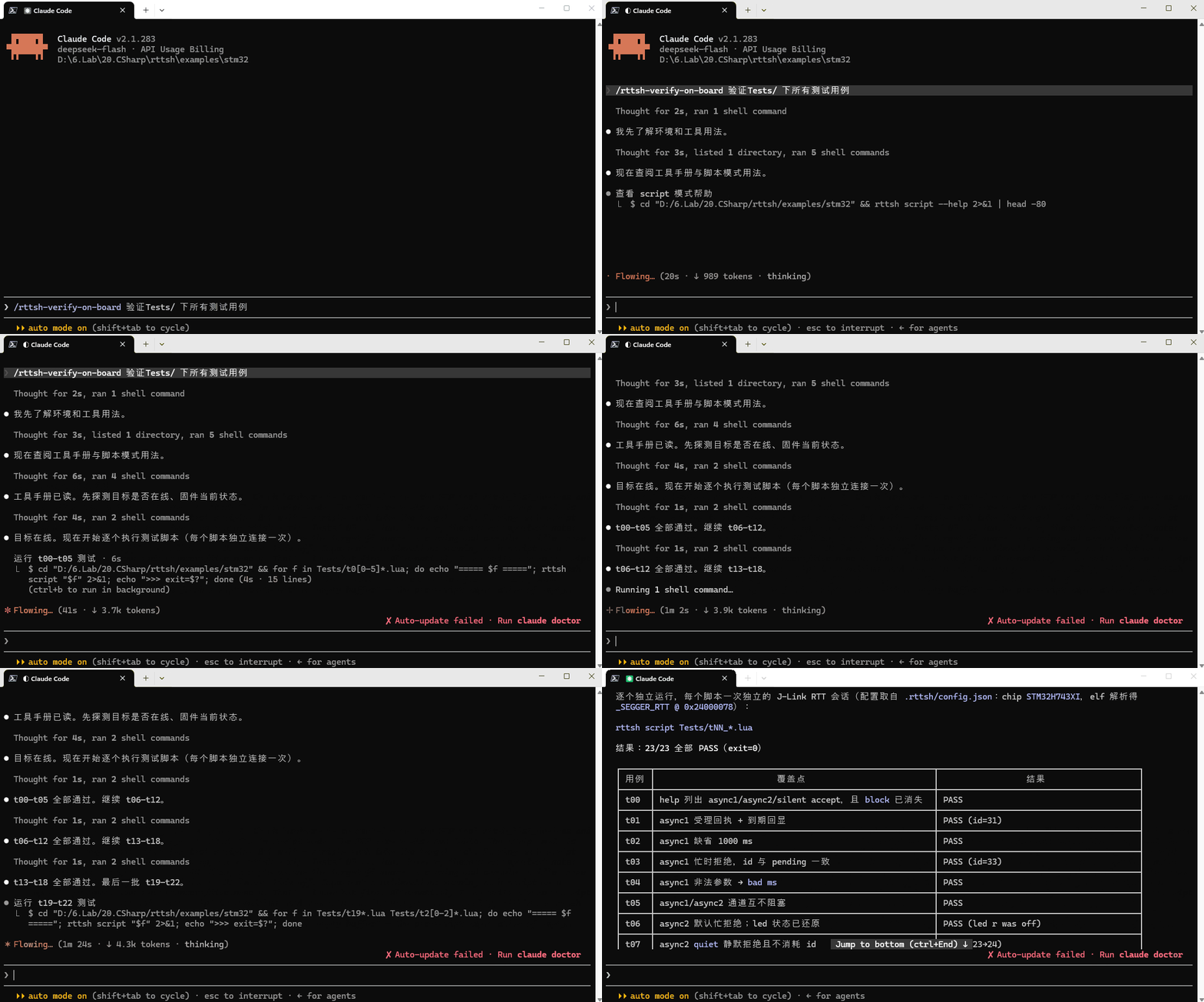
An MCP server (rttsh mcp) and the skills/rttsh-verify-on-board skill are provided for AI coding agents.
Requirements
Windows (depends on JLink_x64.dll and lua54); the .NET 10 runtime (needed by the framework-dependent installer, bundled in the self-contained package); the SEGGER J-Link driver and a probe (the J-Link DLL is auto-detected, or point to one with --dll); firmware linked with the RTT control block (_SEGGER_RTT) and already flashed to the target board. See installer/ for installers and building from source.
Usage
--chip must match a name from the J-Link device database (case-insensitive); look it up with rttsh list-devices --filter H743. An invalid name fails fast with an error (exit 2) and never opens the device-selection dialog.
Send one line and wait for the response:
rttsh send "led r on" --chip STM32H743XI --wait 300
--hex sends raw bytes. Running without a subcommand opens an interactive terminal (-tui selects the chat-style layout), Ctrl+C to exit; when output is redirected it switches to receive-only mode, so it can be piped through grep and the like.
Script mode is the core of automated verification. script --eval runs Lua inline:
rttsh script --eval 'rtt.send("led r toggle"); rtt.expect("LED r toggled", 500)' --chip STM32H743XI
Systematic test cases are written as script files. rtt.expect returns the matched text, which you can parse to assert on response fields:
-- Tests/t21_led_query.lua
local function query_led(name)
  rtt.send("led "..name)
  local q = rtt.expect("LED "..name.." %a+", 500)
  return q:match("LED "..name.." (%a+)")
end
local g0 = query_led("g")
rtt.send("led g toggle")
rtt.expect("LED g toggled", 500)
assert(query_led("g") ~= g0, "state did not flip")
rtt.log("t21 PASS")
The full suite lives in examples/stm32/Tests (23 scripts, a real target board required), covering field extraction, negative assertions, timing windows, channel independence, and more.
An expect timeout is a failure (exit 1), and the error message includes the tail of the receive buffer so the firmware's actual response is visible right in the failure. The rtt.* API also covers binary transfer and target memory access (rtt.mem_read/rtt.mem_write).
By default the RTT control-block address is found by scanning RAM from the SDK; --elf <image> resolves it from the _SEGGER_RTT symbol instead, following rebuilds automatically, with results cached in .rttsh/elf-cache/.
Runtime options can be written to .rttsh/config.json in the working directory and are loaded automatically (keys: chip, speed, interface, sn, channel, rttAddr, rttRange, elf, encoding, eol, wait, scriptTimeout, log; types and defaults in rttsh manual). Machine-level tool paths live in ~/.rttsh/settings.json (keys: dll, fromelf; command line wins; types and details in rttsh manual). -C/--root switches the base directory; --log records session traffic.
Commands
| Command | Description |
|---|---|
| (no subcommand) | Interactive RTT terminal |
send <text> |
Send once, optionally wait for a response |
script [<file.lua>] |
Run a Lua script, or --eval <code> |
flash download <file> |
Flash hex/elf/mot/bin; raw .bin requires --addr; ELF/AXF converts via fromelf (--fromelf / ~/.rttsh/settings.json) |
flash erase |
Chip-wide erase; --yes required when stdin is redirected |
mcp |
Run the MCP server over stdio |
list-devices |
List the device database (filter with --filter) |
manual |
Print the reference manual |
The core remains halted after flash operations; pass
--resetto reset it once the operation completes.
Exit codes: 0 success, 1 run failure (including expect timeouts), 2 usage error. Exit 0 only means rttsh itself ran without error — firmware-level errors also return 0, so verdicts must be based on response text.
MCP
rttsh mcp is launched over stdio by an MCP client and provides eight tools — connect, disconnect, get_status, send, rtt_read, expect, mem_read, list_devices — sharing the same execution engine as the Lua scripts and holding at most one target session at a time. Registration example:
{ "mcpServers": { "rttsh": { "command": "rttsh", "args": ["mcp"] } } }
Documentation
rttsh manual is the full reference (config keys, the rtt.* API, scripting essentials); rttsh --help and each subcommand's --help list all options with their defaults.
Yorumlar (0)
Yorum birakmak icin giris yap.
Yorum birakSonuc bulunamadi