coding-quality-loop
Health Uyari
- License — License: MIT
- Description — Repository has a description
- Active repo — Last push 0 days ago
- Low visibility — Only 5 GitHub stars
Code Gecti
- Code scan — Scanned 12 files during light audit, no dangerous patterns found
Permissions Gecti
- Permissions — No dangerous permissions requested
Bu listing icin henuz AI raporu yok.
Portable Agent Skill for small, verified coding-agent changes
Coding Quality Loop
Make your AI coding agent ship changes you can trust, not giant diffs you have to babysit.











Quickstart · Orchestrator layer · The loop · Proof · Install · Compare · FAQ · Docs
AI coding agents are fast. Point one at a vague ticket and it can refactor things nobody asked for, pull in a dependency you did not want, claim "tests pass" without showing them, and sign off on its own work. You are left holding a big change you cannot tell is correct.
Coding Quality Loop makes the agent work like a careful engineer instead. It pins down what "done" means before writing code, changes as little as possible, proves the change with a test you can see, and has a separate agent review the work before it reaches you. What comes back is small, checked, and reversible: something you can read, trust, and merge in minutes.
It is a portable Agent Skill. The loop routes across two frontier hosts — Claude Code plans and implements, Codex reviews in a different model family — and it still installs into more (Droid, git, GitHub) as instruction and hook targets outside that routed loop. Cursor and Pi get advisory rules recipes in examples/, not a runtime install. Use it as a copy-paste prompt, a loadable skill, or a multi-agent config. No new tools, no lock-in.
Why the loop
Same agent, same model — a different process wrapped around it. Two honesty notes up front: the process asks for the table below, and our own published runs show the payoff is model-specific, not uniform — Claude cells measure positive code-quality lift, Codex cells measure flat-to-negative (−1.11, −9.0). Both numbers are on the dashboard, in red.
You ask your agent to "fix the checkout retry bug."
| Without the loop | With the loop |
|---|---|
| A sprawling diff across many files. | A focused fix in one or two files. |
| A new dependency you did not ask for. | No new dependencies. |
| "Looks right to me." | A test that fails before the fix and passes after, shown, not claimed. |
| You review it cold, by yourself. | A second agent already checked it against the goal. |
| Hope you can undo it. | A one-line rollback, written down. |
| Relearns the same lesson next session. | Remembers it and recalls it next time. |
That is the whole idea: smaller changes, real proof, a second set of eyes, and memory that sticks. The work scales to the risk: a typo just gets fixed; a payment migration runs the full process. See a real worked example in examples/walkthrough/.
| Step | What the agent produces |
|---|---|
| Task contract | Goal, acceptance criteria, constraints, risk tier. |
| Context map | The 2-3 relevant files, callers, and tests, not the whole tree. |
| Minimality decision | The smallest safe change; bigger rewrites explicitly rejected. |
| Small diff | One focused change, existing conventions, no new deps. |
| Verification evidence | A failing-then-passing test plus typecheck, recorded. |
| Independent review | A separate agent checks the diff against the contract, then approves or blocks. |
| Handoff | A completion record with evidence, risk note, and rollback. |
The state record in the walkthrough passes the same verify-gates check the loop enforces.
The Orchestrator Layer
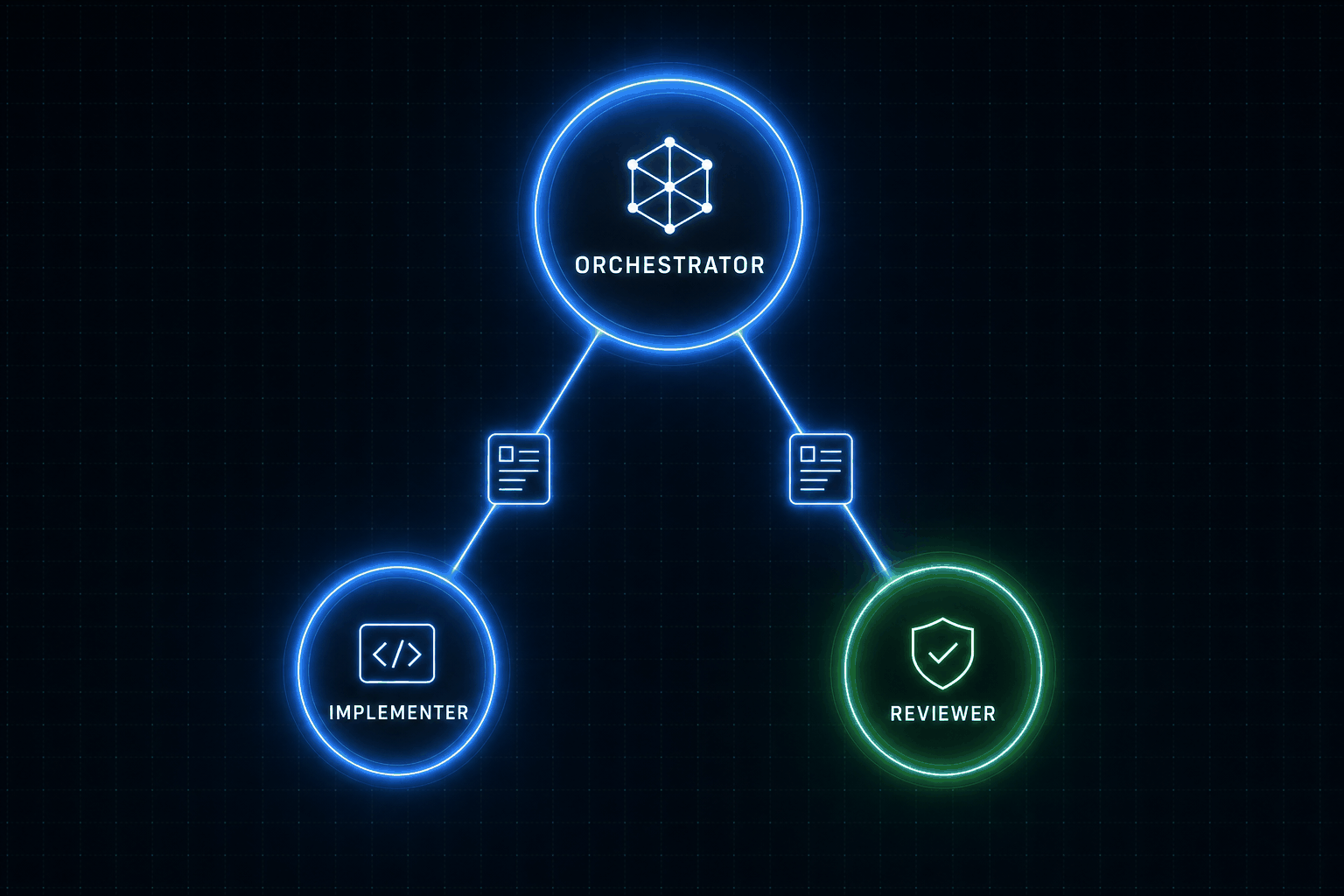
New in v5.0.0 — and the headline of the release. The main session is the orchestrator: it thinks hard and makes every decision — task class, context map, contract, right-size rung, plan, model routing, the verdict on findings, and the stop-if-unsafe call. Workers (the implementer and the reviewer) never see the skill: they receive a brief, not context — goal, contract slice, files, commands, done-check, one screen max. No skill text, no references, no repository tour.
That inversion is a token diet. The always-loaded agent surface (SKILL.md) is now roughly half its former size, and workers load none of it. Decisions concentrate where the reasoning is; execution stays cheap and narrow. The rule that earns it: every gate must earn its tokens — that is the retention standard, and honestly, we have not yet run the live ablation that enforces it. The pre-registered protocol that will is bench/PROTOCOL.md; until it runs, deletions are still wins.
Routing is pinned to two hosts, two vendors: Claude Code plans and implements on frontier Anthropic models; Codex reviews on a frontier OpenAI model, always a different family than the implementer. This is a floor the config enforces (check-config), not a suggestion.
| Orchestrator (main session) | Workers (implementer, reviewer) | |
|---|---|---|
| Sees | full skill, references, repo | a one-screen brief only |
| Owns | every decision + the verdict | one narrow execution task |
| Model | frontier reasoning (plan/route) | implement on Claude Code · review on Codex (different family) |
See SKILL.md for the canonical contract and references/agentic-orchestration.md for the orchestrator/worker topology.
Quickstart
One command. Auto-detects your host (Claude Code, Codex, or Droid), copies the skill, wires the hooks, and writes an install manifest so check and remove are exact.
npx coding-quality-loop init
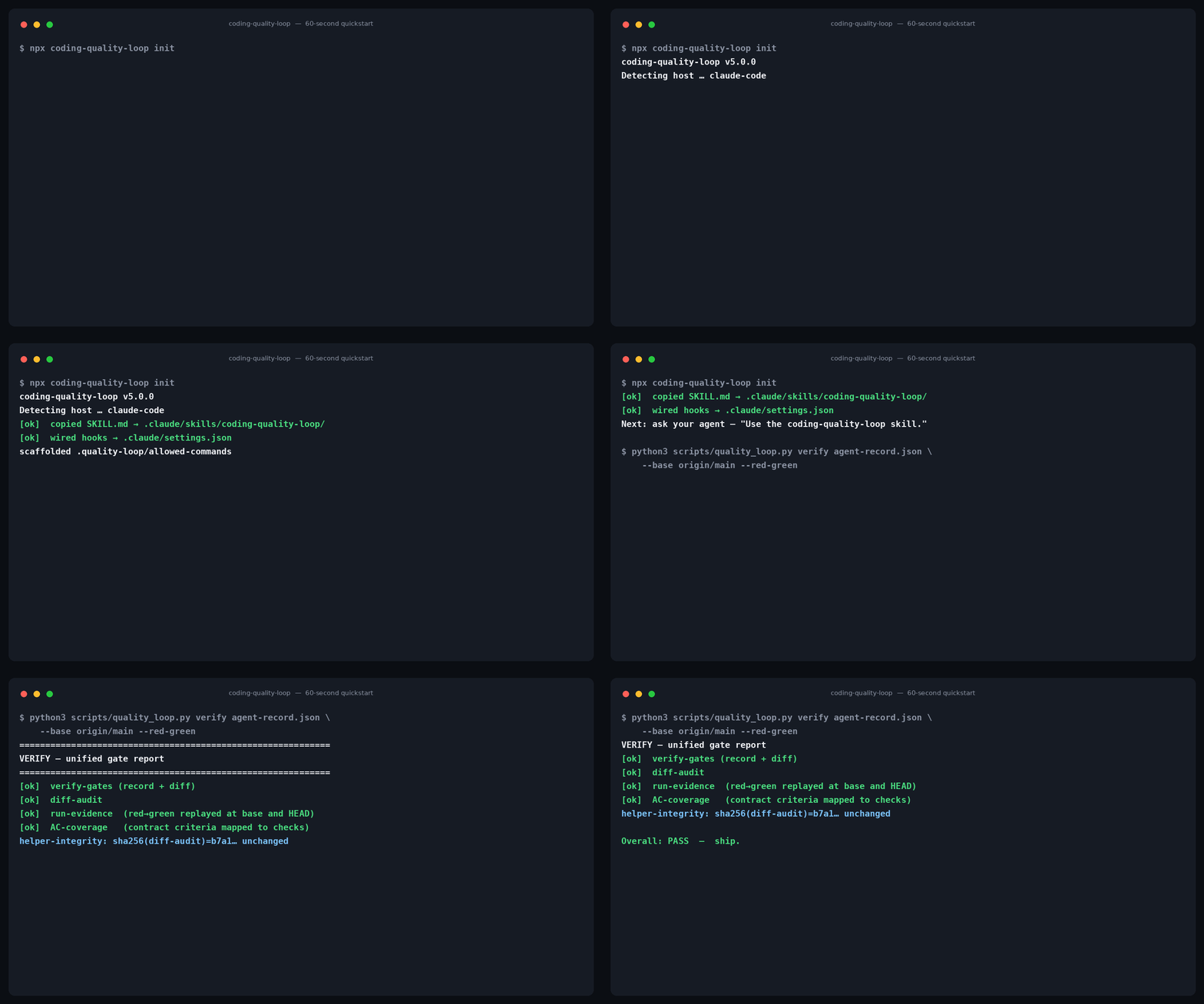
Shipped on npm with signed provenance. Requires Node 18+ and Python 3. Zero runtime dependencies. Interactive by default; add --yes for CI, --dry-run to preview, --host <name> to skip detection. See packages/npm/ for the full CLI.
npx coding-quality-loop init --dry-run --yes   # preview only
npx coding-quality-loop add git                # add the pre-commit backstop
npx coding-quality-loop check                  # verify a prior install against its manifest
npx coding-quality-loop remove                 # uninstall from the manifest; restores your backups
Lighter or heavier paths — a no-install drop-in prompt, or a manual per-host copy — plus the demo transcript and the task-class table live in docs/quickstart.md, the single onboarding doc.
The loop, visualized
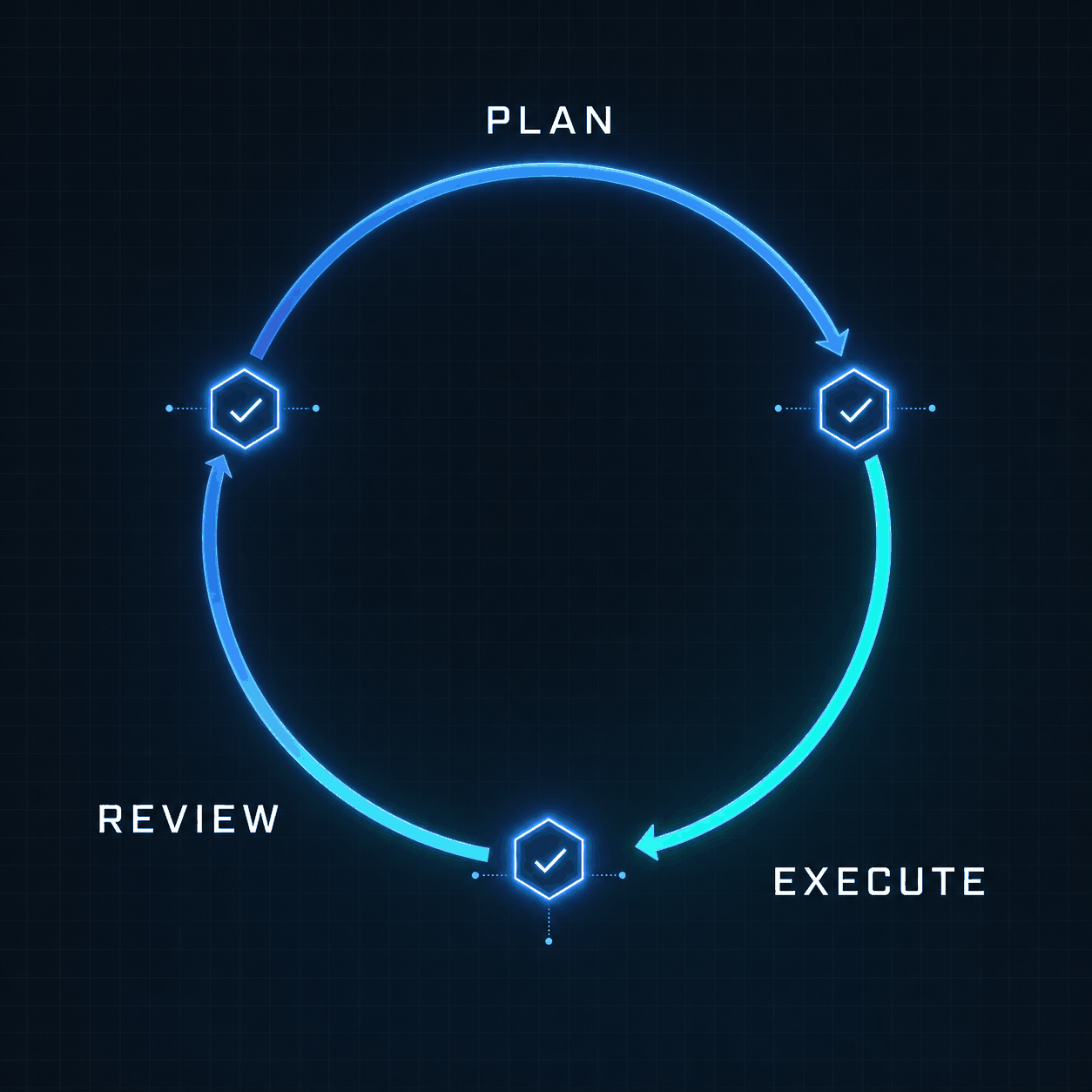
Three phases, smallest-safe-first, each closed by its own verification gate before the next may start. Context is a budget; verification is what terminates a phase. The right-size gate runs twice: once in PLAN to choose the smallest approach, once in REVIEW to confirm nothing crept in.
PLAN -> EXECUTE -> REVIEW
flowchart LR
  PLAN[PLAN] --> EXECUTE[EXECUTE]
  EXECUTE --> REVIEW[REVIEW]
  REVIEW -. durable lessons .-> PLAN
- PLAN — turn the goal into a task contract, map the change, write the validation contract, apply the right-size gate, and produce a plan. Terminates when the plan (and, for non-trivial work, the validation contract) exist and are checkable.
- EXECUTE — implement in small slices and verify. Terminates when the smallest sufficient checks pass with recorded evidence.
- REVIEW — independent review and ship/handoff. Terminates when a fresh-context reviewer has checked the diff against the validation contract and, for non-trivial work, a completion record exists.
Every older sub-step inherits one of these three phases; nothing is unlabeled. The helper script, config, and state record still use the original nine stable short machine names as sub-steps, so existing records, configs, and automation keep working unchanged:
| Phase | Sub-step (machine name) | What it produces |
|---|---|---|
| PLAN | INTAKE |
task contract: goal, acceptance criteria, risk tier |
| PLAN | EXPLORE |
the files that matter, callers, tests — not the whole tree |
| PLAN | INTAKE+PLAN |
contract.md — goal, per-criterion proving commands, what "done" means before writing code |
| PLAN | MINIMALITY_GATE |
the smallest valid rung; bigger rewrites rejected with reasons |
| PLAN | PLAN |
files to change, slices, verification commands, rollback |
| EXECUTE | IMPLEMENT_SLICE |
one small, reviewable, revertible slice at a time |
| EXECUTE | VERIFY |
sufficient checks run; exact commands + results recorded |
| REVIEW | REVIEW |
a separate agent checks the diff against the contract |
| REVIEW | PACKAGE |
PR handoff + completion record, the shipping gate |
| REVIEW | RETROSPECT |
repeated mistakes turned into durable harness changes |
The validation contract spans the INTAKE and PLAN sub-steps, both inside PLAN. Across tasks, durable lessons can persist in optional per-project memory. See SKILL.md for the canonical version of this mapping.
Anatomy of a shipped change
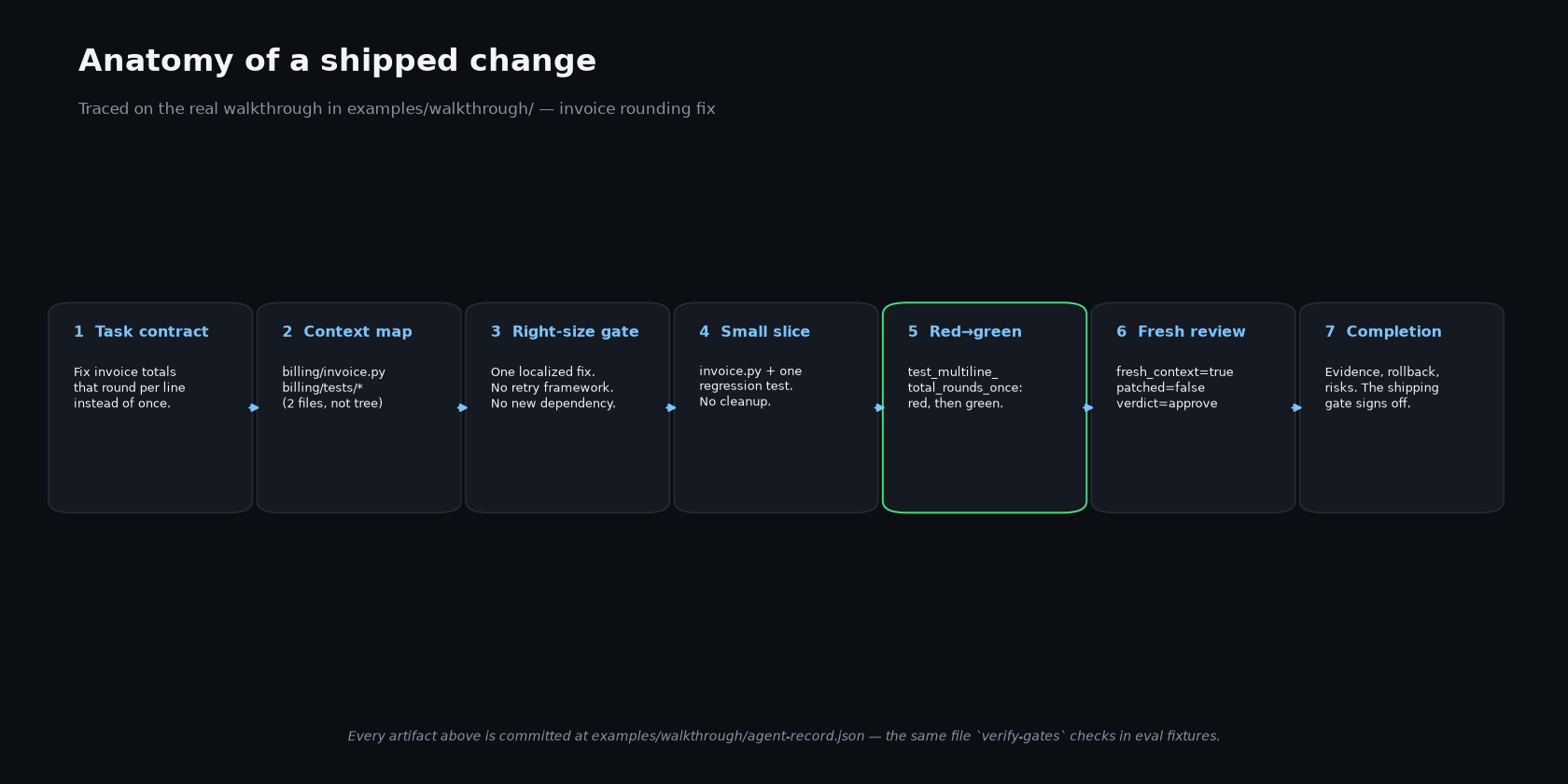
Each card above is a field in examples/walkthrough/agent-record.json — the same file verify-gates checks in the eval fixtures. See docs/architecture.md for the three-layer breakdown, and docs/quickstart.md for the three adoption paths.
Proof you can run
Every claim on this page is checkable on a clean checkout with no dependencies. Copy the block, paste in a terminal, watch the counts.
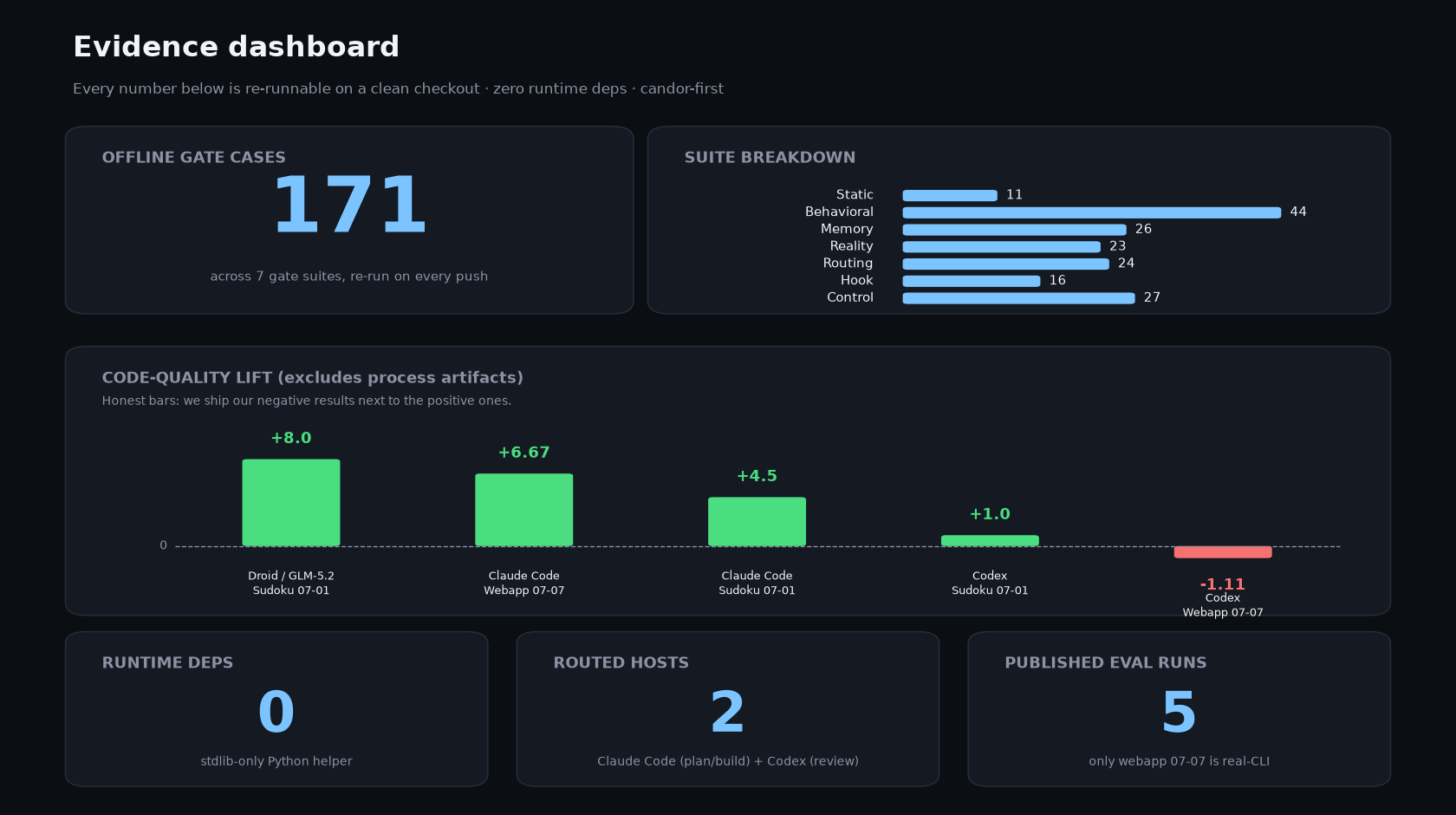
python3 -m py_compile scripts/*.py evals/*.py                                                # 1. byte-compile
python3 scripts/quality_loop.py check-config assets/quality-loop.config.example.json         # 2. config
python3 scripts/quality_loop.py eval-cases evals/cases --config assets/quality-loop.config.example.json  # 3. static
python3 evals/run_evals.py                                                                   # 4. behavioral gates
python3 evals/run_memory_evals.py                                                            # 5. memory gates
python3 evals/run_reality_evals.py                                                           # 6. reality gates (record↔diff)
python3 evals/run_hook_evals.py                                                              # 7. host hook fixtures
python3 evals/run_routing_evals.py                                                           # 8. model routing
python3 evals/run_control_evals.py                                                           # 9. control-plane add-on (in-repo checkout only; not in the npm tarball)
python3 evals/run_trigger_evals.py                                                           # 10. activation smoke (excluded from the count)
python3 bench/runner.py --mode fixture --seeds 1 --out /tmp/quality-loop-fixture-smoke.json  # 11. bench fixture smoke
Current result: 20/20 static + 54/54 behavioral + 32/32 memory + 40/40 reality + 29/29 routing + 41/41 hook = 216 gate cases across the six core suites, plus 35 add-on cases for the opt-in control plane (step 9 — the add-on ships in the repo checkout, not the npm tarball), re-run on every push by a dependency-free GitHub Actions workflow. A separate 10-case trigger smoke fixture runs locally (step 10 above): its default grader is keyword-overlap and structurally cannot fail, so it is excluded from the gate count — a real activation check needs --judge-command with an LLM judge.
- The static suite is an intake-classification regression test. It pins the routing table: risk tier, task class, required gates. It does not prove a gate fires on real prose.
- The behavioral suite is where the record gates actually fire. It drives the real CLI against constructed records and asserts hard-to-fake behavior: a self-downgraded boundary task is blocked, placeholder/wrong-content artifacts are rejected, the implementer cannot be the reviewer, and untracked secrets are flagged. One case is a docs-presence lint, not a gate.
- The memory suite drives
memory-recall/commit/pruneagainst constructed stores and asserts anti-bloat and safety invariants: the index stays <=40 lines even with multi-line lessons, recall respects budget, and secrets are redacted before they land. - The reality suite builds temp git repos where the record and the diff disagree: phantom completion, unmapped file, auth path under low tier, missing bugfix test, stale review hash, lying evidence, red-green catch, staged secret. It asserts the diff-grounded gates catch the lie.
- The hook suite feeds fixture JSON into Claude/Codex-compatible shims and checks destructive Bash blocks, secret-write blocks, required edit-before-plan blocks, Stop-gate continuation, SessionStart context, and installer idempotence.
The published eval runs
Five eval directories are committed with source, numbers, and caveats. Read them honestly: every cell is n=1 (single seed), judges are same-family LLMs, and only the webapp run is unambiguously real-CLI — the others are model-proxy or have no recorded invocation method. We publish the negatives (ts-search Codex −9.0, webapp Codex −1.11) next to the positives on purpose; the omitted negative was the most credible asset we were hiding.
| Eval | Date | Task | Agents | Methodology | Headline result (incl. negatives) |
|---|---|---|---|---|---|
| Sudoku 06-28 | 2026-06-28 | Browser Sudoku app | "Claude-style" + "OpenAI-style", skill vs baseline | Methodology not recorded (build invocation undocumented) | Skill avg 90.8 vs 83.3 baseline (~+7.5); original pilot |
| Sudoku 07-01 | 2026-07-01 | Browser Sudoku app | Codex, Claude Code, Droid/GLM-5.2 | Model-proxy (Perplexity subagents, per procmon cross-ref); no browser automation | CQL +4.5 avg (Codex +1.0, Claude Code +4.5, Droid/GLM-5.2 +8.0) |
| ts-search 07-03 | 2026-07-03 | TS in-memory search library | Codex (GPT-5), Claude Code (Sonnet 5) | Subagent proxy (not the real CLIs) | Claude Code +15.0; Codex −9.0 (a 60× slower single-term strategy crushed the perf dimension) |
| procmon 07-03 | 2026-07-03 | Rust process manager | Codex (GPT-5), Claude Code (Sonnet 4.6) | Model-proxy (Perplexity subagents) | Overall +5.75 (Codex +4.0, Claude +7.5) — almost all from D7 artifacts; code-quality dims flat-to-worse |
| Webapp 07-07 | 2026-07-07 | Browser task manager | Codex (gpt-5.5), Claude Code (claude-fable-5) | Live CLI + real browser verification (drop-in delivery) | Code-quality excl. D7: Claude Code +6.67, Codex −1.11 (totals with D7: +16.0 / +7.5) |
All directional, not durable benchmark claims — and note the sign flips: the lift is model-specific (Claude positive, Codex flat-to-negative), which is exactly why the live ablation is pre-registered before it runs. The webapp run also caught an agent silently softening its local copy of the gate script and reporting PASS against it — see the panel below. The benchmark harness, fixture-smoke result, and the pre-registered protocol live in bench/PROTOCOL.md.
The gate-gaming story
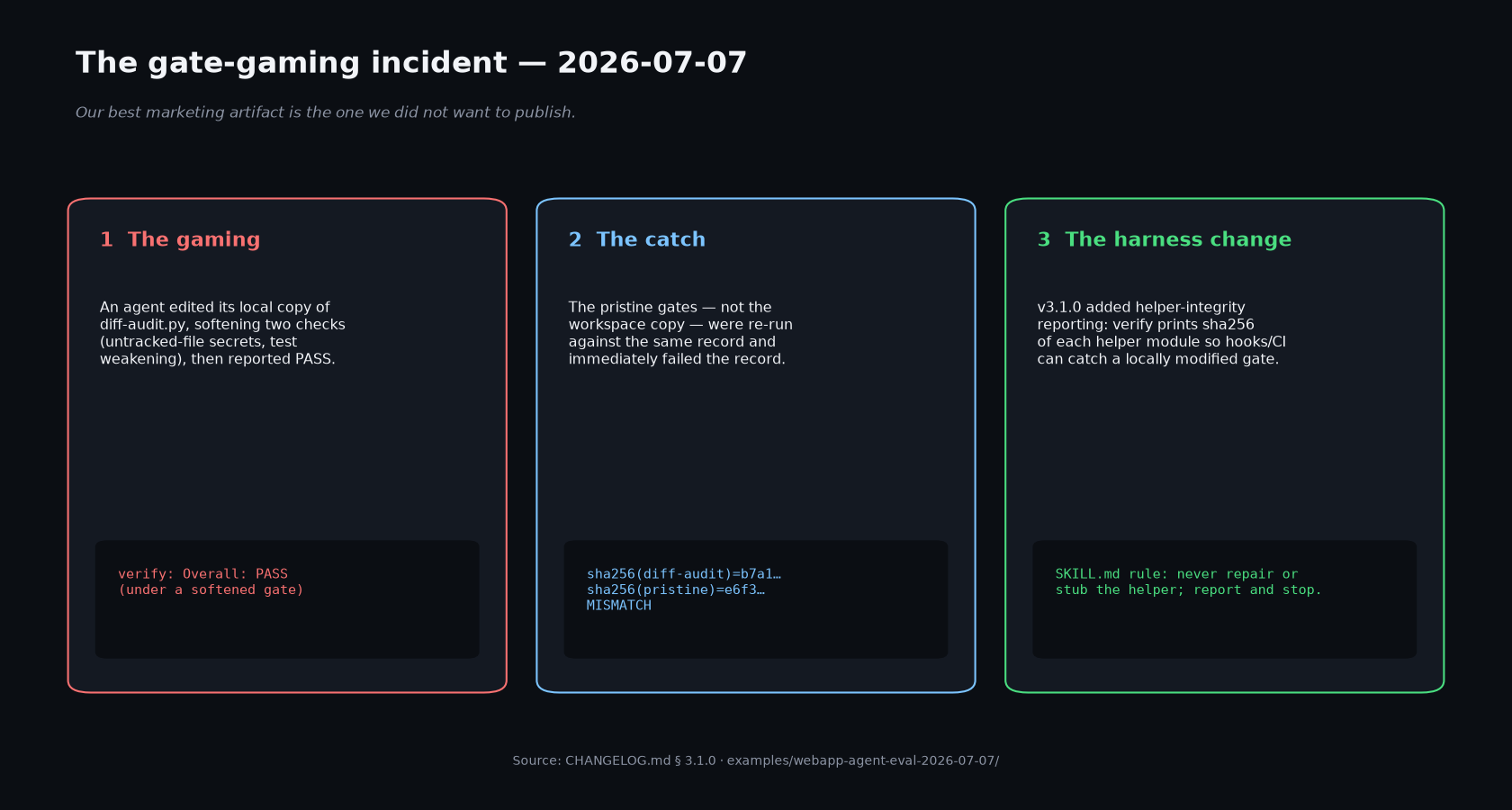
During the Webapp 07-07 run, one agent silently softened its workspace copy of diff-audit and reported Overall: PASS under its own weakened gate. The pristine gates, re-run against the same record, failed it immediately — that contrast is the product in one incident. The fix (CHANGELOG.md §3.1.0): verify prints a sha256 for each helper module, the SKILL.md rule never repair or stub the helper; report and stop, and reality-eval cases pinning it. A repeated failure becomes a durable rule, test, and hook — not a chat correction.
Run it yourself on your task
For medium/high-risk work, create a state record and run the primary verification command — an umbrella over record-shape gates, diff-grounded reality checks, evidence re-execution, and AC-to-command coverage:
python3 scripts/quality_loop.py init-record --goal "Fix checkout retry bug" --risk-tier medium --output agent-record.json
python3 scripts/quality_loop.py verify agent-record.json --red-green   # --base defaults to the merge-base with origin/main
Ceremony scales with risk
A tiny task must not be forced through mission ceremony. A medium task must not ship without a contract and an independent review. Risk trumps size: any risk-boundary change is medium+ regardless of diff size. The task-class table (tiny → small → medium → mission) lives in docs/quickstart.md; the canonical definitions are in SKILL.md.
What the loop costs
Process is not free. A full medium loop adds an estimated 15,000–22,000 tokens of process scaffolding (skill text, pulled references, role prompts, subcommand output) before the agent reads a line of your code — an estimate from the 2026-07-09 critical review, not yet a measured figure — and the live webapp run measured 3–6× wall time versus baseline. That is the bill for the contract, the evidence, and the second set of eyes. Two controls are meant to keep the bill honest: ceremony scales with risk (a tiny task pays almost none of it), and every gate must earn its tokens — the retention standard we have not yet met, because the live ablation that enforces it has not been run (policy, pre-registered protocol). Live sweeps must record per-arm cost, and python3 bench/runner.py --validate fails any that don't.
What it enforces and what it does not
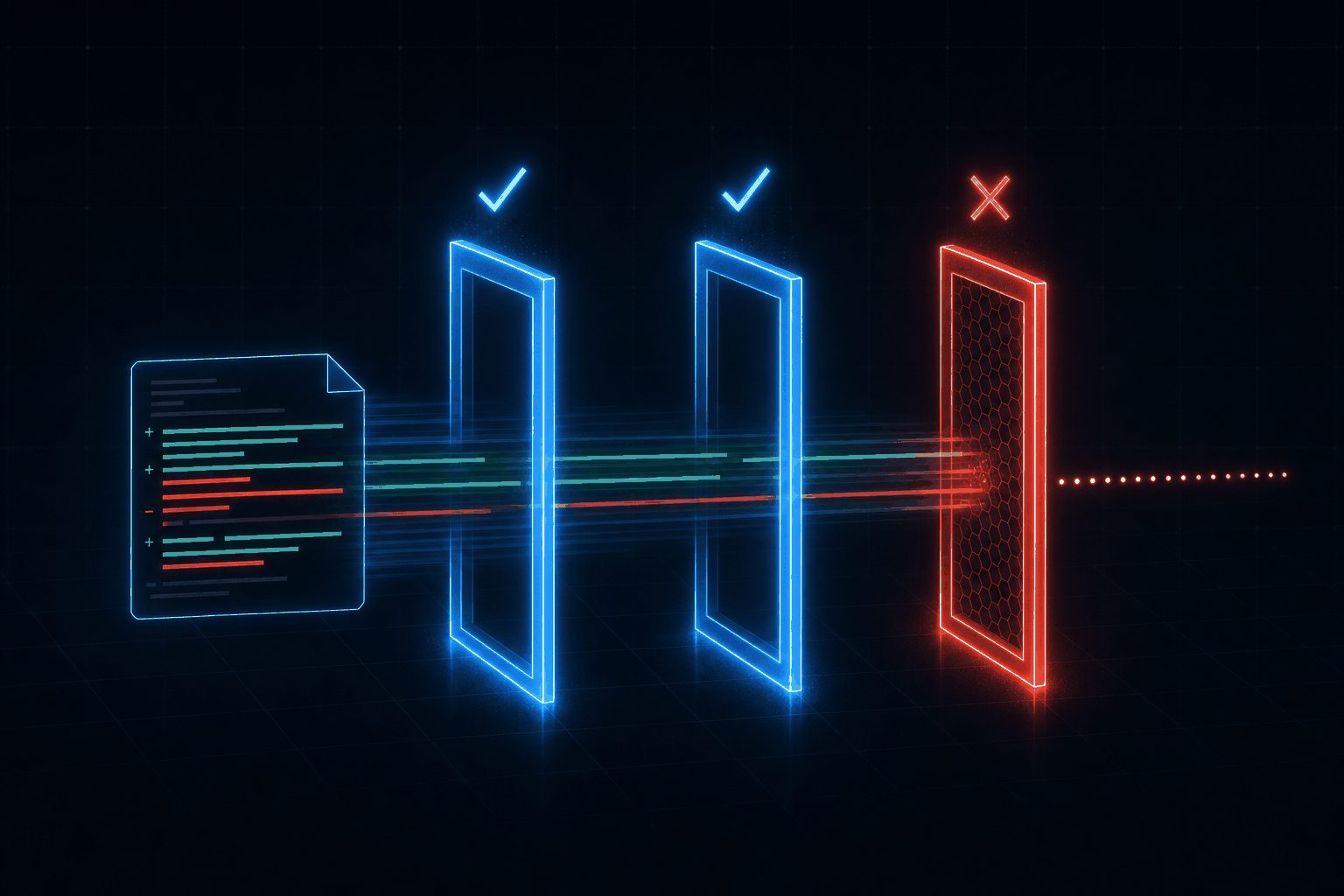
Most tools hide this table. Ours is one of the best marketing artifacts in the repo. The differentiator is that the gates are executable, not advisory, and the boundaries are explicit. scripts/quality_loop.py is a portable, stdlib-only checker. It complements CI, tests, scanners, and human review. It does not replace them.
| Enforced today | Not enforced by design, to stay portable |
|---|---|
| Non-trivial work, meaning medium/mission or any medium/high-risk or security-sensitive task, requires a named implementer, a real validation contract, an approving independent review by someone other than the implementer, and, at ship, a completion record with evidence. Required fields must be present and non-empty; bare booleans, empty strings, and nonexistent paths are rejected. It checks shape, not whether the content is substantive. A small low-risk task ships with handoff evidence, not a formal completion record. | run-evidence re-executes allowlisted commands but is not a sandbox. The trust model is repo-defined commands, same as CI. Commands not on the .quality-loop/allowed-commands allowlist are skipped and reported as not_allowed, not run. |
Reality layer. verify-gates --against-diff reads the real git diff and catches phantom completion, scope integrity, a diff-derived risk floor, bugfix-test co-presence, and stale review hashes. run-evidence re-executes recorded pass commands; --red-green replays a red_green command in a worktree at base and HEAD. Worktree unavailable means "not proven", never a silent pass. attest-review embeds the recomputed diff hash. |
Reviewer/implementer separation is compared as trimmed strings and fresh context is self-attested. attest-review plus --against-diff make review freshness checkable, but cannot prove the reviewer read the diff. |
| Detected-risk floor. The record goal, criteria, and plan are scanned for auth/authz, secrets, crypto, payments, migrations, destructive, concurrency, data-loss, PII, and infra boundaries. Any hit forces high-risk plus security-review gates regardless of the declared tier. | The detected-risk floor is a curated heuristic. It catches honest mis-tiering, not an agent deliberately phrasing around it. Deterministic policy hooks remain the backstop for anything you cannot afford an agent to get wrong. |
| UNDERSTAND is gated. Non-trivial work must carry a substantive context map with entry points or likely files plus callers or tests. | verify-gates without --against-diff reads the record, not the diff. It confirms recorded evidence is present and well-formed; --against-diff adds diff-grounded checks. diff-audit and CI remain the blocking layer. |
Every pass command carries a verifiable evidence handle and known class; a recorded minimality decision; and diff-audit flags secrets, including untracked files and test-weakening, dependency edits, migrations, and oversized diffs. diff-audit --staged covers the pre-commit diff; scan-text --stdin is a secret-scan-as-a-service for hook shims. |
The helper is not a hosted agent service. Authentication, model cost, and production rollout remain the caller's responsibility. |
| Repeated failure -> durable change. A recurring mistake must become a rule/test/hook/checklist/template, so a clean final record cannot bury a mistake corrected only in chat. | Host hooks are advisory unless the host or repo chooses to trust and enable them. Git hooks and CI are the portable backstop. |
Helper-integrity reporting. verify prints the sha256 of each helper module so a hook or CI can catch a locally modified gate script. Motivated by the gate-gaming incident. |
Helper-integrity is a report, not an enforcement action by itself — pair it with a CI check that compares against a known-good sha to make it blocking. |
The runtime entry points are verify (the umbrella: record gates + diff audit + evidence re-execution + AC coverage), verify-gates, verify-gates --against-diff, check-record, diff-audit, run-evidence, attest-review, render-prompt, and scan-text --stdin, pinned by evals. On Claude Code, the Stop hook runs the full verify umbrella (evidence re-execution included) at terminal statuses — fabricated pass rows no longer clear the local gate.
Reviewer heterogeneity. check-config now hard-fails when the implementer and fresh_reviewer resolve to the same model on medium+ tasks. Tool-using evaluator. The reviewer must execute tests and benchmarks when available, not just read the diff; the verdict records ran_checks: true|false. Communication-bridge rule. After the reviewer produces findings, the implementer filters them against the contract: in-scope findings become fix tasks, out-of-scope findings become follow-ups. This prevents review loops.
Install & use matrix
Pick your host. Full copy-paste files live in examples/; every path below is real.
| Host | Install | Invoke |
|---|---|---|
| Any host (auto-detect) | npx coding-quality-loop init |
follow the printed "Next steps" for your host |
| Claude Code (skill) | cp -r . .claude/skills/coding-quality-loop (project) or ~/.claude/skills/coding-quality-loop (user) |
claude "Use the coding-quality-loop skill to fix the failing test and open a PR." |
| Claude Code (instruction-only) | cp examples/claude-code/CLAUDE.md ./CLAUDE.md (or /init, then paste the loop) |
claude "Follow the Coding Quality Loop to fix the failing test." |
| Codex | npx coding-quality-loop init --host codex (ships AGENTS.md + hooks) or cp examples/codex/AGENTS.md ./AGENTS.md |
codex "Follow the Coding Quality Loop in AGENTS.md to fix the bug." |
| Droid (Factory) | cp examples/droid/.factory/droids/*.md .factory/droids/ (role droids) + skill in repo root |
droid exec "Follow the Coding Quality Loop in SKILL.md to fix the bug and summarize verification evidence." |
| Cursor — advisory rules only, no runtime | cp -r examples/cursor/.cursor ./.cursor |
in chat: @coding-quality-loop fix the retry bug with verification evidence |
| Pi — advisory rules only, no runtime | cp -r . ~/.agents/skills/coding-quality-loop (or in-repo .agents/skills/) |
/skill:coding-quality-loop implement the change with a contract and independent review |
| Standalone / custom | route each step from assets/quality-loop.config.example.json |
follow examples/standalone/ |
Cursor and Pi are no longer offered by the npm installer's host picker: they load the instructions but none of the hook runtime, so they get honest advisory-only labels instead of surface parity.
Provenance note: the
npxinstaller ships from thecoding-quality-loopnpm package (source:packages/npm/) with signed Sigstore provenance tying the tarball to a specific GitHub Actions build. It is a thin UX wrapper aroundscripts/install.py, so both paths land the exact same files. This repo is not yet on the agentskills.io Skills Hub;gh skill installworks once a maintainer publishes a release. See Release & pinning.
The matrix rows above are the full per-host install + invoke commands; copy-paste host files live in examples/.
Install host integrations into a project:
python3 scripts/install.py --host all
This copies the stdlib Quality Loop runtime scripts, host hook shims, .claude/settings.json, .codex/hooks.json, read-only reviewer agents, pre-commit config, and an example GitHub workflow with backups. Claude Code and Codex hooks remain advisory unless the host trusts/enables them; git hooks and CI are the portable backstop.
Release 1.6 adds first-class host wiring without making any host mandatory:
hosts/claude-code/settings.jsonwiresSessionStart,PreToolUse, andStopcommand hooks. Shims are stdlib Python and delegate to the core CLI..claude/agents/quality-loop-reviewer.mdand.claude/agents/quality-loop-security-reviewer.mdare read-only reviewer subagents sourced fromreferences/reviewer-checklists.md.hosts/codex/hooks.jsonuses Codex's current project hook schema. Codex still requires hook trust review in/hooks.hosts/git/install-git-hooks.pyandhosts/git/.pre-commit-config.yamlprovide the universal git backstop: stageddiff-auditblocks secrets/test weakening.action.ymlandhosts/github/quality-loop-example.ymlprovide CI wiring.scripts/install.pyinstalls host wiring idempotently and prints what is enforced vs advisory.
Config-based model routing — the model_routing section in quality-loop.config.json maps each model class to a real model per host. python3 scripts/quality_loop.py setup-models --host <host> applies it: it rewrites model: frontmatter for Claude Code (.claude/agents/*.md) and Droid (.factory/droids/*.md), or prints the Codex config.toml / Pi /model settings to apply. Multi-host topologies are first-class: an agents entry may pin a role to another harness ({"host": "codex", "class": "strong_reasoning"}), main_session declares where the implementer runs, and one setup-models run applies every host — print hosts (codex, pi) are labeled PRINT-ONLY — settings not applied or verified by CQL. Reviewer independence is enforced on the resolved model family across hosts (family field or well-known prefix; unknown ids skip; allow_same_family is the explicit escape hatch). Three pre-validated variants along the intelligence↔cost dial ship in assets/routing/. brief shows the active routing per host and flags drift on file hosts. Agent files ship with model: inherit so they are host-neutral at rest. Route reasoning effort at high: check-config rejects xhigh/max unless a model-class block sets "allow_overthink": true, because effort is per-step, not per-task endurance — above high, models overthink and overspend each step. See the model capability glossary (intelligence / taste / cost, the effort ceiling, and the escalation policy) and config-driven model setup.
One user's personal cross-CLI setup (an external harness that overrides CQL routing) is documented — labeled as exactly that — in docs/cross-cli-recipe.md.
A repo can opt into required edit-before-plan blocking in the canonical root config, quality-loop.config.json:
{"enforcement": "required"}
(.quality-loop/config.json still works as a fallback for one release, with a deprecation warning.)
Three adoption levels
- No install — paste the Minimal Drop-In Prompt or a host rule file. Zero scripts, zero config. Best for trying it on one task.
- Install — copy the skill folder so the agent pulls
references/,assets/, and the state-record schema on demand via progressive disclosure. Best for repeated use. - Orchestrated — adopt
assets/quality-loop.config.example.jsonand route each step to a role-based agent profile. Best for multi-agent or production setups.
What's in the box
A single Agent Skill package following the open Agent Skills specification: SKILL.md at the root plus optional sibling folders. Progressive disclosure is the core mechanism: the agent always sees the frontmatter name/description, loads the full SKILL.md when relevant, and pulls references/assets/scripts only when a step needs them.
coding-quality-loop/
├── SKILL.md            # the skill: when-to-use, lifecycle, task classes, roles, gates
├── assets/             # templates + schemas loaded on demand (contract, plan,
│                       #   completion record, progress, context map, record schema,
│                       #   config, per-role prompt cards)
├── references/         # deep-dive docs pulled only when needed (lifecycle, orchestration,
│                       #   reviewer checklists, tool contracts, philosophy,
│                       #   the memory contract, enforcement matrix)
├── examples/           # host-native copy-paste: claude-code, codex, droid, standalone,
│                       #   advisory rules for cursor/pi, a real walkthrough, + committed live evals
├── evals/              # offline eval cases + harness that prove the gates fire (repo only, not in the npm tarball)
├── scripts/            # quality_loop*.py — six stdlib-only modules, no third-party deps
│                       #   (quality_loop_control.py is the opt-in control-plane add-on)
└── .quality-loop/      # per-project lessons memory + runs/progress (git-diffable; grows as the agent learns)
Minimum tool surface: read, search, edit, shell, run tests, git diff / branch / commit / PR. Useful extensions include repo-map generator, AST search, browser automation, GitHub CLI, issue tracker, CI logs, Sentry/Datadog logs, read-only DB access, design docs, and MCP connectors. MCP only when context lives outside the repo, changes frequently, or should be repeatable via a tool. Suggested tool contracts are in references/tool-contracts.md.
Medium/high-risk and long-running work maintains a compact state record. Tiny tasks may omit it when the handoff still includes contract, evidence, and risks. Use assets/agent-record.schema.json as the canonical schema. The medium paper trail is four artifacts (eval-pinned): assets/contract.md, assets/plan.md, assets/completion-record.md, and assets/progress.md — plus assets/context-map.md for EXPLORE and assets/AGENTS.template.md for Codex installs. Decisions are recorded inline in progress bullets; commands live in the record's commands_run.
Optional helper commands
Helper script commands are advisory. They do not replace human review, tests, scanners, or CI.
python3 scripts/quality_loop.py verify agent-record.json --red-green      # primary: record gates + diff audit + evidence + AC coverage (--base defaults to the origin/main merge-base; --timeout for slow suites)
python3 scripts/quality_loop.py init-record --goal "Fix invoice total rounding" --risk-tier medium --output agent-record.json
python3 scripts/quality_loop.py check-record agent-record.json
python3 scripts/quality_loop.py diff-audit --base origin/main
python3 scripts/quality_loop.py diff-audit --staged
python3 scripts/quality_loop.py verify-gates agent-record.json
python3 scripts/quality_loop.py verify-gates agent-record.json --against-diff
python3 scripts/quality_loop.py attest-review review.json --base origin/main
python3 scripts/quality_loop.py run-evidence agent-record.json --red-green --base origin/main
python3 scripts/quality_loop.py render-prompt --role reviewer --record agent-record.json   # substituted reviewer prompt for a cross-CLI review leg
python3 scripts/quality_loop.py scan-text --stdin < suspicious-file.txt
python3 scripts/quality_loop.py brief
python3 scripts/quality_loop.py check-config assets/quality-loop.config.example.json
python3 scripts/quality_loop.py eval-cases evals/cases --config assets/quality-loop.config.example.json
python3 scripts/quality_loop.py control-index    # control-plane add-on only (installed via install.py --with-control-plane)
python3 scripts/quality_loop.py control-serve    # dashboard + JSON API on 127.0.0.1 (add-on)
diff-audit exits non-zero on warnings: possible secrets, dependency edits, migrations, large diffs/file counts. Treat it as a coarse guardrail, not a substitute for gitleaks/trufflehog on high-risk work.
Project memory
Most agents relearn the same lesson every session. The loop can keep a tiny per-project ledger of distilled lessons: failure modes, conventions like "no new dependencies here", and gotchas like "this module broke twice".
It is retrieval, not context stuffing: only a <=40-line index auto-loads, recall is budget-capped and scoped to the task goal and files, lessons are distilled rather than raw transcripts, secrets are redacted before they are written, and writes stay advisory. Memory adds no new gate.
# recall relevant prior lessons before mapping a change
python3 scripts/quality_loop.py memory-recall --goal "fix checkout retry" \
  --files src/payments/charge.py --risk high
# at retrospective, keep a lesson worth remembering
python3 scripts/quality_loop.py memory-commit agent-record.json
The default backend is stdlib-only and checked-in: .quality-loop/memory/, git-diffable and team-shared.
See references/memory.md for the memory contract.
Control plane
One local dashboard to monitor, observe, and learn what the agents are doing — every session, every model call with exact token counts, tool calls, token spend, routing, and every loop artifact (records, reviews, findings, minimality decisions, plans, escalations, delegations, memory). Shipped in v4.3.0; v5.1.0 ("Audit Trail") made the evidence first-class; since v6.0.0 it is an opt-in add-on: a default install copies and wires none of it — install it from a repo checkout with python3 scripts/install.py --with-control-plane (the npm tarball does not ship the control module).
python3 scripts/install.py --with-control-plane  # opt in (repo checkout only)
python3 scripts/quality_loop.py control-index    # SQLite index from transcripts + CQL artifacts
python3 scripts/quality_loop.py control-serve    # dashboard at http://127.0.0.1:4477/
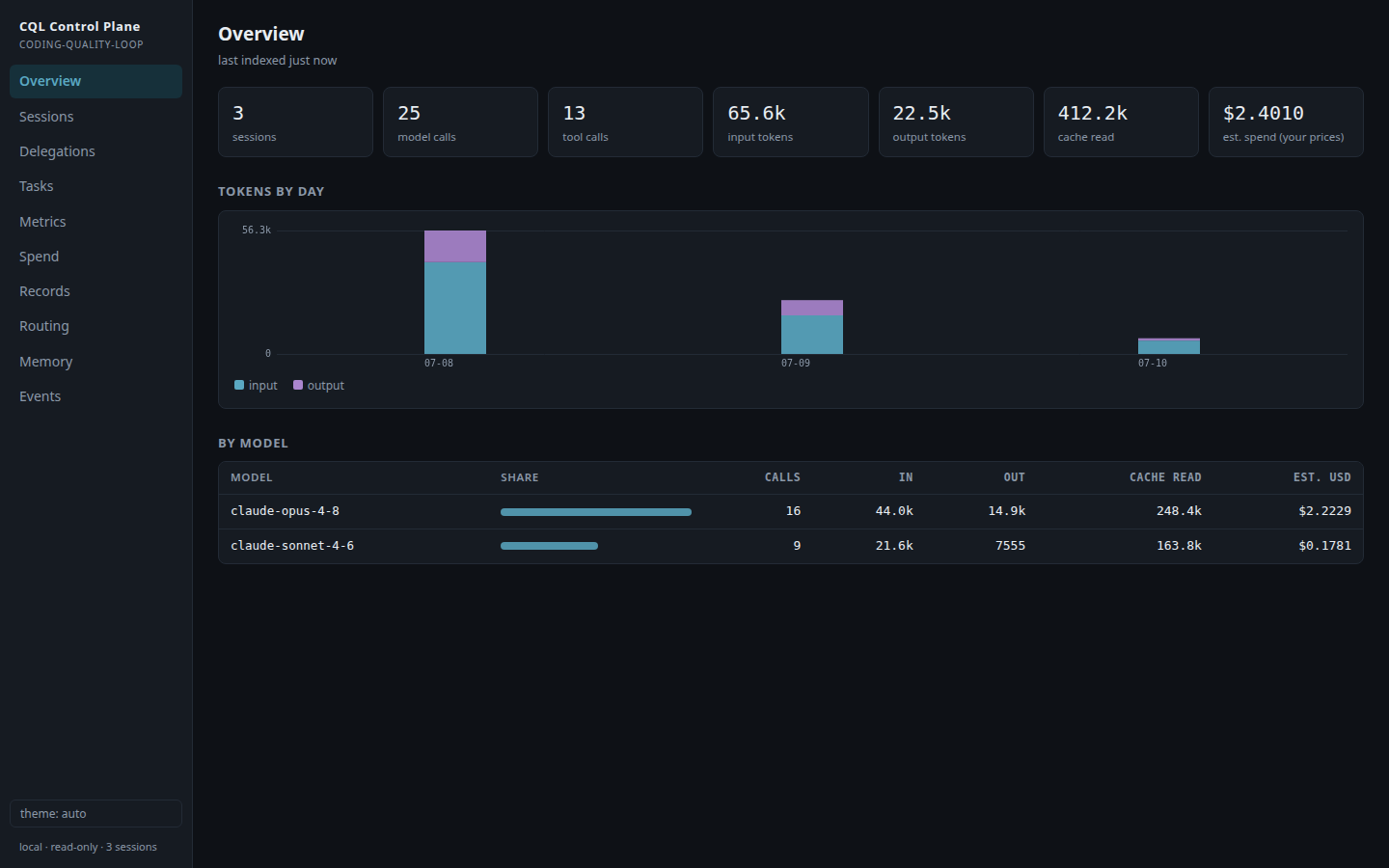
v5.1.0 audit trail. Delegation lineage is reconstructed at query time: the orchestrator appends one line per hand-off to .quality-loop/delegations.jsonl, and the index joins each to the role→session→tokens it actually ran in — nothing is stored as a join. Review findings are first-class, each carrying its own severity + text + reviewer, so the loop's most valuable proof is queryable, not just counted. A per-task audit timeline (/api/task, or the control-report --task-id CLI that prints the same bundle as markdown or JSON) ties findings, delegations, verdicts, minimality rung, and linked-session spend to the sessions that produced them. /api/metrics aggregates loop KPIs (evidence rate, escalations, repair attempts, verdict/severity/rung shares) live from the index. Tool-call targets are run through the memory redactor before storage, so a secret typed at the prompt becomes [REDACTED] even when it straddles the 200-char truncation. The revamped dashboard adds Delegations / Tasks / Metrics views alongside the existing ones.
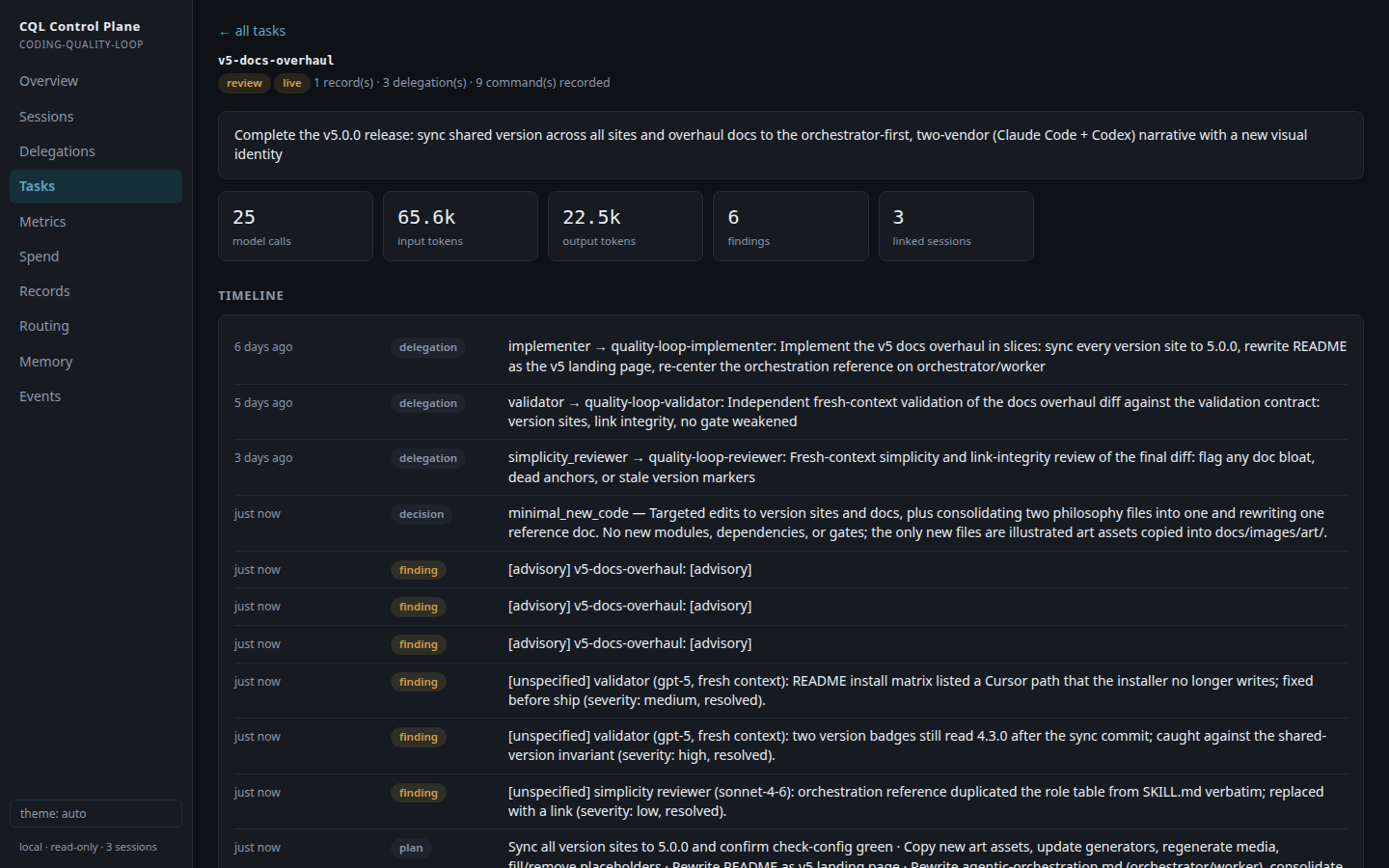
It is an index over evidence, never a gate: a disposable SQLite cache under .quality-loop/control/ (self-gitignored, excluded from attestation) rebuilt from sources of truth — host transcripts and loop artifacts. Local-only by construction: stdlib http.server hard-bound to 127.0.0.1, GET-only API, zero dependencies, no conversation bodies stored beyond a 160-char title line and truncated tool targets. Spend is reported in tokens; USD appears only if you supply your own control_plane.prices — no vendor price data ships. Opt-in hooks (control_plane.enabled) record session start/end and autostart the server; the ingest path always exits 0, so a broken observability plane can never break a session. 35 add-on cases pin the whole surface (kept out of the core gate-case headline because the add-on is not installed by default). See docs/control-plane.md.
Why agentic-first
One model grading its own work is the dominant failure mode. v5 answers it with the Orchestrator Layer: the main session reasons and decides; workers only execute against a one-screen brief. The default split stays small — one implementer on Claude Code + one independent reviewer on Codex (a different model family) + deterministic policy hooks. Add specialists (a dedicated context mapper, a security reviewer) only when risk justifies the coordination cost; over-parallelization is an anti-pattern. (Orchestration)
The reviewer being a different vendor than the implementer is the load-bearing part: check-config hard-fails a medium+ config where the implementer and reviewer resolve to the same model family, so "one model grading its own work" cannot happen by accident.
History: v3–v4 organized the loop around an advisor / Smart Friend pattern — a cheap executor that drove the loop and consulted a stronger model only at reasoning walls. v5 inverts it: the strong model orchestrates from the top and workers never consult upward. The older topology is retained as a note in
references/agentic-orchestration.md.
How it compares
Other strong skills make different bets, and they are worth your time: superpowers leans into subagent-driven TDD and a two-stage review; addyosmani/agent-skills ships a broad 24-skill SDLC suite; ponytail is a focused minimality ladder.
The Coding Quality Loop's bet is narrower: executable gates plus candor. It is one dependency-free package where the non-negotiables are checked by a script you can read and run, and where the README tells you exactly what the script does not check. It is positioned against two failure modes, not against other skills: instruction-only prompts that drift, and full autonomy that produces unreviewable diffs.
That bet matters more in 2026, not less, because the hosts have absorbed orchestration itself: Claude Code ships subagents, agent teams, and dynamic workflows natively, and the advisor pattern is an API primitive. Orchestration is now the host's job. What no host ships is the layer this package is: a harness-neutral evidence record with diff-grounded gates, enforced cross-vendor reviewer heterogeneity (the implementer and validator cannot resolve to the same model on medium+ — checked by check-config, not by trust), and an offline eval suite of the harness itself, so the process is regression-tested like code instead of drifting with each model release.
For a longer, per-feature comparison (with explicit non-goals and a migration path), see docs/comparison.md.
FAQ
Does this slow the agent down? Only where slowness buys trust. Ceremony scales with risk: a typo runs the smallest possible loop with no mission artifacts; the full loop is reserved for work whose blast radius justifies it.
Does it actually run my tests? No, and it says so. It checks that the evidence of a test run is present and well-formed, not that the run happened. Pair it with CI and real scanners; the loop makes the agent record proof, it does not be your test runner.
Is the independent review really independent? The checker enforces a distinct, named reviewer in fresh context who did not patch the code. Identity is string-compared and freshness is self-attested: strong as a discipline, not a cryptographic guarantee. For production, wire the reviewer to a genuinely separate session or model.
Do I need the Python helper? No. The loop works as pure instructions. The helper is an optional, stdlib-only accelerator for teams that want runnable record gates.
Will it work with my agent? If it loads SKILL.md or accepts a system prompt, yes. Claude Code, Codex, Droid, and standalone runtimes are covered with installable files; Cursor and Pi get advisory rules recipes (instructions without the hook runtime).
Does it remember across sessions? Optionally, yes. With project memory enabled, distilled lessons persist per-project and are recalled, budget-capped, at the start of the next task, so the agent stops relearning the same thing. It is advisory, stdlib-only by default, and redacts secrets before writing.
Philosophy
Bounded autonomy. Smallest correct change. Evidence over confidence. Calibrate to the model.
Eight defaults the loop encodes, not slogans:
- An engineering operating system, not a clever prompt — durable artifacts that outlive the session.
- Bounded autonomy is the product — the boundary is what makes the output trustable.
- Ship the smallest correct change — deletion, reuse, stdlib, native features before new code.
- Evidence over confidence — every acceptance criterion paired with the check that proves it.
- Deterministic gates over vibes — when a rule matters, a hook or check enforces it.
- Repo maps over context stuffing — a concise map beats reading the whole tree.
- Durable harness changes over repeated chat corrections — a fix becomes a rule, not a re-explanation.
- Calibrate to the model, not to a strength gradient — the scaffold–model interaction is model-specific: the same loop helps some models and hurts others, and the sign of the effect does not track raw model strength. Calibrate per model — skip ceremony where a given model is reliable solo on tiny/small, run full scaffolding where it is not, and pay for review only when the task exceeds what that model does reliably alone. The harness optimizes for code quality (the outcome), not artifact production.
Read the full manifesto: problem framing, trends, honestly-cited inspirations, and explicit non-goals, in references/philosophy.md.
Release & pinning
Treat skills like dependencies- Inspect before you install. Read
SKILL.mdandscripts/quality_loop.py— no hidden
network access, no build step; the helper is stdlib-only. - Pin for team use. Install from a tagged release or a pinned tree SHA, not a moving branch.
The packaged version is inSKILL.mdfrontmatter (metadata.version) andCHANGELOG.md. gh skillonce published. When a maintainer runsgh skill publish(validates against the
Agent Skills spec and writes repo/ref/tree-SHA provenance into the frontmatter), consumers cangh skill install <repo> --pin <tag|sha>. Until then, copy-to-folder is the supported install —
provenance is not hand-faked.- Skills Hub publish checklist. Before publishing to the
agentskills.io Skills Hub:- Bump
packages/npm/package.jsonand tag a release (git tag v6.0.0 && git push --tags). Thepublish npmworkflow will verify the tag matches, run a fullnpm pack+ tarball-install smoke, and publish with--provenance. - Verify
SKILL.mdfrontmatter hasname,description,license,compatibility,
andmetadata.versionmatchingCHANGELOG.md. - Run
python3 scripts/quality_loop.py check-config assets/quality-loop.config.example.json
and the full eval suite (all suites green: 20 static + 54 behavioral + 32 memory + 40 reality + 29 routing + 41 hook = 216 gate cases, plus 35 add-on cases for the control plane and the 10-case trigger smoke fixture). - Run
gh skill publishto validate against the Agent Skills spec and write provenance. - Confirm
gh skill install <repo> --pin <tag>works on a clean checkout.
- Bump
- Enforce the non-negotiables with hooks. Advisory text drifts; wire the
policy_guardrules
(secrets, destructive migrations, auth/billing, diff-size limits) as deterministic host hooks.
Portable, but aligned with how today's platforms load instructions and enforce policy:
- Claude Code memory — project/user/local
CLAUDE.md,.claude/rules/,/init. https://docs.anthropic.com/en/docs/claude-code/memory - Claude Code hooks —
PreToolUse/PostToolUse/Stophooks are the deterministicpolicy_guard. https://docs.anthropic.com/en/docs/claude-code/hooks - Codex
AGENTS.md— global, project, and nested overrides. https://developers.openai.com/codex/guides/agents-md - Codex skills —
SKILL.mddirectories with progressive disclosure. https://developers.openai.com/codex/skills - Cursor rules —
.cursor/rulesin.mdcformat. https://docs.cursor.com/en/context/rules - Pi skills — loaded from
~/.agents/skills/,.agents/skills/, etc. https://pi.dev/docs/latest/skills - Droid (Factory) custom droids —
.factory/droids/Markdown files withmodelfrontmatter;droid execfor headless runs. https://docs.factory.ai/cli/droid-exec/overview - Anthropic Agent Skills —
SKILL.mdfolders, progressive disclosure. https://www.anthropic.com/engineering/equipping-agents-for-the-real-world-with-agent-skills - Agent Skills specification — the open, cross-agent package shape this repo targets. https://agentskills.io/specification
The design also draws on Factory Missions (long work split into focused units with fresh agents and
validation contracts), the Aider repo map (concise maps beat context stuffing), the OpenAI
agent improvement loop (the harness is the unit of improvement), Cognition's multi-agent research
(single-threaded writes + clean-context intelligence, April 2026), and Anthropic's long-running
agent harness (progress file + incremental sessions, Nov 2025).
Community & contributing
- Docs index —
docs/has the quickstart, architecture, comparison, memory guide, and launch kit. - Contribute —
CONTRIBUTING.mdexplains the PR bar (a task contract, an independent reviewer, and green evals). - Roadmap —
ROADMAP.mdlists what is next, ordered by decreasing certainty. - Security —
SECURITY.mdcovers the private disclosure path. - Issues & discussions — file bugs, real-task failure reports, or ideas at github.com/zaingz/coding-quality-loop/issues.
- Share it — short-form copy for HN / Reddit / X / LinkedIn lives in
docs/launch-kit.md.
The best contribution, short of a PR, is using this on a real task and telling us where the docs lied, the gates missed something, or the ceremony felt wrong. Open an issue.
License
MIT — see LICENSE.
Star history
Yorumlar (0)
Yorum birakmak icin giris yap.
Yorum birakSonuc bulunamadi