htmlify
Health Uyari
- No license — Repository has no license file
- Description — Repository has a description
- Active repo — Last push 0 days ago
- Low visibility — Only 7 GitHub stars
Code Basarisiz
- process.env — Environment variable access in bin/htmlify-answer.js
- process.env — Environment variable access in hooks/claude-code-stop-htmlify.js
- child_process — Shell command execution capability in index.js
- exec() — Shell command execution in index.js
- process.env — Environment variable access in index.js
- process.env — Environment variable access in test/extension.test.js
Permissions Gecti
- Permissions — No dangerous permissions requested
Bu listing icin henuz AI raporu yok.
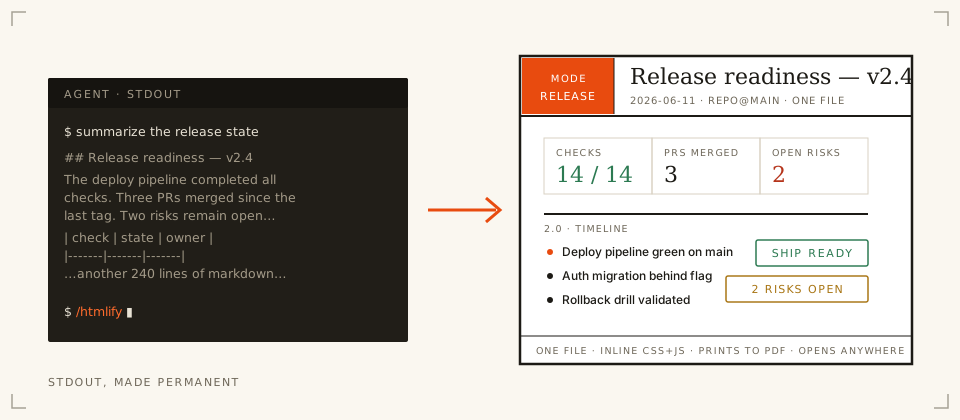
Turn agent answers into self-contained HTML artifacts — operator briefs, plans, review packets, incident timelines, and presentation decks. Zero dependencies, zero build, one file.
htmlify
Turn long agent answers into self-contained HTML artifacts people can scan, discuss, annotate, and ship.
What It Is
htmlify is both:
- a Pi / Oh My Pi extension for exporting long assistant replies as local HTML
- an agentskills.io-compatible skill for asking coding agents to produce useful single-file HTML briefs, maps, reviews, reports, explainers, and lightweight editors
It merges three ideas:
- Long answers should stay visible in the terminal until the user explicitly exports them.
- HTML beats markdown when the work is spatial, comparative, interactive, or meeting-facing.
- Operator artifacts should be evidence-first, visual, self-contained, and production-safe.
Skill Install
This repository root is a valid Agent Skill directory because it contains SKILL.md.
mkdir -p ~/.codex/skills
git clone https://github.com/zakelfassi/htmlify.git ~/.codex/skills/htmlify
For other clients that support the agentskills.io format, install or copy this folder into that client's skills directory. The required skill entrypoint is:
htmlify/SKILL.md
The skill uses progressive disclosure: SKILL.md is the activation surface, and references/htmlify-principles.md is loaded only when deeper artifact guidance is needed.
Coding Agent Integrations
htmlify can be used two ways across coding agents:
- Skill/manual mode: install the folder and invoke
htmlifywhen a response should become a browser-ready artifact. - Hook/automatic mode: configure the agent to write an HTML artifact when a final answer is longer than a threshold.
Codex local skill install:
mkdir -p ~/.codex/skills
git clone https://github.com/zakelfassi/htmlify.git ~/.codex/skills/htmlify
Claude Code skill install:
mkdir -p ~/.claude/skills
git clone https://github.com/zakelfassi/htmlify.git ~/.claude/skills/htmlify
Claude Code optional Stop hook:
{
  "hooks": {
    "Stop": [
      {
        "hooks": [
          {
            "type": "command",
            "command": "node /Users/zakelfassi/.claude/skills/htmlify/hooks/claude-code-stop-htmlify.js",
            "timeout": 30
          }
        ]
      }
    ]
  }
}
The Claude hook reads last_assistant_message from the Stop event and writes an HTML artifact when it is at least HTMLIFY_MIN_CHARS characters. Default threshold is 2500.
For Cursor, Windsurf, Aider, and other agents, point the agent at SKILL.md or use the bundled CLI:
printf '%s' "$LONG_ANSWER_TEXT" | npx @zakelfassi/htmlify htmlify-answer --title "Agent Answer"
See references/agent-integrations.md for project-level rules, hook safety, and per-agent recipes.
Extension Install
Native Pi npm install:
pi install npm:@zakelfassi/htmlify
Native Pi git install:
pi install git:https://github.com/zakelfassi/htmlify.git
Oh My Pi / OMP global install:
mkdir -p ~/.omp/agent/extensions
git clone https://github.com/zakelfassi/htmlify.git ~/.omp/agent/extensions/htmlify
Then ask for a long answer and run:
/htmlify-version
/htmlify local
Legacy command aliases remain available: /html-last, /html-last-version, and /html-comments.
Render Modes

| Mode | What it does | Best for |
|---|---|---|
local |
Fast local render with a designed shell, outline rail, excerpt hero, and clickable links | Speed and reliability |
pi |
Uses the current Pi model for a richer second-pass HTML render | Staying in the current session/model context |
gemini |
Uses Gemini CLI for a richer external render; falls back to local HTML if valid HTML is not returned | Maximum polish when Gemini is available |
Commands
| Command | Result |
|---|---|
/htmlify |
Opens quick local HTML without starting a Pi model turn |
/htmlify choose |
Opens a render-mode chooser |
/htmlify local |
Forces quick local HTML |
/htmlify pi |
Forces designed HTML via the current Pi model |
/htmlify gemini |
Forces designed HTML via Gemini CLI |
/htmlify-version |
Shows the loaded extension version |
/htmlify-comments <comments.json> |
Imports downloaded HTML review comments and sends them back to the current agent |
Runtime Behavior

- Long answers are detected from message length, line count, or paragraph count.
- Long answers are captured into session state so export commands can work after the answer finishes.
- Local and designed exports open automatically in the browser after the file is written.
- Exports include a trusted local annotation layer: highlight text, add comments, copy Markdown for the agent, or download a comments JSON bundle.
- Rich Pi/Gemini renders must be standalone HTML documents with inline CSS only.
- Rich HTML is validated before writing: scripts, event-handler attributes,
javascript:URLs, external assets, external CSS URLs, unsafe tags, oversized output, and overly complex output are rejected or routed to fallback behavior.
Repo Layout
htmlify/
├── .github/workflows/ci.yml
├── assets/
├── bin/
│   └── htmlify-answer.js
├── hooks/
│   └── claude-code-stop-htmlify.js
├── references/
│   ├── agent-integrations.md
│   └── htmlify-principles.md
├── test/
│   └── extension.test.js
├── index.js
├── package.json
├── pnpm-lock.yaml
├── README.md
└── SKILL.md
Development
Use PNPM:
pnpm install
pnpm test
If you modify the runtime, re-test these flows:
- long answer -> answer remains visible; no automatic replacement notice appears
/htmlify-> local HTML writes and opens without starting a Pi model turn/htmlify choose-> chooser appears when supported/htmlify pi-> second-pass render path queues/runs and validates rich HTML/htmlify gemini-> Gemini render path succeeds or cleanly falls back/htmlify-comments <comments.json>-> browser comments validate and queue a structured review prompt/htmlify-version-> version shown in-session
Publishing
The unscoped npm name htmlify is already taken. Publish this package under the scoped name:
NPM_CONFIG_CACHE=/private/tmp/htmlify-npm-cache npm publish --access public
Trust And Security
Extensions run with your user permissions. Only install from sources you trust, review the source before installing, and pin a git ref or tag when you need reproducible behavior.
Rich HTML generated by Pi or Gemini is treated as untrusted until it passes validation. The validator is intentionally conservative: if rich output includes active scripts, event handlers, external assets, or unsafe URLs, htmlify falls back to local HTML rather than writing the rich document.
Yorumlar (0)
Yorum birakmak icin giris yap.
Yorum birakSonuc bulunamadi