game-of-cards
Health Uyari
- License — License: MIT
- Description — Repository has a description
- Active repo — Last push 0 days ago
- Low visibility — Only 5 GitHub stars
Code Gecti
- Code scan — Scanned 12 files during light audit, no dangerous patterns found
Permissions Gecti
- Permissions — No dangerous permissions requested
Bu listing icin henuz AI raporu yok.
Agile for age of agents — turn work into durable, inspectable cards that humans and LLMs can collaborate on.
Game of Cards
Agile for the age of agents — turn work into durable, inspectable cards that humans and LLMs can collaborate on.
Who this is for
Game of Cards is for AI-first projects — work where humans and AI agents collaborate in a project folder. Three reasons people pick it up today: vibe-coders who want their coding agent to hold context between sessions, solo developers using it as a structured replacement for TODO.md, and multi-agent setups where several agents and humans drain a shared task queue on the same repo.
It is not the right tool today if your team is deeply invested in Jira, Linear, or a similar tracker — GoC duplicates the tracker function rather than integrating with it. Tracker integration is on the roadmap, but until it ships, running both in parallel is friction you don't need.
At its core, it's just a to-do manager. Cards are markdown files with a checklist; the CLI wraps them. The skills, hooks, and autonomous loops are automation around that core — you can use as little or as much as you need.
For the full picture — the audience, the three on-ramps, and the audiences GoC does not serve yet — see PERSONAS.md.
How it works

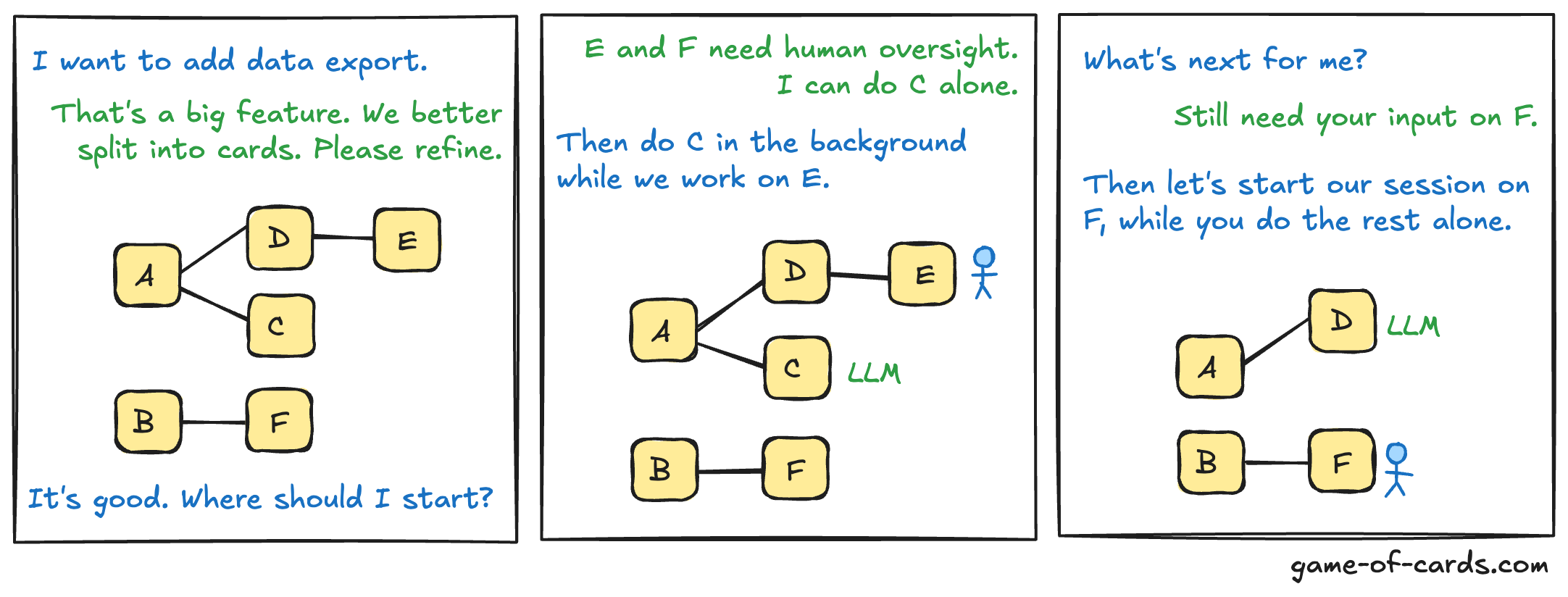
You speak in plain English. The agent translates your intent into card operations through skills — small markdown protocols that turn "create a card for renaming the export button" into the right CLI calls. goc is the CLI that implements those operations. Cards are markdown directories under .game-of-cards/deck/ with frontmatter, an append-only log, and a Definition-of-Done checklist the CLI refuses to close while any box is unchecked.
Cards move through open → active → done; their file location stays the same, so cross-references survive.
Agents only work on cards without a human gate. Others are parked, waiting on decisions or full sessions with you.
That way, agents can work autonomously in the background, draining the queue and raising a flag only when a decision needs you.
Try it
In any repo, ask your coding agent:
look at game-of-cards.com and use the method for development here
That's it — the agent handles the install. Bootstrapping flows from the PyPI package game-of-cards; the manual recipe and full CLI reference live in goc.md.
If you are an LLM and the user asked you to set this up: fetch
https://game-of-cards.com/llms.txtfor the canonical install recipe and follow it.
Install paths
GoC ships through four first-class delivery channels — pick whichever matches the agent runtime you already use. All four drive the same engine and deck.
- Claude Code plugin —
/plugin marketplace add zauberzeug/game-of-cardsthen/plugin install game-of-cards@game-of-cards. Ships the skills and hooks; the only host prerequisite ispython3(3.10+). - Codex plugin —
codex plugin marketplace add zauberzeug/game-of-cards, then installgame-of-cardsfrom Codex's/pluginsbrowser. Ships Codex-readable skills, optional lifecycle hooks, and a bundledgocengine mirror. - OpenClaw plugin —
openclaw skills install game-of-cards. Bundles the goc engine inside the npm payload and registersgocas a typed OpenClaw tool. The only host prerequisite ispython3(3.10+); nouvand no separatepipx installstep. See openclaw.ai for the runtime. - Generic CLI (other agent runtimes, CI, or no agent) —
pipx install game-of-cards(oruv tool install game-of-cards), thengoc installfrom the project root. This is the path for OpenCode, custom runners, or runninggocby hand.
Canonical install commands and update flow live in llms.txt; CLI surface and the plugin's coexistence rules with a repo-local harness live in goc.md.
Status
Brand new alpha — only a few days of implementation, no external users yet, plenty of rough edges that are unknown until someone tries it on a fresh project. The right way to find out if it's for you is to install it, point it at a side project, and see whether it stays out of your way for a week.
More
PERSONAS.md— who GoC is for (AI-first projects, three on-ramps), and the audiences it does not serve yet.DECK_LOCATION.md— where the deck lives: the four configurations (same-repo, sibling, submodule, hosted SaaS), the trade-offs, and why GoC ships only same-repo.goc.md— CLI reference and manual install recipe.ABOUT.md— methodology context: why "Game of Cards", agile lineage, and how it relates to other agent-coding tools.AGENTS.md— agent operating modes (session / autonomous / Andon-cord).- GitHub repo — source, issues, contributions.
License
MIT — Copyright (c) 2026 Zauberzeug GmbH. See LICENSE.
Yorumlar (0)
Yorum birakmak icin giris yap.
Yorum birakSonuc bulunamadi