Bridge
Health Uyari
- License — License: MIT
- Description — Repository has a description
- Active repo — Last push 0 days ago
- Low visibility — Only 5 GitHub stars
Code Basarisiz
- os.homedir — User home directory access in credential-resolver/src/resolver.ts
Permissions Gecti
- Permissions — No dangerous permissions requested
Bu listing icin henuz AI raporu yok.
MCP server that gates mainframe z/OS changes behind spec and plan approval
Zcrafter Bridge
Give AI Agents real access to your mainframe and keep it from changing anything you haven't approved.
What's an MCP server?
MCP is how AI Agents talks to outside systems. An MCP server hands AI a set of tools it can call. Bridge is an MCP server whose tools are your mainframe - datasets, members, z/OS UNIX files, jobs, spool, TSO and the operator console, with an approval gate in front of anything that changes the system.
Install it once, point Claude Code/Codex at it, then just talk to Claude.
Setup
Before you start
- Python 3.11+ and Node.js 20+
- Claude Code — install guide
- A working Zowe CLI profile. Test it:
zowe zosmf check status. If that fails, fix Zowe first — Bridge reads the same profile.
1. Get the code
git clone https://github.com/ZcrafterAI/Bridge.git
cd Bridge
2. Install
python -m venv .venv
source .venv/bin/activate          # Windows: .venv\Scripts\activate
pip install -r requirements.txt

cd credential-resolver && npm install && npm run build && cd ..
The credential resolver reads your mainframe password from your OS keychain at run time. No password is stored in this repo.
3. Check it starts
python -m mainframe_workflow_mcp.server
It should start and wait silently. Press Ctrl+C. Errors? See Troubleshooting.
4. Connect Claude Code
From inside the Bridge folder:
claude mcp add mainframe-workflow -- "$(pwd)/.venv/bin/python" -m mainframe_workflow_mcp.server
Windows: use .venv\Scripts\python.exe.
Verify with claude mcp list — you want mainframe-workflow: ✔ Connected.
5. Install the skill
mkdir -p ~/.claude/skills
cp -r .claude/skills/mainframe-workflow ~/.claude/skills/
How the gate works
Reading is free. Listing datasets, reading members, checking jobs, searching spool — no approval needed.
Changing anything is gated. Before an agent can write a member, submit a job, run a command or delete a dataset, it must:
- Open a request
- Write a spec (what changes and why) and get your yes
- Write a plan that lists every change as a step, and get your yes
Only you can say yes. The agent can ask for an approval. It cannot give one. Bridge asks you directly, outside the agent's reach:
- in your AI client's own prompt, when the client has one, or
- on a page Bridge opens in your browser, on your machine only, or
- in a terminal, with
python -m mainframe_workflow_mcp.approve, on a machine with no browser.
The page's address carries a one-time token the agent never sees, so an agent that can browse still cannot press Approve.
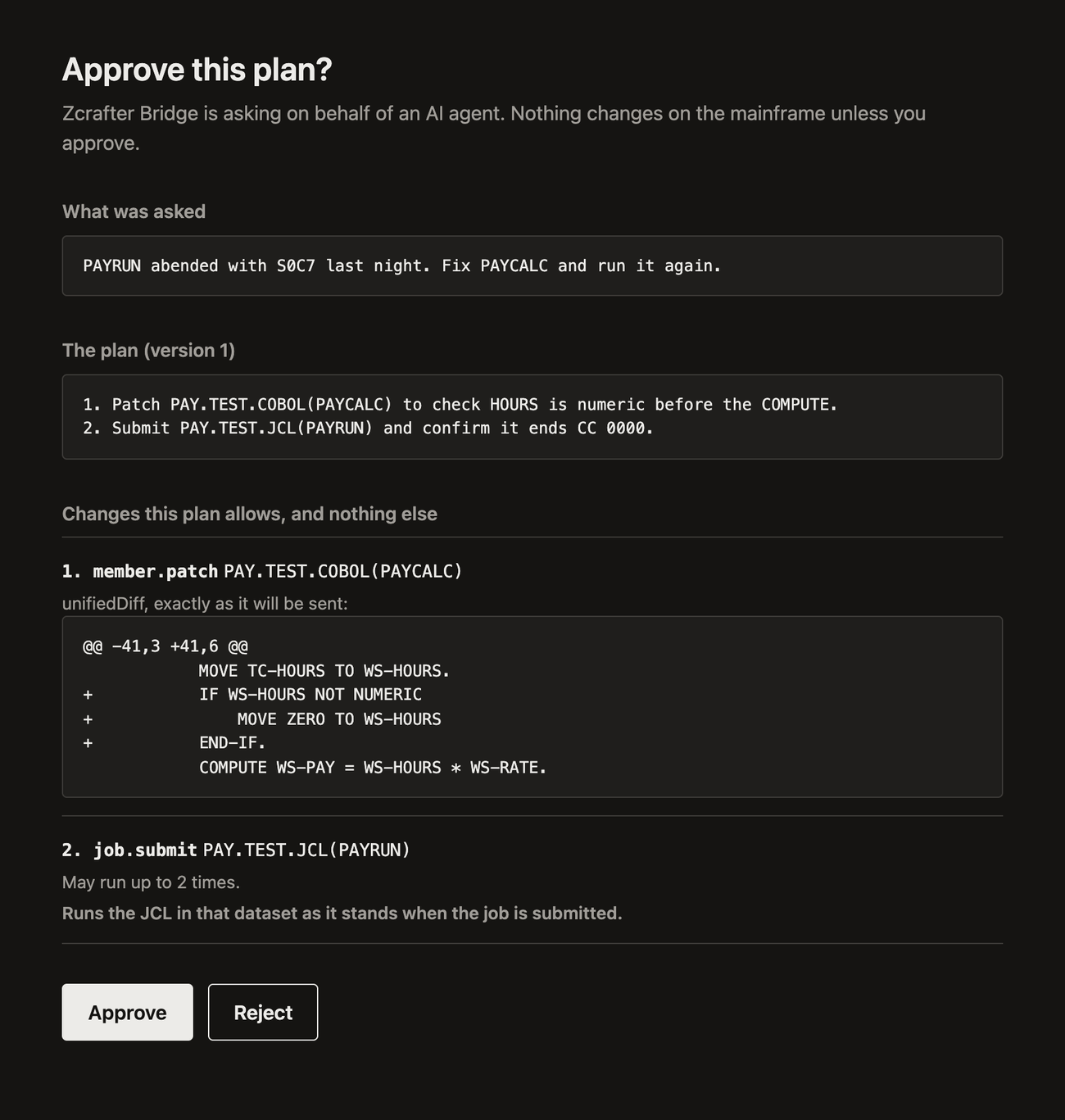
Your yes covers the listed steps and nothing else. Each step names one tool and its target, for example member.write on PAY.TEST.COBOL(PAYCALC). After approval a change runs only if it matches a step, and each step runs once unless the plan says more. A command step fixes the exact command. A step can also fix the exact content, diff or JCL, and then that is what must be sent.
| The agent tries | It gets |
|---|---|
| A change before you approved | PLAN_NOT_APPROVED |
| To approve its own plan | WAITING_FOR_PERSON, and you get asked |
| A change the plan did not list | STEP_NOT_IN_PLAN |
| A change to a protected dataset | PROTECTED_DATASET |
Editing the spec after approval un-approves the plan too. Every change is logged with its inputs; passwords are redacted, diffs are hashed.
Tools
48 tools. The ones in italics change the system, so they need an approved plan step.
| Datasets | list, info, read, write, create, create like, delete, rename, copy, recall, migrate |
| Members | list, read, search, write, patch, delete, rename |
| z/OS UNIX files | list, read, write, create, delete, rename, chmod |
| Jobs | list, status, steps, failed jobs, wait, JCL, spool, output, submit, cancel, purge, hold, release, change class |
| TSO | tso.query for read-only commands (LISTCAT, LISTDS, LISTUSER...), tso.command for anything else |
| Operator console | console.command |
| System | list systems, verify connection, list profiles, search the tool catalog |
job.steps shows which step of a job failed, and job.failed lists the jobs that ended badly, so an agent can start from the failure instead of reading every log.
Large reads (member.read, dataset.read, job.output, job.spool.read) accept searchText, maxLines and regex — so Claude finds one line in a 40,000-line job log instead of pulling the whole thing into context.
Configuration
Copy .env.example to .env to change defaults.
| Variable | Default | |
|---|---|---|
MAINFRAME_WORKFLOW_ZOWE_PROFILE |
default |
Which Zowe profile to use |
MAINFRAME_WORKFLOW_DB_PATH |
./mainframe_workflow_mcp/state.db |
Where requests are stored |
MAINFRAME_WORKFLOW_IDLE_DAYS |
14 |
Abandon untouched requests after |
MAINFRAME_WORKFLOW_RETENTION_DAYS |
90 |
Archive finished requests after |
MAINFRAME_WORKFLOW_APIML_BASE_PATH |
— | Set if z/OSMF is behind API ML |
MAINFRAME_WORKFLOW_APPROVAL |
auto |
How you approve: auto (your AI client's prompt, else a browser page), prompt, browser, terminal |
MAINFRAME_WORKFLOW_APPROVAL_WAIT_SECONDS |
60 |
How long one approval call waits for you before telling the agent to ask again |
MAINFRAME_WORKFLOW_READ_ONLY |
false |
true offers no tool that changes anything |
MAINFRAME_WORKFLOW_PROTECTED_DATASETS |
— | Patterns the dataset and member tools may never write to, e.g. SYS1.**,*.PROD.** |
MAINFRAME_WORKFLOW_TSO_ACCOUNT |
ACCT |
TSO account number, used on z/OSMF without the one-request TSO interface |
MAINFRAME_WORKFLOW_APPROVAL=unsafe-agent turns the person off: the agent's own call counts as approval. It exists for automated runs against throwaway systems. Do not use it on a mainframe you care about.
Troubleshooting
Zowe config not found — Bridge reads ~/.zowe/zowe.config.json. Run zowe config list to confirm you have one.
z/OSMF profile "default" not found — your profile has another name. Run zowe config list profiles, then set MAINFRAME_WORKFLOW_ZOWE_PROFILE in .env.
Resolved profile is missing host/user/password — credentials aren't in your OS vault. Re-run zowe config secure.
Claude says a tool isn't allowed — approve it when prompted, or check claude mcp list.
The agent says an approval is waiting but nothing opened — the address is printed in the server's log (stderr), or run python -m mainframe_workflow_mcp.approve in a terminal.
STEP_NOT_IN_PLAN — the agent tried a change you did not approve. It has to write a new plan revision that lists it and ask you again.
tso.command or console.command answers 401 or 403 — your user ID needs TSO or EMCS console authority on the mainframe. Bridge cannot grant it.
Development
pip install -r requirements-dev.txt
pytest                                    # 167 tests
cd credential-resolver && npm test        # 8 tests
Architecture notes: docs/architecture.md. The tool catalog lives in mainframe_workflow_mcp/toolbox/ and the z/OSMF calls in mainframe_workflow_mcp/clients/.
MIT licensed. Contributions welcome — see CONTRIBUTING.md.
Yorumlar (0)
Yorum birakmak icin giris yap.
Yorum birakSonuc bulunamadi