dotnet-pilot
Health Uyari
- License — License: MIT
- Description — Repository has a description
- Active repo — Last push 0 days ago
- Low visibility — Only 5 GitHub stars
Code Basarisiz
- exec() — Shell command execution in hooks/__tests__/check-consistency.js
- fs module — File system access in hooks/__tests__/check-consistency.js
- child_process — Shell command execution capability in hooks/__tests__/run.js
- spawnSync — Synchronous process spawning in hooks/__tests__/run.js
- rm -rf — Recursive force deletion command in hooks/__tests__/run.js
- fs.rmSync — Destructive file system operation in hooks/__tests__/run.js
- process.env — Environment variable access in hooks/__tests__/run.js
- fs module — File system access in hooks/__tests__/run.js
- fs module — File system access in hooks/_lib/build-state.js
- os.homedir — User home directory access in hooks/_lib/config.js
- fs module — File system access in hooks/_lib/config.js
- fs module — File system access in hooks/_lib/dotnet.js
- fs.rmSync — Destructive file system operation in hooks/_lib/json-file.js
- fs module — File system access in hooks/_lib/json-file.js
Permissions Gecti
- Permissions — No dangerous permissions requested
Bu listing icin henuz AI raporu yok.
.NET development assistant for - Roslyn-backed DI verification, EF Core migration safety, clean-architecture enforcement, convention-aware scaffolders, and project lifecycle commands.
🚀 DotnetPilot
A .NET development assistant plugin for Claude Code
Roslyn-backed DI verification · EF Core migration safety · Clean-architecture enforcement · Convention-aware scaffolders




16 commands · 9 specialized agents · 15 skill packs · 16 Roslyn MCP tools
Quick Install
/plugin marketplace add zdanovichnick/dotnet-pilot
/plugin install dotnet-pilot@dotnet-pilot-marketplace
/reload-plugins
dotnet tool install -g DotnetPilot.Mcp.Roslyn   # first install
dotnet tool update  -g DotnetPilot.Mcp.Roslyn   # update to latest
Strongly recommended — enable auto-update (one-time setup). GitHub-sourced marketplaces have auto-update disabled by default; without this step you'll have to update manually each release. Add to ~/.claude/settings.json:
{
  "extraKnownMarketplaces": {
    "dotnet-pilot-marketplace": { "autoUpdate": true }
  }
}
That's it. Open Claude Code in your .sln / .slnx directory and run /dotnet-pilot:utility:help.
Why DotnetPilot?
AI coding tools make these .NET mistakes constantly — DotnetPilot fixes them at the source:
| Without DotnetPilot | With DotnetPilot |
|---|---|
| Creates services, forgets DI registration | dnp-di-wiring-checker catches it immediately |
| Manually edits EF migration files (breaks the chain) | add-migration always uses dotnet ef migrations add |
| Puts domain models in the wrong project layer | dnp-architect enforces clean architecture in real time |
Skips dotnet build verification |
Build hook verifies after every scaffold |
| Ignores existing patterns in your codebase | Every scaffolder reads your conventions before writing code |
📦 Installation
Step 1 — Install the plugin
/plugin marketplace add zdanovichnick/dotnet-pilot
/plugin install dotnet-pilot@dotnet-pilot-marketplace
/reload-plugins
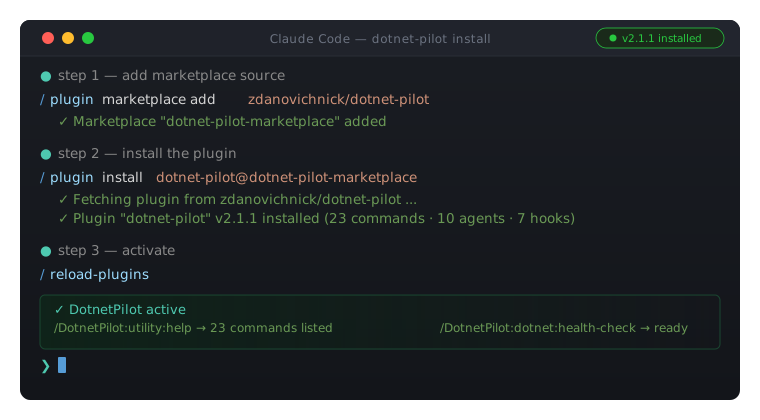
Verify it worked:
/dotnet-pilot:utility:help            → should list 16 commands
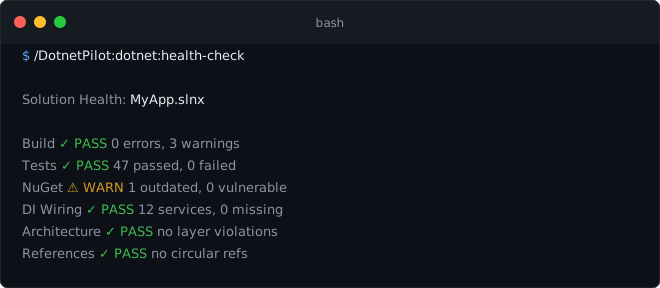
/dotnet-pilot:dotnet:health-check     → validates build, tests, DI, architecture
Keeping it up to date.
Easiest: Open the plugin manager (/plugin → Installed tab → dotnet-pilot) and click "Update now". Then /reload-plugins to activate.
CLI alternative:
/plugin marketplace update dotnet-pilot-marketplace
/reload-plugins
Auto-update (GitHub-sourced marketplaces disable it by default). Enable once via the /plugin UI (Marketplaces tab → dotnet-pilot-marketplace → Enable auto-update), or persist it in .claude/settings.json:
{
  "extraKnownMarketplaces": {
    "dotnet-pilot-marketplace": { "autoUpdate": true }
  }
}
Once the plugin lands in
claude-plugins-official, the install collapses to/plugin install dotnet-pilot— auto-update on by default.
Alternative: install from a local clone
Use this when you cloned the repo and want to run your own build, or contribute changes.
# Windows  (type in Claude Code chat)
/plugin marketplace add C:\path\to\dotnet-pilot

# macOS / Linux
/plugin marketplace add /path/to/dotnet-pilot
Then activate:
/plugin install dotnet-pilot@dotnet-pilot-marketplace
/reload-plugins
Session-only (plugin active only while this Claude Code process is running):
# Windows
claude --plugin-dir "C:\path\to\dotnet-pilot"

# macOS / Linux
claude --plugin-dir "/path/to/dotnet-pilot"
After editing plugin source (commands, agents, hooks), run
/reload-pluginsto pick up changes without restarting.
Step 2 — Install the Roslyn MCP server
dotnet tool install -g DotnetPilot.Mcp.Roslyn   # first install
dotnet tool update  -g DotnetPilot.Mcp.Roslyn   # update to the latest release
The plugin's .mcp.json auto-starts dnp-roslyn when Claude Code loads. It requires a .sln or .slnx file in your working directory.
Step 3 — Enable Context7 (recommended)
In Claude Code, enable the Context7 MCP server at the account level — agents use it for live NuGet / ASP.NET Core / EF Core documentation.
Step 4 — Verify
/dotnet-pilot:utility:help            → should list 16 commands
/dotnet-pilot:dotnet:health-check     → validates build, tests, DI, architecture
⚡ Quick Start
Initialize your project (once per solution)
/dotnet-pilot:project:init
Scans your solution, detects architecture style / test framework / EF contexts, and writes config.json plus solution-map.json into a user-scoped .planning/ directory — nothing lands in the repo.
Create a full entity in one command
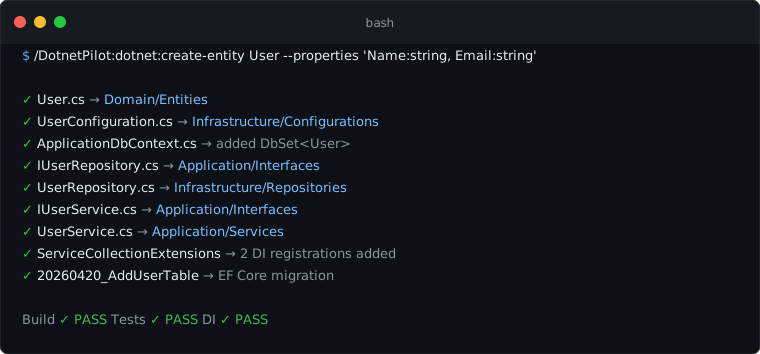
Or go even faster with the shorthand
/dotnet-pilot:dotnet:create-entity Category --properties 'Name:string, SortOrder:int'
/dotnet-pilot:dotnet:scaffold api Category
/dotnet-pilot:dotnet:add-migration AddCategoryTable
🗺️ Architecture
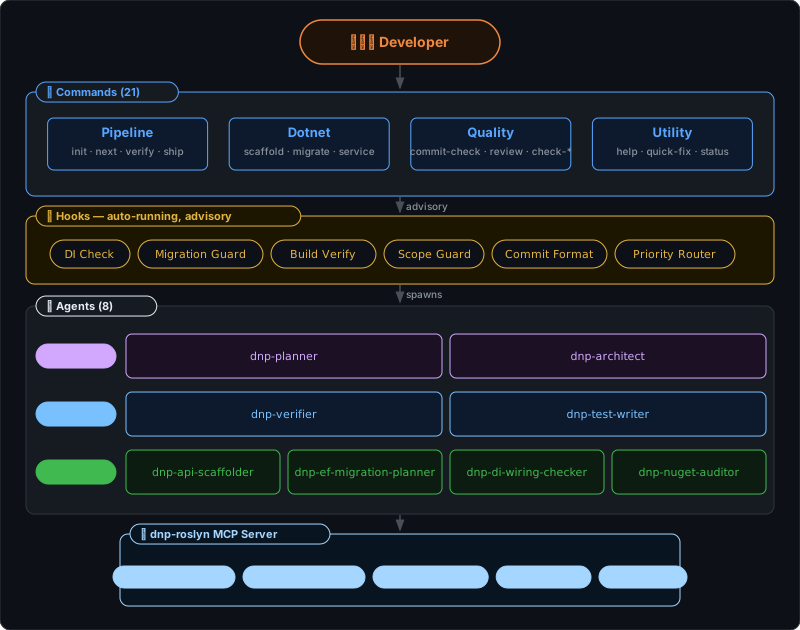
Flow: Developer invokes a /dotnet-pilot:* command → the command spawns the right agent → the agent calls the Roslyn MCP server for semantic C# analysis (DI completeness, architecture violations, EF Core models, symbol references). Hooks run automatically on file writes and git events, feeding advisory feedback back to the command layer — they never block by default.
v2.0.0 breaking change: Commands were renamed for clarity.
pipeline:*→project:*,scaffold-*→create-*,audit-*→check-*, and several others. See the tables below for full mapping.v3.0.0 breaking change: 13 commands and 6 agents were removed or folded into survivors.
/dotnet-pilot:utility:helpprints a "Did you mean" table mapping every old command name to its replacement;CHANGELOG.mdhas the full list.
📋 Commands
Project — project lifecycle
| Command | Usage | What it does |
|---|---|---|
project:init |
/dotnet-pilot:project:init [--refresh] |
Initialize for a .NET solution — discover projects, write the user-scoped .planning/ (config.json, solution-map.json) |
project:verify |
/dotnet-pilot:project:verify [--quick] |
Verify readiness before shipping — build, tests, DI completeness, architecture check. --quick is the pre-commit form: adds the format check, downgrades DI/architecture to warnings |
project:ship |
/dotnet-pilot:project:ship [--draft] |
Create a pull request for completed work — runs final checks and invokes gh pr create |
Dotnet — scaffolding & solution management
| Command | Usage | What it does |
|---|---|---|
dotnet:scaffold |
scaffold [feature|api|service|project] <Name> [--arch vsa|clean|ddd] |
Detect the solution's architecture via Roslyn, then scaffold a feature (default), an API surface over an entity (--minimal for minimal APIs), a service with interface + DI registration (--lifetime), or a new project (--type) |
dotnet:create-entity |
create-entity <name> [--properties '...'] |
Create a full entity stack: entity class, EF configuration, repository, service, and DI registration, then hand off to dotnet:add-migration for the migration |
dotnet:add-endpoint |
add-endpoint <controller> <method> <route> [--with-dto] |
Add an endpoint to an existing controller or endpoint group |
dotnet:add-migration |
add-migration <name> [--context <Name>] |
Generate an EF Core migration safely — checks for pending migrations, runs migrations add with --context, has dnp-ef-migration-planner inspect the generated Up() and removes the migration if it is destructive, then builds and emits an idempotent migrations script for review |
dotnet:tdd |
tdd <task> [--complexity easy|hard] [--existing <target>] |
Implement a feature using TDD — failing tests first, then production code. --existing adds tests to a class, file, or project that already exists without touching production code |
dotnet:run-tests |
run-tests [project] [--coverage] [--filter ...] |
Run tests with coverage reporting and failure diagnosis |
dotnet:health-check |
health-check [--fix] |
Validate full solution health — build, tests, NuGet, project references, DI completeness |
Quality — safety checks
| Command | Usage | What it does |
|---|---|---|
quality:review |
review [--base <ref> | --staged | --last-commit | --scope <glob>] [--depth quick|standard|deep] |
Sharded, Workflow-backed .NET review — haiku scouts per diff shard (shards validated in JS from the preflight manifest), opus confirmers per finding (routed to the specialist agent for security / performance / DI / architecture), one deterministic digest that names every coverage gap |
quality:check-architecture |
/dotnet-pilot:quality:check-architecture |
Scan for clean architecture layer violations — forbidden project references, DI issues, package placement |
quality:security-scan |
/dotnet-pilot:quality:security-scan |
Three-phase audit: dotnet list package --vulnerable → dnp-security-auditor OWASP scan → combined CRITICAL findings report |
quality:de-sloppify |
de-sloppify [--scope path] |
Safe refactoring pass — dead code removal, naming normalization, duplication elimination. Requires tests passing first |
quality:reviewis Workflow-backed. A Node preflight (scripts/dnp-review-preflight.js, Node ≥18, no deps) shards the selected diff and the command hands the manifest's shards to the workflow, which validates them in JS (falling back to per-file, then whole-diff units); haiku scouts read each shard, near-duplicate findings are merged, opus confirmers try to refute every finding against the source, and a fixed-format digest reports confirmed, refuted and unconfirmed findings plus every coverage gap — same change set, same report shape, every run.--depth quickstops after the scouts (≤6 agents),standardadds one confirmer per finding (≤11),deepadds four lens sweeps (≤20). Artifacts land in${CLAUDE_PLUGIN_DATA}/review/<runId>/; if Claude Code prompts on every run, allow the permission ruleWorkflow(dnp-review).
Utility — housekeeping
| Command | Usage | What it does |
|---|---|---|
utility:help |
/dotnet-pilot:utility:help |
Print the version banner, every command with its arguments, the agent / skill / hook rosters (each hook with its hooks.* toggle key), and a "Did you mean" table for command names removed in v3.0.0 |
utility:statusline |
statusline [--manual] |
Install the .NET-aware statusline and wire it into ~/.claude/settings.json (backs up any existing statusLine) |
🤖 Agents
Commands are thin orchestrators — all heavy work happens in one of these 9 agents, each with scoped tool access, a model tier, and a reasoning-effort level.
Effort is the second half of routing. Model tier sets capability; effort: sets how much reasoning is spent within that tier — so a mechanical check runs cheap on a capable model instead of being pushed onto a weaker one. Levels: low → medium → high → xhigh → max.
Implementation
| Agent | Model | Effort | Role |
|---|---|---|---|
dnp-tdd-developer-easy |
Sonnet | low | Fast TDD for routine .NET tasks — writes both tests and production code following RED-GREEN-REFACTOR; also the worker behind dotnet:scaffold and dotnet:add-endpoint |
dnp-tdd-developer-hard |
Opus | medium | Deep TDD for complex .NET tasks — architectural decisions, ambiguous edge cases, cross-layer integration. Returns [HALT: <question>] instead of guessing when a design choice is underdetermined |
dnp-refactor-cleaner |
Sonnet | high | Dead code removal, naming normalization, duplication elimination — behavior preserved, verified by tests after each step |
Architecture & data
| Agent | Model | Effort | Role |
|---|---|---|---|
dnp-architect |
Opus | high | Solution architecture, clean-arch layer enforcement, project-reference and package-placement validation; advises on architectural [HALT questions from dotnet:tdd and confirms architecture findings in quality:review (loads the clean-architecture skill) |
dnp-ef-migration-planner |
Sonnet | low | Plans safe EF Core migrations — detects breaking changes, validates chain integrity, targets correct DbContext (loads the ef-core-patterns skill) |
Review confirmers (fast, focused)
| Agent | Model | Effort | Role |
|---|---|---|---|
dnp-security-auditor |
Sonnet | high | OWASP Top 10 for .NET APIs — injection, secrets exposure, auth config, CORS, dependencies, input validation; judges a single routed finding when given a focused brief |
dnp-performance-analyst |
Sonnet | high | Async hotspots, EF Core N+1 queries, missing CancellationToken, caching gaps, benchmark design; judges a single routed finding when given a focused brief |
dnp-di-wiring-checker |
Sonnet | low | Cross-references constructor injection against DI registrations — finds missing services and captive dependencies; judges a single routed finding when given a focused brief |
dnp-nuget-auditor |
Sonnet | low | Scans for vulnerable, outdated, and version-inconsistent NuGet packages across the solution |
Agents never prompt the user. A decision an agent cannot make comes back as
[HALT: <question>], and the command that spawned it asks you, then re-briefs the agent with the answer. For an architectural question,dotnet:tddfirst asksdnp-architectand lists its pick as the recommended option.Effort is model-gated and unsupported on Haiku 4.5, so every agent runs on Sonnet or Opus with an explicit
effort:; the mechanical ones sit ateffort: low, which is where the cost/capability trade-off Haiku was reaching for actually lives.Models are tier aliases (
opus/sonnet), not dated IDs, so frontmatter tracks each tier's current default and needs no bump on a model release; the consistency check rejects anything else, because Claude Code's allowlist substitution covers aliases only.
🪝 Hooks
Hooks run automatically during Claude Code sessions. Advisory hooks warn but don't block, and they respect per-project toggle settings in .planning/config.json. The sync hook keeps the global CLAUDE.md up to date with the plugin's rule set. One hook (Git Auto-Approve) is non-advisory by design — it speaks the PreToolUse permission protocol to skip prompts on safe git/gh commands.
| Hook | Trigger | What it does |
|---|---|---|
| Global CLAUDE.md Sync | On session start/resume/clear/compact | Injects/updates the DotnetPilot rule block in ~/.claude/CLAUDE.md — replaces an existing block only when the plugin version is newer, and never rewrites an unparseable settings.json. Toggle hooks.sync_global_claude_md: false to disable |
| Git Auto-Approve | Before git/gh commands from the Bash tool |
Returns permissionDecision: allow for single git/gh commands that pass a per-subcommand allowlist (status/diff/log/add/commit/branch/switch/push, read-only gh pr/run/issue/repo verbs, gh pr create, one exact heredoc-commit shape) so commit + PR run without a prompt. Falls through to the normal prompt for chained, multi-line or redirected commands; $, globs, braces or backslashes anywhere; force pushes and ref deletion; --output, --ext-diff, -c; reset/restore/clean, checkout other than -b, git config, gh api, --no-verify commits; and anything from the PowerShell tool. Toggle hooks.git_autoapprove: false to disable |
| DI Registration Check | After writing/editing .cs files |
New services missing DI registration |
| Migration Guard | Before writing/editing migration files | Warns when manually editing EF migration files |
| Project Scope Guard | After writing/editing any file | Warns when editing outside the current phase's focused projects (<Project>.Tests counts as inside); at most one advisory per project per hour |
| Build Verify | After dotnet build / dotnet test runs — including ones that exit non-zero |
Classifies the output by text markers, so builds piped through 2>&1 | grep still count; records consecutive failures in the per-solution state the statusline BUILD ✗ segment reads; warns at 3, escalates at 5; a green run resets it. Toggle hooks.build_verify: false to disable |
| Stop Verify | When Claude is about to stop after editing .cs/.csproj/.razor files |
If the tree has uncommitted source changes and no green dotnet build/dotnet test was recorded since the last edit, nudges with the exact commands to run before reporting done. Advisory; set hooks.stop_verify_block: true to make it block instead. Toggle hooks.stop_verify: false to disable |
| Subagent Result | When a dnp-* agent finishes |
Surfaces [HALT: …], [PARTIAL …] and [ROUTING: …] verdicts as a system message so a halted or truncated worker is not silently absorbed. Toggle hooks.subagent_result: false to disable |
| Post-Edit Format | After Write/Edit/MultiEdit on .cs files |
Runs dotnet format --include <file> on the nearest project; skips obj/, bin/, Migrations/, generated files |
| Commit Format | Before git commit (Bash or PowerShell tool) |
Enforces type(scope): message conventional commit format |
| Priority Router | Before spawning an Agent | Detects .NET projects and injects DotnetPilot agent routing priority over generic equivalents; also steers C# code inspection to mcp__roslyn__ over mcp__*code-analyzer__. Toggle hooks.dotnet_priority: false to disable |
| Code-Analyzer Redirect | Before a code-analyzer MCP tool call |
When the call targets C# (a .cs file, a .NET project_path, or a .NET cwd), nudges toward the C#-aware mcp__roslyn__ tools — the Python/TS/JS code-analyzer has no C# support. Advisory only; never blocks. Toggle hooks.code_analyzer_redirect: false to disable |
| Build-failure toasts (mod) | After dotnet build / dotnet test through the Bash or PowerShell tool |
Same classification as Build Verify; shows a toast at the 3rd and 5th consecutive failure. Needs a Claude Code build with mod support; additive to the Node hook. Toggle plugin option build_status |
| Routing roster (mod) | Each system-prompt composition | In a .NET project, adds the routing guidance once per session as a session-scoped section. Needs mod support. With it active, set hooks.dotnet_priority: false to drop the per-Agent nudge. Toggle plugin option routing |
| Pressure meter (mod) | After dotnet build/dotnet test, Edit calls, and prompts |
Scores the session 0–100 from red runs (+25/+30), re-edits of the same file after a red run (+10), corrections in your prompt (+10) and loosening test edits (+25); a green run takes 45 off. Shows pressure N steady/strained/high in the status line, /dnp-pressure lists the events. After a red run, an Edit to a test file that adds Skip, removes an assertion or a [Fact], or comments an assertion out gets a toast; with pressure_test_guard_block: true it is denied while the score is ≥ 60. While the score is ≥ 60 a short system-prompt section asks for a stated blocker or [HALT] instead of another retry. Toggle plugin option pressure |
| Statusline Sync | On session start/resume/clear/compact | Refreshes the installed statusline script at ~/.claude/dnp-statusline.js when the plugin ships a newer version. Only wires ~/.claude/settings.json when statusline.auto_enable: true (default off) — never clobbers an existing statusLine without opt-in |
📊 Statusline
A compact, .NET-aware statusline. Install it with /dotnet-pilot:utility:statusline:
- Line 1 (always):
🤖 <model> │ ⚡ EFF <effort>[ (set: <configured>)] │ 🧠 <bar> <pct>% · <tokens> │ 🌿 <branch> ✚<dirty> ↑<ahead>↓<behind> │ ⏱ <elapsed> │ 💰 $<cost> - Line 2 (only inside a .NET solution):
📦 SLN <name> │ 🎯 TFM <framework> │ ❌ BUILD <n>x - Line 3 (only inside a .NET solution):
💡 TIP <rotating DotnetPilot command hint>— a slowly-rotating pointer to the plugin's commands, for discovery
Every segment carries an emoji icon and a saturated color on its value (labels stay dim), so the data reads before the scaffolding. Three segments are threshold-colored rather than fixed: the 🧠 context bar and percentage (green → yellow → red past 50 / 75 / 90%), the ⚡ effort level (dim low up to bold red max), and the 💰 cost (green → yellow → red past $2 / $10). Set NO_COLOR for plain text.
⚡ EFF <effort> shows the live per-turn reasoning-effort level (low/medium/high/xhigh/max) when Claude Code pipes it — it reflects mid-session /effort changes and the resolved level under auto (not a static config value), and is color-coded by level (brightest at the top of the scale) so a change is obvious at a glance; omitted when the model doesn't support effort. When the level you configured is not the one in force, a yellow (set: <configured>) suffix names it — e.g. EFF high (set: xhigh).
BUILD ✗ Nx reflects the same failure state the Build Verify hook records (so it also surfaces dotnet test failures); absence means "no recent failure recorded", not a guaranteed green build.
Claude Code plugins cannot register a statusLine directly, and ${CLAUDE_PLUGIN_ROOT} is not expanded in statusLine command strings — so the command installs the script to a stable path (~/.claude/dnp-statusline.js) and points settings.json at it. It detects and backs up any existing statusLine before replacing (or run with --manual to print the snippet instead). To activate automatically every session, set statusline.auto_enable: true in .planning/config.json; it coexists with — never silently replaces — another statusline unless you opt in. Honors NO_COLOR.
📚 Skill Packs
Skills are on-demand knowledge packs loaded by agents when needed — they encode .NET conventions that would otherwise require repeated prompting. Every SKILL.md carries a when_to_use: line so the right one loads on trigger, and the three largest (authentication, caching, resilience) keep their detail in references/*.md files loaded one at a time.
| Skill | What it teaches |
|---|---|
aspnet-api-patterns |
Minimal APIs, controller patterns, IExceptionHandler + AddProblemDetails, built-in AddOpenApi, Asp.Versioning |
ef-core-patterns |
DbContext design, migrations, query optimization, owned entities |
testing-dotnet |
xUnit conventions, NSubstitute, WebApplicationFactory over Testcontainers, test tiers, mock fidelity |
clean-architecture |
Layer rules, project layout, dependency direction, shared kernel |
dotnet-project-init |
Solution setup, NuGet config, CI scaffolding |
modern-csharp |
C# 12–14 gotchas: field keyword, extension members, null-conditional assignment, span conversions, async and cancellation |
error-handling |
The single Result<TValue,TError> definition, RFC 9457 ProblemDetails, IProblemDetailsService-backed global handler, exception boundaries |
resilience |
Polly v8 ResiliencePipelineBuilder, retry, circuit breaker, timeout, hedging, IHttpClientFactory |
caching |
HybridCache (.NET 9+), IOutputCache, cache-aside, IMemoryCache, typed cache keys |
authentication |
JWT bearer, ASP.NET Identity, OIDC, policy-based auth, IAuthorizationHandler |
vertical-slice |
Feature folders, IEndpointGroup, endpoint filters, no shared base classes |
ddd |
AggregateRoot<TId>, value objects (ComplexProperty mapping), strongly-typed IDs, domain events via TimeProvider, repository-placement variants |
convention-learner |
6-step protocol: detect naming, folder structure, DI style, test framework, DTO style, error handling before writing any code |
logging |
Serilog setup, message templates (not interpolation), LogContext, request logging, PII rules |
opentelemetry |
ActivitySource, IMeterFactory, OTLP config, Aspire AddServiceDefaults(), Serilog correlation |
📖 Use Cases
1. Scaffold a CRUD entity end-to-end in 30 seconds
> /dotnet-pilot:dotnet:create-entity Category --properties 'Name:string, Description:string?, SortOrder:int'

Created 9 files:
  src/ECommerce.Domain/Entities/Category.cs
  src/ECommerce.Infrastructure/Configurations/CategoryConfiguration.cs
  src/ECommerce.Infrastructure/Data/ApplicationDbContext.cs        (added DbSet<Category>)
  src/ECommerce.Application/Interfaces/ICategoryRepository.cs
  src/ECommerce.Infrastructure/Repositories/CategoryRepository.cs
  src/ECommerce.Application/Interfaces/ICategoryService.cs
  src/ECommerce.Application/Services/CategoryService.cs
  src/ECommerce.Api/Extensions/ServiceCollectionExtensions.cs      (2 DI registrations added)
  Migration: 20260420_AddCategoryTable

Build: PASS · Tests: PASS · DI: PASS

> /dotnet-pilot:dotnet:scaffold api Category

Created 4 files:
  src/ECommerce.Api/DTOs/CreateCategoryRequest.cs
  src/ECommerce.Api/DTOs/CategoryResponse.cs
  src/ECommerce.Api/Controllers/CategoriesController.cs
  src/ECommerce.Api/Validators/CreateCategoryRequestValidator.cs

Build: PASS
2. Safely migrate a project with multiple DbContexts
> /dotnet-pilot:dotnet:add-migration AddCompanyNameToTenant


Multiple DbContexts detected. Which one?
  1. ApplicationDbContext (Infrastructure, 12 entities)
  2. TenantDbContext (Infrastructure, 4 entities)
→ 2

Checking for breaking changes...
  Analysis: Adding nullable column CompanyName — safe, no data loss.
  Chain: 7 existing migrations, chain valid.

Running: dotnet ef migrations add AddCompanyNameToTenant
  --project src/ECommerce.Infrastructure
  --startup-project src/ECommerce.Api
  --context TenantDbContext

Build: PASS · Dry run: PASS
Committed: feat(Infrastructure): add migration AddCompanyNameToTenant
3. Catch architecture violations before they ship
> /dotnet-pilot:quality:check-architecture

Architecture Audit: ECommerce.slnx
  Style: clean

  Violations (1):
    [ERROR] ECommerce.Domain → ECommerce.Infrastructure
            Domain should not reference Infrastructure.
            Fix: Move the shared helper to Domain, or create an interface
            in Application that Infrastructure implements.
4. Find and fix missing DI registrations
> /dotnet-pilot:dotnet:health-check

  DI Wiring:    FAIL (15 services, 2 missing)

  Missing:
    IPaymentGateway      → consumed by OrderService (Application/Services/OrderService.cs:14)
    INotificationService → consumed by OrderCompletedHandler (Application/Handlers/...:9)

> /dotnet-pilot:dotnet:health-check --fix

  Fixed ServiceCollectionExtensions.cs:
    + services.AddScoped<IPaymentGateway, StripePaymentGateway>();
    + services.AddScoped<INotificationService, EmailNotificationService>();

  DI Wiring:    PASS (17 services, 0 missing)
5. Pre-commit quality gate
> /dotnet-pilot:project:verify --quick

  [PASS] Build:        0 errors
  [PASS] Tests:        72 passed
  [WARN] Format:       2 files need formatting
  [PASS] DI Wiring:    all services registered
  [PASS] Architecture: no violations

  Ready to commit. Run `dotnet format` to fix formatting issues.
  git status: 3 files modified, 1 untracked
6. Deep code review before a PR merge
> /dotnet-pilot:quality:review --depth deep


  [HIGH]   UserService.cs:45
           Async method calls .Result on a Task — deadlocks under ASP.NET Core.
           Fix: await the call instead.

  [HIGH]   UsersController.cs:28
           SQL injection: string interpolation in LINQ query with user input.
           Fix: use parameterized queries or LINQ expressions.

  [MEDIUM] OrderRepository.cs:62
           N+1 query: .Include() inside a loop. Use eager loading outside.

  [LOW]    OrderService.cs:15
           ILogger injected but never used. Remove or add error-path logging.

  4 issues found: 2 high · 1 medium · 1 low
⚙️ Configuration
After /dotnet-pilot:project:init, configuration lives at ~/.claude/projects/<flat-repo-path>/.planning/config.json.
{
  "dotnet": {
    "solution_path": "MyApp.slnx",
    "target_framework": "net10.0",
    "test_framework": "xunit",
    "ef_contexts": ["ApplicationDbContext"],
    "architecture_style": "clean",
    "use_minimal_api": false,
    "central_package_management": false
  },
  "hooks": {
    "di_check": true,
    "migration_guard": true,
    "project_scope_guard": true,
    "build_verify": true,
    "post_edit_format": true,
    "commit_format": true
  },
  "statusline": {
    "auto_enable": false
  },
  "workflow": {
    "build_after_task": true,
    "test_after_task": true,
    "di_check_on_write": true
  }
}
Edit the file directly; hooks/_lib/config.js in the plugin is the authoritative list of keys it reads.
| Setting | Change to | Reason |
|---|---|---|
hooks.di_check |
false |
DI advisory is too noisy for your workflow |
hooks.project_scope_guard |
false |
You routinely edit across multiple projects at once |
hooks.commit_format |
false |
Skip conventional-commit enforcement |
statusline.auto_enable |
true |
Auto-install + wire the .NET statusline every session (backs up any existing statusLine once) |
workflow.build_after_task |
false |
Skip automatic build after every scaffold |
🔬 What the Roslyn MCP Server provides
dnp-roslyn gives DotnetPilot semantic understanding of your C# code — not regex guessing.
| Tool | What it does |
|---|---|
get_solution_structure |
Projects, references, frameworks, document counts |
get_class_outline |
Member signatures (no bodies) for a class |
get_method_body |
Full source of a specific method/constructor/property |
find_references |
Cross-solution symbol references |
find_implementations |
Interface/abstract class implementations |
find_di_registrations |
All service registrations (AddScoped, AddTransient, etc.) |
find_di_consumers |
All constructor-injected types |
check_di_completeness |
Missing registrations + captive dependency detection |
check_architecture_violations |
Clean architecture layer rule enforcement |
get_ef_models |
DbContexts, entities, properties, navigations |
find_symbol |
Locate any type, method, or property by name across the solution |
find_callers |
Find all callers of a specific method (call graph, not text search) |
find_dead_code |
Identify unreferenced types and members — confidence-scored by accessibility |
detect_antipatterns |
Syntax-level scan: async void, .Result/.Wait(), new HttpClient(), log interpolation, Thread.Sleep, missing CancellationToken, broad catch (Exception), DateTime.Now |
detect_circular_dependencies |
DFS cycle detection across project reference graph |
Without dnp-roslyn, DI checking falls back to regex-based hooks (less accurate). Roslyn tools only activate when Claude Code is opened inside a
.sln/.slnxdirectory.
🚫 What DotnetPilot does NOT do
DotnetPilot deliberately avoids wrapping stock Claude Code capabilities — use them directly:
| Task | Native Claude Code alternative |
|---|---|
| Multi-step planning | Plan Mode (EnterPlanMode) + TaskCreate |
| General code review | Stock code-reviewer agent |
| Security audit | Stock /security-review command |
| Library research | Context7 MCP or WebSearch |
| Tracking work within a conversation | TaskCreate / TaskUpdate |
| Gathering user intent | Claude Code's built-in question prompt — from the command layer only; agents return [HALT: <question>] |
| Initial CLAUDE.md | Stock /init |
DotnetPilot wins only for .NET-specific behavior: Roslyn semantics, EF migration chains, DI wiring across project boundaries, clean-architecture layer rules, and scaffolders that match your existing project conventions.
🔍 Troubleshooting
"Failed to reconnect to plugin:dotnet-pilot:roslyn"
dnp-roslyn couldn't find a .sln or .slnx file in the current directory. Navigate to your solution directory and restart Claude Code there.
dnp-roslyn doctor # shows solution detection status
"DotnetPilot not initialized"
Every command works without init. Run /dotnet-pilot:project:init once if you want the cached solution-map.json and per-project hook toggles.
Hooks are too noisy
{ "hooks": { "di_check": false, "project_scope_guard": false } }
Build keeps failing after scaffolding
DotnetPilot aborts after 5 consecutive build failures. Check that dotnet build works manually, then run /dotnet-pilot:dotnet:health-check --fix for auto-repair.
Commands missing after update (e.g. dotnet:tdd not found)
Claude Code caches the plugin at install time. After a major version update, new command files may not appear until the cache is refreshed.
Option 1 — UI (easiest): /plugin → Installed → dotnet-pilot → "Update now" → /reload-plugins
Option 2 — short CLI reset:
/plugin uninstall dotnet-pilot
/plugin install dotnet-pilot@dotnet-pilot-marketplace
/reload-plugins
Option 3 — full reset (if Options 1 & 2 don't work):
/plugin uninstall dotnet-pilot
/plugin marketplace remove dotnet-pilot-marketplace
/plugin marketplace add zdanovichnick/dotnet-pilot
/plugin install dotnet-pilot@dotnet-pilot-marketplace
/reload-plugins
Verify: /dotnet-pilot:utility:help — should list 16 commands including dotnet:tdd, dotnet:scaffold, and quality:security-scan.
"Context7 tools not available"
Context7 must be enabled at the account level in Claude Code settings.
📅 Roadmap
| Version | Status | Changes |
|---|---|---|
| v0.1 | ✅ shipped | Core pipeline + agents + hooks |
| v0.2 | ✅ shipped | Roslyn MCP server: DI analysis, solution structure, file-level queries, architecture checker |
| v0.3 | ✅ shipped | Roslyn: EF Core model introspection, verbose stderr logging |
| v1.0.0 | ✅ shipped | Scope narrowed; retired spec-driven pipeline; pinned model IDs; hardened hooks; hook test harness |
| v1.1.0 | ✅ shipped | pipeline:init/next/status merged to core; pipeline:verify added; user-scoped .planning/ path; planner & architect upgraded to Opus 4.7; plugin published to Claude Platform as dotnet-pilot |
| v2.0.0 | ✅ shipped | Breaking: 12 commands renamed for clarity (pipeline:* → project:*, scaffold-* → create-*, audit-* → check-*, and others). New: a test-generation command and dotnet:tdd (21 → 23). New: global CLAUDE.md sync hook auto-injects .NET code-style rules on plugin install/update (5 → 6 hooks). Marketplace version synced. |
| v2.1.1 | ✅ shipped | New: .NET priority routing hook — auto-detects .NET projects and injects DotnetPilot agent routing priority before generic agents are spawned (6 → 7 hooks). |
| v2.2.0 | ✅ shipped | Major content expansion. +10 skills (modern C#, error handling, resilience, caching, auth, VSA, DDD, convention learner, logging, OpenTelemetry). +9 knowledge docs (anti-patterns, package recommendations, common infrastructure snippets, breaking changes, 5 ADRs). +4 agents (build-error-resolver, security-auditor, performance-analyst, refactor-cleaner). +5 commands (scaffold, security-scan, de-sloppify, a build-repair loop, a pre-commit gate). +5 templates (web-api, modular-monolith, blazor-app, worker-service, class-library). Post-edit auto-format hook. |
| v2.2.1 | ✅ shipped | Fix: ship the 5 Roslyn MCP tools that were referenced by agents but never implemented — find_symbol, find_callers, find_dead_code, detect_antipatterns, detect_circular_dependencies. Roslyn server bumped to 0.5.0. Tool count 10 → 15. |
| v2.2.2 | ✅ shipped | Model routing: every agent switched from pinned/dated model IDs to tier aliases (opus/sonnet/haiku) so frontmatter auto-tracks each tier's current default and needs no bump on future model releases (e.g. Opus 4.8). Synced the model columns in README.md and CLAUDE.md, the command delegate-notes, and the architecture diagram. Also adds a Git rule to the injected global CLAUDE.md — fetch CODEOWNERS reviewers when opening PRs. |
| v2.3.0 | ✅ shipped | New: Git Auto-Approve hook — returns permissionDecision: allow for safe single git/gh commands (status/diff/log/add/commit/branch/push, gh pr create, heredoc commit) so commit + PR skip the permission prompt (7 → 8 hooks). Plus doc-drift fixes and hook robustness hardening. |
| v2.4.0 | ✅ shipped | .NET-first tooling priority. New Code-Analyzer Redirect advisory hook + extended Priority Router steer C# code inspection to mcp__roslyn__ over kouhesion's Python code-analyzer (which has no C# support); adds a .NET-First Tooling Priority rule to the injected global CLAUDE.md; shared _lib/dotnet.js detection (with parent walk-up); both priority hooks are now config-toggleable (8 → 9 hooks). |
| v2.5.0–2.5.3 | ✅ shipped | .NET-aware statusline. New statusline/dnp-statusline.js (model, context, git, elapsed, cost + a .NET line with solution / TFM / build-fail count) plus the dnp-statusline-sync SessionStart hook and /dotnet-pilot:utility:statusline installer (9 → 11 hooks). Added the reasoning-effort segment, colour-coded it by level, and fixed a sha1(cwd) build-fail state collision shared with dnp-build-verify. |
| v2.6.0 | ✅ shipped | Effort-aware routing + Fable advisor. Every agent and command now carries an explicit effort: level, so reasoning spend is routed independently of model tier. The 6 Haiku agents moved to Sonnet + effort: low — effort is unsupported on Haiku 4.5, so the old pairing would have been a silent no-op. New Fable-5 read-only advisor agent (ADVISE / UNBLOCK / ADJUDICATE) for decision-point consults (14 → 15 agents; removed in v3.0.0). Statusline now renders ⚙ <active>≠<configured> when the configured effort level is not actually in force — the failure mode that made a stale CLAUDE_CODE_EFFORT_LEVEL pin look like a statusline bug. |
| v2.7.0 | ✅ shipped | Statusline restyle. The effort segment drops the double-width ⚙ glyph for an EFF label, and its configured-level mismatch now reads as a spelled-out (set: <configured>) instead of a cramped ≠<configured>. Every segment gained an emoji icon and a saturated value color (labels stay dim), context usage renders as a threshold-colored 10-cell bar, and cost/context/effort now ramp green → yellow → red with pressure — following the icon + progress-bar style of the official statusline docs. Context-engineering pass for Claude 5. The two TDD agents shed 680 lines of guardrail scaffolding — anti-rationalization tables, epistemic-gate and predict-first protocols, LLM-1..6 self-verification checklists, and six pages of few-shot ideal-output transcripts — keeping the .NET gotchas that the model can't infer. Test-tier selection, mock-fidelity rules, and boundary-coverage tables moved into the testing-dotnet skill, loaded on demand instead of inlined. The global CLAUDE.md rules block lost a live contradiction ("prefer explicit types" vs "always use var") and its duplicated .NET style sections. dnp-dotnet-priority stopped re-injecting the 16-line agent roster on every Agent call — Claude Code already surfaces agent descriptions. Command references corrected from the never-valid /DotnetPilot: prefix to /dotnet-pilot: (109 occurrences). New Comments rule in the injected global block — default to none, and a comment earns its place only where the code cannot say the thing itself; the test-writer agent's example test dropped its // Arrange / // Act / // Assert labels, which had been demonstrating the opposite of the stated convention. |
| v3.0.0 | ✅ shipped | Breaking: pruned to what gets used, then modernized. 29 → 16 commands — the project/service/API scaffolders folded into dotnet:scaffold modes, test generation into dotnet:tdd --existing, the pre-commit gate into project:verify --quick; the rest removed, with utility:help printing a "Did you mean" table for every old name. 15 → 9 agents (planner, verifier, Fable advisor, API scaffolder, build-error resolver, test writer removed; scaffolding now routes to dnp-tdd-developer-easy). Agents no longer prompt — they return [HALT: <question>] and the command asks; frontmatter dropped the scoped Bash form and permission-mode keys plugin subagents never honored. Side-effect commands (init, ship, statusline, add-migration) carry disable-model-invocation. Skills: Blazor placeholder removed, when_to_use: on all 15, authentication/caching/resilience split into SKILL.md + references/, testing-dotnet moved to NSubstitute + Testcontainers. The injected global rules block was cut to what hooks don't already enforce. Hooks: a shared build-state library, a Stop-time verification hook, a subagent-result hook, hardened git auto-approve, array-shaped solution-map.json in the scope guard, and a consistency checker + GitHub Actions CI over the hook harness. quality:review became Workflow-backed (triage → scout → confirm → report). CHANGELOG.md added; plugin.json gained displayName. |
| v3.1.0 | ✅ shipped | Fable for architecture judgment. dnp-architect runs on fable at effort: xhigh; quality:review routes architecture findings to it at standard+ depth, and dotnet:tdd consults it before surfacing an architectural [HALT], listing its pick as the recommended option. utility:help prints the version banner, every command's arguments and the agent / skill / hook rosters. The consistency check rejects any model: that is not a family alias. The injected ## Comments rule leads with minimum, critical-only comments; the hook harness README diagrams its run loop and the hook event contract. |
| v3.2.0 | ✅ shipped | Opus 5.5 for judgment. dnp-architect moves from fable/xhigh to opus/high and dnp-tdd-developer-hard from sonnet/high to opus/medium; every quality:review confirmer runs on opus. Opus 5.5 matches Fable 5.1 on most work at 40% of the price, its default medium effort beats Opus 5 at high, and it reports fewer false positives in code review — so Fable is no longer a requirement. Thin orchestrator commands drop to effort: medium. The statusline reads modelSettings[<model>].effortLevel and no longer reports a user-level top-level effortLevel as configured on Opus 5.5 and later, where Claude Code ignores it. Also hardens dnp-git-autoapprove (per-subcommand allowlist; closes heredoc, --output, force-push and gh bypasses), stops the sync hooks from rewriting an unparseable settings.json, drops the review workflow's triage agent, makes add-migration inspect before it keeps a migration, and corrects stale samples across the skills. |
| v3.3.0 | ✅ shipped | First mod. A Claude Code mod (hooks/mods/) adds build-failure toasts at the 3rd/5th consecutive dotnet build/dotnet test failure and appends the .NET routing guidance to the system prompt once per session. Additive: the Node hooks remain for builds without mod support. Toggle with the build_status and routing plugin options. |
| v3.4.0 | ✅ shipped | Pressure meter. A mod scores the session's pressure (red runs, re-edits, corrections) 0–100 in the status line, warns — or, opt-in, blocks — test edits that loosen a test after a red run, and adds a system-prompt section while the score is high asking for a stated blocker or [HALT] over another retry. Motivated by Anthropic's finding that a "desperation" representation under mounting failure drives reward hacking; the mod measures the observable proxy, not the model. /dnp-pressure lists the events. |
| v3.5 | 🔜 backlog | MAUI / mobile support |
Requirements
| Dependency | Version | Purpose |
|---|---|---|
| Claude Code | Latest | AI coding assistant (CLI, desktop, or IDE) |
| .NET SDK | 10+ | Your .NET project must build |
| Node.js | 18+ | Hooks are JS scripts executed by Claude Code |
| dnp-roslyn | v0.3+ | Roslyn MCP for semantic C# analysis |
| Context7 | latest | Live library docs for the agents (recommended) |
| jq | any | Better JSON parsing in commit-format hook (optional) |
| GitHub CLI | any | Required only for project:ship (optional) |
.NET SDK
winget install Microsoft.DotNet.SDK.10   # Windows
brew install dotnet-sdk                  # macOS
sudo apt-get install -y dotnet-sdk-10.0  # Ubuntu/Debian
Node.js
winget install OpenJS.NodeJS   # Windows
brew install node              # macOS
sudo apt-get install -y nodejs # Ubuntu/Debian
dnp-roslyn
dotnet tool install -g DotnetPilot.Mcp.Roslyn
dotnet tool update  -g DotnetPilot.Mcp.Roslyn
dnp-roslyn version
jq (optional)
winget install jqlang.jq   # Windows
brew install jq            # macOS
sudo apt-get install -y jq # Ubuntu/Debian
GitHub CLI (optional)
winget install GitHub.cli  # Windows
brew install gh            # macOS
sudo apt-get install -y gh # Ubuntu/Debian
Nick Zdanovych · [email protected]
MIT License · © 2026
Yorumlar (0)
Yorum birakmak icin giris yap.
Yorum birakSonuc bulunamadi