AgentsServer
Health Uyari
- License — License: Apache-2.0
- No description — Repository has no description
- Active repo — Last push 0 days ago
- Community trust — 76 GitHub stars
Code Basarisiz
- rm -rf — Recursive force deletion command in .github/workflows/server-release.yml
Permissions Gecti
- Permissions — No dangerous permissions requested
Bu listing icin henuz AI raporu yok.
AgentsServer
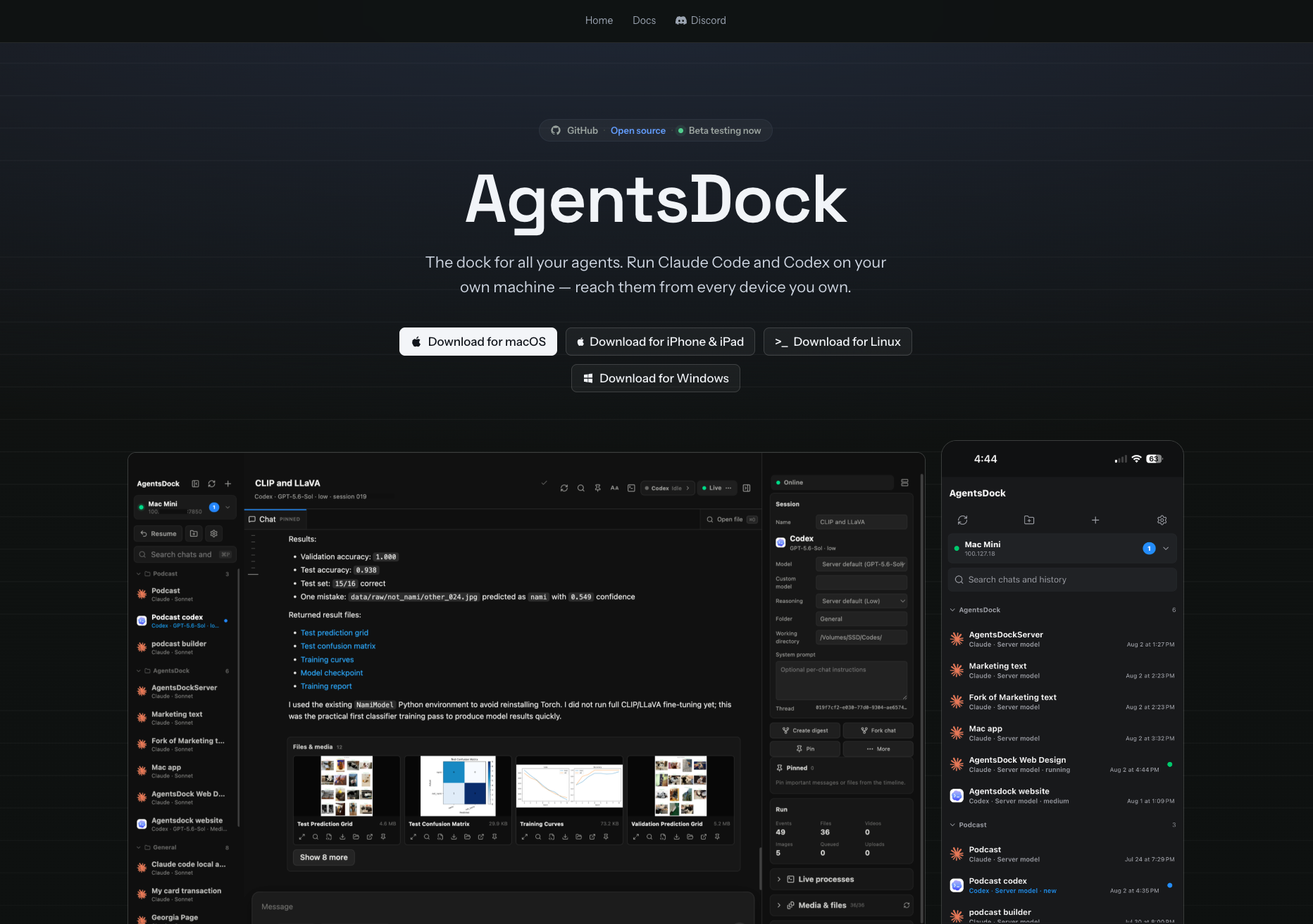
AgentsServer is the self-hosted execution backend for
AgentsDock. AgentsDock provides
the polished desktop and mobile chat experience; AgentsServer runs on the
machine that owns your workspaces, Claude Code installation, and Codex CLI.
Together they provide persistent agent chats without routing private project
files through a third-party chat service.
The desktop and mobile client source is publicly available at
ZhengyiLuo/AgentsDock.
AgentsServer exposes an authenticated HTTP/WebSocket API and streams normalized
Claude/Codex events, files, videos, uploads, scheduled jobs, process inspection,
and persistent tmux terminals to AgentsDock clients.
AgentsDock (macOS, Linux, Windows, iPhone, iPad, Android)
        |
        | private HTTP/WebSocket connection
        v
AgentsServer (your workstation or server)
        |
        +-- Claude Code CLI
        +-- Codex CLI
        +-- local workspaces, files, jobs, and tmux sessions
This repository is intentionally server-only. It should not contain local chat
state, uploaded files, tokens, compiled caches, private hostnames, or personal
machine paths.
What It Gives AgentsDock
- Creates and resumes chat sessions for Claude and Codex CLI backends.
- Streams live agent events over WebSocket while preserving a JSONL event
history on disk. - Accepts file uploads and serves generated artifacts, including videos.
- Supports queued turns, stop requests, chat forking, context digests, and rough
history import from provider sessions. - Recovers oversized Codex provider threads by rolling the same chat onto a
fresh thread with bounded recent memory when remote compaction fails. - Creates handoff digests with an actual LLM summarizer; the raw transcript/file
pack is only internal source material. - Runs recurring/loop jobs per chat with host load/memory guardrails.
Archiving a chat pauses every interval, cron, and RRULE job attached to it;
unarchiving leaves those jobs paused until the user explicitly enables them. - Gives each live provider turn a private, chat-scoped Jobs/Publish authority
and rotates it with the logical run during native steering. Failed steering
restores the predecessor only when rejection is proven safe; stopped,
uncertain, and restarted runs fail closed. - Provides optional live process and tmux-pane inspection for active work.
- Hosts one persistent interactive tmux terminal per chat. Clients attach over
an authenticated PTY WebSocket; disconnecting a client does not stop the
tmux session, its panes, or processes. Structured actions create, select,
split, and close individual windows while guarding the final persistent
window from accidental destruction. Archiving a chat kills this owned tmux
session and prevents it from being recreated until the chat is unarchived. - Gives every Claude and Codex turn the owning chat's tmux session name through
AGENTSDOCK_TMUX_SESSIONand prompt context. Agents can inspect the current
pane withtmux capture-panewhen it is relevant, but are instructed not to
type into, resize, or destroy the interactive terminal without an explicit
user request. - Discovers available runtime models/efforts from the installed CLI tools when
possible. - Reports Claude Code and Codex installation, authentication, version, and
latest-run health separately from basic server connectivity. New turns are
rejected with an actionable error before timeline activity when their
selected runtime is unavailable.
Requirements
- Linux or Apple silicon (arm64) macOS host. The trusted
uvruntime below
provisions the release's isolated Python 3.10+ environment. Intel macOS is
unsupported because the patched cryptography runtime no longer publishes or
supports x86_64 macOS wheels;install.shrejects that architecture before
changing state, releases, configuration, or services. - A trusted, preinstalled
uvonPATHis required for the isolated runtime.
On macOS, install it withbrew install uv; on Linux, use your trusted OS or
package-management environment. The installer never downloads and executes
a mutable bootstrap script. - Claude CLI and/or Codex CLI installed and authenticated on the agent host.
- Optional:
tmux, for the persistent chat terminal, tmux-pane inspection,
and in-app managed updates. Everything else (chats, turns, jobs, files)
works without it.install.shoffers to install it with Homebrew on macOS;
elsewhere, install it yourself and reruninstall.shany time to enable
these features. - Tailscale on the agent host and each client device if you want to use the
server from another Mac, iPhone, or iPad. - Optional: a user-level
systemdservice on Linux.
Optional: tmux
tmux is not required to run AgentsServer, chat with agents, or use jobs,
files, or search. It only backs three features: the persistent interactive
chat terminal, live tmux-pane inspection, and in-app managed updates
(Settings > Install or update AgentsServer in AgentsDock), which needs tmux to
survive the server restarting itself mid-update. GET /api/health reportscapabilities.tmux.available so clients can grey those features out without
tmux rather than failing.
If tmux is missing, install.sh proceeds anyway and prints the install
command for your platform. On macOS with Homebrew installed and an
interactive terminal, it asks first whether to run brew install tmux for
you. Install tmux at any time and rerun install.sh to pick it up; no state,
release, or service is affected.
AgentsDock
AgentsDock is the companion client for this server. It provides multiple chats
and folders, queues and scheduled jobs, rich Markdown/code rendering, inline
media, downloads and drag-out, code review, search, notifications, and
persistent per-chat terminals.
Get the client and current installation instructions from
agentsdock.net. The macOS desktop app is available
as a Developer ID-signed and Apple-notarized build; Apple-platform test
builds are also distributed through TestFlight.
To build or contribute to the client, see its
desktop build guide,
mobile development guide,
and contribution guidelines.
This repository contains the maintained, deployable AgentsServer backend. The
client repository's server/ directory contains frozen compatibility fixtures
for cross-stack tests; use this repository to run or develop the server.
Guided Setup
The recommended first install is AgentsDock > Set up AgentsServer. The
direct desktop app downloads a pinned release archive, verifies its SHA-256,
and runs the same idempotent installer locally or over an existing SSH key.
The app shows live progress, a finite deadline, cancellation, and a persistent
diagnostic log instead of leaving a setup spinner running indefinitely.
For a manual fallback, clone the repository and run the installer as the user
who will run Claude Code or Codex:
git clone https://github.com/ZhengyiLuo/AgentsServer.git
cd AgentsServer
./install.sh
Before changing state, releases, configuration, or services, the installer
checks for a working, preinstalled uv and the platform service command
(launchctl on macOS or systemctl on Linux), and verifies that the current
user's service domain responds. Missing tools or an unavailable user service
session produce platform-specific guidance and stop the install. The preflight
never invokes a package manager or sudo itself, with one opt-in exception:
on macOS with Homebrew present and an interactive terminal, it offers to runbrew install tmux if tmux is missing. Declining, running unattended
(--non-interactive or no TTY, as with the SSH-driven app flow), or being on
a host without Homebrew all just print the manual tmux install command and
continue — tmux is optional, so its absence never blocks setup. See
Optional: tmux below for what it enables.
After that preflight, the installer uses the trusted uv, installs a user-level service,
creates a private access token, verifies authenticated health, and preserves
existing ~/.agentsdock chat state on every update. Network downloads retry
with bounded timeouts, and the longer runtime/dependency stages print output
and periodic heartbeats with hard deadlines. A failure leaves the active
release unchanged and prints recovery guidance. An install lock prevents a
cancelled or disconnected SSH attempt from racing a retry, and timeout cleanup
terminates the complete dependency-worker process group. Existing~/.zenithbot-agent state is migrated automatically and left behind as a
compatibility link. The installer does not use sudo.
If the default port is already held by something other than the AgentsServer
release being replaced, the installer detects that listener before restarting
the user service, reports what it found (with lsof, when available), and
selects one of up to 5 higher free ports. It never treats a newly started but
unhealthy AgentsServer as a port conflict; that path still rolls back. A port
chosen this way is called out at the end of the run and reflected inAGENTSDOCK_SETUP_RESULT. Passing --port pins an exact port by default;
combine it with --allow-port-fallback to opt an explicit port into nearby
selection, or use --no-port-fallback to disable selection explicitly.
AgentsDock desktop can run this same installer locally or over an existing SSH
key connection from its first-run setup window. Remote clients should use the
Tailscale URL printed by the installer.
The same guided flow is available later from Settings > Install or update
AgentsServer. Rerunning it is the supported app-managed update path: it
replaces the server runtime and restarts the user service while preserving the
access token, configuration roots, chat history, jobs, files, and terminals.
Direct desktop builds can perform local/SSH setup; App Store-sandboxed builds
can configure the server URL and token but cannot launch service installers.
Once a versioned installation is present, AgentsDock can also check and apply
signed releases directly from Settings. The server downloads a release only
from this repository's GitHub Releases page, verifies an Ed25519-signed
manifest and the archive SHA-256, installs into a versioned directory, restarts
the user service, and accepts the release only after authenticated health
passes. The previous healthy release remains available for automatic rollback.
Team Hub preview
AgentsServer 0.1.25-beta.3 and later can designate one installed server as the
Team Hub host. Team Hub runs inside that AgentsServer process and listener;
there is no second service or separate uv command to keep running. For
same-machine use, enable it on exactly one development server with:
./install.sh --team-hub-host
For private remote access, expose only the existing listener through a
tailnet-only Tailscale Serve HTTPS port that Tailscale Funnel cannot use, then
bind the exact canonical URL during the host install. For example:
tailscale serve --bg --https=8444 http://127.0.0.1:7850

./install.sh --non-interactive \
  --team-hub-tailscale-serve-url \
  https://my-server.my-tailnet.ts.net:8444/api/team-hub
The installer persists and verifies the exact Team Hub transport and URL but
does not alter Tailscale configuration. Confirm separately that the exact 8444
mapping appears under Web in tailscale serve status --json, and runtailscale funnel status to confirm Team Hub's :8444 mapping is not public;
unrelated mappings may remain untouched. Do not use Funnel, a generic reverse
proxy, or one of Funnel's supported ports
(443, 8443, or 10000).
The ordinary AgentsServer endpoint and any unrelated Serve/Funnel mappings are
unchanged.
AgentsServer 0.1.25-beta.5 adds an optional bare-IP route. For a fresh host,
the operator may additionally advertise the exact route used by its
authenticated AgentsServer profile:
./install.sh --non-interactive \
  --team-hub-tailscale-serve-url \
  https://my-server.my-tailnet.ts.net:8444/api/team-hub \
  --team-hub-direct-ip-url \
  http://100.73.184.23:7850/api/team-hub
If Serve is not configured on a fresh/disabled host,--team-hub-direct-ip-url selects Direct IP as the primary route. Direct IP is
advanced and unencrypted: the AgentsServer bearer, Teamspace credentials and
messages are plaintext in transit. Literal IP shape is not proof of Tailscale
or identity. The route must be canonicalhttp://<literal-ip>:<AgentsServer-port>/api/team-hub; it cannot use a
hostname, loopback, another port/path, credentials, query or fragment. The
AgentsServer retains this legacy transport for manual host configuration and
rollback continuity. The current desktop filters and refuses Direct-IP routes
instead of offering them for selection; use secure pairing or private Tailscale
Serve. Automatic selection continues to use the advertised Serve primary.
If the host install fails or you abandon this setup, remove only that listener:
tailscale serve --https=8444 off
The host choice and exact primary/Direct-IP routes are preserved by managed
updates and rollback. A fresh server with no Hub database may be designated
directly.--no-team-hub-host stops serving an existing Hub but preserves its data and
managed host binding. It is never silently reactivated. To bring that exact
preserved host back on the same AgentsServer, request the guarded transition:
./install.sh --non-interactive --reactivate-team-hub-host
The installer requires disabled mode, verifies the stored Hub binding against
this server's durable identity without migrating the source database, and
writes and re-verifies a complete pre-reactivation snapshot before changing
configuration or service state. A candidate failure restores that snapshot.
Foreign, unbound, fenced, missing, or concurrently changed state is refused.
The Tailscale Serve or Direct-IP options may be supplied with the explicit
reactivation flag when retaining the corresponding supported origin; ordinary--team-hub-host remains the fresh-state path.
Adding or changing Direct IP on an existing live Hub is intentionally rejected
by the ordinary installer, including a same-version reinstall. That change
needs an authenticated transaction that closes admission and journals the
exact route before restart; do not edit the environment behind a running Hub
and assume update continuity will adopt it.
An existing beta.2 host remains loopback-only during a normal managed update;
an origin change is never inferred from mutable environment state. The remote
command above is for a fresh, disabled server with no Hub database. Do not use
it to re-home existing Team Hub state: changing the origin of an existing Hub
requires a separate signed, snapshot-protected migration. Leave every other
server disabled.
The desktop discovers the separate Hub URL through authenticated AgentsServer
health. Start Teamspace asks the active AgentsServer for a short-lived,
one-time enrollment grant and redeems it directly with Team Hub over the
verified Serve origin. The AgentsServer bearer authorizes that one narrow
parent bootstrap-grant endpoint, but it is never accepted as a Team Hub
credential; Team Hub credentials likewise never authorize ordinary
AgentsServer routes. Grant issuance additionally requires the exact configured
private Serve origin and its verified Tailnet identity. Remote clients must
select the designated host's server profile; switching profiles closes
Teamspace instead of carrying its state to another server.
For a loopback host, the equivalent installed command is:
~/.local/share/agents-server/current/install.sh \
  --non-interactive --team-hub-host
The installed release also provides host operator controls; no repository
checkout or separate service is needed. These commands print the path to an
owner-only proof file, never the proof secret itself:
PYTHONPATH=~/.local/share/agents-server/current \
  ~/.local/share/agents-server/current/.venv/bin/python -m agentsdock_team_hub.cli \
  bootstrap-proof --data-dir ~/.agentsdock/team-hub

PYTHONPATH=~/.local/share/agents-server/current \
  ~/.local/share/agents-server/current/.venv/bin/python -m agentsdock_team_hub.cli \
  device-recovery --data-dir ~/.agentsdock/team-hub \
  --email [email protected] --device-label "Member Mac"
Issuing a device-recovery proof immediately revokes every existing device
session and live refresh token for that person. Deliver and redeem the printed
proof path on the replacement device within ten minutes.
Authenticated human owners can list and revoke pending invitations and can
change, suspend, reactivate, or permanently revoke non-owner human memberships;
owner, automation, and self rows are not mutable through this API. Human users
can list and revoke only their own device sessions. Device revocation takes
effect on the next authenticated request and revokes every still-live refresh
token for that device. These controls keep invitation, membership, session, and
audit ledger rows rather than deleting security history. The member,
pending-invitation, and device-session inventory endpoints use opaque,
authenticated keyset cursors with a default page size of 50 and a maximum of
100; callers follow next_cursor only while has_more is true.
If you override the install or state directory, use the exact operator commands
printed by install.sh at the end of a host-mode install.
Team Hub keeps its own credentials and authorization boundary even though it
shares the AgentsServer process. AgentsServer bearer tokens and Team Hub
credentials are mutually non-interchangeable. Team posts and messages are
passive in this preview: agent dispatch and wake-up are not available. Managed
updates snapshot and verify the Hub database, signing key, and local enrollment
proofs before replacement; if the candidate cannot prove the same server and
Hub identities, the installer restores that snapshot before starting the
previous server release.
Agent Team Network mail
API contract v24 advertises capabilities.agent_team_mail_v1. Agent mail is
default-deny: only an ordinary user prompt whose first token is exactly/mail receives a short-lived provider capability. The helper freezes at most
512 currently visible destinations as opaque run-local routes, accepts at most
four sends, and reads the UTF-8 body from stdin so message content does not
appear in process arguments. Every listed destination is an active, non-owned
server and every new item is addressed to that server's passive Team Network
Inbox; /mail never targets, starts, or steers a remote agent. Scheduled jobs,
synthetic handoffs, and near-matches such as /mailbox do not receive this
authority. The provider mail harness creates message items only; it cannot
create new Team Network requests. Legacy agent-addressed mail and request
records remain readable through compatibility APIs, but provider and secure-
peer mail paths cannot create new ones. The separate Team Hub request lifecycle
also remains readable for backward data compatibility.
The additive strict form /mail server NAME MESSAGE treats NAME as one
case-sensitive token and the remainder as the exact normalized message body.
AgentsServer filters the private route snapshot to active server destinations
whose raw display name exactly equals NAME. Zero matches fail as not found;
multiple matches, including equal names on different Team Networks, fail as
ambiguous. A successful strict command exposes only that one opaque route and
permits exactly one idempotent kind=message effect with the exact body. It
cannot target an agent destination, use a case-insensitive name, create a request,
rewritten content, or a second send. Legacy /mail remains available for
older clients. Health advertises the strict syntax and feature flags insideagent_team_mail_v1, so clients can discover it without a global API-contract
revision.
Manual Onboarding
- Clone this repo on the machine that will run the agents.
git clone https://github.com/ZhengyiLuo/AgentsServer.git
cd AgentsServer
- Create a Python environment.
uv venv
uv sync --frozen
- Install and authenticate the backend CLI tools you want to use.
AgentsServer does not bundle Claude or Codex. It shells out to the CLI tools
that are already installed on the agent host. Install the official Claude CLI
and/or Codex CLI, sign in or configure credentials for each, then verify the
commands work in the same shell/user that will run the server:
command -v claude
claude --version

command -v codex
codex --version
If you only want one backend, install only that backend and setAGENTSDOCK_BACKEND accordingly.
- Start the server locally.
uv run python agent_server.py serve --bind 0.0.0.0 --port 7850
- Check health from the server machine.
curl http://127.0.0.1:7850/api/health
- Connect AgentsDock.
Open AgentsDock, enter the server URL printed by the installer, and paste its
access token. The desktop app can also run the installer for you during
first-run setup.
For a client on the same machine, use:
http://127.0.0.1:7850
For another Mac, iPhone, or iPad, use Tailscale. Install Tailscale on the agent
host and client device, confirm both devices are in the same tailnet, then use
the server's Tailscale IP:
http://<tailscale-ip>:7850
Do not expose port 7850 directly to the public internet. Use Tailscale or
another private network, and set AGENTSDOCK_AGENT_TOKEN for shared-token
access control.
Run Locally
uv run python agent_server.py serve --bind 0.0.0.0 --port 7850
Health check:
curl http://127.0.0.1:7850/api/health
The default state directory is ~/.agentsdock. Override it when you want
state somewhere else:
AGENTSDOCK_STATE_DIR=/path/to/state \
uv run python agent_server.py serve --bind 0.0.0.0 --port 7850
Security
Set AGENTSDOCK_AGENT_TOKEN to require a shared bearer token for HTTP calls,
uploads, file/video fetches, and WebSocket streams.
export AGENTSDOCK_AGENT_TOKEN='replace-with-a-long-random-token'
uv run python agent_server.py serve --bind 0.0.0.0 --port 7850
Clients should send either:
Authorization: Bearer replace-with-a-long-random-token
or X-AgentsDock-Token. The legacy X-ZenithDock-Token header remains
accepted for existing clients.
Leave the variable unset only for trusted local development.
install.sh prints the generated token once, at the end of setup. To see it
again later without reinstalling anything:
./install.sh --show-token
This only reads the existing configuration and exits; it makes no changes.
Managed server restart
Authenticated clients can discover restart support through the additivecapabilities.server_restart v1 health capability and the top-levelserver_instance_id. Restart is available only when AgentsServer proves that
the running process belongs to the supported launchd or systemd user service
and is executing from the installer's resolved current release.
GET  /api/admin/restart
POST /api/admin/restart
Both endpoints require the access token in an authorization header; URL token
parameters and browser-originated requests are rejected. POST accepts a small
JSON body containing a UUID request_id, the exactexpected_server_identity, the exact expected_server_instance_id, andconfirmed: true. It returns 202 before signaling the managed process.
Replaying the same request ID is idempotent; another pending or recently
completed request is rejected.
A cooperative restart is fail-closed while an active update, active turn,
provisional queue write, provider background task, lifecycle operation, or
HTTP mutation is in flight. Durable queued turns remain queued for recovery
after relaunch. Unmanaged processes cannot use this control.
Forced (emergency) restart
Adding force: true and force_confirmed: true to the POST body requests an
emergency restart. It exists for the case where the server is wedged, so it
never refuses or waits on server state beyond authentication, the managed
service proof, and the exact expected_server_identity /expected_server_instance_id pair:
- Cooldowns, a pending or stale restart record, an active managed update,
safety-critical work (Codex maintenance, session deletions, in-flight HTTP
mutations, goal reconfiguration), and Team Hub snapshot failures are
overridden and recorded inforced_auditinstead of rejected. expected_blocker_revisionis optional. A stale or omitted revision is
audited (blockers_changed_after_confirmation,blocker_revision_omitted)
rather than refused, because a wedged server may be unable to serve a fresh
blocker snapshot at all.- Every admission lock and probe on the forced path is bounded by a short
timeout. If one cannot be obtained the audit snapshot is markedsnapshot_degradedand the restart still proceeds.GET /api/admin/restart
and/api/healthuse the same bounded snapshot so they cannot hang. - The restart journal is best effort: if it cannot be written the restart
still proceeds. - SIGTERM is sent from a dedicated thread after the
202response, and a
hard-kill watchdog sends SIGKILL a few seconds later if graceful shutdown
has not finished, so the user service always relaunches the server.
Forced restarts interrupt active agent turns and can leave provider children
to be reaped by the relaunched server; use the cooperative restart when the
server is healthy.
Schedule-bound force update
capabilities.server_updates v11 lets a native client bind that audited force
restart to one exact pending update. The existing restart POST body adds:
{
  "force": true,
  "force_confirmed": true,
  "expected_update_schedule_id": "0123456789abcdef0123456789abcdef"
}
The remaining restart fields are still required. Unlike a generic emergency
restart, this path must acquire the update-operation lock, confirm that the
exact schedule is still pending, and durably make it noncancelable before the
restart is accepted. A canceled, replaced, or already-started schedule returns409 server_force_update_changed; lock contention returns retryable503 server_force_update_busy. Neither refusal signals a restart. The 202
restart status includes the exact update_schedule_id.
After relaunch, that reservation gets update admission before durable queue
recovery can execute work. New user messages remain durably queueable, while
other mutations and provider execution stay fenced until the updater starts or
reports an actionable failure. Active turns are interrupted; already durable
queued turns are preserved for the updated server.
Remote Access With Tailscale
Remote access is expected to go through Tailscale. This keeps the server
reachable from phones, tablets, and laptops without publishing the raw agent
port on the internet. It's optional: everything else in this README works
without it, so install.sh only prints a reminder with the download link
at the end of a successful run when Tailscale isn't already on the host —
it never blocks setup or is installed automatically.
On the agent host:
tailscale status
tailscale ip -4
On the client device, make sure Tailscale is connected to the same account or
tailnet, then set the AgentsDock server URL to:
http://<tailscale-ip>:7850
If the browser can open /api/health but the app cannot connect, check:
- the client is also connected to Tailscale
- the URL includes the correct port
- the same
AGENTSDOCK_AGENT_TOKENis configured in the app - the server is bound to
0.0.0.0or the Tailscale interface, not only127.0.0.1
Updating AgentsServer
Pull the newest version and rerun the installer. It updates the runtime and
service while preserving the access token and all chat state:
git pull --ff-only
./install.sh
On Linux, inspect the installed service with:
systemctl --user status agents-server.service --no-pager -l
journalctl --user -u agents-server.service -f
On macOS, the installer creates the LaunchAgentcom.agentsdock.server and writes logs under~/Library/Logs/AgentsServer/.
Managed updates from AgentsDock
Managed update endpoints use the same access token as the rest of the API.
Release manifests and archives are also verified with the public Ed25519 key
bundled by the installer, so the endpoint can install only an official signed
AgentsServer release:
GET  /api/admin/update
POST /api/admin/update/check
POST /api/admin/update/start
The update runs in a detached tmux session so restarting AgentsServer cannot
terminate its own installer. Progress is written to~/.agentsdock/admin/server-update.json, and installer output is kept inserver-update.log beside it. Chat history, files, jobs, tokens, and tmux
sessions remain under the persistent state/configuration roots and are never
placed inside a release directory.
capabilities.server_updates v11 retains v10's install-when-idle behavior: an
ordinary pending reservation is passive and durable for human work. Chats,
ordinary turns, durable message intake, Force Send, provider controls,
terminal connections, settings changes, and manual restart remain available
while the reservation is pending.
Autonomous scheduled and loop job admissions are deferred losslessly so they
cannot replenish the active set forever; they resume after the update or an
explicit cancellation. The server begins maintenance only when one shared-lock
snapshot proves existing work is actually idle; that same atomic transition
closes new-work admission. A pending reservation survives a manual restart and
is re-armed after startup. (Releases before 0.1.26-beta.31 parked every new
turn behind the reservation; that global operator lockout remains gone.)
Uninstalling AgentsServer
./uninstall.sh
This stops and removes the user service, the versioned release runtime, and
generated configuration (including the access token). It prompts before
making changes unless --yes is passed. Chat history, jobs, files, and
terminals under the state directory (~/.agentsdock by default) are kept by
default, so a later ./install.sh picks the same ordinary AgentsServer history
back up. Preserved Team Hub state is intentionally not auto-reactivated in this
beta; re-enable an exact same-server preserved host explicitly with./install.sh --reactivate-team-hub-host, which verifies its durable binding
and takes a rollback snapshot first.
Passing --purge-state permanently deletes that too, but always requires an
interactive exact-path confirmation that --yes cannot bypass. Before any
change, the uninstaller rejects root, home, broad system/user directories,
path traversal, and overlapping install/configuration/state roots. Likeinstall.sh, it never invokes a package manager or sudo. Persistent chat
terminal tmux sessions (named zd_*) are left running; list them with tmux ls and remove them yourself if you no longer need them.
Development Deployment Helper
New installations should use install.sh. For a managed installation,deploy.sh copies the complete server runtime into the active release,
compiles it, restarts the configured user service, and checks local health on
the remote host. It is intended for development, not end-user upgrades. It
refuses a designated Teamspace host or a paired secure-peer Teamspace client;
use the signed managed updater for those servers so exact continuity and
versioned rollback remain available.
./deploy.sh <ssh-host>
Optional variables:
AGENTSDOCK_REMOTE_APP_DIR='.local/share/agents-server/current' \
AGENTSDOCK_SERVER_SERVICE='agents-server.service' \
AGENTSDOCK_AGENT_TOKEN='replace-with-a-long-random-token' \
./deploy.sh <ssh-host>
The deploy helper writes to:
<remote-app-dir>/agent_server.py
Run install.sh before the first deploy so the versioned runtime, environment,
token, and service are present. A reference Linux unit lives atsystemd/agents-server.service.example.
Systemd Template
New installations do not need to copy the template because install.sh
creates and manages agents-server.service automatically. The template is
provided for inspection and custom deployments.
Manual install flow:
mkdir -p ~/.config/systemd/user
cp systemd/agents-server.service.example ~/.config/systemd/user/agents-server.service
systemctl --user daemon-reload
systemctl --user enable --now agents-server.service
Then check it:
systemctl --user status agents-server.service --no-pager -l
curl -H 'Authorization: Bearer replace-with-a-long-random-token' \
  http://127.0.0.1:7850/api/health
Useful Configuration
Most settings are environment variables. New configurations should useAGENTSDOCK_*. Historical ZENITHBOT_* and ZENITHDOCK_AGENT_TOKEN names are
accepted only as compatibility aliases so existing installations can migrate
without losing chat state:
| Variable | Purpose | Default |
|---|---|---|
AGENTSDOCK_STATE_DIR |
Persistent session/job/file state directory | ~/.agentsdock |
AGENTSDOCK_AGENT_CWD |
Default working directory for new sessions | user home |
AGENTSDOCK_AGENT_BIND |
Bind address | 0.0.0.0 |
AGENTSDOCK_AGENT_PORT |
Port | 7850 |
AGENTSDOCK_AGENT_TOKEN |
Shared bearer token | unset |
AGENTS_SERVER_INSTALL_DIR |
Versioned server runtime root | ~/.local/share/agents-server |
AGENTSDOCK_BACKEND |
Default backend, claude or codex |
claude |
CLAUDE_BIN |
Claude Code executable name/path | claude |
AGENTSDOCK_CLAUDE_TRANSPORT |
Interactive Claude transport: auto, agent-sdk, or print |
auto |
AGENTSDOCK_CLAUDE_SDK_IDLE_TTL_SECONDS |
Idle per-chat SDK client retention | 300 |
AGENTSDOCK_CLAUDE_SDK_MAX_LOADED_CHATS |
Maximum retained per-chat SDK clients | 4 |
CODEX_BIN |
Codex executable name/path | codex |
AGENTSDOCK_RUNTIME_CATALOG_TIMEOUT_SECONDS |
Per-command CLI version/help/model probe timeout | 6 |
AGENTSDOCK_CLAUDE_AUTH_PROBE_TIMEOUT_SECONDS |
Separate timeout for claude auth status --json |
15 |
AGENTSDOCK_RUNTIME_DIAGNOSTIC_TTL_SECONDS |
Cache lifetime for safe CLI version/auth probes | 60 |
CLAUDE_PROJECTS_ROOT |
Claude history search root | ~/.claude/projects |
CODEX_SESSIONS_ROOT |
Codex history search root | ~/.codex/sessions |
AGENTSDOCK_JOB_MAX_ACTIVE_RUNS |
Scheduled-job concurrency cap (0 disables this dedicated cap) |
0 |
AGENTSDOCK_MAX_ACTIVE_AGENT_RUNS |
Optional server-wide concurrency cap for chat, cron and goal runs (0 means no count limit) |
0 |
AGENTSDOCK_JOB_MIN_AVAILABLE_MEM_MB |
Job launch memory guardrail | 4096 |
AGENTSDOCK_MIN_START_AVAILABLE_MEM_MB |
Interactive launch memory guardrail | 2048 |
AGENTSDOCK_HANDOFF_DIGEST_BACKEND |
LLM backend for context digests, claude or codex |
claude |
AGENTSDOCK_HANDOFF_DIGEST_MODEL |
LLM model for context digests | sonnet |
AGENTSDOCK_HANDOFF_DIGEST_EFFORT |
Optional digest reasoning/effort setting | unset |
AGENTSDOCK_HANDOFF_DIGEST_TIMEOUT_SECONDS |
Digest summarizer timeout | 180 |
AGENTSDOCK_HANDOFF_DIGEST_CHARS |
Final digest character cap | 56000 |
AGENTSDOCK_CODE_DIFF_SNAPSHOT_TIMEOUT_SECONDS |
Maximum time for each isolated Git worktree snapshot | 120 |
Runtime catalog refreshes share a 25-second CLI/network-probe budget so they
can finish before the desktop and mobile clients' 30-second request timeout.
Provider health checks run concurrently so a slow provider cannot prevent the
others from being checked.
The Claude authentication timeout is independent of the six-second version,
help, and model probes. A timeout does not establish that a user is signed out.
If the refresh budget is exhausted, unfinished checks keep any prior diagnostic
with its original timestamp; providers without a prior result are reported as
unknown, not missing or unauthenticated. Model discovery uses its existing
fallbacks, and incomplete checks are not added to the diagnostic cache.
Context Digests
POST /api/sessions/{session_id}/digest creates a real LLM-summarized handoff
for another chat. The server first builds a bounded source packet from recent
events and files, then asks the configured digest backend to summarize it into
a clean Markdown handoff. If the LLM summarizer fails, the endpoint fails
visibly instead of returning the raw source packet as if it were a digest.
By default, the digest summarizer uses Claude Sonnet:
AGENTSDOCK_HANDOFF_DIGEST_BACKEND=claude
AGENTSDOCK_HANDOFF_DIGEST_MODEL=sonnet
You can switch it to Codex or another installed CLI model, but the relevant CLI
must already be authenticated for the same Unix user that runs the service.
Claude Agent SDK Transport
Interactive desktop clients can opt individual Claude chats into a persistent,
per-chat ClaudeSDKClient. This enables native steering plus approval and
question cards without sharing one Claude process across chats. The server
advertises the exact claude_sdk_interactive_v1 capability before the desktop
app opts in.
Set AGENTSDOCK_CLAUDE_TRANSPORT to auto (default), agent-sdk, or print.print always uses the compatible claude -p path. Clients that do not send
the exact capability—including older iOS builds and scheduled jobs—also remain
on claude -p, regardless of the server's interactive transport setting.
Idle SDK clients are retained for at most five minutes by default, with up to
four chat processes loaded. Active chats are never evicted to enforce the idle
limit.
Claude-controls capability v3 adds authenticated MCP management without
changing global API contract v13. Clients gate oncapabilities.claude_controls.features.mcp_management and use the additive
v1 endpoints:
GET  /api/sessions/{session_id}/claude/mcp
POST /api/sessions/{session_id}/claude/mcp
GET lazily connects an idle chat's Agent SDK client and returns an opaque
generation string plus at most 100 exact-name-deduplicated, sorted, allowlisted
server rows; truncated marks an incomplete list. POST requires that exact
generation and supports reconnect, reconnect_all, enable, and disable.
Both operations reject active/provider-starting turns, are lifecycle-serialized
with managed-update admission, and have a bounded native-control timeout.
Responses never expose MCP commands, environment, headers, configuration URLs,
raw provider errors, or tool metadata. Print transport and SDK-unavailable
hosts return an explicit unavailable snapshot; older servers continue to
return 404. Tune the default 15-second bound withAGENTSDOCK_CLAUDE_MCP_CONTROL_TIMEOUT_SECONDS.
Backend CLI Notes
The backend selection in AgentsDock only chooses which CLI the server invokes.
The model, effort, authentication, provider-side session storage, and available
commands still come from the installed CLI tools and their local configuration.
Recommended checks before connecting clients:
# Claude backend
command -v claude
claude --version

# Codex backend
command -v codex
codex --version

# Cursor backend
command -v cursor-agent || command -v agent
cursor-agent --version || agent --version
Run these as the same Unix user that owns the systemd service. If the CLI works
in your login shell but fails under systemd, check the service PATH, virtual
environment, and any provider-specific auth/config files.
Runtime diagnostics
API contract v9 exposes privacy-safe runtime status in two places:
GET /api/health
GET /api/runtime/catalog?refresh=true
The health response includes cached runtimes entries. The catalog endpoint'srefresh=true query forces a fresh version/authentication probe. Each backend
reports ready, missing, unauthenticated, or probe error, plus an
actionable recovery instruction. It never returns account identity, auth
output, or tokens.
Cursor capability contract v2 advertises the hardened process guard, bounded
idle warning/timeout lifecycle, and explicit permission-mode semantics.
A new prompt performs the same preflight before reserving real agent work. If
the selected CLI is unavailable, the endpoint returns a structured503 runtime_unavailable response. Failures after a healthy launch remain alast_error on a ready runtime so model overloads, bad thread IDs, and ordinary
provider failures are not mislabeled as missing installations.
Agent-managed scheduled jobs
Every Claude and Codex turn receives a compact snapshot of up to 25 jobs
belonging to that chat. The snapshot contains only job ID, title, enabled
state, schedule, IANA timezone, and next-run time; job prompts are omitted.
The helper's list command returns the complete current set. Agents are
instructed to change jobs only after an explicit scheduling request.
The installed agentsdock_jobs.py helper is the authoritative interface from
an agent turn. Every live turn receives a private, run-scoped authority file
and exact helper command in its provider-authority block. The helper accepts
that file and the bound chat ID explicitly, then uses server-enforced
agent-only routes for list, get, runs, create, update, and delete.
It deliberately provides no run-now command. The main server bearer is never
inherited by a provider process. For example, using the literal authority path
and chat ID shown in the current turn:
"$AGENTSDOCK_JOBS_CLI" --authority-file /path/from/turn.json --chat-id sess_from_turn list
"$AGENTSDOCK_JOBS_CLI" --authority-file /path/from/turn.json --chat-id sess_from_turn get JOB_ID
"$AGENTSDOCK_JOBS_CLI" --authority-file /path/from/turn.json --chat-id sess_from_turn runs JOB_ID --limit 20
"$AGENTSDOCK_JOBS_CLI" --authority-file /path/from/turn.json --chat-id sess_from_turn create --title "Daily status" \
  --prompt "Summarize the current project status." \
  --interval-seconds 86400 --loop
"$AGENTSDOCK_JOBS_CLI" --authority-file /path/from/turn.json --chat-id sess_from_turn create --title "Weekday status" \
  --prompt "Summarize the current project status." \
  --cron "0 9 * * MON-FRI" --timezone America/Los_Angeles
"$AGENTSDOCK_JOBS_CLI" --authority-file /path/from/turn.json --chat-id sess_from_turn update JOB_ID \
  --rrule "FREQ=WEEKLY;BYDAY=MO,WE,FR;BYHOUR=8;BYMINUTE=0;BYSECOND=0" \
  --timezone Europe/London
"$AGENTSDOCK_JOBS_CLI" --authority-file /path/from/turn.json --chat-id sess_from_turn delete JOB_ID
API contract v13 includes the durable per-chat provider_jobs_access setting.
Its default full mode exposes the existing helper surface, read_only
permits only list, get, and runs, and blocked permits no agent Jobs
calls. Capability issuance records the mode at turn start and every agent Jobs
route also checks the live session setting, so a human can tighten access while
a provider turn is running. Restoring broader access beyond the turn's issued
ceiling takes effect on the next turn. Authenticated app/human Jobs endpoints
are unaffected. Clients can detect the contract throughcapabilities.provider_jobs_access_control_v1 in /api/health.
Cron accepts Vixie five-field expressions, aliases such as @daily, and
seconds-first six- or seven-field expressions (the seventh field is year).
Hashed H fields are stable per job; nondeterministic R fields are rejected.
RRULE accepts one RFC 5545 recurrence-rule property with an optional RRULE:
prefix. Explicit first-run timestamps run exactly once even when off-rule;
subsequent runs return to the calendar schedule. Missed occurrences are
skipped, retries do not move the canonical schedule, nonexistent DST times are
skipped, and ambiguous fall-back times run once.
Interval schedules are capped at ten years. RRULE COUNT is capped at 10,000,
and leap-second BYSECOND=60 is rejected because the runtime clock cannot
represent second 60.
Cross-chat handoffs
Permanent chat pairs and independent messages (API contract 28)
An accepted explicit structured @Chat grants the exact two chats permanent
bidirectional permission. Each later run receives fresh, live-run-bound
credentials and discovers its permitted routes with chats list when needed.
The permission persists without another mention; it does not extend to other
chats, forks, or a recipient's other routes.
Clients negotiate chat_conversation_async_route_v1 using the additive health
capability. For paired routes advertising mode: async_route_v1, send andask each send one independent message and return after acceptance. An idle
recipient starts a normal turn; a busy recipient receives a normal queued
message. respond-current explicitly sends another message on the exact
reverse pair. Ordinary final answers are never forwarded automatically, and
there is no reply obligation, exchange leg budget, or one-use route permission.
Saved routes and configured-route messages have no count or hourly quota;
message-size bounds remain. Provider discovery uses bounded cursor pages, not
a permission limit. The existing per-message reference input bound and legacy
exchange budgets remain separate from permanent pair permission.
The desktop receives chat_conversation_message_* lifecycle events keyed by
the message envelope, shows the sender's card at acceptance, and shows an
incoming queued item until recipient execution starts. Cancel and revoke use
the existing durable delivery ledger and final admission fence. See
the async route contract for negotiation, event
fields, compatibility, and isolated validation.
Legacy route-hint exchange contract (capability v13)
An inline structured @Chat is an optional target hint. It never forwards the
raw user prompt. On successful ordinary-turn admission, an exact local
single-@Chat reference authored by a v2 client with grant_intent: true
idempotently creates or refreshes a durable directional source-to-target
grant. Subsequent turns receive only that source chat's current grants; there
is no ambient all-chat authority. An explicit user request to send, ask, tell,
or contact a named chat requires the agent to use the matching helper; passive
mentions remain optional. Every accepted configured-route Send carries one optional terminal
reply path back to its immutable source; it creates no reply obligation, never
automatically relays the target's ordinary final answer, cannot request a
follow-up, and grants no durable reverse route. Ask explicitly requests one
terminal answer over the same exchange-scoped return mechanism. It commits
immediately as a durable two-leg agent message and keeps the source provider
turn attached until that answer arrives or the exchange is explicitly stopped.
The target delivery remains a normal durable turn and waits in its FIFO when
that chat is busy. Each helper invocation observes one bounded HTTP heartbeat
slice and returns either the answer or a resumable pending=true receipt. The
provider immediately runs a new foreground wait call with the same exact
lease after every pending receipt. Those slices stay below provider shell-tool
caps; they never convert the exchange into a later source-chat turn or impose a
semantic response deadline.
pending=true is returned only when the server confirms it is still waiting.
A lost connection instead produces an ok=false, transport_error=true,retryable=true receipt with the same exchange, inbound leg, and lease; the
CLI prints that receipt and exits nonzero. Retry that exact wait, never the
original Ask: the answer may already be saved. Completed-answer delivery does
not wait indefinitely for disconnect-watcher cleanup.
Active agent messaging is strictly same-server: Studio chats can address only
Studio chats, and Sonic chats can address only Sonic chats. Communication
between servers uses passive Team Network Inbox messages (server, human,
or all recipients); it never wakes an agent or creates an active cross-chat
exchange.
/chat is a composer alias for selecting the same structured hint.
Scheduled runs never inherit the source chat's grants. Each job stores its own
exact route selection, authorized by route ID in the job editor/helper flow,
and revalidates its target, revision, and action on every firing. Its prompt
contains the corresponding exact single @Chat marker for display and
binding; no @@ authoring syntax is required. The health surface advertises
cross-chat version 13, durable_route_grants, configured-routeinstruction_reply_once, configured_route_live_request_reply,configured_route_request_reply_default: live,live_wait_timeout_async_fallback: false,live_wait_restart_async_fallback: true,agent_ambient_local_handoffs: false,
scheduled Jobs version 5, and global API contract 27. Capability v13 also
advertises the bounded transport heartbeat, no semantic live-wait deadline,
and the explicit asynchronous source-chat recovery used only when a server
restart loses the process-local provider call.
Capability v10 retains this reply-once behavior for existing
configured instruction grants as well as newly created ones. The return path
is a property of each accepted delivery, not a new durable target grant: it is
bound to the original source, delivery run, exchange generation, two-leg
budget, and expiry. Revoking or revising the source route still blocks future
deliveries immediately.
Beta-era local direct_message and @@ references remain readable only for
safe migration/recovery. They are quarantined from ordinary authority and can
never mint a durable grant; queued v6 snapshots are narrowed against current
persisted grants and cannot recreate a revoked route. Nonterminal legacy UI
envelopes are failed/cancelled during upgrade before they can be resubmitted.
Existing configured-route Send/Ask effects, action-specific secure-peer hints,
and final-result obligations retain their separate exact authorization and
lifecycle fences.
For a current ordinary turn, the provider-authority block exposes only opaque
route IDs. The agent lists the available routes, then sends or asks when the
user explicitly requests contact (and may otherwise decide no contact is
warranted):
"$AGENTSDOCK_CHATS_CLI" --authority-file /path/from/turn.json list
"$AGENTSDOCK_CHATS_CLI" --authority-file /path/from/turn.json \
  send --route route_opaque --message "Verify the API contract."
"$AGENTSDOCK_CHATS_CLI" --authority-file /path/from/turn.json \
  ask --route route_opaque --message "Which rollout is blocked?"
"$AGENTSDOCK_CHATS_CLI" --authority-file /path/from/turn.json \
  wait --exchange exchange_exact --inbound-leg leg_exact --lease lease_exact
The helper never exposes or accepts an inferred chat ID. It accepts only the
opaque IDs in that run's authority snapshot, uses loopback AgentsServer URLs,
disables redirects and proxies, and submits one bounded agent-authored
message. Send creates a correlated two-leg exchange with one optional terminal
reply capability available only to its exact delivery run. If the target does
not deliberately use that capability, its ordinary final stays local and the
exchange closes without sending anything back. Ask creates the same bounded
two-leg exchange and, by default, keeps the provider turn attached to its
exact live lease through bounded foreground wait slices until the answer or
a terminal failure. A pending receipt requires another exact wait call; it
is not a timeout or permission to finish the turn. A live-request exchange
does not expire merely because its original 24-hour authorization window
elapsed.
Explicit --async-response and restart recovery deliver the eventual result
in a later source-chat turn.
Historical action-specific grants (v1-v2)
API contract v11 added durable, same-server handoffs selected by the user in
the AgentsDock composer. API contract v13 upgradedcapabilities.cross_chat_handoffs_v1 to version 2 and added bounded
request/reply exchanges. These historical structured references authorized
one exact exchange, instruction, or automatic final-result delivery. They are
retained for readable stored records and secure action-specific compatibility;
they are not the current @Chat authoring model. Self, archived, deleted,
legacy-transport, and unpaired foreign-server targets fail closed.
When such an action-specific grant is replayed, the provider-authority block
may print a one-use opaque target handle:
"$AGENTSDOCK_CHATS_CLI" --authority-file /path/from/turn.json \
  send --target OPAQUE_HANDLE --message "Verify the API contract."
OPAQUE_HANDLE is capability data, never a session ID. Delivery is a normal
durable target turn using the target chat's own provider, permission policy,
queue, and timeline. A server restart reconciles the ledger and lifecycle
outbox without silently duplicating a handoff. The desktop bearer remains
required to inspect or cancel handoffs.
Request/reply grants use the exact exchange ID reserved when the source turn
is admitted. The source agent starts it with ask; a recipient may answer or
ask a clarification with the exact respond command printed in that delivery
turn's provider-authority block:
"$AGENTSDOCK_CHATS_CLI" --authority-file /path/from/turn.json \
  ask --target OPAQUE_HANDLE --message "Which rollout is blocked?"
"$AGENTSDOCK_CHATS_CLI" --authority-file /path/from/turn.json \
  respond --exchange exchange_exact --inbound-leg leg_exact \
  --message "Do you mean the desktop or server rollout?" --request-response
An exchange is limited to six directed conversational legs (three rounds).
Asynchronous exchanges expire after 72 hours. An attached same-server live
request does not time-expire while its exact source provider run remains its
owner; explicit cancellation, Stop, participant deletion/archive, or a server
restart closes or recovers it. A successful non-empty recipient final automatically
returns one terminal answer when the inbound leg expects a reply and no
explicit response won the one-use CAS.
Failures, stops, expiry, participant deletion/archive, and queue-owner loss are
durable visible outcomes; non-user failures also create one bounded native
status wake for the waiting sender. Exchange turns reuse the existing hiddencross_chat_handoff_delivery purpose so older clients do not expose synthetic
prompts or queue controls.
Durable directional route management (v8)
The default-empty per-source-chat grant list is the sole ordinary cross-chat
authority ceiling. Inline @Chat admission manages it automatically, while
these authenticated endpoints support inspection and explicit administration:
GET    /api/sessions/{source_session_id}/agent-handoff-routes
POST   /api/sessions/{source_session_id}/agent-handoff-routes
PATCH  /api/sessions/{source_session_id}/agent-handoff-routes/{route_id}
DELETE /api/sessions/{source_session_id}/agent-handoff-routes/{route_id}?expected_revision={revision}
PATCH and DELETE use the route revision as a compare-and-swap precondition;
a stale or missing valid route returns HTTP 409 withcode: route_revision_conflict, a safe message, and the current route ornull. A chat can hold at most 16 routes, aliases and targets are unique,
routes cannot point to their source chat, and forks inherit neither routes nor
their private mutation journal. Only v2 agent_cross_chat_routes_v2
submissions carrying exact grant_intent provenance may persist an inline
grant. Older v1/v6 turns and recovered queue hints remain one-run legacy data
and never become durable policy.
Grant mutation and turn admission cross two durable files. AgentsServer first
stores a hidden pending route journal, then fsyncs the exact turn_started orturn_queued admission ID, and only then exposes the grant. Startup rolls the
exact route revisions back when no matching event exists, or finalizes them
when it does; later edits and revocations are never recreated. Scheduled,
internal, digest, standalone, and cross-chat delivery turns receive no source
grant snapshot. Every helper call intersects its issued snapshot with the
exact live route revision and allowed actions, so removal or policy edits
block future acceptance immediately; an already accepted ledger item remains
visible and cancelable through authenticated desktop APIs.
The turn-scoped helper surface accepts only opaque issued route IDs:
"$AGENTSDOCK_CHATS_CLI" --authority-file /path/from/turn.json list
"$AGENTSDOCK_CHATS_CLI" --authority-file /path/from/turn.json \
  send --route route_opaque --message "Apply the corresponding mobile change."
"$AGENTSDOCK_CHATS_CLI" --authority-file /path/from/turn.json \
  ask --route route_opaque --message "Which mobile behavior must match?"
list is capability-scoped; there is no provider chat search or arbitrary
target parameter. Ask is not transcript access: it creates a normal target
turn containing only the bounded relayed message, then keeps the source
provider turn on the exact live lease through separate foreground wait
slices until one terminal answer arrives. --async-response
is the explicit compatibility mode that returns immediately and later queues
the answer in the source chat. Configured-route Send and Ask are limited to two
legs; non-live exchanges expire after 24 hours, while an attached live Ask is
owned by its exact source run instead of a wall-clock deadline. A Send reply is
always terminal; Ask also has no follow-up under the configured-route contract.
Route bodies and answers are
limited to 16,000 characters and 64 KiB UTF-8. A live run can accept at most
one effect per route and four route handoffs total; durable source and target
limits are 12 accepted route effects per rolling hour.
Provider projections contain only the opaque route ID, safe alias, sanitized
bounded title, backend, allowed actions, and generic availability. They never
expose target/session IDs, folders, working directories, models, provider IDs,
transcripts, rate counts, or route mutation history. Configured delivery
prompts likewise omit route and ledger identifiers; a returning answer may
include only the target's sanitized, explicitly untrusted display label.
Agent-created jobs use the same job store as the desktop and mobile clients,
so they immediately appear in the Jobs panel. The scoped helper routes are:
GET/POST /api/sessions/{session_id}/jobsPATCH/DELETE /api/sessions/{session_id}/jobs/{job_id}
Working-directory completion
AgentsDock can complete New Chat working-directory paths against the active
AgentsServer host (including remote hosts) whencapabilities.working_directory_completion is advertised:
GET /api/working-directories/complete?path=/srv/pro&limit=24
The authenticated endpoint performs one bounded, shallow scan and returns
directories only. Older clients and servers continue to use the ordinary path
field without a global API compatibility failure.
Workspace Files
The optional workspace_files health capability exposes a chat-scoped text
workspace rooted at that chat's exact cwd. It is additive to API contract v9,
so older clients continue to work without a global compatibility failure.
GET /api/sessions/{session_id}/workspace
GET /api/sessions/{session_id}/workspace/entries?path=&offset=0&limit=500
GET /api/sessions/{session_id}/workspace/search?q=app&limit=100
GET /api/sessions/{session_id}/workspace/file?path=src/App.tsx
PUT /api/sessions/{session_id}/workspace/file
POST /api/sessions/{session_id}/workspace/entry
PATCH /api/sessions/{session_id}/workspace/entry
DELETE /api/sessions/{session_id}/workspace/entry?path=src/old.ts&expected_revision=...&recursive=false
Reads accept complete UTF-8 regular files up to 32 MiB by default, replacing
the legacy 2 MiB editor ceiling. Writes are atomic,
require the SHA-256 revision returned by the read endpoint, and reject stale
revisions, symlinks, special files, hard links, archived chats, and read-only
targets. Directory traversal is descriptor-relative and fails closed when the
host lacks secure no-follow file APIs. Configure the text limit withAGENTSDOCK_WORKSPACE_TEXT_MAX_BYTES; a positive value selects a bounded
transport ceiling, while an explicit zero disables the AgentsServer ceiling.
Workspace-files capability v2 adds an opaque revision to every explorer and
search entry. Rename accepts {path, new_name, expected_revision}, is limited
to the same parent directory, and uses the host's atomic no-replace primitive,
so it never overwrites another entry. Delete requires the current entry
revision. A non-recursive delete removes files, symlinks, or empty
directories; recursive=true confirms deletion of a non-empty directory.
Recursive traversal remains descriptor-relative, never follows symlinks, and
rejects mounted filesystems rather than crossing them.
Workspace-files capability v4 adds no-overwrite creation. Post{path, kind: "file"} to create an empty UTF-8 file or{path, kind: "directory"} to create one directory. Creation is
descriptor-relative, rejects symlinked parents and existing destinations, and
is unavailable for archived chats.
Imported provider history
The Import Chat list shows local main conversations across projects. It excludes
Claude sidechains and subagent directories, Codex subagent conversations and
the native archived_sessions directory, and sessions already imported into
AgentsDock (including archived AgentsDock chats). Older or stopped main chats,
headless main sessions, and user-created forks remain eligible. These discovery
filters do not delete transcripts or change existing chats or direct session-ID
lookup.
Opening a chat catches its timeline up with messages added to the provider
transcript outside AgentsDock. The sync anchors on the newest timeline
messages, skips the parse when the transcript file is unchanged, refuses to
import a transcript that matches nothing on a populated timeline, and closes
every import batch with a turn_finished marked imported: true. Imported
turns never set a chat's active run, so replayed history can never make a
stopped chat look busy.
Servers before 0.1.26-beta.30 could append the same transcript tail on every
open. To remove those duplicates from a chat's event log:
POST /api/sessions/{session_id}/history/prune-duplicates
{"dry_run": true}
The default dry run reports how many events and import runs would be
removed; {"dry_run": false} rewrites the log atomically while the chat is
idle, keeping the first occurrence of every message.
Whole-History Search
GET /api/search?q=<query>&limit=<chat-count> searches user, assistant, error,
job, reasoning-summary, and file text across every chat. Quoted phrases remain
phrases; unquoted terms use prefix matching for responsive type-ahead search.
The first request incrementally builds history_search.sqlite3 inside the
agent state directory. Each transcript stores its indexed byte offset, so later
requests ingest only newly appended JSONL records. The index is persistent and
safe across server restarts; a replaced or truncated transcript is rebuilt
automatically. Indexing runs in a worker thread and does not block agent turns.
Per-Turn Code Review
For Git worktrees, the server snapshots the repository immediately before and
after each agent turn through an isolated temporary index. This captures the
complete turn-specific textual patch without modifying the user's real index
or folding pre-existing dirty changes into the review.
The append-only timeline stores only a compact code_diff event with file and
line-count metadata. Clients fetch the complete patch on demand:
GET /api/sessions/{session_id}/diffs/{run_id}
The endpoint uses the same bearer-token authentication as the rest of the API.
Binary changes remain compact Git binary markers rather than being copied into
the event log.
Public API Sketch
The server exposes JSON endpoints under /api.
GET /api/healthGET /api/sessionsGET /api/searchPOST /api/sessionsPATCH /api/sessions/{session_id}GET /api/sessions/{session_id}/eventsGET /api/sessions/{session_id}/subagentsGET /api/sessions/{session_id}/provider-commandsPOST /api/sessions/{session_id}/promptPOST /api/sessions/{session_id}/stopPOST /api/sessions/{session_id}/forkPOST /api/sessions/{session_id}/digestGET /api/sessions/{session_id}/filesGET /api/sessions/{session_id}/diffs/{run_id}POST /api/sessions/{session_id}/uploadGET /api/jobsPOST /api/jobsPATCH /api/jobs/{job_id}DELETE /api/jobs/{job_id}GET /api/sessions/{session_id}/jobsPOST /api/sessions/{session_id}/jobsPATCH /api/sessions/{session_id}/jobs/{job_id}DELETE /api/sessions/{session_id}/jobs/{job_id}GET /api/cross-chat/handoffs/{envelope_id}POST /api/cross-chat/handoffs/{envelope_id}/cancelGET /api/sessions/{session_id}/processesGET /api/sessions/{session_id}/tmuxGET /api/runtime/catalogGET /api/admin/updatePOST /api/admin/update/checkPOST /api/admin/update/startGET /ws/sessions/{session_id}
The event stream is append-only JSONL on disk and paged through the events API.
Large clients should page history instead of loading every event at once.
The subagents endpoint folds Claude local-agent lifecycle records into boundedsubagent_state snapshots without returning provider prompts, raw events,
tool-result output, commands, or output-file paths.
Native provider commands
Authenticated clients can callGET /api/sessions/{session_id}/provider-commands?refresh=false to retrieve a
bounded, sanitized inventory for that chat's backend and working directory.
Codex returns native skills from app-server skills/list; Claude returns the
commands reported by the Claude Agent SDK. Cursor currently reports explicit
unsupported metadata and an empty inventory.
Clients select an entry by sending only its opaque id and inventoryrevision in the optional turn field skill_selection. They never receive or
submit a provider filesystem path. AgentsServer re-discovers and revalidates
the selection against the session, backend, working directory, and current
provider inventory immediately before execution. A valid Codex selection uses
Codex's structured skill input, while a valid Claude selection invokes the
provider-reported command through the SDK. Unknown or unselected leading-slash
text remains an ordinary literal message, and normal approval policy is
unchanged.
Opaque IDs and revisions are scoped to the current AgentsServer process so
native filesystem paths cannot be inferred from them. After a server restart,
clients must fetch a fresh inventory. A previously queued selection is
visibly removed as stale during promotion, and later queue entries continue in
FIFO order.
Development and Tests
The Python test suite lives in tests/; deployable server modules remain at
the repository root. Run tests from the repository root using Python 3.13,
matching the release workflow:
Pull requests to main run the lock check, test-file compilation, and full
Python suite in the test-only Server CI workflow. It can also be started
manually and does not build or publish releases.
uv sync --locked --python 3.13
ulimit -s "$(ulimit -Hs)"
PYTHONDONTWRITEBYTECODE=1 uv run --python 3.13 python -m unittest discover -s tests -t . -v
Run an individual module with its package name:
PYTHONDONTWRITEBYTECODE=1 uv run --python 3.13 python -m unittest tests.test_provider_history_sync -v
The tests package also supports plain python -m unittest discover from
the repository root. Tests are not included in server release archives.
Client development instructions live in the separate
AgentsDock repository.
Repository Hygiene
Before publishing:
python3 -m py_compile agent_server.py agentsdock_jobs.py agentsdock_chats.py agentsdock_emergency.py agentsdock_publish.py provider_commands.py claude_sdk_client.py codex_app_server.py cursor_agent_client.py update_runner.py
rg -n 'private-host|/home/<name>|/Users/<name>|token-value' .
Do not commit:
~/.agentsdockstate (and the legacy~/.zenithbot-agentcompatibility link)- uploads or generated artifacts
.envfiles or access tokens- machine-specific hostnames, IP addresses, or user home paths
- compiled Python caches
License
AgentsServer's original code and documentation are licensed under the
Apache License 2.0. See NOTICE for attribution.
Third-party components retain their respective copyrights and licenses.
Yorumlar (0)
Yorum birakmak icin giris yap.
Yorum birakSonuc bulunamadi