memsearch
Health Gecti
- License — License: MIT
- Description — Repository has a description
- Active repo — Last push 0 days ago
- Community trust — 1036 GitHub stars
Code Gecti
- Code scan — Scanned 12 files during light audit, no dangerous patterns found
Permissions Gecti
- Permissions — No dangerous permissions requested
Bu listing icin henuz AI raporu yok.
A Markdown-first memory system, a standalone library for any AI agent. Inspired by OpenClaw.
 memsearch
Cross-platform semantic memory for AI coding agents.












https://github.com/user-attachments/assets/31de76cc-81a8-4462-a47d-bd9c394d33e3
Why memsearch?
- 🌐 All Platforms, One Memory — memories flow across Claude Code, OpenClaw, OpenCode, and Codex CLI. A conversation in one agent becomes searchable context in all others — no extra setup
- 👥 For Agent Users, install a plugin and get persistent memory with zero effort; for Agent Developers, use the full CLI and Python API to build memory and harness engineering into your own agents
- 📄 Markdown is the source of truth — inspired by OpenClaw. Your memories are just
.mdfiles — human-readable, editable, version-controllable. Milvus is a "shadow index": a derived, rebuildable cache - 🔍 Progressive retrieval, hybrid search, smart dedup, live sync — 3-layer recall (search → expand → transcript); dense vector + BM25 sparse + RRF reranking; SHA-256 content hashing skips unchanged content; file watcher auto-indexes in real time
🧑💻 For Agent Users
Pick your platform, install the plugin, and you're done. Each plugin captures conversations automatically and provides semantic recall with zero configuration.
For Claude Code Users
# Install
/plugin marketplace add zilliztech/memsearch
/plugin install memsearch
After installing, just chat with Claude Code as usual. The plugin captures every conversation turn automatically.
Verify it's working — after a few conversations, check your memory files:
ls .memsearch/memory/          # you should see daily .md files
cat .memsearch/memory/$(date +%Y-%m-%d).md
Recall memories — Claude searches automatically when relevant, or trigger manually:
/memsearch:memory-recall what did we discuss about Redis?
For OpenClaw Users
# Install from ClawHub
openclaw plugins install clawhub:memsearch
openclaw gateway restart
After installing, chat in TUI as usual. The plugin captures each turn automatically.
Verify it's working — memory files are stored in your agent's workspace:
# For the main agent:
ls ~/.openclaw/workspace/.memsearch/memory/
# For other agents (e.g. work):
ls ~/.openclaw/workspace-work/.memsearch/memory/
Recall memories — the LLM calls memory_search automatically when it needs history, or ask explicitly:
Search your memory for what we discussed about batch size
🔧 For OpenCode Users
// In ~/.config/opencode/opencode.json
{ "plugin": ["@zilliz/memsearch-opencode"] }
After installing, chat in TUI as usual. A background daemon captures conversations.
Verify it's working:
ls .memsearch/memory/ # daily .md files appear after a few conversations
Recall memories — the LLM calls memory_search automatically, or ask:
Use memory_search to find discussions about authentication
🔧 For Codex CLI Users
# Install
bash memsearch/plugins/codex/scripts/install.sh
codex --yolo  # needed for ONNX model network access
After installing, chat as usual. Hooks capture and summarize each turn.
Verify it's working:
ls .memsearch/memory/
Recall memories — use the skill:
$memory-recall what did we discuss about deployment?
⚙️ Configuration (all platforms)
All plugins share the same memsearch backend. Configure once, works everywhere.
Embedding
Defaults to ONNX bge-m3 — runs locally on CPU, no API key, no cost. On first launch the model (~558 MB) is downloaded from HuggingFace Hub.
memsearch config set embedding.provider onnx     # default — local, free
memsearch config set embedding.provider openai   # needs OPENAI_API_KEY
memsearch config set embedding.provider ollama   # local, any model
All providers and models: Configuration — Embedding Provider
Milvus Backend
Just change milvus_uri (and optionally milvus_token) to switch between deployment modes:
Milvus Lite (default) — zero config, single file. Great for getting started:
# Works out of the box, no setup needed
memsearch config get milvus.uri   # → ~/.memsearch/milvus.db
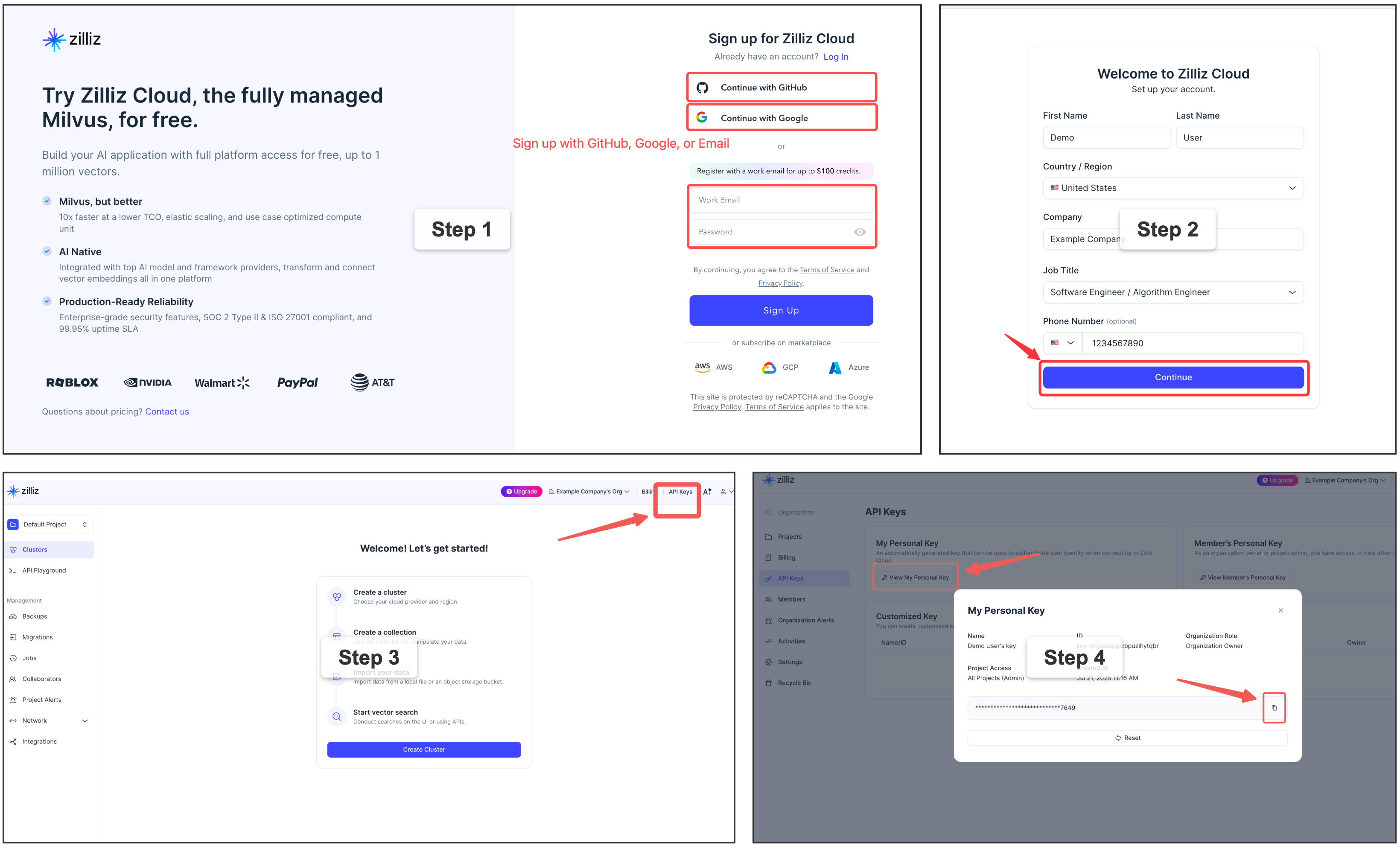
⭐ Zilliz Cloud (recommended) — fully managed, free tier available — sign up 👇:
memsearch config set milvus.uri "https://in03-xxx.api.gcp-us-west1.zillizcloud.com"
memsearch config set milvus.token "your-api-key"
You can sign up on Zilliz Cloud to get a free cluster and API key.
For multi-user or team environments with a dedicated Milvus instance. Requires Docker. See the official installation guide.
memsearch config set milvus.uri http://localhost:19530
📖 Full configuration guide: Configuration · Platform comparison
🛠️ For Agent Developers
Beyond ready-to-use plugins, memsearch provides a complete CLI and Python API for building memory into your own agents. Whether you're adding persistent context to a custom agent, building a memory-augmented RAG pipeline, or doing harness engineering — the same core engine that powers the plugins is available as a library.
🏗️ Architecture Overview
┌──────────────────────────────────────────────────────────────┐
│ 🧑💻 For Agent Users (Plugins) │
│ ┌──────────┐ ┌──────────┐ ┌──────────┐ ┌────────┐ ┌──────┐ │
│ │ Claude │ │ OpenClaw │ │ OpenCode │ │ Codex │ │ Your │ │
│ │ Code │ │ Plugin │ │ Plugin │ │ Plugin │ │ App │ │
│ └────┬─────┘ └────┬─────┘ └────┬─────┘ └───┬────┘ └──┬───┘ │
│ └─────────────┴────────────┴───────────┴────────┘ │
├────────────────────────────┬─────────────────────────────────┤
│ 🛠️ For Agent Developers │ Build your own with ↓ │
│ ┌─────────────────────────┴──────────────────────────────┐ │
│ │ memsearch CLI / Python API │ │
│ │ index · search · expand · watch · compact │ │
│ └─────────────────────────┬──────────────────────────────┘ │
│ ┌─────────────────────────┴──────────────────────────────┐ │
│ │ Core: Chunker → Embedder → Milvus │ │
│ │ Hybrid Search (BM25 + Dense + RRF) │ │
│ └────────────────────────────────────────────────────────┘ │
├──────────────────────────────────────────────────────────────┤
│ 📄 Markdown Files (Source of Truth) │
│ memory/2026-03-27.md · memory/2026-03-26.md · ... │
└──────────────────────────────────────────────────────────────┘
Plugins sit on top of the CLI/API layer. The API handles indexing, searching, and Milvus sync. Markdown files are always the source of truth — Milvus is a rebuildable shadow index. Everything below the plugin layer is what you use as an agent developer.
How Plugins Work (Claude Code as example)
Capture — after each conversation turn:
User asks question → Agent responds → Stop hook fires
                                          │
                     ┌────────────────────┘
                     ▼
              Parse last turn
                     │
                     ▼
         LLM summarizes (haiku)
         "- User asked about X."
         "- Claude did Y."
                     │
                     ▼
         Append to memory/2026-03-27.md
         with <!-- session:UUID --> anchor
                     │
                     ▼
         memsearch index → Milvus
Recall — 3-layer progressive search:
User: "What did we discuss about batch size?"
                     │
                     ▼
  L1  memsearch search "batch size"    → ranked chunks
                     │ (need more?)
                     ▼
  L2  memsearch expand <chunk_hash>    → full .md section
                     │ (need original?)
                     ▼
  L3  parse-transcript <session.jsonl> → raw dialogue
📄 Markdown as Source of Truth
  Plugins append ──→  .md files  ←── human editable
                          │
                          ▼
                  memsearch watch (live watcher)
                          │
                  detects file change
                          │
                          ▼
                  re-chunk changed .md
                          │
                  hash each chunk (SHA-256)
                          │
              ┌───────────┴───────────┐
              ▼                       ▼
       hash unchanged?          hash is new/changed?
       → skip (no API call)     → embed → upsert to Milvus
              │                       │
              └───────────┬───────────┘
                          ▼
                ┌──────────────────┐
                │  Milvus (shadow) │
                │  always in sync  │
                │  rebuildable     │
                └──────────────────┘
📦 Installation
# pip
pip install memsearch

# or uv (recommended)
uv add memsearch
pip install "memsearch[onnx]"    # Local ONNX (recommended, no API key)
# or: uv add "memsearch[onnx]"

# Other options: [openai], [google], [voyage], [ollama], [local], [all]
🐍 Python API — Give Your Agent Memory
from memsearch import MemSearch

mem = MemSearch(paths=["./memory"])

await mem.index()                                      # index markdown files
results = await mem.search("Redis config", top_k=3)    # semantic search
scoped = await mem.search("pricing", top_k=3, source_prefix="./memory/product")
print(results[0]["content"], results[0]["score"])       # content + similarity
import asyncio
from datetime import date
from pathlib import Path
from openai import OpenAI
from memsearch import MemSearch

MEMORY_DIR = "./memory"
llm = OpenAI()                                        # your LLM client
mem = MemSearch(paths=[MEMORY_DIR])                    # memsearch handles the rest

def save_memory(content: str):
    """Append a note to today's memory log (OpenClaw-style daily markdown)."""
    p = Path(MEMORY_DIR) / f"{date.today()}.md"
    p.parent.mkdir(parents=True, exist_ok=True)
    with open(p, "a") as f:
        f.write(f"\n{content}\n")

async def agent_chat(user_input: str) -> str:
    # 1. Recall — search past memories for relevant context
    memories = await mem.search(user_input, top_k=3)
    context = "\n".join(f"- {m['content'][:200]}" for m in memories)

    # 2. Think — call LLM with memory context
    resp = llm.chat.completions.create(
        model="gpt-4o-mini",
        messages=[
            {"role": "system", "content": f"You have these memories:\n{context}"},
            {"role": "user", "content": user_input},
        ],
    )
    answer = resp.choices[0].message.content

    # 3. Remember — save this exchange and index it
    save_memory(f"## {user_input}\n{answer}")
    await mem.index()

    return answer

async def main():
    # Seed some knowledge
    save_memory("## Team\n- Alice: frontend lead\n- Bob: backend lead")
    save_memory("## Decision\nWe chose Redis for caching over Memcached.")
    await mem.index()  # or mem.watch() to auto-index in the background

    # Agent can now recall those memories
    print(await agent_chat("Who is our frontend lead?"))
    print(await agent_chat("What caching solution did we pick?"))

asyncio.run(main())
pip install memsearch anthropic
import asyncio
from datetime import date
from pathlib import Path
from anthropic import Anthropic
from memsearch import MemSearch

MEMORY_DIR = "./memory"
llm = Anthropic()
mem = MemSearch(paths=[MEMORY_DIR])

def save_memory(content: str):
    p = Path(MEMORY_DIR) / f"{date.today()}.md"
    p.parent.mkdir(parents=True, exist_ok=True)
    with open(p, "a") as f:
        f.write(f"\n{content}\n")

async def agent_chat(user_input: str) -> str:
    # 1. Recall
    memories = await mem.search(user_input, top_k=3)
    context = "\n".join(f"- {m['content'][:200]}" for m in memories)

    # 2. Think — call Claude with memory context
    resp = llm.messages.create(
        model="claude-sonnet-4-5-20250929",
        max_tokens=1024,
        system=f"You have these memories:\n{context}",
        messages=[{"role": "user", "content": user_input}],
    )
    answer = resp.content[0].text

    # 3. Remember
    save_memory(f"## {user_input}\n{answer}")
    await mem.index()
    return answer

async def main():
    save_memory("## Team\n- Alice: frontend lead\n- Bob: backend lead")
    await mem.index()
    print(await agent_chat("Who is our frontend lead?"))

asyncio.run(main())
pip install "memsearch[ollama]"
ollama pull nomic-embed-text          # embedding model
ollama pull llama3.2                  # chat model
import asyncio
from datetime import date
from pathlib import Path
from ollama import chat
from memsearch import MemSearch

MEMORY_DIR = "./memory"
mem = MemSearch(paths=[MEMORY_DIR], embedding_provider="ollama")

def save_memory(content: str):
    p = Path(MEMORY_DIR) / f"{date.today()}.md"
    p.parent.mkdir(parents=True, exist_ok=True)
    with open(p, "a") as f:
        f.write(f"\n{content}\n")

async def agent_chat(user_input: str) -> str:
    # 1. Recall
    memories = await mem.search(user_input, top_k=3)
    context = "\n".join(f"- {m['content'][:200]}" for m in memories)

    # 2. Think — call Ollama locally
    resp = chat(
        model="llama3.2",
        messages=[
            {"role": "system", "content": f"You have these memories:\n{context}"},
            {"role": "user", "content": user_input},
        ],
    )
    answer = resp.message.content

    # 3. Remember
    save_memory(f"## {user_input}\n{answer}")
    await mem.index()
    return answer

async def main():
    save_memory("## Team\n- Alice: frontend lead\n- Bob: backend lead")
    await mem.index()
    print(await agent_chat("Who is our frontend lead?"))

asyncio.run(main())
📖 Full Python API reference: Python API docs
⌨️ CLI Usage
Setup:
memsearch config init                              # interactive setup wizard
memsearch config set embedding.provider onnx       # switch embedding provider
memsearch config set milvus.uri http://localhost:19530  # switch Milvus backend
Index & Search:
memsearch index ./memory/                          # index markdown files
memsearch index ./memory/ ./notes/ --force         # re-embed everything
memsearch search "Redis caching"                   # hybrid search (BM25 + vector)
memsearch search "auth flow" --top-k 10 --json-output  # JSON for scripting
memsearch expand <chunk_hash>                      # show full section around a chunk
Live Sync & Maintenance:
memsearch watch ./memory/                          # live file watcher (auto-index on change)
memsearch compact                                  # LLM-powered chunk summarization
memsearch stats                                    # show indexed chunk count
memsearch reset --yes                              # drop all indexed data and rebuild
📖 Full CLI reference with all flags: CLI docs
⚙️ Configuration
Embedding and Milvus backend settings → Configuration (all platforms)
Settings priority: Built-in defaults → ~/.memsearch/config.toml → .memsearch.toml → CLI flags.
📖 Full config guide: Configuration
🔗 Links
- 📖 Documentation — full guides, API reference, and architecture details
- 🔌 Platform Plugins — Claude Code, OpenClaw, OpenCode, Codex CLI
- 💡 Design Philosophy — why markdown, why Milvus, competitor comparison
- 🦞 OpenClaw — the memory architecture that inspired memsearch
- 🗄️ Milvus | Zilliz Cloud — the vector database powering memsearch
🤝 Contributing
Bug reports, feature requests, and pull requests are welcome! See the Contributing Guide for development setup, testing, and plugin development instructions. For questions and discussions, join us on Discord.
📄 License
Yorumlar (0)
Yorum birakmak icin giris yap.
Yorum birakSonuc bulunamadi