scholaraio
Health Gecti
- License — License: MIT
- Description — Repository has a description
- Active repo — Last push 0 days ago
- Community trust — 267 GitHub stars
Code Gecti
- Code scan — Scanned 12 files during light audit, no dangerous patterns found
Permissions Gecti
- Permissions — No dangerous permissions requested
ScholarAIO is an AI agent-powered research workspace that allows coding agents like Claude Code to search academic literature, parse PDFs into structured Markdown, and manage scientific workflows directly from the terminal.
Security Assessment
Overall Risk: Low. The automated code scan checked 12 files and found no dangerous patterns, hardcoded secrets, or requests for excessive permissions. Because the tool is designed to interact with external scientific software, parse local PDFs, and act as a research assistant, it will inherently execute commands and make network requests to fetch academic papers or documentation. However, these actions align with its stated purpose. No malicious behavior was detected, though users should remain aware of the standard risks associated with allowing AI agents to execute dynamic code and API calls.
Quality Assessment
This project demonstrates strong health and active maintenance. It was updated very recently, ensuring compatibility with current environments. It uses the highly permissive MIT license, making it fully open source and safe for integration into larger projects. With nearly 270 GitHub stars, it has achieved a solid baseline of community trust and validation from developers, indicating that the codebase has been reviewed and found useful by a decent audience.
Verdict
Safe to use.
Scholar All-In-One: AI agent-powered research terminal



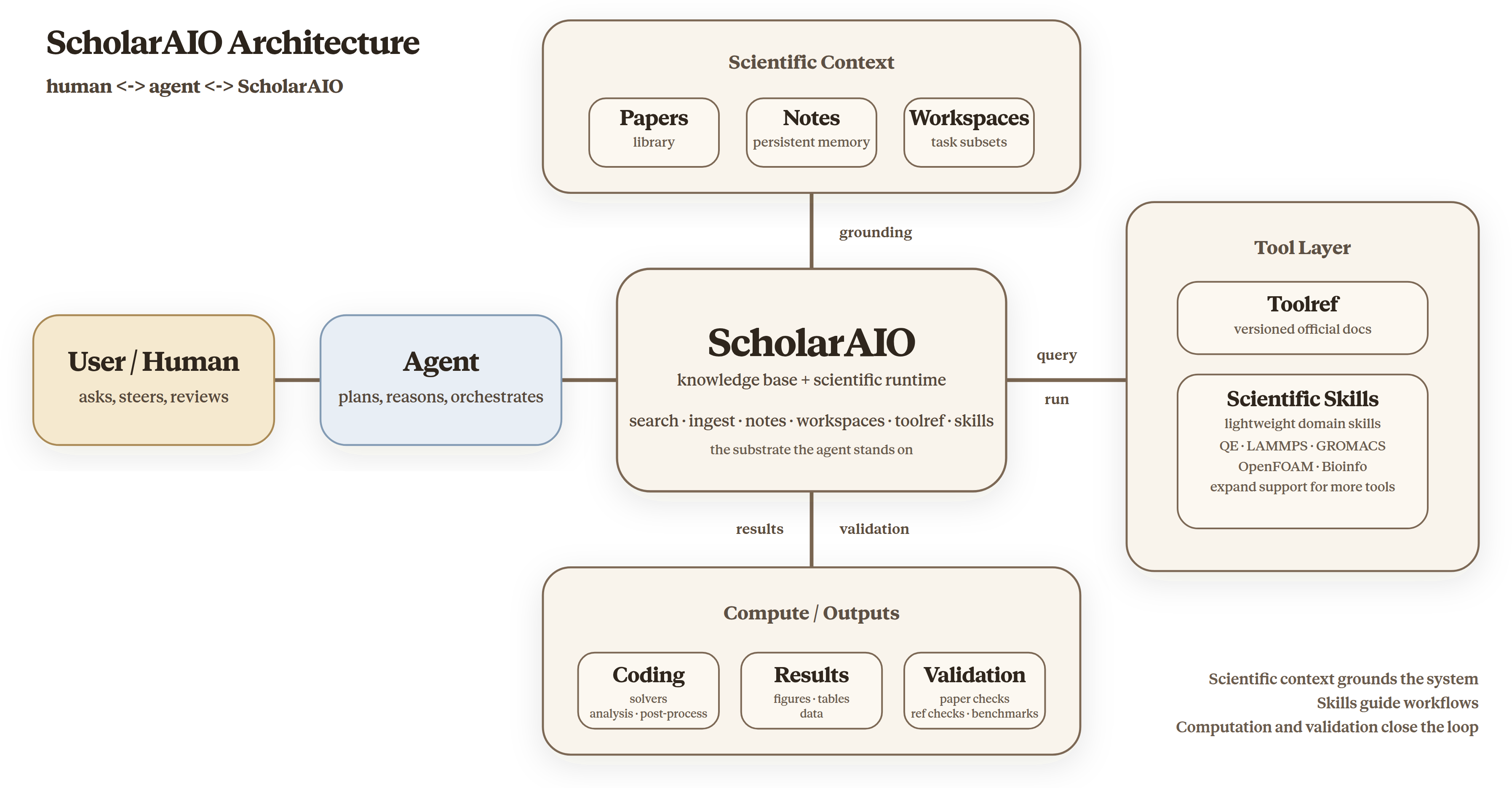
Your coding agent already reads code, writes code, and runs experiments. ScholarAIO adds a structured research workspace on top, so the same agent can search literature, cross-check results against papers, use scientific software more accurately, and carry the whole research workflow from one terminal.
- Your paper library becomes a reusable knowledge base for the same agent.
- When scientific software questions come up, the agent can consult official documentation at runtime instead of guessing from prompts.
- The system is built to keep expanding as new tools and workflows become worth supporting.
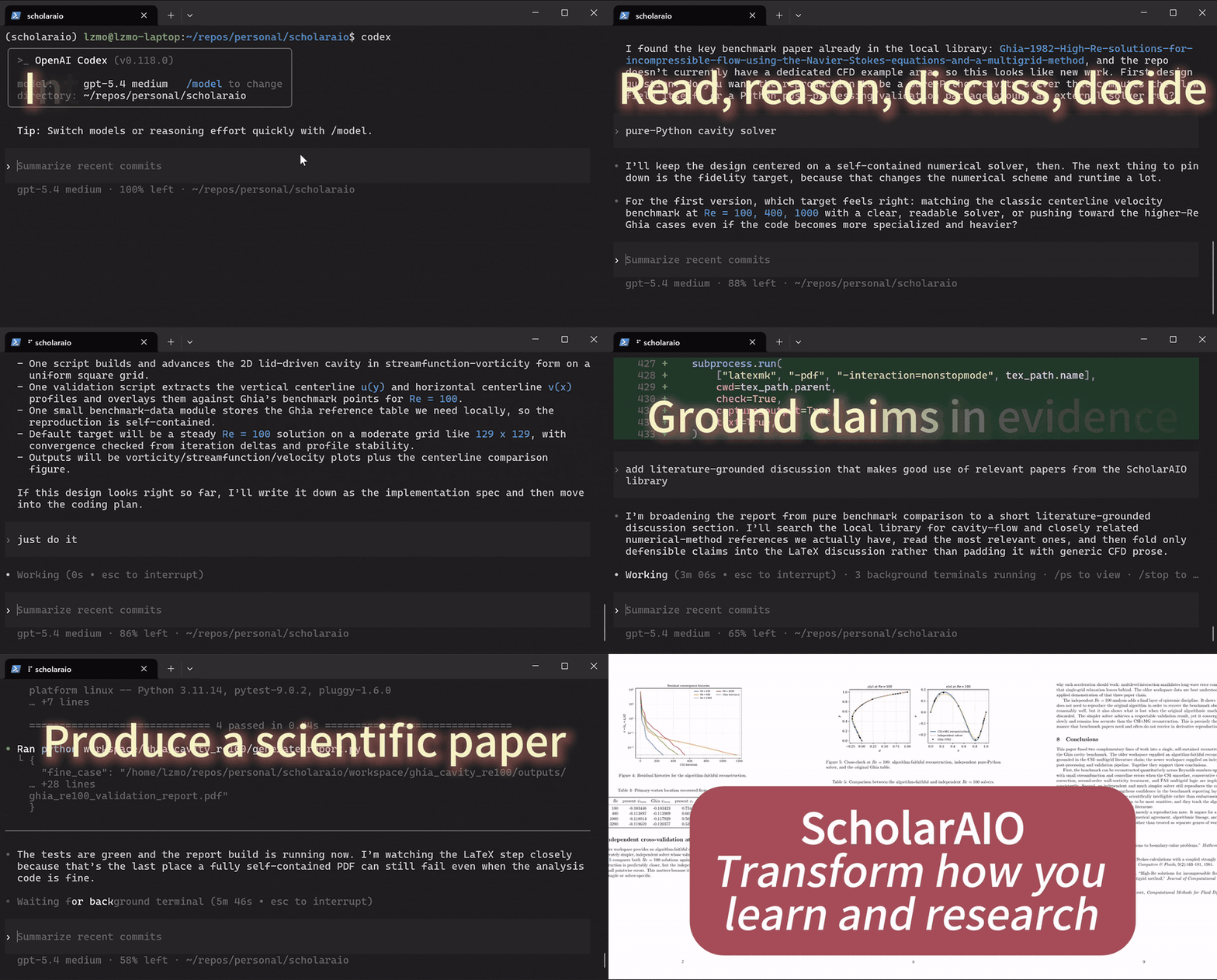
ScholarAIO offers more than search. It gives an AI coding agent a research workspace that supports natural-language interaction, papers and notes, more reliable use of scientific software, writing and running code, checking results against the literature, and structured academic writing.
Quick Start
The default and recommended way to use ScholarAIO is simple: install it, configure it once, and open this repository directly with your coding agent.
git clone https://github.com/ZimoLiao/scholaraio.git
cd scholaraio
pip install -e ".[full]"
scholaraio setup
Then open the repository in Codex, Claude Code, or another supported agent. In this setup, the agent gets the fullest experience: bundled instructions, local skills, the CLI, and the complete codebase context are all available directly. For Claude Code plugins, Codex/OpenClaw skill registration, and other setup paths, see docs/getting-started/agent-setup.md.
What It Does
| Feature | Details | |
|---|---|---|
| PDF Parsing | Deep structure extraction | Convert PDFs into structured Markdown while preserving formulas, figures, and layout as much as possible |
| Not Just Papers | More than papers | Journal articles, theses, patents, technical reports, standards, and lecture notes — four inbox categories with tailored metadata handling |
| Hybrid Search | Keyword + semantic fusion | Combine full-text and vector retrieval for stronger search results |
| Topic Discovery | See what your library is about | Automatically group papers into research themes and use interactive views to grasp the overall structure quickly |
| Literature Exploration | Multi-dimensional discovery | Explore a research direction through journal, topic, author, institution, keyword, year, citation impact, and more |
| Citation Graph | References & impact | Forward citations, backward citations, and shared-reference analysis |
| Layered Reading | Read on demand | Start with metadata or the abstract, then move into conclusions or full text only when you need to |
| Multi-Source Import | Connect your existing library | Import directly from reference managers, PDFs, and Markdown without rebuilding your library from scratch |
| Workspaces | Organize by project | Manage paper subsets with scoped search and BibTeX export |
| Multi-Format Export | BibTeX, RIS, Markdown, DOCX | Export your full library or a workspace for Zotero, Endnote, submission, or sharing |
| Persistent Notes | Cross-session memory | Keep analysis notes for each paper so future sessions can reuse them instead of starting over |
| Research Insights | Reading behavior analytics | Search hot keywords, most-read papers, reading trends, and semantic neighbor recommendations for papers you haven't read yet |
| Federated Discovery | Cross-library search | Search your main library, exploration libraries, and arXiv from one entry point instead of hopping across tools |
| AI-for-Science Runtime | Use scientific software more accurately | Use scientific software against official documentation at runtime instead of guessing commands and parameters |
| Extensible Tool Onboarding | Keep adding the tools that matter | As new scientific tools and workflows become important, the system can keep expanding |
| Academic Writing | AI-assisted writing | Literature review, paper sections, citation check, rebuttal, and gap analysis — with every citation traceable to your own library |
Works With Your Agent
ScholarAIO is designed to be agent-agnostic, but different agents expose different integration paths. Some work best when you open this repository directly; others are easier to use through plugins.
| Agent / IDE | Open this repo directly | Reuse from another project |
|---|---|---|
| Claude Code | CLAUDE.md + .claude/skills/ |
Claude plugin marketplace |
| Codex / OpenClaw | AGENTS.md + .agents/skills/ |
Symlink skills into ~/.agents/skills/ |
| Cline | .clinerules + .claude/skills/ |
CLI + skills |
| Cursor | .cursorrules |
CLI + skills |
| Windsurf | .windsurfrules |
CLI + skills |
| GitHub Copilot | .github/copilot-instructions.md |
CLI + skills |
Skills follow the open AgentSkills.io standard, and .agents/skills/ is a symlink to .claude/skills/ so different agents can discover and reuse the same skills.
Migrating from existing tools? Import directly from Endnote (XML/RIS) and Zotero (Web API or local SQLite), with PDFs, metadata, and references brought over together. More import sources are on the roadmap.
Configuration
Start by opening
scholaraiowith your agent and let it walk you through the setup. The notes below are only a basic overview.
ScholarAIO works with a minimal setup and can be expanded as needed.
scholaraio setupwalks you through the basics.- An LLM API key is optional but recommended for more robust metadata extraction and content completion.
- A MinerU token is optional but recommended, and free. You can also deploy MinerU or Docling locally for PDF parsing.
scholaraio setup checkshows what is installed, what is optional, and what is missing.
Full setup and configuration details → docs/getting-started/agent-setup.md, config.yaml
Agent First, CLI Available
ScholarAIO works best through an AI coding agent, but it also provides a CLI for scripting, debugging, and quick queries. For a current command reference aligned with the code, see docs/guide/cli-reference.md.
Project Structure
scholaraio/             # Python package — CLI and all core modules
  ingest/               #   PDF parsing + metadata extraction pipeline
  sources/              #   External source adapters (arXiv / Endnote / Zotero)

.claude/skills/         # Agent skills (AgentSkills.io format)
.agents/skills/         # ↑ symlink for cross-agent discovery
data/papers/            # Your paper library (gitignored)
data/proceedings/       # Proceedings library (gitignored)
data/inbox/             # Drop PDFs here for ingestion
data/inbox-proceedings/ # Drop proceedings volumes here for dedicated ingest
Full module reference → CLAUDE.md or AGENTS.md
Citation
If you use ScholarAIO in your research, please cite:
@software{scholaraio,
  author = {Liao, Zi-Mo},
  title = {ScholarAIO: AI-Native Research Terminal},
  year = {2026},
  url = {https://github.com/ZimoLiao/scholaraio},
  license = {MIT}
}
License
MIT © 2026 Zi-Mo Liao
Yorumlar (0)
Yorum birakmak icin giris yap.
Yorum birakSonuc bulunamadi