sigint
Health Uyari
- License — License: MIT
- Description — Repository has a description
- Active repo — Last push 0 days ago
- Low visibility — Only 5 GitHub stars
Code Gecti
- Code scan — Scanned 12 files during light audit, no dangerous patterns found
Permissions Gecti
- Permissions — No dangerous permissions requested
This toolkit is a market intelligence plugin for Claude Code. It orchestrates iterative research workflows, generates multi-format analytical reports, models trends, and can automatically create GitHub issues from its findings.
Security Assessment
The overall risk is rated as Medium. While the automated code scan did not find dangerous patterns or hardcoded secrets, the tool's core functionality involves complex network interactions. It explicitly creates GitHub issues, requiring API access and user tokens, and mentions integrating with an "Atlatl Memory" MCP to persist research state. No dangerous system permissions are requested, but users should be cautious about what research data and GitHub repositories the tool is granted access to.
Quality Assessment
The project is very new and currently has low community visibility with only 5 GitHub stars. However, it is actively maintained, with its most recent push happening today. It is properly licensed under the standard MIT license, making it safe for personal and commercial use.
Verdict
Use with caution — the code itself appears safe, but the low community adoption and extensive GitHub integration mean you should carefully monitor token permissions before deploying.
Market intelligence toolkit for Claude Code. Iterative research workflows, trend modeling with three-valued logic, multi-format reports, and automated GitHub issue creation from findings.
sigint - Signal Intelligence



Comprehensive market research toolkit for Claude Code with report generation, GitHub issue creation, and trend-based analysis.
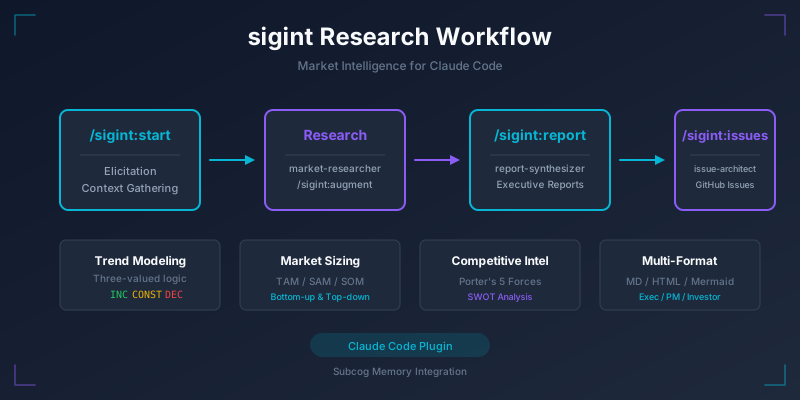
Quick Start
# 1. Start research with a topic
/sigint:start AI-powered code review tools

# 2. Answer elicitation questions (decision context, audience, priorities)

# 3. Check progress
/sigint:status

# 4. Generate report
/sigint:report

# 5. Create GitHub issues (optional)
/sigint:issues
See the Getting Started Tutorial for a detailed walkthrough.
Features
- Swarm-Orchestrated Research: Parallel dimension-analysts coordinate via Atlatl blackboard
- Iterative Research Workflow: Start, refine, and finalize market research through commands
- Multi-Audience Reports: Generate reports for executives, PMs, investors, and developers
- Trend-Based Modeling: Three-valued logic analysis (INC/DEC/CONST) for uncertain data
- GitHub Integration: Automatically create sprint-sized issues from findings
- Atlatl Memory: Persist research state across sessions via Atlatl MCP
- RLM Large Document Processing: Source-chunker handles documents exceeding context limits
- Multi-Format Output: Markdown, HTML, Mermaid diagrams
Installation
Claude Code
# Option 1: Plugin Marketplace (recommended)
/plugins add sigint

# Option 2: Local development
claude --plugin-dir /path/to/sigint

# Option 3: Manual install to plugins directory
cp -r sigint ~/.claude/plugins/
Cowork
- Open Claude Desktop app > Cowork tab
- Click Customize > Browse plugins
- Search for "sigint" and click Install
For organization-wide deployment and detailed setup, see the Cowork deployment guide.
Commands
| Command | Description |
|---|---|
/sigint:start <topic> |
Begin new research session |
/sigint:augment <area> |
Deep-dive into specific area |
/sigint:update |
Refresh existing research data |
/sigint:report |
Generate comprehensive report |
/sigint:issues |
Create GitHub issues from findings |
/sigint:resume |
Resume previous research session |
/sigint:status |
Show current research state |
/sigint:init |
Initialize plugin configuration |
Agents
- research-orchestrator: Coordinates parallel dimension-analysts via blackboard, merges findings
- dimension-analyst: Focused research on a single dimension (competitive, sizing, trends, etc.)
- source-chunker: RLM processor for large documents — partitions, analyzes chunks, synthesizes
- issue-architect: Converts findings to sprint-sized GitHub issues
- report-synthesizer: Generates multi-format reports with visualizations
Skills (Research Methodologies)
Each skill teaches AND executes the methodology:
- Competitive Analysis: Porter's 5 Forces, competitor mapping
- Market Sizing: TAM/SAM/SOM calculations
- Trend Analysis: Macro/micro trend identification
- Customer Research: Persona development, needs analysis
- Tech Assessment: Technology evaluation, feasibility
- Financial Analysis: Revenue models, unit economics
- Regulatory Review: Compliance, legal considerations
- Report Writing: Executive report best practices
- Trend Modeling: Three-valued logic (INC/DEC/CONST), scenario graphs
Report Structure
Reports include:
- Executive Summary
- Market Size (TAM/SAM/SOM)
- Competitive Landscape
- SWOT Analysis
- Recommendations
- Risk Assessment
- Data Sources & Methodology
- Transitional Scenario Graphs (Mermaid)
Storage Structure
./reports/
├── README.md                   # Master index of all research
└── topic-name/
    ├── README.md               # Topic research index
    ├── state.json
    ├── YYYY-MM-DD-research.md
    ├── YYYY-MM-DD-report.md
    ├── YYYY-MM-DD-report.html
    └── YYYY-MM-DD-issues.json
Configuration
Configuration uses a cascading system where project settings override global defaults.
Configuration Locations
| Location | Scope | Purpose |
|---|---|---|
~/.claude/sigint.local.md |
Global | User-wide defaults for all projects |
./.claude/sigint.local.md |
Project | Project-specific overrides |
Resolution order: Project > Global > Built-in defaults
Configuration File Format
Create sigint.local.md in either location:
---
default_repo: owner/repo
report_format: markdown
audiences:
  - executives
  - product-managers
auto_atlatl: true
---

Additional research context or preferences...
Example Setup
# Global defaults (applies to all projects)
mkdir -p ~/.claude
cat > ~/.claude/sigint.local.md << 'EOF'
---
report_format: markdown
audiences:
  - executives
---
EOF

# Project-specific override
mkdir -p .claude
cat > .claude/sigint.local.md << 'EOF'
---
default_repo: myorg/myrepo
audiences:
  - developers
  - product-managers
---
EOF
Dependencies
Required:
- WebSearch/WebFetch tools for research
Optional:
- Atlatl MCP server for blackboard coordination and persistent memory (falls back to file-based state)
- GitHub MCP server or GitHub CLI (
gh) for issue creation
References
Primary Research
This plugin's trend modeling methodology is based on:
Bočková, N., Volná, B., & Dohnal, M. (2025). "Optimisation of complex product innovation processes based on trend models with three-valued logic." arXiv:2601.10768v1. https://arxiv.org/abs/2601.10768
Key concepts adapted from this research:
- Three-valued logic (INC/DEC/CONST): Minimally information-intensive quantifiers for trend analysis
- Transitional scenario graphs: Visual representation of possible state transitions
- Qualitative modeling: Analysis under information scarcity without precise numerical parameters
Frameworks & Methodologies
- Porter's Five Forces: Porter, M.E. (1979). "How Competitive Forces Shape Strategy." Harvard Business Review, 57(2), 137-145.
- SWOT Analysis: Learned, E.P., Christensen, C.R., Andrews, K.R., & Guth, W.D. (1965). Business Policy: Text and Cases. Homewood, IL: Irwin.
- TAM/SAM/SOM: Blank, S. & Dorf, B. (2012). The Startup Owner's Manual. K&S Ranch.
Market Research Methods
- Competitive Analysis: Fleisher, C.S. & Bensoussan, B.E. (2015). Business and Competitive Analysis: Effective Application of New and Classic Methods. FT Press.
- Customer Research & Personas: Cooper, A. (1999). The Inmates Are Running the Asylum. Sams Publishing.
- Technology Assessment: Coates, J.F. (1976). "Technology Assessment." American Scientist, 59(4), 412-418.
Trend Modeling
- Three-Valued Logic Foundations: Kleene, S.C. (1952). Introduction to Metamathematics. North-Holland.
- Scenario Planning: Schwartz, P. (1991). The Art of the Long View. Doubleday.
Financial Analysis
- Unit Economics: Ries, E. (2011). The Lean Startup. Crown Business.
- Revenue Modeling: Osterwalder, A. & Pigneur, Y. (2010). Business Model Generation. Wiley.
License
MIT
Yorumlar (0)
Yorum birakmak icin giris yap.
Yorum birakSonuc bulunamadi