zosma-cowork
Health Gecti
- License — License: MIT
- Description — Repository has a description
- Active repo — Last push 0 days ago
- Community trust — 112 GitHub stars
Code Basarisiz
- os.homedir — User home directory access in .github/skills/impeccable/scripts/context.mjs
- process.env — Environment variable access in .github/skills/impeccable/scripts/context.mjs
- network request — Outbound network request in .github/skills/impeccable/scripts/context.mjs
- process.env — Environment variable access in .github/skills/impeccable/scripts/critique-storage.mjs
- exec() — Shell command execution in .github/skills/impeccable/scripts/design-parser.mjs
Permissions Gecti
- Permissions — No dangerous permissions requested
Bu listing icin henuz AI raporu yok.
Open-source AI work platform for teams — run Pi and other agent harnesses across machines with supervision, approvals, and shared results.
Zosma Cowork
The open-source AI work platform for companies and teams
Run AI coworkers across employee machines, servers, and harnesses from one secure workspace.






Documentation · Releases · Roadmap · Discord
Zosma Cowork is an MIT-licensed, work-focused AI agent platform. It gives people and teams one place to delegate work, supervise long-running agents, review approvals, and collect results—without forcing everyone to use the same model or agent harness.
Cowork is built for more than software development. It is intended for finance, operations, research, sales, support, administration, and engineering teams working with files, applications, business systems, and repeatable processes.
Project status: Cowork ships as a local Pi-powered web application in a thin Tauri shell. The transport-independent Pi backend, versioned
/api/v1discovery and read-only session slice are shipped; the next slices move interactive commands and events behind the same boundary. The machine daemon, control plane, mobile client, and additional harness adapters remain planned.
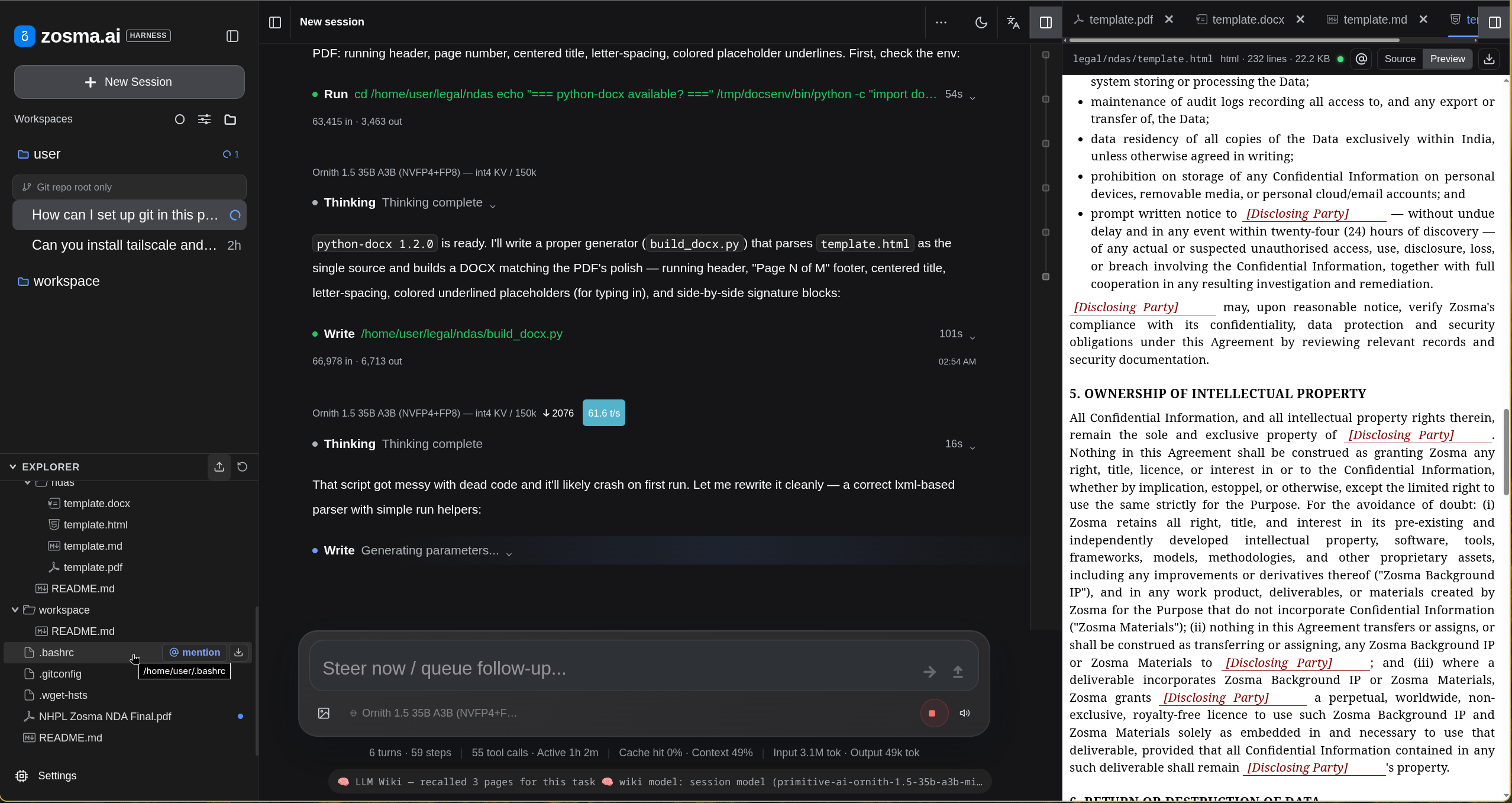
What Cowork Is
Cowork is an open-source, MIT-licensed work harness for individuals, small teams, and large organizations. It runs in the cloud or on your own machines, stays provider-agnostic, and lets you use the model of your choice. Thanks to Pi and other open-source packages, Cowork stands on the shoulders of the open-source ecosystem rather than reinventing it.
What Cowork Is Not
Cowork is not a coding assistant that opens a folder. It is not tied to a single provider, model, or harness — you choose the tools that fit the work.
What Cowork Wants to Be
A single, open work platform where a person, a small team, or a whole company can run their AI work across any provider and any model, from any device, under a permissive MIT license — on the infrastructure of their choosing.
Our Goal
To work with agents as seamlessly as possible.
Chat, get notifications of clarifications, information, and approvals — and schedule repeated tasks as you talk to the harness.
The agents create skills, learn from past experiences, and grow the more you use them.
That's the goal.
Product vision
A company installs one lightweight Cowork daemon on each employee machine or managed server. The daemon discovers and supervises supported agent harnesses, keeps credentials and execution local, and opens an authenticated outbound connection to the Cowork backend.
People use the web, mobile, or desktop app to start work, monitor sessions, answer questions, approve sensitive actions, and review outputs from anywhere.
flowchart LR
    W[Next.js Web] --> B[TypeScript Control Plane]
    M[Expo Mobile] --> B
    E[Tauri Desktop<br/>bundles the Next.js app] --> B
    B <--> D[TypeScript Machine Daemon]
    E -. local mode .-> D
    D --> PI[Pi]
    D --> CC[Claude Code]
    D --> CX[Codex]
    D --> ACP[ACP Agents]
    ACP --> H[Hermes]
    ACP --> G[Gemini / Cursor / Copilot / Kimi]
One daemon, many harnesses
The machine daemon owns the capabilities every harness needs:
- process and session supervision
- reconnects, heartbeats, and crash recovery
- files, Git, worktrees, terminals, and artifacts
- local credentials and machine capabilities
- approvals and organization policy enforcement
- normalized events for every client
Harness adapters only translate between native harness protocols and Cowork's protocol. We prefer SDKs, JSON-RPC, JSONL, native APIs, and ACP over terminal-screen scraping.
Agents of your choosing
Cowork plans to support multiple agent harnesses, chosen per employee's job type and the work they do — starting with our favourite, the Pi Coding Agent. Pi remains Cowork's first-class runtime: existing Pi extensions, skills, prompts, providers, steering, session trees, and deeper runtime controls stay available.
Each harness advertises its own capabilities rather than being forced into a lowest-common-denominator interface, so the app exposes richer controls whenever a selected harness supports them.
| Harness | Integration | Status |
|---|---|---|
| Pi | Native TypeScript SDK | ✅ First-class runtime; backend extraction and /api/v1 read slice shipped |
| Claude Code | Native structured integration | ⬜ Planned |
| Codex | Native app-server integration | ⬜ Planned |
| ACP-compatible agents | Agent Client Protocol adapter | ⬜ Planned |
| Hermes | ACP first, native adapter only if needed | ⬜ Planned |
Applications
The target monorepo has three user-facing applications:
apps/
├── web/       # Next.js web application
├── app/       # React Native application built with Expo
└── desktop/   # Tauri shell that bundles and renders apps/web
Web
The Next.js application is the complete browser experience for individuals, teams, and administrators.
App
The Expo application provides native mobile sessions, push notifications, voice input, approvals, task monitoring, and artifact review.
Desktop
The Tauri application does not maintain a second frontend. In development it loads apps/web; release builds bundle the Next.js standalone server and machine daemon, supervise both processes, and render the local Next.js application in an Tauri window.
Target repository structure
zosma-cowork/
├── apps/
│   ├── web/                  # Next.js
│   ├── app/                  # React Native + Expo
│   └── desktop/              # Tauri; bundles apps/web and daemon/
├── backend/                  # TypeScript control plane: HTTP, realtime, teams, policy
├── daemon/                   # TypeScript service installed on each machine
├── packages/
│   ├── protocol/             # Shared runtime schemas, commands, and events
│   └── api-client/           # Shared authenticated HTTP/WebSocket client
├── extensions/
│   ├── pi/                   # Pi-native extensions
│   ├── mcp/                  # Portable tools for multiple harnesses
│   └── skills/               # Portable instruction-based skills
├── infra/                    # Deployment and OS service packaging
├── docs/
├── scripts/
├── pnpm-workspace.yaml
├── package.json
└── tsconfig.base.json
This is the migration target. Useful functionality from the current repository will move into these boundaries rather than preserving the old layout.
Deployment modes
| Mode | Description | Status |
|---|---|---|
| Local | Desktop talks directly to the local web/runtime bundle | ✅ Current product; standalone machine daemon is next |
| Hosted | Zosma control plane connects users and company machines | ⬜ Planned |
| Self-hosted | Company operates the control plane in its own environment | ⬜ Planned |
The daemon initiates outbound connections, so employee machines do not need publicly exposed ports. Provider credentials remain on the machine unless an organization explicitly configures managed credentials.
Roadmap
Last updated: 2026-09-09
Current state: API foundation shipped; interactive API cutover is next.
This roadmap tracks the product that exists today and the next architecture slices. The detailed implementation plan lives in docs/superpowers/roadmaps/2026-09-07-modular-headless-pi-backend-roadmap.md.
Shipped
- Tauri shell and Next.js web UI migration
- Pi backend contracts, errors, runtime manager, session services, and model services
- Versioned
/api/v1health, capability, model, runtime-state, and read-only session endpoints - Persistent sessions, session trees, concurrent runs, streaming, tools, files, Git, worktrees, extensions, and provider configuration
- Cross-platform desktop packaging and local-first operation
Current focus
- 🚧 Move session creation, prompts, abort, steering, follow-ups, queues, and SSE onto
/api/v1 - 🚧 Move runtime controls, tools, compaction, Bash, model/thinking controls, and reload onto
/api/v1 - 🚧 Finish history, branching, export, and extension-UI API adapters
Next platform slices
- Workspace, file, and file-index APIs
- Git status, diffs, and worktree APIs
- Model configuration, project trust, provider credentials, and OAuth APIs
- Skills, plugins, updates, and remaining utility APIs
- Retire legacy agent/session/model routes after browser migration is complete
Product direction
- TypeScript machine daemon with local credentials, supervision, reconnects, and approvals
- Hosted and self-hosted TypeScript control plane
- Web, Tauri desktop, and Expo mobile clients using shared protocol contracts
- Native Pi, Claude Code, Codex, and ACP harness adapters
- Team workspaces, scheduled work, policies, audit history, and usage controls
For the implementation sequence, see ROADMAP.md and the dated design plans under docs/superpowers/.
What works today
The current release is a local Pi-powered Cowork application with persistent sessions, streaming, tools, files, Git support, extensions, model configuration, and packaged desktop builds. The current web/Tauri runtime is the stable product surface while the standalone daemon and control-plane architecture are developed.
Download the current release from GitHub Releases.
Build the current implementation
Requirements:
- Node.js 22.19 or newer
- pnpm 10
- Rust 1.85 or newer for the current Tauri shell
git clone https://github.com/zosmaai/zosma-cowork.git
cd zosma-cowork

corepack enable
pnpm install
pnpm -C web install

# Browser development server
pnpm web:dev

# Current desktop application
pnpm dev
Useful checks:
pnpm -C web lint
pnpm -C web test
pnpm -C web build
cargo fmt --all --check
cargo clippy --workspace -- -D warnings
Development commands will change as the repository moves to the target pnpm workspace.
Principles
- Work is the product. The agent and harness should disappear behind the result.
- Humans remain accountable. Sensitive actions require visible policy and approval.
- Execution stays close to the work. The daemon runs on company-controlled machines and servers.
- No harness lock-in. Use Pi deeply while supporting structured alternatives.
- Open-source honest. No dark patterns, hidden execution, or artificial engagement loops.
- Boring infrastructure wins. Start with a modular monolith and one daemon; split only when measured constraints demand it.
Open-source
Zosma Cowork is released under the permissive MIT License. Third-party harnesses, models, extensions, and services keep their own licenses and terms.
Contributing
Contributions are welcome across the daemon, backend, applications, adapters, extensions, documentation, design, and testing.
Before starting a large change, open an issue or join the Discord community so the implementation fits the current migration phase.
Citation
@software{zosma_cowork,
  author  = {Nayak, Arjun and Mhaskar, Akshay and Shanvit and Mishra, Devendra},
  title   = {{Zosma Cowork: An Open-Source AI Work Platform}},
  url     = {https://github.com/zosmaai/zosma-cowork},
  year    = {2026}
}
License
Yorumlar (0)
Yorum birakmak icin giris yap.
Yorum birakSonuc bulunamadi