gortex
Health Warn
- License — License: NOASSERTION
- Description — Repository has a description
- Active repo — Last push 0 days ago
- Low visibility — Only 5 GitHub stars
Code Pass
- Code scan — Scanned 12 files during light audit, no dangerous patterns found
Permissions Pass
- Permissions — No dangerous permissions requested
This tool is a code intelligence engine that indexes software repositories into an in-memory knowledge graph. It is designed to integrate with AI coding agents via an MCP server, providing deep code analysis and context to reduce token usage.
Security Assessment
Overall Risk: Medium. The light code scan found no hardcoded secrets, malicious patterns, or dangerous permission requests. However, by design, this tool reads and indexes entire file directories, meaning it will access all local repository data, which could include sensitive files if not configured carefully. It also makes network requests (auto-downloading an ONNX machine learning model and likely communicating with LSPs or AI hosts). While no dangerous execution patterns were found, its deep integration with AI agents and local codebases warrants standard caution.
Quality Assessment
The project is highly active, with its last push occurring just today. It features a robust CI pipeline, a Go Report Card, and extensive documentation, including support for 33 programming languages and 47 MCP tools. On the downside, community trust and visibility are currently very low. The tool only has 5 GitHub stars, indicating very few eyes have reviewed the code. Additionally, its license is marked as NOASSERTION, meaning users technically lack clear legal permissions to use, modify, or distribute the code. The language is correctly identified as Go despite the initial listing.
Verdict
Use with caution: the tool appears safe and well-built based on automated scans, but its unverified license and extremely low community adoption mean you should inspect its network behavior before exposing sensitive repositories.
Code intelligence engine that indexes repositories into an in-memory knowledge graph and exposes it via CLI, MCP Server, and web UI. Built for AI coding agents - expose only needed information - one get_editing_context call replaces 5-10 file reads, cutting token usage by ~94%.
Gortex

Code intelligence engine that indexes repositories into an in-memory knowledge graph and exposes it via CLI, MCP Server, and web UI.
Built for AI coding agents (Claude Code, Kiro, Cursor, Windsurf, Copilot, Continue.dev, Cline, OpenCode, Antigravity) — one smart_context call replaces 5-10 file reads, cutting token usage by ~94%.
Features
- Knowledge graph — every file, symbol, import, call chain, and type relationship in one queryable structure
- Multi-repo workspaces — index multiple repositories into a single graph with cross-repo symbol resolution, project grouping, reference tags, and per-repo scoping
- 33 languages — Go, TypeScript, JavaScript, Python, Rust, Java, C#, Kotlin, Swift, Scala, PHP, Ruby, Elixir, C, C++, Dart, OCaml, Lua, Zig, Haskell, Clojure, Erlang, R, Bash/Zsh, SQL, Protobuf, Markdown, HTML, CSS, YAML, TOML, HCL/Terraform, Dockerfile
- 47 MCP tools — symbol lookup, call chains, blast radius, community/process discovery, contract detection, unified
analyze(dead code, hotspots, cycles), scaffolding, inline editing, symbol renaming, multi-repo management, agent feedback loop, context export, graph-validated config hygiene (audit_agent_config), opening-move routing (plan_turn), narrative repo overview (get_repo_outline), test-coverage gaps (get_untested_symbols), and 18 agent-optimized tools - Semantic search — hybrid BM25 + vector search with RRF fusion. Hugot (pure-Go ONNX runtime with MiniLM-L6-v2) is bundled by default and auto-downloads the model on first use — zero-config, no native dependencies. GloVe word vectors remain as fallback. Optional build tags switch to ONNX or GoMLX for higher throughput
- LSP-enriched call-graph tiers — every edge carries an
origintier (lsp_resolved/lsp_dispatch/ast_resolved/ast_inferred/text_matched); passmin_tiertoget_callers,find_usages,find_implementations, etc. to restrict results to compiler-verified edges for high-stakes refactors - MCP progress notifications — long-running indexing and track_repository calls emit
notifications/progresswith stage messages (walking files → parsing → resolving → semantic enrichment → search index → contracts → done) so hosts show real progress bars on large repos - Type-aware resolution — infers receiver types from variable declarations, composite literals, and Go constructor conventions to disambiguate same-named methods across types
- On-disk persistence — snapshots the graph on shutdown, restores on startup with incremental re-indexing of only changed files (~200ms vs 3-5s full re-index)
- Bridge Mode — HTTP/JSON API exposing all MCP tools for IDE plugins, CI tools, and web UIs with CORS support and tool discovery endpoint
- Semantic enrichment — pluggable SCIP, go/types, and LSP providers upgrade edge confidence from ~70-85% (tree-sitter) to 95-100% (compiler-verified). Additive — graceful degradation when external tools unavailable
- Agent feedback loop — unified
feedbacktool (action: "record"/"query") lets agents report which symbols were useful/missing. Cross-session persistence improves futuresmart_contextquality via feedback-aware reranking - Context export —
export_contexttool +gortex contextCLI render graph context as portable markdown/JSON briefings for sharing outside MCP (Slack, PRs, docs, non-MCP AI tools) - ETag conditional fetch — content-hash based
if_none_matchon source-reading tools avoids re-transmitting unchanged symbols during iterative editing - Token savings tracking — per-call
tokens_savedfield on source-reading tools + session-level metrics ingraph_stats(calls counted, tokens returned, tokens saved, efficiency ratio) - 7 MCP resources — lightweight graph context without tool calls
- 3 MCP prompts —
pre_commit,orientation,safe_to_changefor guided workflows - Two-tier config — global config (
~/.config/gortex/config.yaml) for projects and repo lists, per-repo.gortex.yamlfor guards, excludes, and local overrides - Guard rules — project-specific constraints (co-change, boundary) enforced via
check_guards - Watch mode — surgical graph updates on file change across all tracked repos, live sync with agents
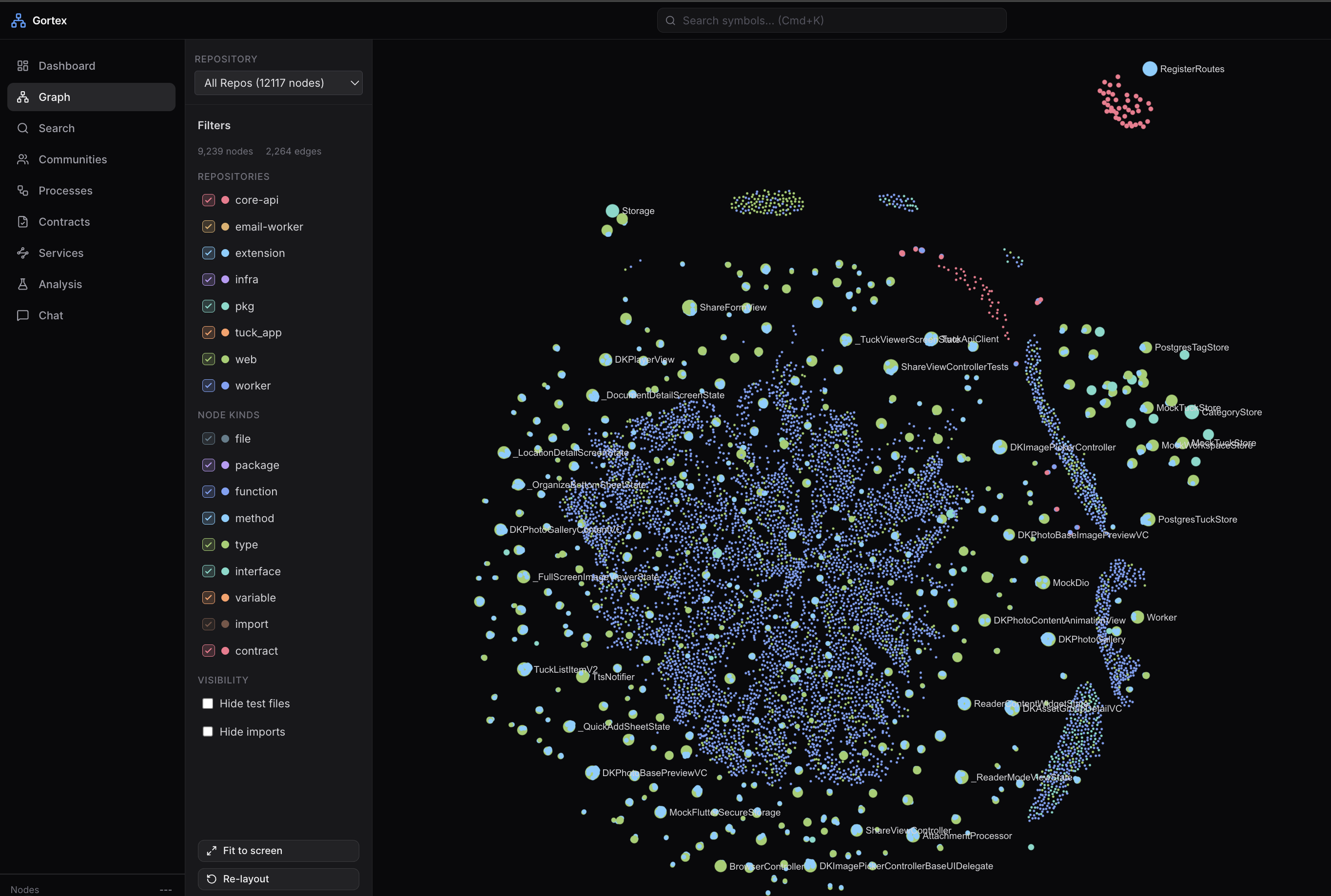
- Web UI — Sigma.js force-directed visualization with node size proportional to importance
- IMPLEMENTS inference — structural interface satisfaction for Go, TypeScript, Java, Rust, C#, Scala, Swift, Protobuf
- PreToolUse + PreCompact + Stop hooks — PreToolUse enriches Read/Grep/Glob with graph context and redirects to Gortex MCP tools; matching
Taskalso briefs spawned subagents with an inline tool-swap table + task-scopedsmart_contextso subagents don't fall back to grep/Read. PreCompact injects a condensed orientation snapshot (index stats, recently-modified symbols, top hotspots, feedback-ranked symbols) before Claude Code compacts the conversation. Stop runs post-task diagnostics (detect_changes→get_test_targets,check_guards,analyze dead_code,contracts checkon modified symbols) so the agent self-corrects before handoff. All hooks degrade silently when the bridge is unreachable - Long-living daemon (optional) —
gortex daemon startruns a single shared process that holds the graph for every tracked repo. Each Claude Code / Cursor / Kiro window connects as a thin stdio proxy over a Unix socket, getting per-client session isolation (recent activity, token stats) + cross-repo queries by default. Live fsnotify watching on every tracked repo so file edits flow into the graph without manual reload.gortex init --globalsets up user-level config;gortex daemon install-serviceinstalls a LaunchAgent (macOS) or systemd--userunit (Linux) so the OS supervises lifecycle and auto-starts at login — no sudo required. Binaries fall back to embedded mode if the daemon isn't running; the feature is additive - Benchmarked — per-language parsing, query engine, indexer benchmarks
- Per-community skills —
gortex skillsauto-generates SKILL.md per detected community with key files, entry points, cross-community connections, and MCP tool invocations for Claude Code auto-discovery - Eval framework — SWE-bench harness for A/B benchmarking tool effectiveness with Docker-based environments and multi-model support
- Zero dependencies — everything runs in-process, in memory, no external services
Installation
Pre-built binaries are published to GitHub Releases for linux/amd64, linux/arm64, darwin/amd64 (Intel Mac), and darwin/arm64 (Apple Silicon). Windows support is planned.
New to Gortex? After installing, see docs/onboarding.md for the 15-minute walkthrough: gortex init → start the server → verify your AI assistant uses graph tools → what to do if it doesn't.
macOS — Homebrew
brew install zzet/tap/gortex
Homebrew strips the homebrew- prefix from tap repositories, so zzet/homebrew-tap is installed as zzet/tap. Updates via brew upgrade. No Gatekeeper prompt — brew doesn't set the quarantine attribute on downloads.
Linux — Debian / Ubuntu (.deb)
ARCH=$(dpkg --print-architecture)  # amd64 or arm64
curl -LO "https://github.com/zzet/gortex/releases/latest/download/gortex_linux_${ARCH}.deb"
sudo dpkg -i "gortex_linux_${ARCH}.deb"
Linux — RHEL / Fedora / CentOS (.rpm)
ARCH=$(uname -m); [ "$ARCH" = x86_64 ] && ARCH=amd64; [ "$ARCH" = aarch64 ] && ARCH=arm64
curl -LO "https://github.com/zzet/gortex/releases/latest/download/gortex_linux_${ARCH}.rpm"
sudo rpm -ivh "gortex_linux_${ARCH}.rpm"
Linux — Alpine (.apk)
ARCH=$(uname -m); [ "$ARCH" = x86_64 ] && ARCH=amd64; [ "$ARCH" = aarch64 ] && ARCH=arm64
curl -LO "https://github.com/zzet/gortex/releases/latest/download/gortex_linux_${ARCH}.apk"
sudo apk add --allow-untrusted "gortex_linux_${ARCH}.apk"
Direct binary download (any Linux or macOS)
# Pick the right asset for your OS/arch
OS=$(uname -s | tr '[:upper:]' '[:lower:]')  # linux or darwin
ARCH=$(uname -m)
case $ARCH in
  x86_64) ARCH=amd64 ;;
  aarch64|arm64) ARCH=arm64 ;;
esac

curl -LO "https://github.com/zzet/gortex/releases/latest/download/gortex_${OS}_${ARCH}.tar.gz"
tar -xzf "gortex_${OS}_${ARCH}.tar.gz"
sudo mv gortex /usr/local/bin/
On macOS, if you downloaded via browser (not curl), remove the quarantine flag once:
xattr -d com.apple.quarantine /usr/local/bin/gortex
Verify the install
gortex version
From source
Requires Go 1.25+ and a C toolchain (the tree-sitter extractors are CGO — no way around it).
git clone https://github.com/zzet/gortex.git
cd gortex
go build -o gortex ./cmd/gortex/
sudo mv gortex /usr/local/bin/
Or without cloning:
go install github.com/zzet/gortex/cmd/gortex@latest
go install drops the binary into $(go env GOBIN) (default ~/go/bin) — make sure that's on your PATH.
Quick Start
gortex init in a terminal opens an interactive wizard that asks whether you want a global daemon or per-project setup, and whether to track the current repo + start the daemon immediately. For scripts or CI the flags below skip the prompt.
Global mode (recommended when you work across multiple repos)
# Interactive: walks you through mode choice + follow-ups
cd ~/projects/myapp
gortex init

# Non-interactive equivalent (CI / scripts):
gortex init --global --start --track

# Daemon lifecycle:
gortex daemon start --detach        # spawn in background
gortex daemon status                # PID, uptime, memory, tracked repos, sessions
gortex daemon stop                  # graceful shutdown + final snapshot
gortex daemon restart               # stop + start
gortex daemon reload                # re-read config, pick up new/removed repos
gortex daemon logs -n 50            # tail the log file

# Auto-start at login (launchd on macOS, systemd --user on Linux):
gortex daemon install-service
gortex daemon service-status
gortex daemon uninstall-service

# Track / untrack repos (daemon-first dispatch; falls back to config-only when no daemon):
gortex track ~/projects/backend
gortex untrack backend

# Per-repo status + daemon-wide status share the same command — it picks:
gortex status
Per-repo mode
# Pick [2] at the wizard, or pass no --global flag and the config stays local:
gortex init /path/to/repo               # creates .mcp.json, CLAUDE.md, hooks, commands
gortex init --analyze /path/to/repo     # indexes first for a richer CLAUDE.md
gortex init --hooks /path/to/repo       # (re)install hooks only

# Run the MCP server standalone (auto-detects daemon via stdio; --no-daemon forces embedded):
gortex serve --index /path/to/repo --watch
gortex serve --no-daemon --watch        # explicit embedded mode
Other commands
gortex skills /path/to/repo              # generate per-community SKILL.md files for Claude Code
gortex bridge --index . --web            # HTTP bridge API + web graph UI at :4747
gortex savings                           # cumulative tokens saved + $ avoided across sessions
gortex version
Multi-Repo Workspaces
Gortex can index multiple repositories into a single shared graph, enabling cross-repo symbol resolution, impact analysis, and navigation.
Configuration
Two-tier config hierarchy:
- Global config (
~/.config/gortex/config.yaml) — projects, repo lists, active project, reference tags - Workspace config (
.gortex.yamlper repo) — guards, excludes, local overrides (workspace wins when both define the same setting)
# ~/.config/gortex/config.yaml
active_project: my-saas

repos:
  - path: /home/user/projects/gortex
    name: gortex

projects:
  my-saas:
    repos:
      - path: /home/user/projects/frontend
        name: frontend
        ref: work
      - path: /home/user/projects/backend
        name: backend
        ref: work
      - path: /home/user/projects/shared-lib
        name: shared-lib
        ref: opensource
CLI
gortex track /path/to/repo          # Add a repo to the workspace
gortex untrack /path/to/repo        # Remove a repo from the workspace
gortex serve --track /path/to/repo  # Track additional repos on startup
gortex serve --project my-saas      # Set active project scope
gortex index repo-a/ repo-b/        # Index multiple repos
gortex status                       # Per-repo and per-project stats
MCP Tools
Agents can manage repos at runtime without CLI access:
| Tool | Description |
|---|---|
track_repository |
Add a repo, index immediately, persist to config |
untrack_repository |
Remove a repo, evict nodes/edges, persist to config |
set_active_project |
Switch project scope for all subsequent queries |
get_active_project |
Return current project name and repo list |
All query tools (search_symbols, get_symbol, find_usages, get_file_summary, get_call_chain, smart_context) accept optional repo, project, and ref parameters for scoping. When an active project is set, it applies as the default scope.
How It Works
- Qualified Node IDs — in multi-repo mode, IDs become
<repo_prefix>/<path>::<Symbol>(e.g.,frontend/src/app.ts::App). Single-repo mode keeps the existing<path>::<Symbol>format. - Cross-repo edges — the resolver links symbols across repo boundaries with same-repo preference. Cross-repo edges carry a
cross_repo: trueflag. - Impact analysis —
explain_change_impact,verify_change, andget_test_targetsfollow cross-repo edges automatically, grouping results by repository. - Shared repos — the same repo can appear in multiple projects with different reference tags. It's indexed once and shared across projects.
- Auto-detection — set
workspace.auto_detect: truein.gortex.yamlto auto-discover Git repos in a parent directory.
Usage with Claude Code
After running gortex init, Claude Code automatically starts Gortex via .mcp.json. The agent gets:
- Slash commands:
/gortex-guide,/gortex-explore,/gortex-debug,/gortex-impact,/gortex-refactor - Global skills: installed to
~/.claude/skills/— available across all repos - PreToolUse hook: automatic graph context + graph-tool suggestions on Read/Grep/Glob
- PreCompact hook: condensed orientation snapshot injected before context compaction so the agent resumes without re-exploring
- Stop hook: post-task diagnostics — tests to run, guard violations, dead code, and contract issues on the changed symbols — injected as context before the agent hands off
- CLAUDE.md instructions: mandatory tool usage table and session workflow
Usage with Kiro
gortex init also sets up Kiro IDE integration automatically:
- MCP server:
.kiro/settings/mcp.json— 40 read-only tools auto-approved for zero-friction use (write tools likeedit_symbolandrename_symbolrequire approval) - Steering files:
.kiro/steering/gortex-workflow.md(always active) teaches Kiro to prefer graph queries over file reads. Additional manual steering files for explore, debug, impact, and refactor workflows are available via#in chat. - Agent hooks:
gortex-smart-context— on each prompt, assembles task-relevant context from the graph in one callgortex-post-edit— after saving source files, shows blast radius and which tests to rungortex-pre-read— before reading source files, enriches with symbol context from the graph
Usage with Antigravity
gortex init also automatically loads project intelligence instructions into the Antigravity agent:
- Knowledge Item (KI): Creates a dedicated KI globally in
~/.gemini/antigravity/knowledge/gortex-workflow/. - Workflow Instructions: Instructs the Antigravity assistant to prioritize executing AST-aware Gortex CLI queries (
./gortex query symbol,./gortex query dependents) via its built-in terminal tool, overriding genericgrepand file read routines. - Token Efficiency: Significantly reduces context token usage by constraining the AI's reads precisely to verified dependency paths and function definitions.
Usage with Cursor
gortex init detects Cursor (via .cursor/ directory, ~/.cursor/, or cursor in PATH) and creates:
- MCP config:
.cursor/mcp.json— project-level config, committable to the repo so the whole team gets Gortex automatically.
Usage with VS Code / GitHub Copilot
gortex init detects VS Code (via .vscode/ directory, code in PATH, or VS Code app data directories) and creates:
- MCP config:
.vscode/mcp.json— project-level config for Copilot Chat agent mode. All Gortex tools are available in Copilot's agent mode.
Usage with Windsurf
gortex init detects Windsurf (via windsurf in PATH or ~/.codeium/windsurf/ directory) and creates:
- MCP config:
~/.codeium/windsurf/mcp_config.json— global config (Windsurf only reads from this location). Merges into existing config without overwriting other servers.
Usage with Continue.dev
gortex init detects Continue.dev (via .continue/ directory in project or ~/.continue/) and creates:
- MCP config:
.continue/mcpServers/gortex.json— project-level config. Continue reads JSON MCP configs from the.continue/mcpServers/directory and supports the same format as Claude/Cursor.
Usage with Cline
gortex init detects Cline (via VS Code or Cursor globalStorage directories) and creates:
- MCP config:
cline_mcp_settings.jsonin the Cline extension's globalStorage directory. Includes analwaysAllowlist for read-only Gortex tools.
Usage with OpenCode
gortex init detects OpenCode (via .opencode/ directory in project, opencode in PATH, or ~/.config/opencode/) and creates:
- MCP config:
.opencode/config.json— project-level config using OpenCode's native format ("type": "local","command"as array,"environment"for env vars). Merges into existing config without overwriting other servers.
CLI Commands
gortex init [path]           Set up Gortex for a project + install global skills
gortex serve [flags]         Start the MCP server (--bridge to add HTTP API)
gortex bridge [flags]        Start standalone HTTP bridge API
gortex eval-server [flags]   Start eval HTTP server for benchmarking
gortex skills [path]         Generate per-community SKILL.md files
gortex context [flags]       Generate portable context briefing for a task
gortex savings [flags]       Show cumulative token savings + cost avoided across sessions
gortex index [path...]       Index one or more repositories and print stats
gortex status [flags]        Show index status (per-repo and per-project in multi-repo mode)
gortex track <path>          Add a repository to the tracked workspace
gortex untrack <path>        Remove a repository from the tracked workspace
gortex query <subcommand>    Query the knowledge graph
gortex clean                 Remove Gortex files from a project
gortex claude-md [flags]     Generate CLAUDE.md block
gortex version               Print version
Query Subcommands
gortex query symbol <name>              Find symbols matching name
gortex query deps <id>                  Show dependencies
gortex query dependents <id>            Show blast radius
gortex query callers <func-id>          Show who calls a function
gortex query calls <func-id>            Show what a function calls
gortex query implementations <iface>    Show interface implementations
gortex query usages <id>                Show all usages
gortex query stats                      Show graph statistics
All query commands support --format text|json|dot (DOT output for Graphviz visualization).
MCP Tools (44)
Core Navigation
| Tool | Description |
|---|---|
graph_stats |
Node/edge counts by kind, language, per-repo stats, and session token savings |
search_symbols |
Find symbols by name (replaces Grep). Accepts repo, project, ref params |
get_symbol |
Symbol location and signature (replaces Read). Accepts repo, project, ref params |
get_file_summary |
All symbols and imports in a file. Accepts repo, project, ref params |
get_editing_context |
Primary pre-edit tool — symbols, signatures, callers, callees |
Graph Traversal
| Tool | Description |
|---|---|
get_dependencies |
What a symbol depends on |
get_dependents |
What depends on a symbol (blast radius) |
get_call_chain |
Forward call graph |
get_callers |
Reverse call graph |
find_usages |
Every reference to a symbol |
find_implementations |
Types implementing an interface |
get_cluster |
Bidirectional neighborhood |
Coding Workflow
| Tool | Description |
|---|---|
get_symbol_source |
Source code of a single symbol (80% fewer tokens than Read). Returns tokens_saved per call |
batch_symbols |
Multiple symbols with source/callers/callees in one call |
find_import_path |
Correct import path for a symbol |
explain_change_impact |
Risk-tiered blast radius with affected processes |
get_recent_changes |
Files/symbols changed since timestamp |
edit_symbol |
Edit a symbol's source directly by ID — no Read needed |
rename_symbol |
Coordinated multi-file rename with all references |
Agent-Optimized (token efficiency)
| Tool | Description |
|---|---|
smart_context |
Task-aware minimal context — replaces 5-10 exploration calls |
get_edit_plan |
Dependency-ordered edit sequence for multi-file refactors |
get_test_targets |
Maps changed symbols to test files and run commands |
suggest_pattern |
Extracts code pattern from an example — source, registration, tests |
export_context |
Portable markdown/JSON context briefing for sharing outside MCP |
feedback |
action: "record": report useful/missing symbols. action: "query": aggregated stats — most useful, most missed, accuracy metrics |
Analysis
| Tool | Description |
|---|---|
get_communities |
Functional clusters (Louvain). Without id: list all. With id: members and cohesion for one community |
get_processes |
Discovered execution flows. Without id: list all. With id: step-by-step trace |
detect_changes |
Git diff mapped to affected symbols |
index_repository |
Index or re-index a repository path |
contracts |
API contracts. action: "list" (default): detected HTTP/gRPC/GraphQL/topics/WebSocket/env/OpenAPI. action: "check": orphan providers/consumers |
Proactive Safety
| Tool | Description |
|---|---|
verify_change |
Check proposed signature changes against all callers and interface implementors |
check_guards |
Evaluate project guard rules (.gortex.yaml) against changed symbols |
audit_agent_config |
Scan CLAUDE.md / AGENTS.md / .cursor/rules / .github/copilot-instructions.md / .windsurf/rules / .antigravity/rules for stale symbol references, dead file paths, and bloat — validated against the Gortex graph (no other competitor does this) |
Code Quality
| Tool | Description |
|---|---|
analyze |
Unified graph analysis. kind: "dead_code": symbols with zero incoming edges. kind: "hotspots": high fan-in/out symbols. kind: "cycles": Tarjan's SCC cycle detection. kind: "would_create_cycle": check if a new dependency would form a cycle |
index_health |
Health score, parse failures, stale files, language coverage |
get_symbol_history |
Symbols modified this session with counts; flags churning (3+ edits) |
Code Generation
| Tool | Description |
|---|---|
scaffold |
Generate code, registration wiring, and test stubs from an example symbol |
batch_edit |
Apply multiple edits in dependency order, re-index between steps |
diff_context |
Git diff enriched with callers, callees, community, processes, per-file risk |
prefetch_context |
Predict needed symbols from task description and recent activity |
Multi-Repo Management
| Tool | Description |
|---|---|
track_repository |
Add a repo at runtime — indexes immediately, persists to global config |
untrack_repository |
Remove a repo — evicts nodes/edges, persists to global config |
set_active_project |
Switch active project scope for all subsequent queries |
get_active_project |
Return current project name and its member repositories |
MCP Resources (7)
| Resource | Description |
|---|---|
gortex://session |
Current session state and activity |
gortex://stats |
Graph statistics (node/edge counts) |
gortex://schema |
Graph schema reference |
gortex://communities |
Community list with cohesion scores |
gortex://community/{id} |
Single community detail |
gortex://processes |
Execution flow list |
gortex://process/{id} |
Single process trace |
MCP Prompts (3)
| Prompt | Description |
|---|---|
pre_commit |
Review uncommitted changes — shows changed symbols, blast radius, risk level, affected tests |
orientation |
Orient in an unfamiliar codebase — graph stats, communities, execution flows, key symbols |
safe_to_change |
Analyze whether it's safe to change specific symbols — blast radius, edit plan, affected tests |
Web UI
Gortex includes a standalone Next.js web application (web/ directory) with 10 pages:
# Start the backend
gortex bridge --index /path/to/repo --web --port 4747

# Start the web UI
cd web && npm run dev
# Open http://localhost:3000
| Page | Features |
|---|---|
| Dashboard | Health, stats, language pie chart, node kind bar chart |
| Graph Explorer | Interactive Sigma.js + ForceAtlas2, node filters, selection, detail panel |
| Search | Semantic search via bridge API, results grouped by kind |
| Symbol Detail | Source code, signature, callers/callees/usages/deps tabs |
| Communities | Community cards with cohesion bars, expandable members |
| Processes | Execution flow table with step lists |
| Analysis | Dead code, hotspots, cycles, index health — 4 tabs |
| Contracts | API contracts (HTTP, gRPC, GraphQL, topics, WebSocket, env vars) with provider/consumer matching |
| Services | Service-level graph visualization with per-repo stats |
| AI Chat | LLM-powered chat with code context (placeholder) |
The legacy embedded web UI (Sigma.js on :8765) is still available via gortex serve --web.
Bridge Mode
The gortex bridge command exposes all MCP tools as an HTTP/JSON API for external integrations:
# Standalone bridge with web UI
gortex bridge --index /path/to/repo --web --port 4747

# Bridge alongside MCP stdio
gortex serve --index /path/to/repo --bridge --port 8765
Endpoints:
| Endpoint | Method | Description |
|---|---|---|
/health |
GET | Status, node/edge counts, uptime |
/tools |
GET | List all available tools with descriptions |
/tool/{name} |
POST | Invoke any MCP tool with JSON arguments |
/stats |
GET | Graph statistics by kind and language |
CORS is enabled by default (--cors-origin '*'). The bridge can serve the web UI on the same port with --web.
Cross-Repo API Contracts
Gortex detects API contracts across repos and matches providers to consumers:
# After indexing, contracts are auto-detected
gortex bridge --index . --web

# Via MCP tools
contracts                        # list all detected contracts (default action)
contracts {action: "check"}      # find mismatches and orphans
| Contract Type | Detection | Provider | Consumer |
|---|---|---|---|
| HTTP Routes | Framework annotations (gin, Express, FastAPI, Spring, etc.) | Route handler | HTTP client calls (fetch, http.Get) |
| gRPC | Proto service definitions | Service RPC | Client stub calls |
| GraphQL | Schema type/field definitions | Schema | Query/mutation strings |
| Message Topics | Pub/sub patterns (Kafka, NATS, RabbitMQ) | Publish calls | Subscribe calls |
| WebSocket | Event emit/listen patterns | emit() | on() |
| Env Vars | os.Getenv, process.env, .env files | Setenv / .env | Getenv / process.env |
| OpenAPI | Swagger/OpenAPI spec files | Spec paths | (linked to HTTP routes) |
Contracts are normalized to canonical IDs (e.g., http::GET::/api/users/{id}) and matched across repos to detect orphan providers/consumers and mismatches.
Per-Community Skills
gortex skills analyzes your codebase, detects functional communities via Louvain clustering, and generates targeted SKILL.md files that Claude Code auto-discovers:
# Generate skills for the current repo
gortex skills .

# Custom settings
gortex skills . --min-size 5 --max-communities 10 --output-dir .claude/skills/generated/
Each generated skill includes:
- Community metadata — size, file count, cohesion score
- Key files table — files and their symbols
- Entry points — main functions, handlers, controllers detected via process analysis
- Cross-community connections — which other areas this community interacts with
- MCP tool invocations — pre-written
get_communities,smart_context,find_usagescalls
Skills are written to .claude/skills/generated/ and a routing table is inserted into CLAUDE.md between <!-- gortex:skills:start/end --> markers.
Semantic Search
Hybrid BM25 + vector search with Reciprocal Rank Fusion (RRF). Multiple embedding tiers:
# Built-in word vectors (always available, zero setup)
gortex serve --index . --embeddings

# Ollama (best quality, local)
ollama pull nomic-embed-text
gortex serve --index . --embeddings-url http://localhost:11434

# OpenAI (best quality, cloud)
gortex serve --index . --embeddings-url https://api.openai.com/v1 \
  --embeddings-model text-embedding-3-small
| Tier | Flag | Quality | Offline | Default build? |
|---|---|---|---|---|
| Hugot (pure Go) | --embeddings |
Good (MiniLM-L6-v2) | Yes (model auto-downloads on first use) | Yes |
| Built-in | --embeddings (when Hugot unavailable) |
Basic (GloVe word averaging) | Yes | Yes |
| API | --embeddings-url |
Best (transformer model) | No | Yes |
| ONNX | --embeddings + build tag |
Best | Yes (model + libonnxruntime required) | No |
| GoMLX | --embeddings + build tag |
Good | Yes (XLA plugin auto-downloads) | No |
The default build ships with Hugot using the pure-Go ONNX runtime — no native dependencies, no manual model placement. The MiniLM-L6-v2 model downloads to ~/.cache/gortex/models/ on first use (~90 MB).
Opt-in faster backends via build tags:
go build -tags embeddings_onnx ./cmd/gortex/   # needs: brew install onnxruntime
go build -tags embeddings_gomlx ./cmd/gortex/  # auto-downloads XLA plugin
Token Savings
Gortex tracks how many tokens it saves compared to naive file reads — per-call, per-session, and cumulative across restarts:
- Per-call:
get_symbol_sourceand other source-reading tools include atokens_savedfield in the response, showing the difference between reading the full file vs the targeted symbol. - Session-level:
graph_statsreturns atoken_savingsobject withcalls_counted,tokens_returned,tokens_saved,efficiency_ratio. - Cumulative (cross-session):
graph_statsalso returnscumulative_savingswhen persistence is wired — includesfirst_seen,last_updated, andcost_avoided_usdper model (Claude Opus/Sonnet/Haiku, GPT-4o, GPT-4o-mini). Backed by~/.cache/gortex/savings.json.
# Show totals + cost across all default models
gortex savings

# Highlight a single model (fuzzy match: "opus" → claude-opus-4)
gortex savings --model opus

# Machine-readable output
gortex savings --json

# Wipe cumulative totals
gortex savings --reset

# Override pricing (JSON array of {model, usd_per_m_input})
GORTEX_MODEL_PRICING_JSON='[{"model":"mycorp","usd_per_m_input":5}]' gortex savings
Token counts use tiktoken (cl100k_base) — the tokenizer Claude and GPT-4 actually use — via github.com/pkoukk/tiktoken-go with an embedded offline BPE loader, so no runtime downloads. The BPE is lazy-loaded on first call. If init fails for any reason, the package falls back to the legacy chars/4 heuristic so metrics stay usable.
Graph Persistence
Gortex snapshots the graph to disk on shutdown and restores it on startup, with incremental re-indexing of only changed files:
# Default cache directory: ~/.cache/gortex/
gortex serve --index /path/to/repo

# Custom cache directory
gortex serve --index /path/to/repo --cache-dir /tmp/gortex-cache

# Disable caching
gortex serve --index /path/to/repo --no-cache
The persistence layer uses a pluggable backend interface (persistence.Store). The default backend serializes as gob+gzip. Cache is keyed by repo path + git commit hash, with version validation to invalidate on binary upgrades.
Architecture
gortex binary
  CLI (cobra)  ──> MultiIndexer ──> In-Memory Graph (shared, per-repo indexed)
  MCP Server ──────────────────────> Query Engine (repo/project/ref scoping)
  Bridge API ──────────────────────> (HTTP/JSON over MCP tools)
  Web Server ──────────────────────> (Nodes + Edges + byRepo index)
  MCP Prompts ─────────────────────> (pre_commit, orientation, safe_to_change)
  MCP Resources ───────────────────> (session, stats, schema, communities, processes)
                   MultiWatcher <── filesystem events (fsnotify, per-repo)
                   CrossRepoResolver ──> cross-repo edge creation (type-aware)
                   Persistence ──> gob+gzip snapshot (pluggable backend)
Data flow:
- On startup, loads cached graph snapshot if available; otherwise performs full indexing
- MultiIndexer walks each repo directory concurrently, dispatches files to language-specific extractors (tree-sitter)
- Extractors produce nodes (files, functions, types, etc.) and edges (calls, imports, defines, etc.) with type environment metadata
- In multi-repo mode, nodes get
RepoPrefixand IDs become<repo_prefix>/<path>::<Symbol> - Resolver links cross-file references with type-aware method matching; CrossRepoResolver links cross-repo references with same-repo preference
- Query Engine answers traversal queries with optional repo/project/ref scoping
- MultiWatcher detects changes per-repo and surgically patches the graph (debounced per-file), then re-resolves cross-repo edges
- On shutdown, persists graph snapshot for fast restart
Graph Schema
Node kinds: file, function, method, type, interface, variable, import, package
Edge kinds: calls, imports, defines, implements, extends, references, member_of, instantiates
Multi-repo fields: Nodes carry repo_prefix (empty in single-repo mode). Edges carry cross_repo (true when connecting nodes in different repos). Node IDs use <repo_prefix>/<path>::<Symbol> format in multi-repo mode.
Language Support (33 languages)
Code Languages
| Language | Functions | Methods + MemberOf | Types | Interfaces | Imports | Calls | Variables |
|---|---|---|---|---|---|---|---|
| Go | Full | Full (receiver) | Full | Full + Meta["methods"] | Full | Full | Full |
| TypeScript | Full | Full | Full | Full + Meta["methods"] | Full | Full | Full |
| JavaScript | Full | Full | Full | - | Full | Full | Full |
| Python | Full | Full | Full | - | Full | Full | Partial |
| Rust | Full | Full (impl blocks) | Full | Full + Meta["methods"] | Full | Full | Full |
| Java | Full | Full | Full | Full + Meta["methods"] | Full | Full | Fields |
| C# | Full | Full | Full | Full + Meta["methods"] | Full | Full | Fields |
| Kotlin | Full | Full | Full | Full | Full | Full | Properties |
| Scala | Full | Full | Full | Full + Meta["methods"] | Full | Full | - |
| Swift | Full | Full | Full | Full + Meta["methods"] | Full | Full | - |
| PHP | Full | Full | Full | Full | Full | Full | - |
| Ruby | Full | Full | Full | - | Full | Full | Constants |
| Elixir | Full | Full (defmodule) | Modules | - | Full | Full | Attributes |
| C | Full | - | Structs/Enums | - | Full | Full | Globals |
| C++ | Full | Full | Classes/Structs | - | Full | Full | - |
| Dart | Full | Full | Classes/Enums/Mixins/Extensions | Abstract interface | Full | Full | Full |
| OCaml | Full | Full (class) | Types/Modules | Module types | open | Full | Full |
| Lua | Full | Full (M.func/M:method) | - | - | require() | Full | Full |
| Zig | Full | - | Structs/Enums/Unions | - | @import | Full | Full |
| Haskell | Full | - | data/newtype/type | class | import | Full | - |
| Clojure | Full (defn) | - | defrecord/deftype | defprotocol | require/use | Full | def |
| Erlang | Full | - | -type/-record | - | -import | Full | - |
| R | Full | - | - | - | library/require/source | Full | Full |
| Bash/Zsh | Full | - | - | - | source/. | Full | Exports |
Data & Config Languages
| Language | What it extracts |
|---|---|
| SQL | Tables (with columns), views, functions, indexes, triggers |
| Protobuf | Messages (with fields), services + RPCs, enums, imports |
| Markdown | Headings, local file links, code block languages |
| HTML | Script/link references, element IDs |
| CSS | Class selectors, ID selectors, custom properties, @import |
| YAML | Top-level keys |
| TOML | Tables, key-value pairs |
| HCL/Terraform | Resource/data/module/variable/output blocks (.tf, .tfvars, .hcl) |
| Dockerfile | FROM (base images), ENV/ARG variables |
Building
make build          # Build with version from git tags
make test           # go test -race ./...
make bench          # Run all benchmarks
make lint           # golangci-lint
make fmt            # gofmt -s
make install        # go install with version ldflags
Requires Go 1.21+ and CGO enabled (for tree-sitter C bindings).
License
Gortex is source-available under a custom license based on PolyForm Small Business. See LICENSE.md for full terms.
Free for: individuals, open-source projects, small businesses (<50 employees / <$500K revenue), nonprofits, education, government, socially critical orgs.
Commercial license required for: organizations with 50+ employees or $500K+ revenue, competing products, resale/bundling. Contact [email protected].
Contributors: active contributors listed in CONTRIBUTORS.md receive a free non-competing commercial license for their employer.
Contributing
See CONTRIBUTING.md for guidelines on adding features, language extractors, and submitting PRs. Active contributors receive a contributor commercial license.
Reviews (0)
Sign in to leave a review.
Leave a reviewNo results found