pai-pro

agent
Guvenlik Denetimi
Basarisiz
Health Uyari
  • License — License: NOASSERTION
  • Description — Repository has a description
  • Active repo — Last push 0 days ago
  • Low visibility — Only 5 GitHub stars
Code Basarisiz
  • rm -rf — Recursive force deletion command in docker/entrypoint.sh
  • process.env — Environment variable access in server/__tests__/canvas_mutator_http.test.js
  • network request — Outbound network request in server/__tests__/canvas_mutator_http.test.js
Permissions Gecti
  • Permissions — No dangerous permissions requested

Bu listing icin henuz AI raporu yok.

SUMMARY

Local AI filmmaking canvas for your coding agent. Skills for scripts, characters, clips, voices — assembled on a visual timeline. From Utopai Studios

README.md

Utopai Studios

pai-pro

Local AI filmmaking canvas, driven by Claude Code. Built by Utopai Studios.

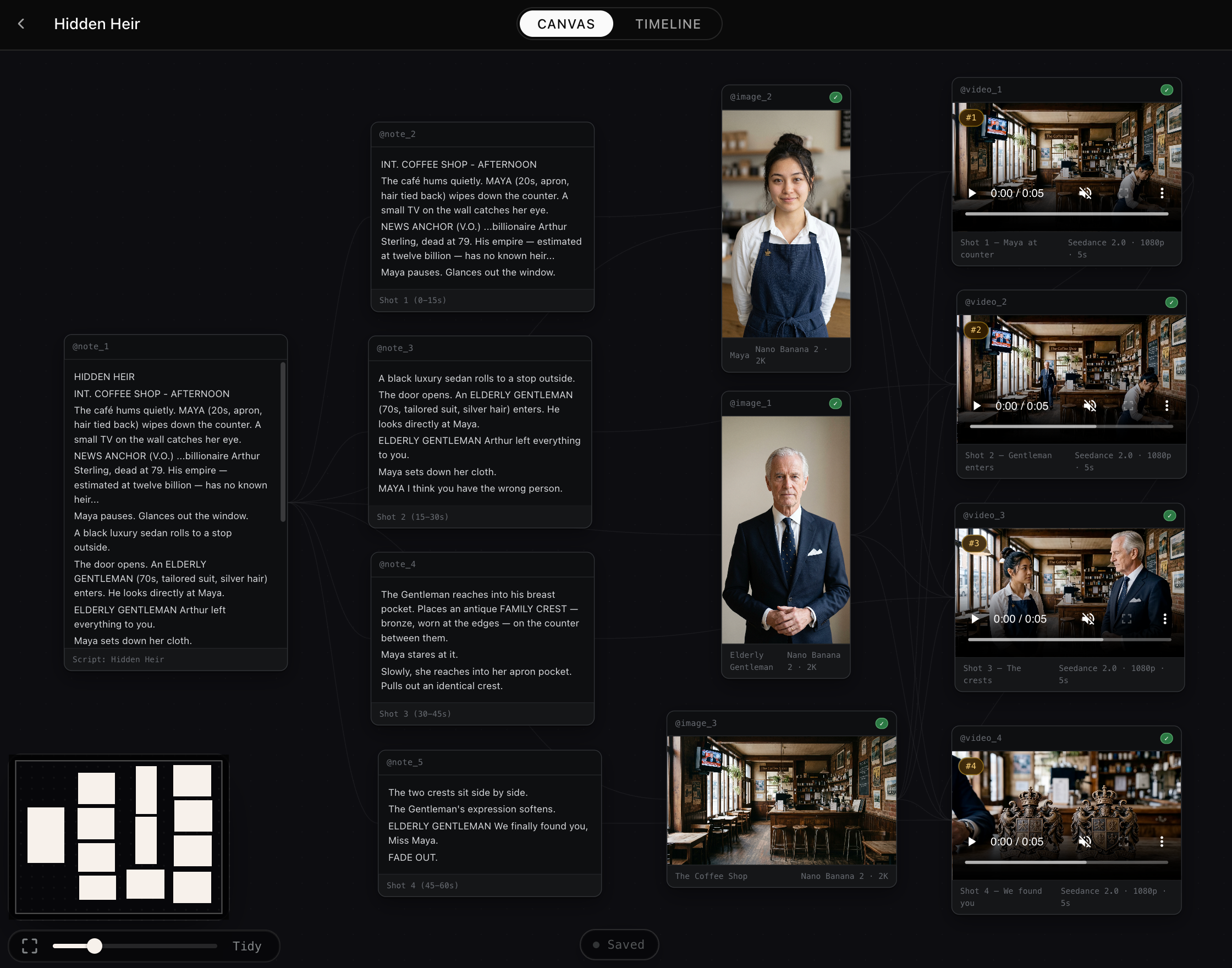
Seven filmmaking skills, a React Flow canvas, and an embedded claude terminal — write a screenplay, design characters, generate clips, lay them out on a timeline. Local-first: your project files live on disk, generated media is mirrored alongside, nothing leaves your machine except the actual generation calls.

┌─ Canvas │ Timeline ──────────────────┬─ Terminal │ History ─┐
│                                      │                      │
│   Detective Morris ──► Diner shot    │  > design morris,    │
│        │                    │        │    weathered, noir   │
│        ▼                    ▼        │  ✓ image_3 created   │
│   Morris voice         Morgue still  │  > animate the diner │
│                                      │  ⠋ rendering 8s…     │
└──────────────────────────────────────┴──────────────────────┘

Bring-your-own AI coding agent. Today: Claude Code (fully wired, embedded terminal, auto-discovered skills). On the roadmap: Codex CLI, Cursor agent, Gemini CLI — the skill format and CLI surface are already cross-agent-compatible; only the launcher + terminal embedding are Claude-Code-specific.

Compatible agent Status
Claude Code ✅ Tested. Embedded PTY + auto-discovered skills via ./setup.
Codex CLI ⏳ Skills work via ~/.codex/skills/; embedded terminal swap-in pending.
Cursor agent ⏳ Skills work via .cursor/rules/; embedded terminal swap-in pending.
Gemini CLI ⏳ Skills work via ~/.gemini/skills/; embedded terminal swap-in pending.

What's in the box

  • Seven filmmaking skills (skills/) that route filmmaking intent → CLI scripts. Standard Anthropic SKILL.md format; the same shape Codex/Cursor/Gemini CLI also consume.
  • A React Flow canvas with character, location, image, video, and note nodes; drag-to-reorder, grouped scenes, mention-pill references between nodes and chat.
  • A Timeline tab that plays your shots in sequence — drag clips onto the reel, reorder, scrub, preview any unattached clip without committing it.
  • An embedded claude terminal in the right rail. Real PTY, tmux-style: survives page reloads, replays a rolling 256 KB buffer on attach, auto-resumes the project's session.
  • Per-project memory — every project owns its workflow.json and asset folder. Switch projects, agent context follows.
  • Live sync via Socket.IO — agent-side edits hit the canvas without a refresh.

Quick start

Two ways to run pai-pro. Docker is the fastest on-ramp — one command from a fresh clone, every system dependency (ffmpeg, poppler, cloudflared, Claude CLI) bundled in the image. Host mode is for active development on the canvas itself — Vite HMR, live code reload, easier debugging. They use different ports (:7588 and :7488) so you can run both side by side, useful for catching "works on my machine" regressions before they ship.

Docker (recommended)

Prereq: Docker Desktop (macOS / Windows, WSL2 backend on Windows) or Docker Engine + Compose v2 (Linux). Tested on Docker 28.

Windows users: run the commands below in PowerShell or a WSL2 terminal — not cmd.exe (which doesn't expand ~ or ${HOME} the same way). Make sure Docker Desktop is using the WSL2 backend (default for new installs on Windows 10/11). If you use WSL2, clone into your WSL2 home for best file-system performance.

git clone https://github.com/Utopai-Research/pai-pro.git ~/pai-pro
cd ~/pai-pro
cp .env.example .env                  # add the API keys you have — all optional
docker compose up --build             # ~5-10 min first build, cached after
open http://localhost:7588            # browser entry (use `start` on Windows, or just paste into a browser)

In the embedded terminal, pick a Claude Code theme and run /login once. After that the canvas is fully wired — generate images, chain into videos, drop notes, scrub the timeline. Your work lives in the pai_projects named volume and survives docker compose restart / down; only docker compose down -v wipes it.

What the image gives you:

  • Non-root runtime as the node user (UID 1000).
  • Multi-stage build — native modules (sharp, node-pty) rebuilt against linux/glibc; runtime layer ships only what's needed.
  • /healthz probe verifies ffmpeg, poppler, claude CLI, volume writability, and PTY availability on every healthcheck interval.
  • An in-container Cloudflare quick tunnel for video-gen reference fetching (PAI's video-generation-assets endpoint fetches refs server-side and localhost is unreachable to it). Anonymous, no account required, ~3 s to land a URL. Set PUBLIC_VIEWER_URL in .env to skip the tunnel and use your own named domain instead.
  • Hardened build context — .dockerignore keeps .env, .tunnel_url, projects/, and other state out of any image layer. Credentials cannot land in the image even by accident.
  • No published image. Build-locally only, so a maintainer's laptop can never push secrets to a registry.

Port differs from host mode on purpose. Container is on :7488 internally but maps to host :7588. Your existing ./start.sh on :7488 keeps working. Set HOST_VIEWER_PORT=7488 in .env if you don't run host mode and want the canonical port.

Host mode (active development)

The original install path — runs Node directly on the host with Vite HMR. Use this when you're hacking on the canvas source itself.

Prerequisites

  • Node.js ≥20 and npm
  • Claude Code installed and logged in (claude should run from any directory)
  • tmux./start.sh launches viewer + web in detached tmux sessions
  • cloudflaredbrew install cloudflared on macOS, or binary download for Linux/Windows. ./start.sh auto-launches it as a quick tunnel so PAI's video-generation-assets endpoint can fetch local video refs from a publicly-reachable URL. Only required for video generation.
  • poppler (pdftotext) — brew install poppler on macOS, apt-get install poppler-utils on Debian/Ubuntu. ./start.sh auto-installs on macOS. Used at upload time to inline a PDF's text into the note body so the agent can read it without a shell-out. Missing → PDF notes fall back to filename-only.

Bootstrap (paste into an AI coding agent)

If you're driving an AI coding agent (Claude Code, Codex, Cursor, Gemini CLI), paste this block — it does the whole install:

git clone https://github.com/Utopai-Research/pai-pro.git ~/pai-pro
cd ~/pai-pro
./setup                              # symlinks skills into your agent's skills dir
npm --prefix server install
npm --prefix web install
cp .env.example .env
# Edit .env — see the API keys section below for which keys you need.
./start.sh                           # tmux: viewer (:7488) + web (:7443)
open http://localhost:7443           # or visit it manually

The first run creates projects/ (gitignored) and brings up the projects grid. Click + New project to start.

API keys

One key, PAI_KEY, drives every capability — image, video, voice, and reference-asset uploads all route through PAI Lite's raw-passthrough surface.

PAI_KEY=PAI_…                        # image + video + voice + asset upload

Get a key (and watch your live balance) at https://pai-pro.utopaistudios.com/. See .env.example for the full template with comments.

Costs are real. Per call: image ~$0.07–0.15 / voice $0.01 per 500 chars / asset upload $0.01 per ref / video several dollars depending on duration + resolution. CLIs only fire when you explicitly ask for media; chat suggestions don't burn credits.

First session

In a new project, drop these into the terminal:

"Design Detective Morris — weathered mid-40s homicide detective, noir style."

"Give him a voice — gravelly, smoke-stained baritone."

"Now a 6-second clip of Morris standing in the rain outside a diner, neon reflections."

"Take a note: morgue scene opens with cold blue light."

Each generation lands as a node, edges show provenance, assets mirror into projects/<slug>/assets/. Open the Timeline tab to play clips back as a reel.

The seven skills

Each skill is a standard SKILL.md with YAML frontmatter — Claude Code auto-discovers them after ./setup. You don't type a slash command; you describe what you want.

Skill Triggers on phrases like What it does
script-compose "Write a screenplay for…", "Break this into shots" Triages screenplay vs. concept, iterates dialogue, splits into ≤15s shots.
image-compose "Design a character", "Edit this image", "Storyboard mosaic" Wraps generate_image.js (~10–30s).
video-compose "Animate this", "Continue the clip", "Restyle the shot" Wraps generate_video.js. Handles I2V, V2V continuation, voice-locked dubs, narrative sequencing.
voice-compose "Give the detective a voice" Wraps generate_voice.js. Attaches to the character node in place.
groups-compose "Group these as Scene 2", "Frame the character refs" Maintains semantic groupings (scenes, ref sets, act beats) on the canvas.
add-note "Take a note", "Remember that", "Jot down…" Appends a note node with provenance edges to neighbors.
show-dag "What do we have?", "Show the graph" Prints a compact rundown of the canvas to chat.

Parallel generations run concurrently — three independent images render in ~20s, not ~60s. See the Parallel calls rule in CLAUDE.md for the contract.

Install via Claude Code plugin marketplace

Want just the skills without the canvas? Install them as a plugin in any Claude Code session:

/plugin marketplace add Utopai-Research/pai-pro
/plugin install pai-pro@pai-pro

The canvas + viewer + embedded terminal require cloning the repo.

How it works

Three layers, each independent enough to hack on alone:

┌─ Browser (web/) ──────────────┐         ┌─ server/local_viewer.js ──────┐
│                               │         │                               │
│  React Flow canvas  ◄── Socket.IO ─────►│  chokidar watcher             │
│  xterm.js terminal  ◄── PTY bridge ────►│    projects/<id>/             │
│                               │         │      workflow.json            │
└───────────────────────────────┘         │      assets/  (served HTTP)   │
                                          │  node-pty → zsh → claude      │
                                          └───────────────────────────────┘
                                                       ▲ writes
                                                       │
                ┌─ skills/ ─┐   ┌─ server/scripts/ ────┴────┐
                │  *.md     │──►│ generate_image.js          │
                │           │   │ generate_video.js          │  local mirror
                │ Claude in │   │ generate_voice.js          │  → assets/
                │ the PTY   │   │ split_image.js             │
                │ reads     │   │ switch_project.js          │
                └───────────┘   └────────────────────────────┘
  1. Skills are plain markdown read by the agent inside the embedded terminal.
  2. CLI scripts call PAI Lite (one key, one base URL — image, video, voice, asset uploads all route through /api/v1/generate or /api/v1/submit), write each result into projects/<slug>/assets/, and print one JSON line.
  3. Viewer watches every project's files and pushes deltas to the browser over Socket.IO, bridges xterm.js ↔ claude via node-pty, and serves the mirrored assets at /projects/:id/assets/....

Layout

pai-pro/
├── skills/                        # the seven skills + skills/CLAUDE.md author guide
├── server/
│   ├── local_viewer.js            # Express + Socket.IO + chokidar + node-pty + asset routes
│   ├── local_mirror.js            # writes/mirrors generated media into projects/<active>/assets/
│   ├── scripts/                   # CLI wrappers (generate_*, canvas_mutate, split_image, …)
│   ├── pai_client.js              # shared HTTP plumbing for /api/v1/generate, /submit, /task/status
│   ├── pai_image_client.js        # image (PAI raw `image-generation`)
│   ├── pai_video_client.js        # video (PAI raw `video-generation`)
│   ├── pai_voice_client.js        # voice (PAI raw `tts`)
│   └── pai_assets_client.js       # asset preupload for video refs (PAI raw `video-generation-assets`)
├── web/                           # Vite + React 18 + TS + Tailwind + xyflow + xterm
├── projects/                      # gitignored — your work lives here
├── CLAUDE.md                      # canvas schema + agent persona + skill routing
├── .claude-plugin/marketplace.json
├── setup                          # symlink skills into ~/.claude/skills
└── start.sh / stop.sh             # tmux launcher / killer

FAQ

Skills don't trigger. Restart your AI agent session after ./setup — skills load at session start. If you're inside the embedded terminal, close the project and reopen.

Generation fails with bad_args. Either .env is missing PAI_KEY, or you asked for a video with a local ref and the tunnel isn't running. Re-run ./start.sh; if cloudflared is missing, install it (macOS: brew install cloudflared; Linux/Windows: https://github.com/cloudflare/cloudflared/releases) and re-run. Last resort: pass a public URL via --reference-image-url / --reference-audio-url / --reference-video-url.

Canvas is empty even though I see asset files on disk. The agent may have mirrored to the wrong project (stale .active_project). Reload the page — CanvasView POSTs /projects/:id/activate on mount to re-sync the symlinks.

Can I run this without an API key? Yes — canvas, terminal, and notes work. Media generation just fails with a clean infra-class error ("PAI_KEY not set in env") until you add the key.

License & Contributing

Released under the PAI PRO Sustainable Use License by Utopai Studios.

See CONTRIBUTING.md for development setup and contribution guidelines.

Yorumlar (0)

Sonuc bulunamadi