mcp-auth-adapter
Health Warn
- License — License: Apache-2.0
- Description — Repository has a description
- Active repo — Last push 0 days ago
- Low visibility — Only 5 GitHub stars
Code Warn
- network request — Outbound network request in src/cimd.ts
- process.env — Environment variable access in src/config.ts
Permissions Pass
- Permissions — No dangerous permissions requested
No AI report is available for this listing yet.
An authentication adapter for Model Context Protocol (MCP) world. It sits in front of any OAuth 2.0 / OIDC IdP and provides functionality required by the MCP Authorization specification for the most common MCP clients (Claude Code/Desktop, Cursor IDE, ChatGPT, Gemini CLI, VS Code, ...) and their known problematic behaviours.
MCP Auth Adapter



An OAuth/OIDC authentication adapter for Model Context Protocol (MCP) clients. It sits in front of any OAuth 2.0 / OIDC upstream IdP - such as Keycloak, Auth0, Okta, Azure AD, Google Identity, or any provider serving standard OAuth 2.0 / OIDC discovery metadata - and provides functionality required by the MCP Authorization specification for the most common MCP clients (Claude Code/Desktop, Cursor IDE, ChatGPT, Gemini CLI, VS Code, ...) and their known problematic behaviours.
MCP servers announce this adapter as their authorization server. MCP clients discover it via .well-known and interact with its endpoints. Authentication itself and token issuing are performed by the upstream IdP - this adapter is only a very thin, transparent, stateless facade.
MCP Spec Compatibility
- MCP Authorization Specification 2025-11-25 — v1.0 fully compatible
- MCP Authorization Specification 2026-07-28 RC — v2.0 fully compatible (adds mandatory RFC 9207
issparameter validation) - MCP OAuth Client Credentials extension — supported in v2.1 (passthrough to upstream IdP)
- MCP Enterprise-Managed Authorization extension — supported in v2.1 (passthrough to upstream IdP)
Features
- Well-known discovery - filtered, MCP-focused view of the upstream IdP metadata with injected adapter endpoints and tailored configurations. See Upstream Well-Known Handling.
- Open Dynamic Client Registration (DCR) (optional) - returns a pre-configured
client_idfor registering MCP clients per RFC 7591. Supports per-MCP-client IdP client mapping based onclient_namewith optional per-client redirect URI enforcement. See Open DCR and its Security Limitations and Per-MCP-Client IdP Client Mapping. - Scope filtering (optional) - intercepts
/authorizeand/parrequests to modify scopes before forwarding to the upstream IdP. - RFC 9207
issparameter validation - mandatory authorization response issuer verification preventing OAuth mix-up attacks per the MCP Auth Spec. See RFC 9207 iss parameter validation. - Resource parameter validation (optional) - validates the RFC 8707
resourceparameter required by the MCP specification, with configurable enforcement, format checking, and allowlist filtering. See Resource Parameter Validation (RFC 8707). - Client Credentials passthrough - transparently proxies
client_credentialsand JWT bearer grants to the upstream IdP per the MCP OAuth Client Credentials extension. See Client Credentials Passthrough. - PAR proxy (optional) - proxies RFC 9126 Pushed Authorization Requests when the authorize proxy is active and the Upstream IdP advertises PAR. See PAR (RFC 9126).
- DPoP header forwarding - always forwards
DPoP/DPoP-Nonceon/tokenand/par; discovery advertisement is opt-in. See DPoP (RFC 9449). - CIMD adapter (EXPERIMENTAL, optional) - accepts Client ID Metadata Document style
client_idURLs, validates metadata documents, and maps them to upstream IdP client_ids. See CIMD Adapter.
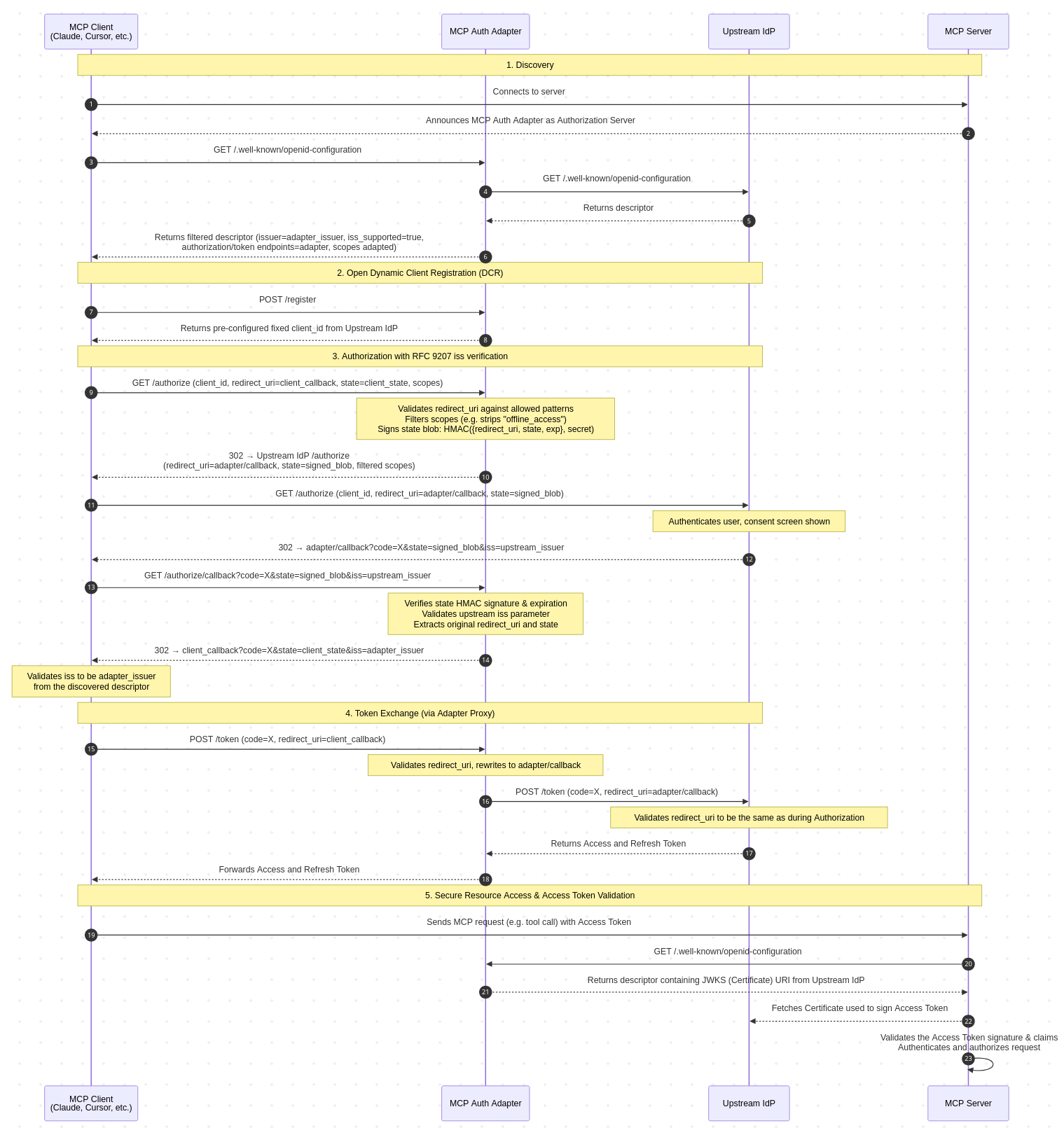
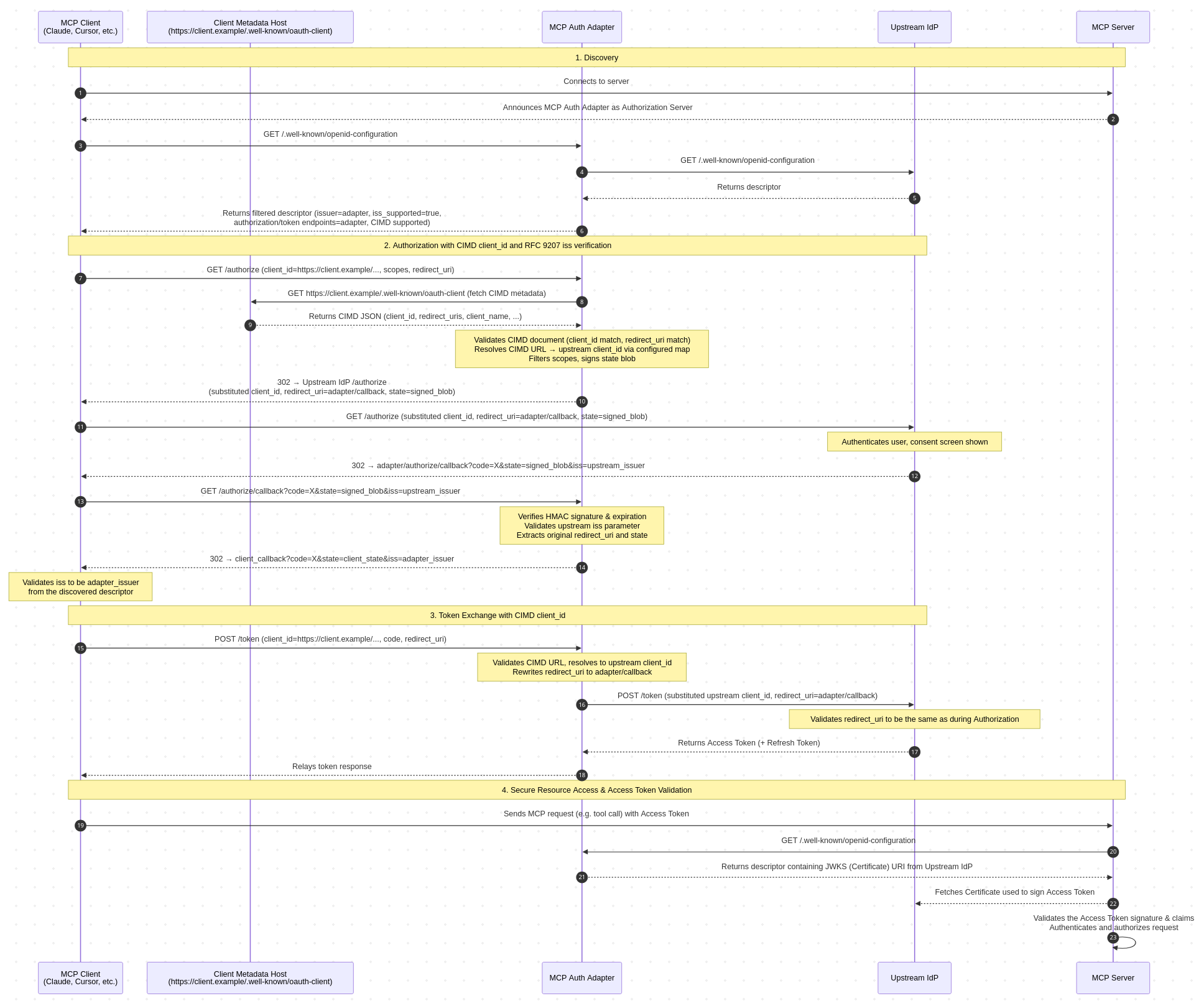
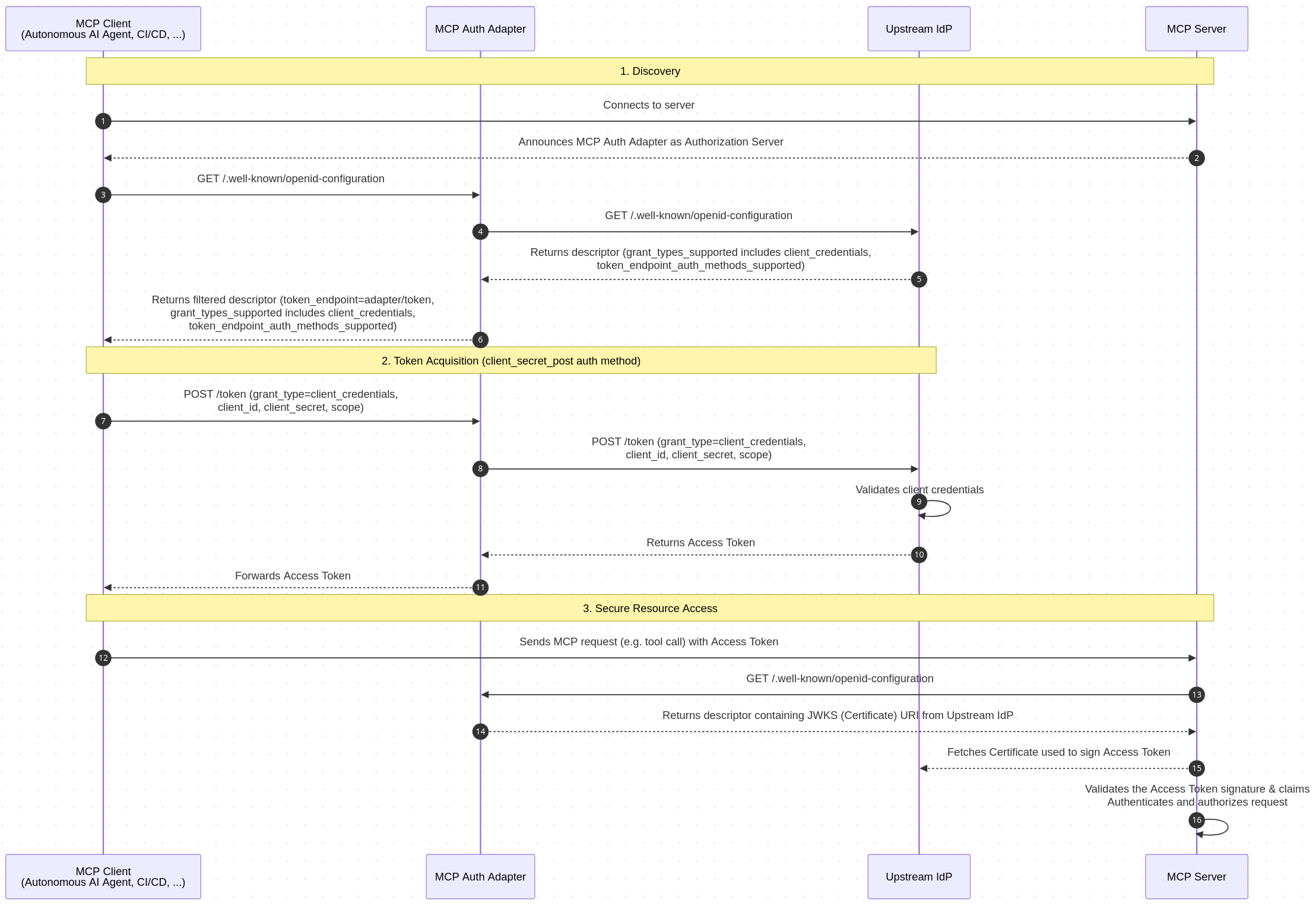
See Flow Diagrams to understand functionality better.
Container Image
Pre-built container images are published to GitHub Container Registry on every release. This is the recommended way to deploy in production - no Node.js installation required.
Image: ghcr.io/redhat-community-ai-tools/mcp-auth-adapter with tags X.Y.Z, X.Y, X, and latest.
Older tags were published under ghcr.io/velias/mcp-auth-adapter. GHCR does not redirect to the new org namespace, so update to ghcr.io/redhat-community-ai-tools/mcp-auth-adapter in pull/run commands.
Prerequisites: Docker or Podman
Pull and run
Podman is used in examples, but you can use docker command instead:
podman run -d --name mcp-auth-adapter \
  -p 3000:3000 \
  -e MCP_BASE_URL=https://mcp-auth.example.com \
  -e MCP_UPSTREAM_SSO_URL=https://sso.example.com/auth/realms/external \
  -e MCP_PROXY_DCR_CLIENT_ID=mcp-client \
  ghcr.io/redhat-community-ai-tools/mcp-auth-adapter:latest
Or use an env file for all configuration (see Configuration below):
podman run -d -p 3000:3000 --env-file .env ghcr.io/redhat-community-ai-tools/mcp-auth-adapter:latest
Available tags
Each release vX.Y.Z produces the following image tags:
X.Y.Z- exact version (recommended for production)X.Y- latest patch within a minor versionX- latest minor within a major versionlatest- most recent release
To build the image locally from source, see CONTRIBUTING.md.
npm Package
The adapter is published on npm and can be run directly with npx — no cloning or building required.
Prerequisites: Node.js >= 20.x, npx or npm
npx mcp-auth-adapter
Or install globally with npm install -g mcp-auth-adapter and run as mcp-auth-adapter.
Or install it into your Node.js project with npm install mcp-auth-adapter to use it.
Build from Source
Prerequisites: Node.js >= 20.x (uses native fetch), npm
npm install
npm run build

# Create .env from the template and edit it
cp .env.example .env

npm start
Configuration
Environment variables are used. All variables are prefixed with MCP_. A .env file in the project root is loaded automatically, explicit environment variables take precedence.
| Variable | Required | Default | Description |
|---|---|---|---|
| Core | |||
MCP_BASE_URL |
Yes | -- | Public base URL of this adapter. Used as issuer (RFC 8414 §3.3) and to construct endpoint URLs. Must be http or https; trailing slashes are stripped automatically. Must exactly match what MCP servers advertise in their Protected Resource Metadata authorization_servers array. |
MCP_UPSTREAM_SSO_URL |
Yes | -- | Base URL (issuer) of the upstream IdP. Must be http or https; trailing slashes are stripped automatically. Works with any OAuth 2.0 / OIDC provider. Discovery is attempted via /.well-known/openid-configuration, then /.well-known/oauth-authorization-server (RFC 8414); on failure, fallback endpoints are derived using Keycloak URL conventions (see below). |
MCP_PORT |
No | 3000 |
Port this app listens on. |
MCP_SHUTDOWN_TIMEOUT_SECONDS |
No | 30 |
Maximum seconds to wait for in-flight requests to drain after SIGTERM/SIGINT before force-exiting. |
Authorize proxy (RFC 9207 iss interception, scopes, resource; auto-enables /authorize + /token; /par when upstream advertises PAR — see PAR) |
|||
MCP_PROXY_AUTH_STATE_SECRET |
Conditional | -- | Hex-encoded HMAC secret for signing state blobs (min 32 bytes = 64 hex chars). Required when the /authorize proxy is active (scope filtering, CIMD, or standalone). Generate with openssl rand -hex 32. Must be identical across all pods. |
MCP_PROXY_AUTH_STATE_SECRET_PREVIOUS |
No | -- | Previous HMAC secret for zero-downtime key rotation (same format). Set to the old key during rotation; remove after TTL has elapsed. |
MCP_PROXY_AUTH_STATE_TTL_MINUTES |
No | 30 |
How long (minutes) the signed state blob remains valid. Must cover full user interaction at the upstream IdP (login + registration + MFA + consent). |
MCP_PROXY_AUTH_ALLOWED_REDIRECT_URIS |
Conditional | -- | Comma-separated allowed redirect URI patterns. Trailing * = host-aware wildcard (exact hostname; http://host* / http://host:* = any port and path; https://host/path* = path prefix); no * = exact match. Domain-extension attacks (host.evil.com) are rejected. Required when /authorize proxy is active (unless CIMD-only, or all MCP_PROXY_DCR_CLIENT_NAME_MAP entries have per-client allowed_redirect_uris with no fallback MCP_PROXY_DCR_CLIENT_ID). See known MCP client patterns for common values. |
MCP_PROXY_AUTH_SCOPES_REMOVED |
No | -- | Comma-separated scopes to strip from /authorize and /par requests (e.g. offline_access). Ignored if MCP_PROXY_AUTH_SCOPES_PRESERVED is also set. Setting this (or scopes preserved / CIMD) auto-enables the authorize proxy. |
MCP_PROXY_AUTH_SCOPES_PRESERVED |
No | -- | Comma-separated scopes to keep in /authorize and /par requests; all others are stripped. Takes precedence over MCP_PROXY_AUTH_SCOPES_REMOVED. |
MCP_PROXY_AUTH_REQUIRE_RESOURCE |
No | false |
Reject /authorize, /par, and /token requests missing the RFC 8707 resource parameter. Enable for strict MCP spec compliance; leave disabled if MCP clients don't yet include it. |
MCP_PROXY_AUTH_ALLOWED_RESOURCES |
No | -- | Comma-separated allowed resource URI patterns. Trailing * = prefix match, *.domain.com = domain wildcard (matches domain and all subdomains), no * = exact match. When set, resource must match a pattern; unmatched values are rejected with 400. |
| Dynamic Client Registration | |||
MCP_PROXY_DCR_CLIENT_ID |
No | -- | Default client_id returned by POST /register. Setting this enables the DCR proxy. Must be pre-registered at the upstream IdP as a public client. When MCP_PROXY_DCR_CLIENT_NAME_MAP is also set, this serves as the fallback for unmatched client names. |
MCP_PROXY_DCR_CLIENT_NAME_MAP |
No | -- | JSON object mapping client_name patterns to upstream IdP client_ids, with optional per-client redirect URI restrictions. Setting this enables the DCR proxy (even without MCP_PROXY_DCR_CLIENT_ID). See Per-MCP-Client IdP Client Mapping. |
| CIMD adapter (EXPERIMENTAL, auto-enables authorize proxy) | |||
MCP_PROXY_CIMD_MAP |
No | -- | JSON object mapping CIMD URLs to upstream IdP client_ids. Format: {"<cimd_url>":"<upstream_client_id>", ...}. N:1 mapping supported. CIMD auto-enables when this is non-empty or MCP_PROXY_CIMD_DEFAULT_CLIENT_ID is set. |
MCP_PROXY_CIMD_DEFAULT_CLIENT_ID |
No | -- | Fallback upstream client_id for CIMD URLs not in the map. If unset, unknown CIMD URLs are rejected with 403 (strict allowlist). |
MCP_PROXY_CIMD_CACHE_MINUTES |
No | 30 |
Cache TTL (in minutes) for validated CIMD metadata documents. |
| Well-known discovery | |||
MCP_WELL_KNOWN_SCOPES_SUPPORTED |
No | -- | Comma-separated scopes to announce in scopes_supported. If empty, the field is omitted. Note: some MCP clients request all announced scopes -- this controls announced scopes, not forwarded scopes. |
MCP_WELL_KNOWN_REFRESH_MINUTES |
No | 60 |
How often (in minutes) to re-fetch the upstream well-known document. |
| Protocol opt-ins | |||
MCP_PROXY_DPOP_ENABLED |
No | false |
When true, advertise upstream dpop_signing_alg_values_supported in discovery only if the Upstream IdP announces it. Off by default — see DPoP. Header forwarding on /token and /par is always on. PAR has no env flag (see authorize proxy note above). |
| Observability | |||
MCP_ACCESS_LOG |
No | true |
Emit per-request access logs at info level with client identification (User-Agent, method, path, IP, plus route-specific fields). Set to false to disable. |
MCP_METRICS_ENABLED |
No | true |
Enable Prometheus metrics endpoint (GET /metrics) and request instrumentation. Set to false to disable (zero overhead). |
MCP_DEBUG |
No | false |
Emit structured debug logs for every request. |
Open DCR and its Security Limitations
MCP Clients need a way to get client_id necessary to login through the upstream IdP.
You can use Open DCR functionality of this adapter if your IdP does not provide it, or if you do not want to use it.
The Open DCR endpoint returns a fixed public client_id (token_endpoint_auth_method: none) to be used by MCP Clients.
But as many MCP Clients are local apps, any local application can obtain this client_id and start an OAuth flow.
IdP do not know who is asking for the client_id. Two emerging standards address this:
- DCR with Software Statement Assertion (SSA) - cryptographically proves client identity via signed JWTs (RFC 7591 §2.3). No major MCP client currently includes Software Statements in DCR requests.
- Client ID Metadata Documents (CIMD) - the
client_idis an HTTPS URL pointing to a metadata document. Default mechanism in the MCP Auth Spec (2025-11-25), not yet universally adopted. This adapter includes experimental CIMD support - see CIMD Adapter.
Until "DCR with SSA" or CIMD is widely supported, user consent during login at the upstream IdP is the last line of defense. This is an accepted limitation of the MCP auth ecosystem.
Per-client IdP client mapping (see below) provides partial mitigation: operators can isolate IdP clients per MCP application.
Per-MCP-Client IdP Client Mapping
Operators often want different MCP clients (Cursor, Claude Code, VS Code, etc.) to use different upstream IdP clients — for per-client consent screens, scope policies, audit logging, and access revocation. DCR client name mapping (below) and CIMD client mapping both support this, using different client identification methods. For how redirect URIs are validated across all client types, see Redirect URIs at the upstream IdP.
DCR Client Name Mapping
MCP_PROXY_DCR_CLIENT_NAME_MAP maps client_name values from DCR requests to upstream IdP client_ids. Pattern matching is case-insensitive; trailing * means prefix match, no * means exact match. Exact matches are checked first, then prefix matches in declaration order.
Simple format (all clients use global MCP_PROXY_AUTH_ALLOWED_REDIRECT_URIS):
MCP_PROXY_DCR_CLIENT_NAME_MAP={"Cursor":"cursor-sso-client","Claude Code*":"claude-sso-client","VS Code*":"vscode-sso-client"}
Extended format (per-client redirect URI enforcement — recommended):
MCP_PROXY_DCR_CLIENT_NAME_MAP={
  "Cursor": {
    "client_id": "cursor-sso-client",
    "allowed_redirect_uris": "cursor://anysphere.cursor-mcp/*"
  },
  "Claude Code*": {
    "client_id": "claude-sso-client",
    "allowed_redirect_uris": "http://localhost:*,http://127.0.0.1:*"
  },
  "VS Code*": "vscode-sso-client"
}
When allowed_redirect_uris is set, these patterns are enforced at /authorize, /par, and /token time for that specific upstream client_id (instead of the global MCP_PROXY_AUTH_ALLOWED_REDIRECT_URIS). Redirect URIs are not validated at DCR time — the adapter is stateless and clients may register multiple URIs for different environments.
Known MCP client client_name values
Common client_name values sent in DCR requests — non-authoritative hints sourced from client source code and issue trackers, please verify at deployment time:
client_name pattern |
Recommended map key | MCP Client | Source |
|---|---|---|---|
Cursor |
Cursor |
Cursor IDE | cursor/cursor#3734 |
Claude Code (<serverName>) |
Claude Code* |
Claude Code CLI | anthropics/claude-code#59445 |
Claude |
Claude |
Claude.ai, Claude Desktop | anthropics/claude-code#30511 |
Visual Studio Code |
Visual Studio Code |
VS Code | modelcontextprotocol/python-sdk#1379 |
Codex |
Codex |
Codex CLI / Codex App | openai/codex#24103 |
Warp |
Warp |
Warp | warpdotdev/Warp#8356 |
Gemini CLI MCP Client |
Gemini CLI* |
Gemini CLI | source code |
Cline |
Cline |
Cline | source code |
MCP Inspector |
MCP Inspector |
MCP Inspector | observed DCR requests |
MCPJam - <serverName> |
MCP Jam -* |
Hosted MCP Jam | observer DCR request |
Some clients (ChatGPT, Goose, Windsurf, Amazon Q CLI, Zed) could not be verified — check the clientName field in access logs (enabled by default). Clients that prefer CIMD (e.g. Goose) fall back to DCR when the server doesn't advertise CIMD support.
Unmatched client names fall back to MCP_PROXY_DCR_CLIENT_ID. If neither matches nor fallback exists, the request is rejected with invalid_client_metadata.
Security notes:
client_nameis self-asserted and spoofable. The mapping provides operational isolation (different consent screens, audit trails, per-client IdP policies) but does not authenticate the calling application. The per-clientallowed_redirect_urisat/authorizetime are the real security layer: even if an attacker spoofsclient_name, they can only redirect to the operator-configured patterns for that client_id.- The fallback
MCP_PROXY_DCR_CLIENT_IDuses the globalMCP_PROXY_AUTH_ALLOWED_REDIRECT_URIS. An attacker can omitclient_nameto get the fallback with its broader allowlist. For strict isolation, either omitMCP_PROXY_DCR_CLIENT_IDor narrow the global allowlist. - Degenerate pattern keys (
*, empty, whitespace-only) are rejected at config startup. - Startup error if a mapped entry with
allowed_redirect_urishas the sameclient_idasMCP_PROXY_DCR_CLIENT_ID— this prevents unintended per-client redirect restrictions on fallback users.
RFC 9207 iss parameter validation
The MCP Auth Spec (2026-07-28 RC) mandates iss parameter validation in authorization responses per RFC 9207. Without authorization callback interception, MCP clients would reject the upstream IdP's iss value because it doesn't match the adapter's well-known issuer.
This adapter solves the problem in v2.0 by intercepting the authorization response:
GET /authorize— validates the client'sredirect_uriagainst configured patterns, wraps the originalredirect_uriandstateinto an HMAC-signed state blob, replacesredirect_uriwith the adapter's callback URL, and redirects to the upstream IdP with own state.GET /authorize/callback— receives the upstream IdP's redirect, verifies the state blob (HMAC + expiry), validates the upstreamissparameter, then redirects to the original MCP clientredirect_uriwith the adapter'sissvalue.POST /token— proxies token requests, validating and rewritingredirect_urito maintain consistency with what the upstream IdP expects by the OAuth specification.
Minimal configuration:
MCP_BASE_URL=https://mcp-auth.example.com
MCP_UPSTREAM_SSO_URL=https://sso.example.com/auth/realms/external
MCP_PROXY_AUTH_STATE_SECRET=$(openssl rand -hex 32)
MCP_PROXY_AUTH_ALLOWED_REDIRECT_URIS=http://localhost:*,http://127.0.0.1:*
Key rotation — to rotate the HMAC secret without downtime:
- Set
MCP_PROXY_AUTH_STATE_SECRET_PREVIOUSto the current key - Set
MCP_PROXY_AUTH_STATE_SECRETto the new key - Wait at least
MCP_PROXY_AUTH_STATE_TTL_MINUTES(default 30 min) - Remove
MCP_PROXY_AUTH_STATE_SECRET_PREVIOUS
Security properties:
- Signed state prevents forging the original
redirect_uri;MCP_PROXY_AUTH_ALLOWED_REDIRECT_URISvalidates destinations before the flow begins - Client's original
stateis preserved inside the blob — tampering is detected via HMAC (crypto.timingSafeEqual) - Configurable TTL prevents reuse of stale authorization responses
- Two-tier upstream
issvalidation — strict when upstream advertises RFC 9207 support, defensive (validate if present) when it doesn't - Callback only forwards a whitelist of OAuth-defined parameters — arbitrary upstream parameters cannot reach the client
redirect_urivalues with fragments, userinfo, or control characters are rejected- Callback sets
Cache-Control: no-storeandReferrer-Policy: no-referrer - Authorization code is never logged (only
code_present: true/false) - State blob is signed, not encrypted — contains redirect_uri and original state (both non-secret); confidentiality relies on TLS and short TTL
Resource Parameter Validation (RFC 8707)
RFC 8707 defines the resource parameter for OAuth 2.0, binding tokens to a specific resource server audience. The MCP specification (2025-06-18+) mandates that clients include resource in both /authorize and /token requests to prevent confused deputy attacks. The adapter applies the same validation on /par (when PAR is active).
Validation layers
Debug logging (always active) —
resourcevalue (orMISSING) appears in per-request debug logs. Enable withMCP_DEBUG=true; grep forresource=MISSINGto find non-compliant clients.Format validation (always active when parameter present) —
resourcemust be a valid absolute URI withhttporhttpsscheme and no fragment per RFC 8707 §2. Malformed values are rejected with400 invalid_request.Optional strict enforcement:
MCP_PROXY_AUTH_REQUIRE_RESOURCE=true— rejects requests missingresourceMCP_PROXY_AUTH_ALLOWED_RESOURCES— comma-separated URI patterns (trailing*= prefix match) restricting which MCP servers can authenticate through the adapter
Configuration examples:
# Permissive (default) — format validation only, log missing values
MCP_DEBUG=true

# Strict — require resource parameter and restrict to known MCP servers
MCP_PROXY_AUTH_REQUIRE_RESOURCE=true
MCP_PROXY_AUTH_ALLOWED_RESOURCES=https://mcp-tools.example.com/*,https://mcp-data.example.com/mcp

# Domain wildcard — match a domain and all its subdomains
MCP_PROXY_AUTH_ALLOWED_RESOURCES=https://*.corp.example.com/*,https://mcp-data.example.com/mcp
Notes
Client support: MCP client support for
resourcevaries (Claude Code/Desktop, VS Code, Cursor IDE, SDKs are at different stages of adoption). Recommendation: start withMCP_PROXY_AUTH_REQUIRE_RESOURCE=falseand monitor logs before enabling enforcement.Upstream IdP compatibility: The adapter validates
resourcelocally and passes it through to upstream IdP. Whether the IdP actually binds the token audience depends on its RFC 8707 support: Keycloak has experimental support since v26.6.0 (requires per-client configuration); Auth0, Okta, and Microsoft Entra ID silently ignore it as of mid-2026. Token audience validation remains the MCP server's responsibility and must be implemented accordingly.refresh_tokenexemption: The adapter skipsresourcevalidation forrefresh_tokengrants per RFC 8707 §2.2 — the original token's audience binding still applies.
Client Credentials Passthrough
The adapter transparently proxies OAuth 2.0 client credentials requests to the upstream IdP, supporting the MCP OAuth Client Credentials extension. This enables machine-to-machine authentication for MCP without interactive user authorization.
Supported credential formats
- Client Secrets (
grant_type=client_credentials) — supports bothclient_secret_post(credentials in the request body) andclient_secret_basic(credentials in theAuthorization: Basicheader per RFC 6749 §2.3.1). - JWT Bearer Assertions (
grant_type=urn:ietf:params:oauth:grant-type:jwt-bearer) — forwards theassertionparameter and anyclient_assertion/client_assertion_typeparameters to the upstream IdP.
How it works
The token proxy forwards all request parameters to the upstream IdP without modification. No redirect_uri validation or rewriting is applied (those only affect authorization_code grants). The Authorization header is forwarded for non-CIMD requests.
Discovery
The adapter includes client_credentials in grant_types_supported in its well-known metadata (both in the fallback document and as a default when the upstream omits the field). The token_endpoint_auth_methods_supported field passes through from the upstream IdP — if the upstream advertises client_secret_post, client_secret_basic, or private_key_jwt, clients will discover them. The fallback document (used when the upstream cannot be reached) includes client_secret_basic, client_secret_post, and none.
JWT Bearer Assertion aud Caveat
When using JWT bearer assertions (RFC 7523), the client constructs a signed JWT with an aud (audience) claim set to the authorization server endpoint it is calling. Since MCP clients discover this adapter as the authorization server, they typically set aud to {MCP_BASE_URL}/token (token endpoint) or {MCP_BASE_URL}/par (PAR endpoint, when used).
When the adapter proxies this assertion to the upstream IdP, the upstream validates aud against its own endpoint URL. This mismatch causes the upstream to reject the assertion.
Workaround 1 (recommended): Configure the upstream IdP to accept the adapter's public endpoint URLs ({MCP_BASE_URL}/token and, if confidential clients use PAR, {MCP_BASE_URL}/par) as valid audiences for JWT client assertions. In Keycloak, this can be configured per-client under "Credentials > Client Authenticator > Signed JWT > Valid Audiences". Other IdPs have similar settings. This is transparent to clients — no client-side changes required.
Workaround 2: Configure the client to use the upstream IdP's endpoint URL directly as the aud claim, rather than deriving it from discovery. This is valid per RFC 7523 — the upstream IdP is the real authorization server, the adapter is just a proxy. Limitations:
- Requires the client to have out-of-band knowledge of the upstream IdP's endpoint URL
- Standard MCP SDK implementations (e.g.
PrivateKeyJwtProvider) typically deriveaudfrom the discoveredtoken_endpoint(or PAR endpoint) automatically — overriding this requires using lower level client code - Couples the client to the deployment's internal architecture
This limitation is inherent to proxying JWT assertions and does not affect the client secrets flow. Public MCP clients with token_endpoint_auth_method=none are unaffected.
DPoP (RFC 9449)
DPoP is not required by MCP spec today and not used by any MCP Client. The adapter still prepares for optional IdP DPoP:
/tokenand/paralways forwardDPoPandDPoP-Noncerequest headers and relayDPoP-Nonceon responses.- Discovery is off by default (
MCP_PROXY_DPOP_ENABLED=false): even if the Upstream IdP advertisesdpop_signing_alg_values_supported, the adapter omits it so DPoP-capable clients keep using bearer tokens through this facade, until it is clear that DPoP really works end to end.
Set MCP_PROXY_DPOP_ENABLED=true only when end-to-end DPoP works. That requires the Upstream IdP to support DPoP at the token endpoint and accept proofs whose htu is this adapter’s public token_endpoint ({MCP_BASE_URL}/token), not only the IdP’s own token URL. No major IdP ships that alternate-htu support today. Without it, MCP clients trying to use DPoP would fail on IdP htu checks and whole MCP authentication would fail.
PAR (RFC 9126)
Pushed Authorization Requests are not required by MCP today. The adapter proxies PAR when the authorize proxy is active and the Upstream IdP advertises pushed_authorization_request_endpoint (no separate env flag):
- Discovery rewrites that field to
{MCP_BASE_URL}/par(and may pass throughrequire_pushed_authorization_requestsfrom upstream). POST /parapplies the same transforms as/authorize(scopes, CIMD, redirect_uri allowlist + HMAC state wrap, resource), forwardsAuthorization/DPoPheaders like/token, and returns the upstreamrequest_uri(the IdP holds PAR state — the adapter stays stateless).GET /authorize?client_id=&request_uri=forwards only those two parameters (with CIMDclient_idsubstitution when needed).
If upstream omits PAR, the adapter omits PAR from discovery, /par returns 404, and /authorize does not take the request_uri shortcut. Confidential clients authenticating at PAR with JWT assertions typically set aud to {MCP_BASE_URL}/par and hit the same dual-audience consideration as /token (see JWT Bearer Assertion aud Caveat); public MCP clients with none auth are unaffected.
Enterprise-Managed Authorization Passthrough
The adapter is compatible with the Enterprise-Managed Authorization extension (io.modelcontextprotocol/enterprise-managed-authorization). This extension uses the urn:ietf:params:oauth:grant-type:jwt-bearer grant type with an ID-JAG (Identity Assertion JWT Authorization Grant) assertion, which the token proxy already forwards transparently to the upstream IdP.
The adapter does not validate or inspect ID-JAG assertions — that is the upstream authorization server's responsibility.
Requirements: The upstream IdP must support JWT bearer assertions (RFC 7523) and be configured to validate ID-JAG tokens from the enterprise IdP. No adapter-specific configuration is needed. ID-JAG assertions use the same JWT aud rules as other bearer assertions — see JWT Bearer Assertion aud Caveat.
CIMD Adapter (EXPERIMENTAL)
For the shared concept of mapping MCP clients to upstream IdP clients, see Per-MCP-Client IdP Client Mapping. This section covers CIMD-specific details.
Status: Based on
draft-ietf-oauth-client-id-metadata-document-01(March 2026), an IETF Internet-Draft not yet at RFC status. This implementation may change as the spec evolves.
When configured, the adapter bridges MCP clients using CIMD-style client_id (HTTPS URLs) to upstream IdPs that don't support CIMD natively:
- Validates CIMD URL syntax per the spec (Section 3)
- Checks if the client is allowed in the configuration (map lookup + optional default) - rejects unknown clients before any I/O
- Fetches and validates the CIMD metadata document (with SSRF protections and caching)
- Validates
redirect_uriagainst the document'sredirect_uris(exact match per RFC 9700) - Substitutes the CIMD
client_idwith a pre-registered upstream IdP client_id - Forwards the request to the upstream IdP
See flow diagram.
Configuration example:
MCP_PROXY_CIMD_MAP='{"https://cursor.com/.well-known/oauth-client.json":"cursor-sso-client","https://claude.ai/.well-known/oauth-client.json":"claude-sso-client"}'
MCP_PROXY_CIMD_DEFAULT_CLIENT_ID=generic-mcp-client
When CIMD is enabled, the well-known document is modified to:
- Advertise
client_id_metadata_document_supported: true - Rewrite
token_endpointto this adapter's/tokenproxy (andauthorization_endpoint/ PAR endpoint when those proxies are active) - Ensure
token_endpoint_auth_methods_supportedincludes"none"
CIMD client_id substitution applies on /authorize, /par, and /token.
Upstream IdP client registration: Each upstream client_id in MCP_PROXY_CIMD_MAP must be pre-registered at the upstream IdP as a public client (token_endpoint_auth_method: none). For redirect URI configuration, see Redirect URIs at the upstream IdP.
CIMD Security Considerations
- Token
azpmismatch: Issued tokens contain the upstream client_id in theazpclaim, not the CIMD URL the MCP client sent. This works only if MCP client validatesazpagainst its ownclient_id. If a future client does, tokens would appear invalid - an inherent limitation of client_id substitution that requires native IdP CIMD support to resolve. - SSRF protection: DNS resolution checks (rejects private/loopback/link-local IPs including IPv6-mapped IPv4), no redirect following, 5KB response size limit, 5-second timeout.
- DNS rebinding caveat: A TOCTOU gap exists between the DNS check and the actual fetch connection. The cache mitigates this by limiting repeated fetches.
- Cache isolation: Configured (mapped) clients are pinned in cache and cannot be evicted by an attacker flooding unknown CIMD URLs. Unpinned cache is capped at 1000 entries.
- Allowlist-first: When
MCP_PROXY_CIMD_DEFAULT_CLIENT_IDis not set, only mapped CIMD URLs are allowed; unknown URLs are rejected without any outbound fetch. - Token proxy: Relays token requests to the upstream IdP with
client_idsubstitution, body size limits, timeouts, response size limits, and header whitelisting.
Token Issuer Validation
Note: The RFC 9207
issparameter in authorization responses is handled correctly. The caveat below applies to JWTissclaims inside tokens, which is a separate concern.
This adapter rewrites issuer in well-known discovery metadata to its own MCP_BASE_URL, but tokens are issued by the upstream IdP — they are signed by upstream IdP signature, and their JWT iss claim (if upstream IdP issues JWT tokens) contains the upstream IdP issuer.
MCP servers and clients must not validate the access token JWT iss claim against this adapter's discovery issuer.
In practice this is not a problem. Most OAuth libraries primarily validate tokens via JWKS signature verification, not by comparing the JWT iss claim against discovery metadata.
All major MCP clients we tested work correctly.
Token validation in the MCP Server:
- JWKS signature verification — the adapter's discovery metadata
jwks_uripoints to the upstream IdP's JWKS, so signature verification cryptographically proves the token's origin correctly. Discovery metadata can, and should, be used here to getjwks_uri. This is OAuth compliant token origin verification behaviour. - Validate
issclaim against the upstream IdP URL — JWTissclaim validation is required by the OIDC spec. If you want this behaviour, explicitly configure the MCP server with upstream IdP issuer and validate against this configuration, do not validate againstissuerfrom the discovery metadata. - Validate
aud(or equivalent) against what the IdP actually emits — configure the MCP server for the upstream IdP's audience claim shape; do not requireaudto equalMCP_BASE_URLor this adapter's identity as MCP spec requires as many IdPs do not support it. The adapter does not rewrite tokenaudin the token to make it MCP Spec compatible, as it is signed by IdP.
Known MCP Client Behaviors
MCP clients interact with OAuth/OIDC in ways that can cause issues with upstream IdPs not specifically designed for MCP. This adapter addresses the most common known problems.
Clients request all announced scopes
MCP clients read scopes_supported from the IdP well-known document and include all of them in the /authorize request. When an upstream IdP announces dozens of scopes, the authorization request balloons with scopes the MCP server doesn't need — confusing users on the consent screen or causing outright rejection by the upstream IdP if some scopes require pre-approval for clients.
Mitigation 1 — control what's announced:
# Only announce scopes your MCP servers actually need
MCP_WELL_KNOWN_SCOPES_SUPPORTED=openid,api.read,api.write
This replaces the upstream scopes_supported in discovery, so greedy clients only see (and request) what you intend.
Mitigation 2 — filter scopes at the authorize proxy:
Even if you cannot control what's announced (e.g. you need scopes_supported to reflect the full upstream list for other consumers), the authorize proxy can strip unwanted scopes on /authorize and /par before forwarding to the upstream IdP:
# Remove specific problematic scopes from authorize requests
MCP_PROXY_AUTH_SCOPES_REMOVED=roles,web-origins,microprofile-jwt

# Or use an allowlist — only these scopes reach the upstream IdP
MCP_PROXY_AUTH_SCOPES_PRESERVED=openid,api.read,api.write
This catches scopes regardless of whether the client added them from the discovery document or hardcoded them.
Clients always request offline_access scope
Some MCP clients (e.g. Claude Code, Cursor IDE) unconditionally add offline_access to every authorization request to obtain refresh tokens. This can be problematic if the upstream IdP requires admin consent for offline tokens, rejects unknown scopes, or your policy restricts long-lived refresh tokens. Use MCP_PROXY_AUTH_SCOPES_REMOVED=offline_access to strip it before forwarding.
Combining both controls
MCP_WELL_KNOWN_SCOPES_SUPPORTED controls the demand side (what clients see and request), while MCP_PROXY_AUTH_SCOPES_REMOVED / MCP_PROXY_AUTH_SCOPES_PRESERVED controls the supply side (what actually reaches the upstream IdP). Using both provides defense in depth.
Deployment Notes
Upstream IdP Client Registration
Every client_id used by this adapter must be pre-registered at the upstream IdP with the following settings. This includes: MCP_PROXY_DCR_CLIENT_ID (default DCR client), all mapped client_ids from MCP_PROXY_DCR_CLIENT_NAME_MAP, and all CIMD-mapped client_ids from MCP_PROXY_CIMD_MAP.
| Setting | Value | Reason |
|---|---|---|
| Client type | Public | MCP clients cannot hold secrets (token_endpoint_auth_method: none) |
| Consent | Enabled (required) | User consent is the primary security control -- it lets users see which application is requesting access and decide whether to grant it |
| Standard flow | Enabled | Authorization code flow is the only flow used by MCP clients |
| Allowed scopes | Must cover all the scopes required by MCP servers using this adapter, mainly those requiring pre-approval |
Note on Client Credentials: The table above applies to interactive MCP clients (authorization code flow). For machine-to-machine access via the Client Credentials passthrough, separate confidential clients must be registered at the upstream IdP — one per calling system — with client_credentials grant enabled. Each system receives its own client_id and client_secret (or key pair for private_key_jwt). These clients are managed entirely outside the adapter — the adapter simply proxies token requests to the upstream IdP.
Redirect URIs at the upstream IdP
With iss interception active (v2.0+, recommended), the adapter intercepts all authorization responses. The upstream IdP only ever sees a single redirect URI — the adapter's callback. This greatly simplifies IdP configuration.
What to register at the upstream IdP:
| Deployment mode | Allowed redirect URI at upstream IdP |
|---|---|
| Any mode with iss interception (v2.0+) | {MCP_BASE_URL}/authorize/callback (single value, applies to all client_ids) |
| Legacy (pre-v2.0, no iss interception) | All MCP client patterns from the table below |
How MCP client redirect URIs are validated (v2.0+):
The adapter validates the MCP client's redirect_uri before the user ever reaches the upstream IdP:
| Client type | Validated against | Configuration |
|---|---|---|
| DCR clients (with per-client map) | allowed_redirect_uris from MCP_PROXY_DCR_CLIENT_NAME_MAP |
Per-entry config |
| DCR clients (without per-client map) | MCP_PROXY_AUTH_ALLOWED_REDIRECT_URIS patterns |
Set to known MCP client patterns below |
| CIMD clients | redirect_uris field in the client's CIMD metadata document |
Automatic, no adapter config needed |
Known MCP client redirect URI patterns
Common MCP client redirect URIs — non-authoritative hints, please verify at deployment time:
| Pattern | MCP Clients |
|---|---|
http://localhost:* |
Claude Code, Claude Desktop, Gemini CLI, Codex CLI, Codex App, Goose, Windsurf, Zed, Warp (CLI agents), Amazon Q CLI, MCP Inspector |
http://127.0.0.1:* |
VS Code |
https://claude.ai/api/mcp/auth_callback |
Claude.ai (web) |
https://claude.com/api/mcp/auth_callback |
Claude.com (web) |
https://chatgpt.com/connector_platform_oauth_redirect |
ChatGPT (web) |
https://chatgpt.com/connector/oauth/* |
ChatGPT (web) |
cursor://anysphere.cursor-mcp/* |
Cursor IDE |
https://insiders.vscode.dev/* |
VS Code Insiders (web) |
https://vscode.dev/* |
VS Code (web) |
warp://mcp/* |
Warp |
vscode://saoudrizwan.claude-dev/* |
Cline |
https://app.mcpjam.com/oauth/callback |
MCPJam (web) |
Note: MCP clients on localhost/127.0.0.1 use ephemeral ports and varying paths, so your IdP must allow any port and any path for these origins (i.e. use wildcard or prefix matching).
Horizontal Scaling / Multi-Pod
The adapter is fully stateless - the only shared secret is MCP_PROXY_AUTH_STATE_SECRET (and optionally MCP_PROXY_AUTH_STATE_SECRET_PREVIOUS), which must be identical across all replicas.
Authorization State blob verification uses absolute timestamps, so pod clocks must be reasonably synchronized (NTP is sufficient; a few seconds of drift is tolerable within the TTL window).
TLS
RFC 7591 §5 requires TLS for the DCR registration endpoint. With iss interception enabled, authorization codes transit through the adapter (in the /authorize/callback redirect) - https is critical to prevent codes from being exposed on the wire. In production, TLS should be terminated at the reverse proxy / load balancer in front of this application andMCP_BASE_URL should be always https://!
Caching
Well-known endpoints return Cache-Control: public, max-age=<seconds> (half of MCP_WELL_KNOWN_REFRESH_MINUTES). DCR and /authorize/callback return Cache-Control: no-store. /token and /par relay upstream Cache-Control (typically no-store). CDNs must honor origin cache headers to ensure clients receive up-to-date discovery documents and never cache authorization responses or tokens.
Rate Limiting
Publicly accessible endpoints that should be rate-limited: POST /register (open DCR, RFC 7591 §3), GET /authorize, GET /authorize/callback, POST /token, and POST /par. This adapter does not implement app-level rate limiting - use an external WAF or reverse proxy (e.g. nginx, Cloudflare, Akamai).
CORS
This adapter intentionally does not set CORS headers. All endpoints are designed for server-to-server or redirect-based flows — none require browser XMLHttpRequest/fetch access from a different origin. The absence of CORS headers also provides a CSRF defense layer for the DCR endpoint. If your deployment requires browser-based access, configure CORS at the reverse proxy layer.
Exposed Endpoints
The adapter serves the following paths. Your reverse proxy (Ingress, nginx, HAProxy, etc.) must route public paths to the adapter and block internal paths from external access:
| Path | Exposure | Notes |
|---|---|---|
/.well-known/openid-configuration |
Public | Discovery |
/.well-known/oauth-authorization-server |
Public | Discovery (RFC 8414) |
/register |
Public | DCR (if enabled) |
/authorize |
Public | Authorization proxy |
/authorize/callback |
Public | ISS interception callback (v2.0+) |
/token |
Public | Token proxy (v2.0+) |
/par |
Public | PAR proxy (when auth proxy active and upstream advertises PAR) |
/health |
Internal only | Composite health check with upstream IdP probe |
/health/live, /health/ready |
Internal only | Kubernetes probes |
/metrics |
Internal only | Prometheus scraping (if enabled) |
Internal endpoints are unauthenticated — keep them behind cluster-internal networking, not on public ingress. They expose only operational data (no tokens, client_ids, or user data). External monitoring tools (e.g. Catchpoint) should use internal/private agents or proxies to reach health and metrics endpoints — do not expose them on public ingress.
Upstream IdP Compatibility
Review startup logs for warnings prefixed with Upstream IdP compatibility: — these indicate the upstream IdP may not fully support MCP requirements. See Upstream Well-Known Handling for details on fallback behavior and compatibility validation.
Health Probes
| Endpoint | Purpose | Response |
|---|---|---|
GET /health |
Composite health check — per-component status for adapter and upstream IdP | 200 JSON when ok, 503 JSON when error |
GET /health/live |
Liveness — process is running, HTTP listener responsive | 200 always |
GET /health/ready |
Readiness — application initialized, ready to serve | 200 normally, 503 during graceful shutdown |
All health endpoints are mounted before body-parsing middleware. /health/live and /health/ready do not check upstream IdP availability — the adapter is functional even with fallback defaults. Use /health for detailed diagnostics that include upstream IdP reachability.
Composite Health Check (GET /health)
Returns a JSON response with per-component status, making it clear whether a problem is in the adapter itself or in the upstream IdP.
{
  "status": "ok",
  "checks": { "adapter": "ok", "upstream_idp": "ok" },
  "upstream_idp": {
    "url": "https://sso.example.com/auth/realms/external",
    "last_success_at": "2026-07-10T12:00:00.000Z"
  }
}
| Status | Meaning | HTTP code |
|---|---|---|
ok |
All components healthy — upstream IdP is reachable | 200 |
error |
Unhealthy — upstream IdP is unreachable, or adapter is shutting down | 503 |
The overall status is error if any component is in error, ok otherwise. A message field is present when status is error. The upstream_idp object includes url, last_success_at, last_error, last_error_at, and using_fallback (when the adapter has never fetched the upstream document and is using fallback config). Use last_success_at to distinguish a brief outage from a prolonged one.
How the upstream probe works: The adapter sends an HTTP HEAD request to {MCP_UPSTREAM_SSO_URL}/.well-known/openid-configuration with a 5-second timeout (GET fallback if HEAD returns 405). The probe only checks reachability — it does not update the cached well-known document.
Probe rate limiting: The probe result is cached for 30 seconds. Repeated /health requests within that window reuse the cached result without contacting the upstream IdP. Concurrent requests during a probe share the same in-flight check (deduplication). Upstream failures are detected within at most 30 seconds.
Note: This checks reachability from the adapter's perspective only. It is not a substitute for monitoring the upstream IdP directly — upstream internal errors that still return 2xx on the well-known endpoint will not be detected.
Graceful Shutdown
On SIGTERM or SIGINT the adapter:
- Marks itself not-ready (
/health/readyreturns503) so the load balancer stops sending new traffic. - Stops accepting new connections.
- Drains in-flight requests until complete (or
MCP_SHUTDOWN_TIMEOUT_SECONDSelapses, default 30 s, then force-exits). - Clears the periodic well-known refresh timer.
Logging
Application logs
The adapter emits structured logs to stdout (info, debug) and stderr (warn, error) in a machine-parseable key=value format. All values are consistently double-quoted for uniform parsing (any " within a value is replaced with '):
ts="2025-06-01T12:00:00.000Z" level="info" msg="MCP Auth Adapter started" port="3000" baseUrl="http://localhost:3000"
| Level | Output | When |
|---|---|---|
info |
stdout | Startup, upstream refresh success, shutdown lifecycle, per-request access logs (when MCP_ACCESS_LOG=true) |
warn |
stderr | Every client request rejection, upstream fetch failures, config conflicts, IdP compatibility issues |
error |
stderr | Unhandled request errors, upstream/external request failures, shutdown errors, fatal startup errors |
debug |
stdout | Detailed per-request internals for troubleshooting — only when MCP_DEBUG=true |
All levels except debug are always active. Set MCP_DEBUG=true to enable verbose per-request logging — useful for development and troubleshooting but noisy for production.
No log aggregation agent or format is assumed — the structured key=value lines with consistent double-quoting are compatible with most log collectors (Fluentd, Promtail, Vector, CloudWatch, etc.) and can be parsed with standard key=value splitters (e.g. Splunk kvextract).
Access logs
Per-request access logs are emitted at info level when MCP_ACCESS_LOG=true (default). Each functional route logs one line per request after the response is sent, with client identification, route-specific fields, and the HTTP response status code:
ts="2026-07-02T14:05:00.000Z" level="info" msg="authorize request" method="GET" path="/authorize" ip="::ffff:127.0.0.1" userAgent="claude-code/2.1.128 (cli)" scope="openid" clientId="mcp-client" redirectUri="http://localhost:8080/callback" responseType="code" codeChallengeMethod="S256" statePresent="true" resource="https://mcp.example.com/api" status="302"
ts="2026-07-02T14:05:01.000Z" level="info" msg="token proxy request" method="POST" path="/token" ip="::ffff:127.0.0.1" userAgent="Cursor" clientId="mcp-client" grantType="authorization_code" hasAuthHeader="false" resource="https://mcp.example.com/api" status="200"
ts="2026-07-02T14:05:02.000Z" level="info" msg="DCR register request" method="POST" path="/register" ip="::ffff:127.0.0.1" userAgent="claude-code/2.1.128 (cli)" clientName="Claude" softwareId="com.anthropic.claude" scope="openid offline_access" grantTypes="authorization_code,refresh_token" redirectUriCount="1" status="201"
Fields per route:
| Route | Fields (beyond common) |
|---|---|
| All routes | method, path, ip, userAgent, status |
/authorize |
scope, clientId, redirectUri, responseType, codeChallengeMethod, statePresent, resource |
/authorize/callback |
code_present, error, iss |
/token |
clientId, grantType, redirectUri, hasAuthHeader, hasDpopHeader, resource |
/par |
scope, clientId, redirectUri, responseType, codeChallengeMethod, statePresent, hasAuthHeader, hasDpopHeader, resource |
/register |
clientName, softwareId, scope, grantTypes, redirectUriCount, idpClient, matchedMapping |
/.well-known/* |
(common fields only) |
The userAgent field is the primary mechanism for identifying which MCP client is making a request. Known User-Agent values include claude-code/<version> (cli), Cursor, mcp-sdk-ts/<version>, and codex-mcp-client/<version>. The DCR endpoint additionally logs clientName and softwareId from the registration metadata (RFC 7591).
Set MCP_ACCESS_LOG=false to disable access logging entirely (e.g. if you rely on reverse proxy access logs and want to reduce log volume).
Metrics / Observability
The adapter exposes a GET /metrics endpoint in Prometheus text exposition format when MCP_METRICS_ENABLED=true (default). Set MCP_METRICS_ENABLED=false to disable entirely - no endpoint, no middleware, no-op instrumentation stubs, zero overhead.
Compatible with:
- OpenShift built-in monitoring (ServiceMonitor)
- Standalone Prometheus
- OpenTelemetry Collectors via the Prometheus receiver -- no application-side OTLP push needed; the OTel Collector scrapes
/metricsand forwards to any backend
Exposed metrics
| Metric | Type | Labels | Description |
|---|---|---|---|
mcp_auth_http_requests_total |
counter | method, path, status |
Total HTTP requests to functional endpoints |
mcp_auth_http_request_duration_seconds |
histogram | method, path |
Request duration (buckets: 5ms, 10ms, 50ms, 100ms, 500ms, 1s, 5s) |
mcp_auth_upstream_refresh_total |
counter | result |
Upstream well-known refresh attempts (success / error) |
mcp_auth_upstream_refresh_duration_seconds |
gauge | -- | Last upstream refresh duration |
mcp_auth_upstream_refresh_last_success_timestamp |
gauge | -- | Unix timestamp of last successful refresh |
mcp_auth_cimd_cache_operations_total |
counter | result |
CIMD cache lookups (hit / miss); only when CIMD is enabled |
mcp_auth_cimd_cache_evictions_total |
counter | -- | CIMD cache evictions |
mcp_auth_cimd_cache_size |
gauge | -- | Current CIMD cache entry count |
mcp_auth_request_rejected_total |
counter | route, reason, grant_type (token only), resource (when allowlist configured), idp_client (when known) |
Requests rejected by input validation |
mcp_auth_authorize_redirects_total |
counter | resource (when allowlist configured), idp_client (when known) |
Successful authorize redirects to upstream |
mcp_auth_token_proxy_upstream_duration_seconds |
histogram | grant_type, resource (when allowlist configured), idp_client (when known) |
Token proxy upstream request duration; only when token proxy is active |
mcp_auth_token_proxy_upstream_status_total |
counter | status, grant_type, resource (when allowlist configured), idp_client (when known) |
Token proxy upstream response status codes |
mcp_auth_par_proxy_upstream_duration_seconds |
histogram | resource (when allowlist configured), idp_client (when known) |
PAR proxy upstream request duration; only when auth proxy is active |
mcp_auth_par_proxy_upstream_status_total |
counter | status, resource (when allowlist configured), idp_client (when known) |
PAR proxy upstream response status codes |
mcp_auth_dcr_registrations_total |
counter | idp_client, match_type |
Successful DCR registrations; only when MCP_PROXY_DCR_CLIENT_NAME_MAP is configured |
process_uptime_seconds |
gauge | -- | Process uptime |
process_resident_memory_bytes |
gauge | -- | Resident memory size |
process_heap_used_bytes |
gauge | -- | V8 heap used |
nodejs_eventloop_lag_seconds |
gauge | -- | Event loop lag (mean) |
Label notes: The resource label uses the matched allowlist pattern (not the raw URI) to ensure bounded cardinality. It is only present when MCP_PROXY_AUTH_ALLOWED_RESOURCES is configured; otherwise it is omitted entirely. The grant_type label only appears for recognized grant types (authorization_code, refresh_token, client_credentials, jwt_bearer); unrecognized values are omitted to prevent cardinality attacks. The idp_client label identifies the upstream IdP client_id for the request; it is bounded by the config-time knownIdpClients set (from DCR map, CIMD map, and fallback client_ids) and omitted for unknown client_ids. The match_type label on mcp_auth_dcr_registrations_total is one of exact, prefix, or default.
Instrumentation scope
Only functional endpoints are instrumented: /.well-known/*, /register, /authorize, /authorize/callback, /token, /par. Health probes (/health/*), the /metrics endpoint itself, and unmatched paths are not tracked. All label values come from a small, fixed set (HTTP methods, known route patterns, status codes, config-time client_ids) — no unbounded cardinality growth. The mcp_auth_dcr_registrations_total counter is only active when MCP_PROXY_DCR_CLIENT_NAME_MAP is configured.
Scraping configuration
For Prometheus auto-discovery via pod annotations, set prometheus.io/scrape: "true", prometheus.io/port: "3000", prometheus.io/path: "/metrics".
ServiceMonitor for OpenShift / Prometheus Operator:
apiVersion: monitoring.coreos.com/v1
kind: ServiceMonitor
metadata:
  name: mcp-auth-adapter
spec:
  selector:
    matchLabels:
      app: mcp-auth-adapter
  endpoints:
    - port: http
      path: /metrics
Upstream Well-Known Handling
The adapter fetches the upstream IdP's discovery document at startup (trying OIDC and RFC 8414 paths) but only exposes a strict whitelist of fields relevant to MCP. See Well-Known Field Filtering for details.
- Discovery fallback chain: The adapter tries
/.well-known/openid-configurationfirst, then/.well-known/oauth-authorization-server(RFC 8414). If both fail, endpoints are derived fromMCP_UPSTREAM_SSO_URLusing Keycloak URL conventions (e.g.{issuer}/protocol/openid-connect/auth). This last-resort fallback is Keycloak-specific - for other IdPs the derived URLs will be incorrect. Capability fields default to safe MCP minimums (e.g.code_challenge_methods_supported: ["S256"]). Optional upstream capabilities are not invented in the fallback (e.g. PAR, DPoP metadata) — those appear only when a real upstream well-known announces them (and any adapter gate still applies; see PAR, DPoP). - Flow-level defaults: When the upstream provides
authorization_endpointandtoken_endpointbut omits flow fields, the adapter injects:response_types_supported: ["code"],grant_types_supported: ["authorization_code", "client_credentials"],code_challenge_methods_supported: ["S256"]. Existing upstream values are never overridden. - Periodic refresh: Re-fetches at the configured interval (default: 60 min). On success, the new document is used immediately. On failure, the previous document is kept.
- Compatibility validation: At startup and on each periodic refresh, the adapter validates the upstream document and logs
Upstream IdP compatibility:warnings for:- Missing
authorization_endpointortoken_endpoint(MCP authorization flow will not work). - Missing
code_challenge_methods_supported(the adapter will advertise["S256"]but if the upstream doesn't actually support PKCE, token exchange will fail). code_challenge_methods_supportedpresent but withoutS256(MCP requires PKCE with S256).
- Missing
Well-Known Field Filtering
The adapter only exposes a strict whitelist of upstream fields. New upstream fields are not automatically included - they must be added to UPSTREAM_WHITELIST_FIELDS in src/routes/well-known.ts.
Included fields
issuer, authorization_endpoint, token_endpoint, jwks_uri, registration_endpoint, scopes_supported, response_types_supported, response_modes_supported, grant_types_supported, token_endpoint_auth_methods_supported, token_endpoint_auth_signing_alg_values_supported, code_challenge_methods_supported, id_token_signing_alg_values_supported, subject_types_supported, claims_supported, introspection_endpoint, userinfo_endpoint, revocation_endpoint, authorization_response_iss_parameter_supported
Conditionally (when auth proxy is on and upstream announces them): pushed_authorization_request_endpoint, require_pushed_authorization_requests. Conditionally (when MCP_PROXY_DPOP_ENABLED): dpop_signing_alg_values_supported.
Adapted fields
| Field | Condition | Adaptation |
|---|---|---|
issuer |
Always | Replaced with MCP_BASE_URL per RFC 8414 §3.3 |
registration_endpoint |
MCP_PROXY_DCR_CLIENT_ID set |
Replaced with {MCP_BASE_URL}/register |
authorization_endpoint |
Auth proxy enabled | Replaced with {MCP_BASE_URL}/authorize |
token_endpoint_auth_methods_supported |
DCR or CIMD enabled | "none" injected if not already present |
token_endpoint |
Auth proxy enabled | Rewritten to {MCP_BASE_URL}/token |
pushed_authorization_request_endpoint |
Auth proxy + upstream has PAR | Rewritten to {MCP_BASE_URL}/par |
authorization_response_iss_parameter_supported |
Auth proxy enabled | Set to true |
client_id_metadata_document_supported |
CIMD enabled | Set to true |
scopes_supported |
MCP_WELL_KNOWN_SCOPES_SUPPORTED set |
Replaced with configured value; omitted if empty |
response_types_supported |
Upstream omits + auth flow present | Defaults to ["code"] |
grant_types_supported |
Upstream omits + auth flow present | Defaults to ["authorization_code", "client_credentials"] |
code_challenge_methods_supported |
Upstream omits + auth flow present | Defaults to ["S256"] |
Excluded fields
Everything not in the whitelist above is automatically excluded — this includes OIDC session/logout, CIBA, device flow, JAR/JARM, mTLS, encryption, server-side auth endpoints, and misc claims fields. To expose an additional upstream field, add it to UPSTREAM_WHITELIST_FIELDS in src/routes/well-known.ts.
Flow Diagrams
Detailed interaction between different components when MCP Authentication happens.
Open DCR with iss interception and scopes filtering
CIMD (EXPERIMENTAL) with iss interception and scopes filtering
Client Credentials passthrough
Development
See CONTRIBUTING.md for development setup, testing, linting, and code style guidelines.
Security
An OWASP Top 10 security review was performed on 2026-05-15. No critical issues were found.
If you discover a security vulnerability, please report it responsibly via GitHub Security Advisories.
Known limitations
- State blob size: The signed state (containing original redirect_uri + state + expiry + HMAC, base64url-encoded) passes as the OAuth
statequery parameter. Very long client state values or redirect URIs could exceed IdP URL length limits. MCP clients typically use short state values, so this is unlikely to be an issue in practice. - Secret rotation window: During rotation, if
MCP_PROXY_AUTH_STATE_SECRET_PREVIOUSis not set, users mid-authentication receive a 400 and must restart the flow. - Clock skew: State blob TTL verification uses absolute timestamps. Significant clock skew between pods (beyond normal NTP drift) can cause valid blobs to be rejected as expired.
Contributing
Contributions are welcome! Please see CONTRIBUTING.md for guidelines. All PRs must reference a GitHub issue, and new features should be discussed in an issue before implementation.
License
This project is licensed under the Apache License 2.0.
Disclaimer
This project is an independent, community-driven effort. It is not affiliated with, endorsed by, or connected to Anthropic or the Model Context Protocol project.
"Model Context Protocol" and "MCP" may be trademarks of their respective owners. Use of these names is solely for descriptive purposes to indicate compatibility.
Reviews (0)
Sign in to leave a review.
Leave a reviewNo results found